


RAPID Synthesizer | Rapid 1.8.0 released | Free "SP - Granular Elements"
-
- KVRAF
- 9897 posts since 15 Sep, 2005 from East Coast of the USA
https://parawave-audio.com/rapid_roadmapDip200 wrote:Will this synthesizer feature FM at some point ?
-

- KVRist
- 242 posts since 8 Oct, 2016 from Hagen | Germany
At the moment there is a PM per osc for wavetables and multisamples as insert-fx. It has a sinewave as source and you can control the intensity and frequency.Examigan wrote:https://parawave-audio.com/rapid_roadmapDip200 wrote:Will this synthesizer feature FM at some point ?
The planed fm should be much more advanced but I don't know exactly.
-
- KVRAF
- 5664 posts since 7 Feb, 2013
I'd love to have a triangle wave as an alternative PM source. And also a "pos-tirangle", as it is called in Virus, here is a pic showing the difference between these twoMirko R. wrote:At the moment there is a PM per osc for wavetables and multisamples as insert-fx. It has a sinewave as source and you can control the intensity and frequency.Examigan wrote:https://parawave-audio.com/rapid_roadmapDip200 wrote:Will this synthesizer feature FM at some point ?
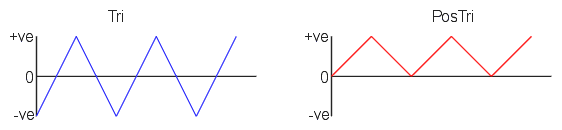
The sounds I'm getting with Rapid's PM are nice but a bit too smooth. I want to make rougher "ripping" psytrance sounds, like those which can be made in Virus by FMing a saw with a "pos triangle" wave two octaves lower.
I understand that there is a difference between FM and PM so it may sound not exactly the same though.
You may think you can fly ... but you better not try
-
- KVRian
- 698 posts since 17 Sep, 2014
+1recursive one wrote:I'd love to have a triangle wave as an alternative PM source. And also a "pos-tirangle", as it is called in Virus, here is a pic showing the difference between these twoMirko R. wrote:At the moment there is a PM per osc for wavetables and multisamples as insert-fx. It has a sinewave as source and you can control the intensity and frequency.Examigan wrote:https://parawave-audio.com/rapid_roadmapDip200 wrote:Will this synthesizer feature FM at some point ?
The sounds I'm getting with Rapid's PM are nice but a bit too smooth. I want to make rougher "ripping" psytrance sounds, like those which can be made in Virus by FMing a saw with a "pos triangle" wave two octaves lower.
I understand that there is a difference between FM and PM so it may sound not exactly the same though.
now i use that superb tool:
http://glowshrimpsoftware.com/sfmwts.html
http://glowshrimpsoftware.com/SerumWavetableMaker2.html
and import it to rapid
a basic set of waveform could be a big plus for rapid fm !
-

- KVRist
- Topic Starter
- 400 posts since 15 Mar, 2016 from Germany
Tables in the Modulation category #106 through #123 do a similar thing. Think of it as pre-calculated FM operator.kokotte wrote:+1recursive one wrote: I'd love to have a triangle wave as an alternative PM source. And also a "pos-tirangle", as it is called in Virus, here is a pic showing the difference between these two
The sounds I'm getting with Rapid's PM are nice but a bit too smooth. I want to make rougher "ripping" psytrance sounds, like those which can be made in Virus by FMing a saw with a "pos triangle" wave two octaves lower.
I understand that there is a difference between FM and PM so it may sound not exactly the same though.
now i use that superb tool:
http://glowshrimpsoftware.com/sfmwts.html
http://glowshrimpsoftware.com/SerumWavetableMaker2.html
and import it to rapid
a basic set of waveform could be a big plus for rapid fm !
Combine this with the regular PM Insert and you already have a basic set of typical FM sounds.
A good example are the patches
Instruments/FM Bell 1
Instruments/FM Bell 2
or
Dream Keys/Underwater World
which use FM, RM and FM-Add tables. A bit of creativity and you'll get nice results. e.g. Why rebuild a "click" with high frequency Saw Operators, if you could also realize it by using click samples.
FM in Rapid
There is a reason why Rapids PM is limited to cosine only. Normal FM Synthesizers use much CPU to guarantee a relatively alias free synthesis of operators. It's not enough to just modulate by [wave]. If that would be the case, we would already have implemented it. But no, it takes a non negligible amount of extra CPU to work. A specialized FM Operator system/matrix. Because it's a bit complex, we spare it for another bigger update. As always, it depends on priority. Some day : )
-
- KVRAF
- 5664 posts since 7 Feb, 2013
Thanks, will try these wavetables. There is gazillion WTs in Rapid, all of them sound great so choosing the right one for a given task is always a guessing gameparawave wrote: Tables in the Modulation category #106 through #123 do a similar thing. Think of it as pre-calculated FM operator.
Combine this with the regular PM Insert and you already have a basic set of typical FM sounds.
A good example are the patches
Instruments/FM Bell 1
Instruments/FM Bell 2
or
Dream Keys/Underwater World
which use FM, RM and FM-Add tables. A bit of creativity and you'll get nice results. e.g. Why rebuild a "click" with high frequency Saw Operators, if you could also realize it by using click samples.
 I'm more interested in metallic/robotic/industral textures than in bells or dreamy keys but this may be two sides of the same coin actually.
I hear you, but I don't think that if some features in Rapid required extra CPU it would be a dealbreaker for anyone.parawave wrote: There is a reason why Rapids PM is limited to cosine only. Normal FM Synthesizers use much CPU to guarantee a relatively alias free synthesis of operators. It's not enough to just modulate by [wave]. If that would be the case, we would already have implemented it. But no, it takes a non negligible amount of extra CPU to work. A specialized FM Operator system/matrix. Because it's a bit complex, we spare it for another bigger update. As always, it depends on priority. Some day : )
I don't know much about DSP but I think that since this "positive triangle" algorhythm was originally invented for early digital hardware synths running relatively slow processors (it was already in Virus A in 1997), its implementation for modern computers wouldn't take much CPU. Adam Szabo's Viper has it and it is not CPU-heavy at all.
You may think you can fly ... but you better not try
-
- KVRAF
- 5664 posts since 7 Feb, 2013
dup
You may think you can fly ... but you better not try
-

- KVRAF
- 12522 posts since 21 Mar, 2008 from Hannover, Germany
VPS Avenger has an "Offset" parameter in the LFOs to shift the waveshape in the y-axis (for the x-axis there is the phase parameter). At an Offset value of +100% it looks like in that picture.recursive one wrote:. And also a "pos-tirangle", as it is called in Virus, here is a pic showing the difference between these two
Synapse Audio DUNE 2.5 has an Offset parameter in the LFOs too.
Such LFO offset parameter does not seem to be really common with other synths.
Ingo Weidner
Win 10 Home 64-bit / mobile i7-7700HQ 2.8 GHz / 16GB RAM //
Live 10 Suite / Cubase Pro 9.5 / Pro Tools Ultimate 2021 // NI Komplete Kontrol S61 Mk1
Win 10 Home 64-bit / mobile i7-7700HQ 2.8 GHz / 16GB RAM //
Live 10 Suite / Cubase Pro 9.5 / Pro Tools Ultimate 2021 // NI Komplete Kontrol S61 Mk1
-
- KVRAF
- 5664 posts since 7 Feb, 2013
if we talk about LFOs, the behaviour of the waveform in the above pic is recreated in many synths by selecting unipolar or bipolar modulation direction (Rapid has this). I don't know about other synths which have this Offset feature you are talking about though, but then I think this can be easily replicated simply by adjusting the starting value of the modulated parameter.Ingonator wrote:VPS Avenger has an "Offset" parameter in the LFOs to shift the waveshape in the y-axis (for the x-axis there is the phase parameter). At an Offset value of +100% it looks like in that picture.recursive one wrote:. And also a "pos-tirangle", as it is called in Virus, here is a pic showing the difference between these two
Synapse Audio DUNE 2.5 has an Offset parameter in the LFOs too.
Such LFO offset parameter does not seem to be really common with other synths.
But the above pic is about FM, not LFO, the difference is at least in that the modulator wave is pitched and is always in predefined harmonic relationship with the modulated oscillator. If you set them two octaves apart they are always two octaves apart no matter the note you are playing, while an LFO doesn't typically change its rate when you hit different notes.
You may think you can fly ... but you better not try
-
- KVRAF
- 12522 posts since 21 Mar, 2008 from Hannover, Germany
Looks like i misunderstood this then. Would be nice to have the same offset parameter for oscilators then to get such results.recursive one wrote:if we talk about LFOs, the behaviour of the waveform in the above pic is recreated in many synths by selecting unipolar or bipolar modulation direction (Rapid has this). I don't know about other synths which have this Offset feature you are talking about though, but then I think this can be easily replicated simply by adjusting the starting value of the modulated parameter.Ingonator wrote:VPS Avenger has an "Offset" parameter in the LFOs to shift the waveshape in the y-axis (for the x-axis there is the phase parameter). At an Offset value of +100% it looks like in that picture.recursive one wrote:. And also a "pos-tirangle", as it is called in Virus, here is a pic showing the difference between these two
Synapse Audio DUNE 2.5 has an Offset parameter in the LFOs too.
Such LFO offset parameter does not seem to be really common with other synths.
But the above pic is about FM, not LFO, the difference is at least in that the modulator wave is pitched and is always in predefined harmonic relationship with the modulated oscillator. If you set them two octaves apart they are always two octaves apart no matter the note you are playing, while an LFO doesn't typically change its rate when you hit different notes.
It should be possible to create a custom waveform like that in your picture with a waveform editor.
With the formula editor in Serum i could get such kind of Triangle with this formula: abs(min(2+2*x, abs((x-0.5)*2)-1))
The ABS() part makes it unipolar. The part min(2+2*x, abs((x-0.5)*2)-1) is a Triangle wave preset in the formula editor. If you like you could edit the waveform further in the waveform editor.
The new unipolar waveform gets "destroyed" when this is loaded into the additive partials editor so that has to be avoided in this case. Does not sem to be possible to get this with only using a partials editor.
When importing the WAV file in Icarus it is destroyed too as Icarus seems to import it as additive partials.
Of course to make use of a custom waveform with FM you need FM between the main oscillators.
Last edited by Ingonator on Wed Jan 31, 2018 10:44 am, edited 1 time in total.
Ingo Weidner
Win 10 Home 64-bit / mobile i7-7700HQ 2.8 GHz / 16GB RAM //
Live 10 Suite / Cubase Pro 9.5 / Pro Tools Ultimate 2021 // NI Komplete Kontrol S61 Mk1
Win 10 Home 64-bit / mobile i7-7700HQ 2.8 GHz / 16GB RAM //
Live 10 Suite / Cubase Pro 9.5 / Pro Tools Ultimate 2021 // NI Komplete Kontrol S61 Mk1
-
- KVRAF
- 5664 posts since 7 Feb, 2013
Many thanks for your tips Ingo, will try to use this technique in Serum.
Unfortunately Rapid currently doesn't allow FM between the main oscs.
Unfortunately Rapid currently doesn't allow FM between the main oscs.
You may think you can fly ... but you better not try
-
- KVRAF
- 12522 posts since 21 Mar, 2008 from Hannover, Germany
Importing the WAV file (from Serum) in Avenger as a new VA Shape seemed to work properly. Since the last bigger update Avenger also offers FM between the main oscillators.
Ingo Weidner
Win 10 Home 64-bit / mobile i7-7700HQ 2.8 GHz / 16GB RAM //
Live 10 Suite / Cubase Pro 9.5 / Pro Tools Ultimate 2021 // NI Komplete Kontrol S61 Mk1
Win 10 Home 64-bit / mobile i7-7700HQ 2.8 GHz / 16GB RAM //
Live 10 Suite / Cubase Pro 9.5 / Pro Tools Ultimate 2021 // NI Komplete Kontrol S61 Mk1
-
- KVRAF
- 6402 posts since 8 Jun, 2009
You would probably need a DC partial to make a unipolar waveform or have the ability to add a DC offset to the generated waveform to make it work with any synth that uses a partial editor.Ingonator wrote: The new unipolar waveform gets "destroyed" when this is loaded into the additive partials editor so that has to be avoided in this case. Does not sem to be possible to get this with only using a partials editor.
When importing the WAV file in Icarus it is destroyed too as Icarus seems to import it as additive partials.
-
- KVRian
- 1185 posts since 27 Apr, 2016
I woudl love to see some updates to Rapid now. It has been out a while and it would be nice to feel there is some progress with the synth. It is a great synth and it gets a lot of use. I would also like to see FM options strengthened. At the moment I avoid rapid for FM cause many synths do it much better for my requirements.
Are there are any updates due in the next month or 2 ?
Are there are any updates due in the next month or 2 ?