



Bye bye VST2
-
- KVRAF
- 3186 posts since 18 Mar, 2008
Time we all move to AU's.
This entire forum is wading through predictions, opinions, barely formed thoughts, drama, and whining. If you don't enjoy that, why are you here?  ShawnG
ShawnG
-
- KVRAF
- Topic Starter
- 2802 posts since 31 Aug, 2011
On Windows you can also find it in LMMS where most of the stock plugins are LADSPA based.Dasheesh wrote:Ok, I’m familiar with the LADSPA through audacity. Thought that was an mp3 standard. This is where it gets beyond my knowledge base.
They even have a website for it.
http://www.ladspa.org
-

- KVRAF
- 37536 posts since 14 Sep, 2002 from In teh net
Ironically so is Steinberg's Padshop VST3chk071 wrote:Aren't most AU's wrapped VST2's anyway?
-
- KVRist
- 425 posts since 27 Apr, 2006
That... was sarcasm.ghettosynth wrote:It's an open code standard for virtual instrument. The license for the standard is permissive. I would like to see migration to an open standard, Steinberg is not a good steward of standards.Asuyuka wrote:Huh? What's LADSPA and DSSI? I don't understand what you're saying!ghettosynth wrote:LOL! Twice and you're still not waking the kids.farlukar wrote:*ahem*Dasheesh wrote:Who ever makes a new open code industry standard for virtual instrumrnt design will have a stature built for them and be immortalized.
 I'm very familiar with both, as my sister used to use Linux to make a lot of her music.
I still, on occasion, switch to LMMS from FL.

-
- KVRAF
- 1713 posts since 25 Jul, 2009
rollasoc wrote:My first thought, when I saw the news on Facebook, was, "given it is 10 years since VST3 was announced, I would imagine VST 4 will be released with Cubase 10 in December".Klinke1 wrote:Time for VST4
So it makes sense to not ship the VST 2 SDK, when 4 will ship with 3.
Hopefully, 4 will sort out the issues with 3 and make porting from 2 easier for developers.
I think this is likely - Cubase 10 along with VST 4.
-
- KVRAF
- 2066 posts since 11 Aug, 2012 from omfr morf form romf frmo
JUCE is a cross-platform application framework. It helps you write programs that will work on multiple platforms (Windows, Mac OS, Linux). It has a plugin library that lets you write programs that will work and function the same across those platforms.Dasheesh wrote:Uuuuuugh, I hate the wrap! Is juice a language or a format standard? asking for a friend.
If you didn't use JUCE, you'd have to port the program to each platform, not just the DSP code, but the user interface as well. UI programming can be very time-consuming; you may have to write completely different code if you depend on the OS' native framework.
Of course, you don't need to create a UI. The plugin standards allow hosts to present sliders and text boxes. AirWindows is a good example of this. Without having to support a GUI, Chris can focus on the DSP.
This is why a lot of synths and FX are made in SynthMaker, Reaktor, Kontakt, etc.. It's a huge undertaking to do cross-platform development that is highly CPU- and graphics-dependent. We've seen sample-based companies branch out to develop plugins and the inexperience shows.
For end users there's nothing to worry about. VST2 is the de facto standard and will be for a long while. It's developers that need to do the thinking. But until they're compelled to move to VST3, there isn't much impetus and very few resources. Steinberg could do a lot less strong-arming and helping the developers they depend on.
-
- KVRAF
- 4751 posts since 22 Nov, 2012
Hey thanks.yellowmix wrote:JUCE is a cross-platform application framework. It helps you write programs that will work on multiple platforms (Windows, Mac OS, Linux). It has a plugin library that lets you write programs that will work and function the same across those platforms.Dasheesh wrote:Uuuuuugh, I hate the wrap! Is juice a language or a format standard? asking for a friend.
If you didn't use JUCE, you'd have to port the program to each platform, not just the DSP code, but the user interface as well. UI programming can be very time-consuming; you may have to write completely different code if you depend on the OS' native framework.
Of course, you don't need to create a UI. The plugin standards allow hosts to present sliders and text boxes. AirWindows is a good example of this. Without having to support a GUI, Chris can focus on the DSP.
This is why a lot of synths and FX are made in SynthMaker, Reaktor, Kontakt, etc.. It's a huge undertaking to do cross-platform development that is highly CPU- and graphics-dependent. We've seen sample-based companies branch out to develop plugins and the inexperience shows.
For end users there's nothing to worry about. VST2 is the de facto standard and will be for a long while. It's developers that need to do the thinking. But until they're compelled to move to VST3, there isn't much impetus and very few resources. Steinberg could do a lot less strong-arming and helping the developers they depend on.
 Something to think about. There appears to be several grass roots options available to the vst standard.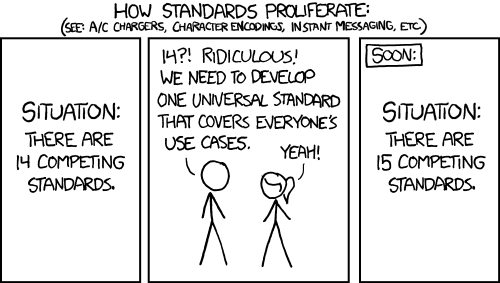

-
- KVRAF
- 1713 posts since 25 Jul, 2009
deastman wrote:
Always happens when someone comes up with a proprietary standard.
What's needed is a cooperative standard that all manufacturers and developers agree to.
Like what happened when midi was birthed.
-

- Banned
- 44 posts since 17 May, 2018
You mean something like VST3? It works great.felis wrote:What's needed is a cooperative standard that all manufacturers and developers agree to.
It's time to set the flux capacitor to 2018, bye bye VST2 and 32 bit.
-

- KVRAF
- 7691 posts since 11 Jun, 2006
meh, VST2 already has just about every synth/fx you need. beyond that is just another
poker added to a fork that already does the job fine. nooooooo sweat.
poker added to a fork that already does the job fine. nooooooo sweat.
HW SYNTHS [KORG T2EX - AKAI AX80 - YAMAHA SY77 - ENSONIQ VFX]
HW MODULES [OBi M1000 - ROLAND MKS-50 - ROLAND JV880 - KURZ 1000PX]
SW [CHARLATAN - OBXD - OXE - ELEKTRO - MICROTERA - M1 - SURGE - RMiV]
DAW [ENERGY XT2/1U RACK WINXP / MAUDIO 1010LT PCI]
HW MODULES [OBi M1000 - ROLAND MKS-50 - ROLAND JV880 - KURZ 1000PX]
SW [CHARLATAN - OBXD - OXE - ELEKTRO - MICROTERA - M1 - SURGE - RMiV]
DAW [ENERGY XT2/1U RACK WINXP / MAUDIO 1010LT PCI]