

Hello, my friends
Basic question.., my friend Piston is asking me to write a VI-V progression in the key of E minor.
My question is: which minor scale is usually used? Nat minor, harmonic or melodic?
Thanks
Minor keys progressions
-
- KVRian
- 1002 posts since 1 Dec, 2004
For the note D in E minor, you use natural minor (D), then contextually sharpen it to D# on the V chord to get a stronger chord progression (B D F# -> B D# F#).
It kinda depends on what style you're writing IRL:
- If you're imitating baroque, you'll sharpen C->C# along with D->D# to avoid the augmented 2nd jump (C - D#) = melodic minor.
- Going towards romantic music, the C - D# gap became accepted, which gives you harmonic minor. (this is probably the style expected by those exercises!)
- Starting with Jazz, the natural D came back into style (along with other more modal ideas), so you often stick with natural minor and then add in sharps/flats to follow the chords, which means in many songs you only get D# on chords like B7. Some chords have both D# and D at the same time (!), such as B7#9#5 (B D# G A D).
It kinda depends on what style you're writing IRL:
- If you're imitating baroque, you'll sharpen C->C# along with D->D# to avoid the augmented 2nd jump (C - D#) = melodic minor.
- Going towards romantic music, the C - D# gap became accepted, which gives you harmonic minor. (this is probably the style expected by those exercises!)
- Starting with Jazz, the natural D came back into style (along with other more modal ideas), so you often stick with natural minor and then add in sharps/flats to follow the chords, which means in many songs you only get D# on chords like B7. Some chords have both D# and D at the same time (!), such as B7#9#5 (B D# G A D).
-

- KVRAF
- 11162 posts since 16 Mar, 2003 from Porto - Portugal
Don't complicate what's simple. You're studying harmony, so, the "scale" (I hate this term) used is the harmonic (it's called "harmonic" for a reason). You definitely need the D# or else you'll destroy the sense of tonality.
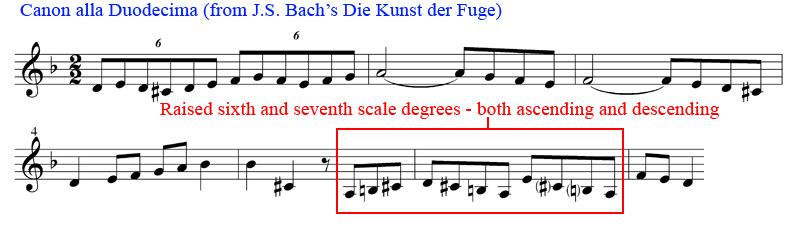
BTW - "imitating baroque" is NOT raising the sixth and the seventh. Bach did that on some occasions, but ONLY when going up melodically through the sixth and seventh degrees. Otherwise, it would not raise the sixth. And this was only when going up - when going down both sixth and seventh would become natural, instead.
However, when we are talking about chords, the C is usually kept natural, and only the D is raised, most of the time.
And occasionally, you would also see the augmented second, even.
BTW (I already wrote this in the past): There is ONLY ONE minor mode. Natural, harmonic and melodic are just "flavors" - different colors of the same thing.
BTW - "imitating baroque" is NOT raising the sixth and the seventh. Bach did that on some occasions, but ONLY when going up melodically through the sixth and seventh degrees. Otherwise, it would not raise the sixth. And this was only when going up - when going down both sixth and seventh would become natural, instead.
However, when we are talking about chords, the C is usually kept natural, and only the D is raised, most of the time.
And occasionally, you would also see the augmented second, even.
BTW (I already wrote this in the past): There is ONLY ONE minor mode. Natural, harmonic and melodic are just "flavors" - different colors of the same thing.
Last edited by fmr on Sat Sep 15, 2018 5:34 pm, edited 1 time in total.
Fernando (FMR)
-
- KVRist
- Topic Starter
- 467 posts since 6 Feb, 2005 from Portugal
Thanks for the replies.Don't complicate what's simple. You're studying harmony, so, the "scale" (I hate this term) used is the harmonic (it's called "harmonic" for a reason). You definitely need the D# or else you'll destroy the sense of tonality.
I've used the harmonic...after some search in the web there was only one article answering my question and I followed it.
When you say that "...You definitely need the D# or else you'll destroy the sense of tonality." are you talking about the weakening of the pull to the tonic by using a D instead of D#?
-

- KVRAF
- 26033 posts since 20 Oct, 2007 from gonesville
Just to reinforce Fernando: you are given capital letters for the roman numerals: VI and V. In E minor that's C and B major. It's obviously harmonic minor, given no further information.
As to some of the historical assertions above: per the music of JS Bach, he moves around a lot and harmonies are still results of linear writing; the decisions (EG: #6 & #7 vs natural minor) are melodic first so much of the time.
Additionally he liked things like V of v and modulations to v; and we find V of VII, VII V i (Well-Tempered Clavier Book 1, C minor Fugue for instance), there C7 to F in G minor. So stuff like 'flat 7' as a particularly later, or much later development is not very true. Nor is it a regression to modality particularly. As to the augmented second as an issue per se, well if we arpeggiate a diminished seventh harmony, in the melody it may occur. I donno, viiº7: in E minor, D# F# A C; C D#; this does_not have to resolve immediately to i.
Per the original question VI to V occurs in JS Bach frequently; the presence of this harmonic move does not mean the melody needs do 6 #7 1, anyway.
As to some of the historical assertions above: per the music of JS Bach, he moves around a lot and harmonies are still results of linear writing; the decisions (EG: #6 & #7 vs natural minor) are melodic first so much of the time.
Additionally he liked things like V of v and modulations to v; and we find V of VII, VII V i (Well-Tempered Clavier Book 1, C minor Fugue for instance), there C7 to F in G minor. So stuff like 'flat 7' as a particularly later, or much later development is not very true. Nor is it a regression to modality particularly. As to the augmented second as an issue per se, well if we arpeggiate a diminished seventh harmony, in the melody it may occur. I donno, viiº7: in E minor, D# F# A C; C D#; this does_not have to resolve immediately to i.
Per the original question VI to V occurs in JS Bach frequently; the presence of this harmonic move does not mean the melody needs do 6 #7 1, anyway.
-
- KVRAF
- 26033 posts since 20 Oct, 2007 from gonesville
Well, D to E here is not the strong V-i. However, as I went into above, the mere presence of a tone or an interval does not through itself mean these other moves of harmony. I recommend analysis of the WTC preludes, particularly for insight rather than receive blanket statements like this to mean more than they can really mean.rbarata wrote: When you say that "...You definitely need the D# or else you'll destroy the sense of tonality." are you talking about the weakening of the pull to the tonic by using a D instead of D#?
Last edited by jancivil on Sat Sep 15, 2018 5:42 pm, edited 1 time in total.
-
- KVRAF
- 11162 posts since 16 Mar, 2003 from Porto - Portugal
Better than the WTC (which sometimes extends the development of the harmony for several bars), I recommend the harmonized chorales.
It's the "bible" I and many other students followed, and it still serves me to teach. For example, I found this harmonization analyzed much in the way I used to do during my student days. The harmony here is very condensed, which is good to study the progressions:
You may get a PDF file with all the harmonized chorales here: https://www.slideshare.net/trazomt/joha ... ction=save
It's the "bible" I and many other students followed, and it still serves me to teach. For example, I found this harmonization analyzed much in the way I used to do during my student days. The harmony here is very condensed, which is good to study the progressions:
You may get a PDF file with all the harmonized chorales here: https://www.slideshare.net/trazomt/joha ... ction=save
Last edited by fmr on Sat Sep 15, 2018 5:49 pm, edited 2 times in total.
Fernando (FMR)
-
- KVRAF
- 26033 posts since 20 Oct, 2007 from gonesville
That's perfect, for harmony and a look at figured bass particularly.fmr wrote:The harmony here is very condensed, which is good to study the progressions:
I think it's appropriate for someone like R who has been at this for several years to now get a good look at figured bass and the relationship between line and harmony vertically considered.
-
- KVRist
- Topic Starter
- 467 posts since 6 Feb, 2005 from Portugal
So, basically, the way I see it (as an attemp to organize things in my head) is:
Chord progressions: Harmonic minor
Melodies: Melodic minor (up and down)
Natural minor: apart from the usage in descending Melodic minor, it is applicable when you intentionally want the sonorities it provides.
Obviously there's no right or wrong in using them differently but, in a general view, that's how I, as a beginner, see it.
Chord progressions: Harmonic minor
Melodies: Melodic minor (up and down)
Natural minor: apart from the usage in descending Melodic minor, it is applicable when you intentionally want the sonorities it provides.
Obviously there's no right or wrong in using them differently but, in a general view, that's how I, as a beginner, see it.
-
- KVRAF
- 11162 posts since 16 Mar, 2003 from Porto - Portugal
There is no reason to enforce the use of the melodic minor nowadays. Bach used it to avoid the augmented second jump because it wasn't "canonical" at the time. Nowadays, not only the interval doesn't shock anymore, it may even be considered beautiful (I tend to like these augmented second jumps - in fact, the Gypsy Mode is one of my favorites, pastly because of the augmented seconds)rbarata wrote:So, basically, the way I see it (as an attemp to organize things in my head) is:
Chord progressions: Harmonic minor
Melodies: Melodic minor (up and down)
The Natural is basically the first church mode (AKA Protus, AKA Dorian), except that the sixth degree is raised. Actually it was born out of this mode, with the bemolization of the B (sixth degree when the mode starts in D, which was how it was used then), which was common in the "musica ficta" practice. The lack of leading tone is one of the key characteristics of this mode. If you use it, together with harmonies, you may fall into an ambivalence mood that is neither modal nor tonal -rbarata wrote: Natural minor: apart from the usage in descending Melodic minor, it is applicable when you intentionally want the sonorities it provides.
It depends if it's what you want or not. And if you don't treat the harmonies carefully, you may even fall into another tonality (the seventh degree Major mode).
Fernando (FMR)
-
- KVRAF
- 26033 posts since 20 Oct, 2007 from gonesville
Analyze music, instead of believing in words. You want to be able to draw inferences you can use moving forward out of that. If you have to write like Bach for whatever reason, def. take that analysis very seriously and immerse yourself.
-
- KVRist
- Topic Starter
- 467 posts since 6 Feb, 2005 from Portugal
Yes, I'll get there.jancivil wrote:Analyze music, instead of believing in words. You want to be able to draw inferences you can use moving forward out of that. If you have to write like Bach for whatever reason, def. take that analysis very seriously and immerse yourself.
For now I'm just remembering all the main particular progressions that need special resolutions.
I'll save me some time.