

Had a lot of issues mainly due to a poor writing between bass and soprano (if you noticed they move in similar motion most of the time).
Anyway...here it is:
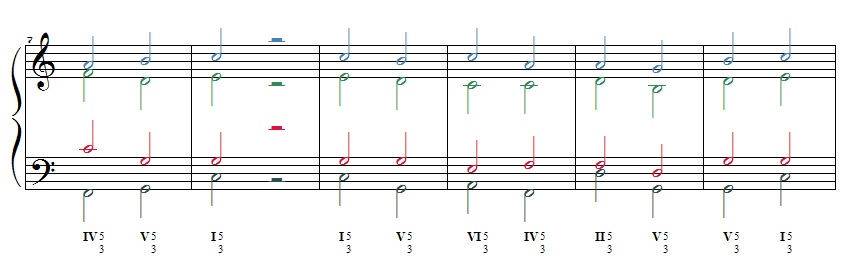
The key is C Maj...the software doesn't use lower case numerals so don't care about it.

Yes, I have some practice on know how to use inversions. But as this was an exercise with just root position chords (so the bass was the cantus firmus), my poor choice of the soprano created most of these problems.KBSoundSmith wrote:I assume you haven't gotten to writing with inversions yet. In which case, I'll base all advice purely around root position movement. Quick question: are you writing the bass and soprano part from scratch, or are you using a cantus firmus given to you in an exercise book (which book are you using by the way)?
As the alto is moving conjunctly I thought it would be ok (same thought applied to other similar occurrences in the piece).KBSoundSmith wrote:The movement from IV - ii has a mistake: direct octaves (8ves) between bass and alto; it is more problematic as well since they move from a perfect interval (perfect 5ths) to a perfect interval (perfect 8ves). There's a simple fix here: double the fifth by moving the alto down to an A.
I tried not to change too much the soprano. I thought about moving it to a B but in the next V chord there was also a B, which is "mandatory" to the resolution of the leading tone. So I decided to, for variety sake, to use other than a B.KBSoundSmith wrote:The movement from ii - V also has a mistake: direct octaves between soprano and bass, again from a perfect 5th to a perfect 8ve. Starting from the voicing of the ii chord as you currently have it written, the better solution here would be to have the soprano move up to B, the alto remain on D, and have the tenor move up to G. Notice also that you have direct fifths between the bass and tenor -- this is avoided by having the tenor move in contrary motion up to the G.
That's something I was not aware of. Always learning!KBSoundSmith wrote:Next, you have V moving to V over the bar line. This should be avoided. Generally, when moving from an area of metric or rhythmic weakness to an area of metric or rhythmic accent, it's desirable to change the chord entirely. Changing from one voicing of the same chord is fine within the context of a single measure, particularly if it's from one inversion to another, but you want to avoid doing so over the bar line, at least in your exercises. You should move directly to the I chord and end on a whole note or leave a half note rest instead.

Maybe I'll try a different version with a better soprano.KBSoundSmith wrote:As you noted, the relationship between your soprano and bass is what lead to most of the issues facing you in this exercise. Try to rely more on contrary motion, and the rest of the part writing will be made much easier.
By the way, good for you for attempting this type of disciplined approach!
rbarata wrote:As the alto is moving conjunctly I thought it would be ok (same thought applied to other similar occurrences in the piece).KBSoundSmith wrote:The movement from IV - ii has a mistake: direct octaves (8ves) between bass and alto; it is more problematic as well since they move from a perfect interval (perfect 5ths) to a perfect interval (perfect 8ves). There's a simple fix here: double the fifth by moving the alto down to an A.
The solution of lowering the A won't it create direct 5ths between bass and alto?
No problem. Another quick tip for when you try another soprano line, especially as you introduce inversions into your writing: you should generally lean toward using an interval of a 3rd or 6th between the bass and soprano, typically reserving 5ths and 8ves for cadences. Of course, you don't have to do those things exclusively -- but it will often make the lines more interesting and internal voices easier to write later.rbarata wrote:Maybe I'll try a different version with a better soprano.
Thanks for the detailed evaluation.
Nice tip. I have read it somewhere in the last few days but there's so many things to be aware of that I skipped it.KBSoundSmith wrote:Another quick tip for when you try another soprano line, especially as you introduce inversions into your writing: you should generally lean toward using an interval of a 3rd or 6th between the bass and soprano, typically reserving 5ths and 8ves for cadences. Of course, you don't have to do those things exclusively -- but it will often make the lines more interesting and internal voices easier to write later.
Struggling to understand here...rbarata wrote:Had a lot of issues mainly due to a poor writing between bass and soprano (if you noticed they move in similar motion most of the time).
Well, that's my next task. Just tried to see what could be done with it.ChamMusic wrote:Struggling to understand here...rbarata wrote:Had a lot of issues mainly due to a poor writing between bass and soprano (if you noticed they move in similar motion most of the time).
You post it with a sentence that sums up the core problem behind just about all the other issues in there!
FANTASTIC...you've analysed it and identified a serious problem...
Why, then didn't you change it? Why not rewrite the Soprano line if you knew that it had issues?

rbarata wrote:Well, that's my next task. Just tried to see what could be done with it.ChamMusic wrote:Struggling to understand here...rbarata wrote:Had a lot of issues mainly due to a poor writing between bass and soprano (if you noticed they move in similar motion most of the time).
You post it with a sentence that sums up the core problem behind just about all the other issues in there!
FANTASTIC...you've analysed it and identified a serious problem...
Why, then didn't you change it? Why not rewrite the Soprano line if you knew that it had issues?
Everything KB suggests is spot on, but this is your other core issue here...the parts do NOT work very well as independent melodies.KBSoundSmith wrote:ou want to have each voice be as independent as possible so that they can all be heard as their own melody


Don't just rely on one source of education on this sort of topic...rbarata wrote:Piston's Harmony book.
BertKoor wrote:Maybe one purpose of this excersize is to show you what troubles it gives when not using any inversions
Submit: News, Plugins, Hosts & Apps | Advertise @ KVR | Developer Account | About KVR / Contact Us | Privacy Statement
© KVR Audio, Inc. 2000-2026