

You will have to rename those, adding -WT256 to their names, for them to be read in Hive. Other than that, to be used in Hive they are perfectly OK, since Hive interpolates in real-time (that's what we've been discussing in the last few pages).Funkybot's Evil Twin wrote: Sat Dec 22, 2018 5:52 pm I came across a bunch of waveedit wavetables, all are 256 sample waves with 64 frames per table. Thinking about going through the effort of converting these via the script thinking that after I did it once, it's very easy to just change the name of the import file, and use find and replace to change the interpolation modes for the remaining wavetables.
I'm assuming the benefit of doing it this way is smoother interpolation as 64 frames essentially become 256 frames. Figure it will be a good, but highly tedious, way to dip my toes in.

u-he Hive 1.2 - free update - adds wavetables and more
-

- KVRAF
- 11162 posts since 16 Mar, 2003 from Porto - Portugal
Fernando (FMR)
-
- KVRian
- 991 posts since 29 May, 2011 from Germany
Thanks for that reply. Interestingly, this is exactly why I enjoy browsing good Serum soundsets (the best sounds of which often seem to stem from specific songs, therefore the complex modulation curves are, indeed, either "random-ish" or so tailored to a specific rhythm that one would have to use that as a song starter...), while I prefer making sounds with Hive.Urs wrote: Sat Dec 22, 2018 4:20 pm Serum has an excellent editor, loads of filter types, a lot of modulation feedback and very nice LFO shaping tools. Neither of which we find to be a "must have" for Hive.
We will figure out *some* modulation feedback sooner or later, but the editors in particular, as good as they are, would contradict our claim that Hive is a streamlined synth aka "less is more".
The real question is, from what point does complex modulation become so arbitrary that the means to get there become arbitrary as well? From what point does it not matter anymore whether a curve has been sculpted by sophisticated tools, or a randomizer?
[...]
So my interest fro Hive's future is to create an extremely minimal set of controls which let you achieve the same complexity, density and broad palette of sounds that e.g. Serum excells at, without the need to spend hours in sophisticated editors. The results don't need to be exactly the same, so long as they're equally as useful, musical and interesting.
-

- u-he
- Topic Starter
- 30253 posts since 8 Aug, 2002 from Berlin
I guess Audio-term then adds that Serum-specific chunk. Maybe I'll ask Steve if it's okay for us to add it as well.fmr wrote: Sat Dec 22, 2018 4:56 pmThe wavetables created in Audio-Term using the Serum format "just load" directly in Serum. I don't have to do anything. I will test with Icarus.Urs wrote: Sat Dec 22, 2018 4:46 pm A wavetable saved be Serum contains a special chunk which apparently includes some kind of identification scheme.
We don't (can't?) write this into the files, so you need to import instead, or add a text file (see Serum manual).
Do wavetables exported from something else "just load" in Serum?
-
Funkybot's Evil Twin Funkybot's Evil Twin https://www.kvraudio.com/forum/memberlist.php?mode=viewprofile&u=116627
- KVRAF
- 12513 posts since 16 Aug, 2006
Yeah, I figured out the renaming thing, but if you watch the video Urs posted, he takes two waves from Zebra2, and using "crossfade" interpolation in Hive, demonstrates a very simple crossfade. Nothing fancy. Then after loading those two waveforms in the script and doing the interpolation there, he loads them back into Hive and gets a complex, morphed sound while still only using crossfade interpolation in Hive. So in effect, it seems like the script created a 100 frame morphed wavetable from two very simple waveforms. Which seems cool.fmr wrote: Sat Dec 22, 2018 6:01 pm You will have to rename those, adding -WT256 to their names, for them to be read in Hive. Other than that, to be used in Hive they are perfectly OK, since Hive interpolates in real-time (that's what we've been discussing in the last few pages).
But my question is this: if what you're saying is the case, and the results will be the same, why not just do the morphing interpolation entirely in Hive? Or does allowing the script to create extra frames upfront offer even better intpolation because Hive has more to work with? If no difference, then why bother with morphing wav files in the script at all; why not just do it all in Hive?
-
- u-he
- Topic Starter
- 30253 posts since 8 Aug, 2002 from Berlin
Only, drag'n'drop isn't as straight forward as it seems. One either has to store the wavetable content in the preset (gigabytes galore), or one ends up with reference paths outside of the install location, or *best* case, the software copies the file into some "imported" directory. But what happens if someone drags the same file on it *twice*? - Do you do a second copy? Do you go through lengths and check if it's really the same file, again?THE INTRANCER wrote: Sat Dec 22, 2018 5:08 pm When I saw wavetables being introduced into Hive, I had expected that it would simply be a case of drag and drop of a wave file onto the hex display... Simple and straight forward..the way Hive is supposed to be.
We've been thinking about this a lot. The most straight forward, most economic and fail safe solution is to put all files you need into a location the software knows, and have a browser. Symbolic links allowed.
-
- u-he
- Topic Starter
- 30253 posts since 8 Aug, 2002 from Berlin
An early alpha version of Hive 1.2 had the morphing done in realtime. It ate more CPU than the early days of Diva.
The script based morphing can turn a 2 frame wavetable into a 200 frame morphed wavetable. If you do "crossfade" or "spectral" in realtime is of lesser importance, once you got 200 frames.
-
- KVRAF
- 3497 posts since 30 Dec, 2014
Well, I'm sure you can figure out an alternate path to make the drag and drop option possible, providing the user a set of options to choose from, just as the Windows Operating does in file management. I mean it's not a show stopper as it is now, but it's a friendlier workflow as one might expect from a Sampler instrument. And yes I know that it isn't Sampler, but it is treading that territory now....Urs wrote: Sat Dec 22, 2018 8:02 pmOnly, drag'n'drop isn't as straight forward as it seems. One either has to store the wavetable content in the preset (gigabytes galore), or one ends up with reference paths outside of the install location, or *best* case, the software copies the file into some "imported" directory. But what happens if someone drags the same file on it *twice*? - Do you do a second copy? Do you go through lengths and check if it's really the same file, again?THE INTRANCER wrote: Sat Dec 22, 2018 5:08 pm When I saw wavetables being introduced into Hive, I had expected that it would simply be a case of drag and drop of a wave file onto the hex display... Simple and straight forward..the way Hive is supposed to be.
We've been thinking about this a lot. The most straight forward, most economic and fail safe solution is to put all files you need into a location the software knows, and have a browser. Symbolic links allowed.
Other than that, there is some other aspects of Hive, that are looking a bit long in the tooth...and this is probably more important that drag and drop is. This being filter and LFO types... Other than some stiff competition from the likes of Dune 3 and that funnily named Pigments synths, even your older free synths have way way more filtering options than Hive has. LFO shape wise, you have just 8. Native Instruments 'Form' Instrument has 90 different ones to select from. Reversing and flipping of LFO shapes, various playback options, looped, reverse, one shot, free-scan, retrig modes on top of that. I'm not saying hive should match that of what Form provides, but Hive should really improve significantly in that area as freeform drawing isn't something that I think you're aiming for with Hive.
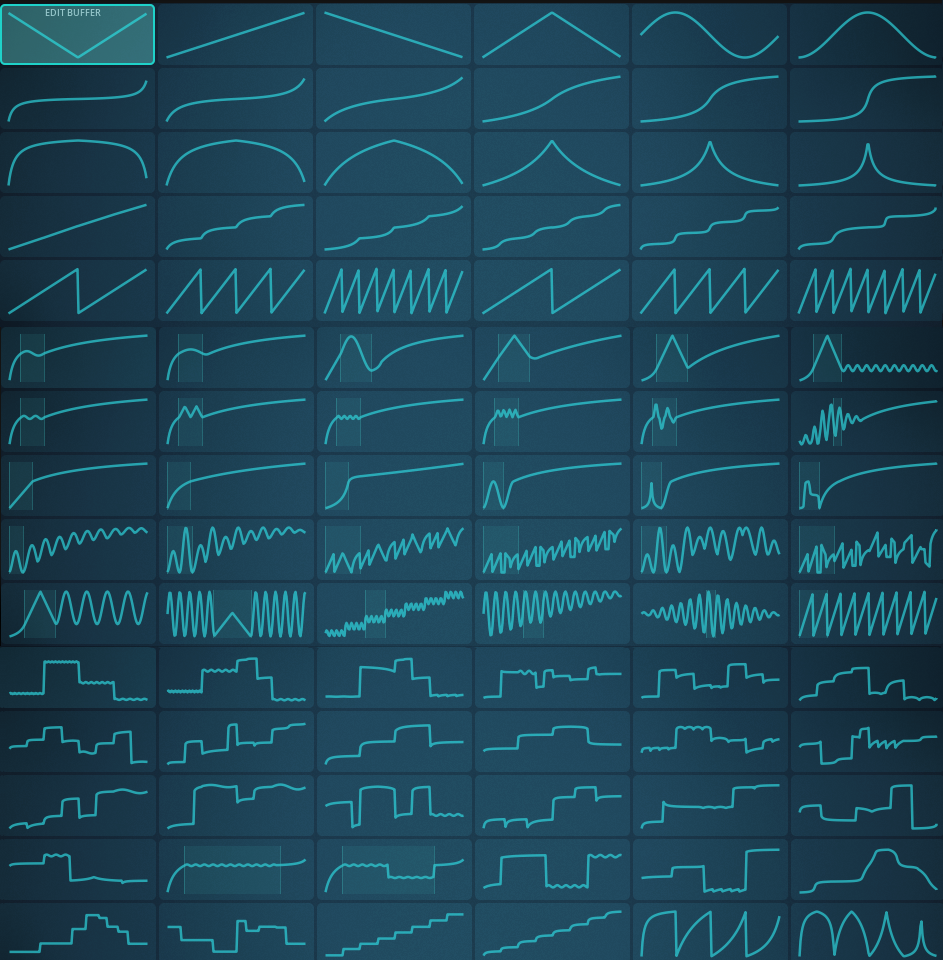
The introduction of wavetables is great as is the XY control / pages and I appreciate that which increasing the diversity of what Hive is able to create sound wise but there is area's such as these which are particularly neglected, and even more so now when looking at other recent synths in what they have. Dune 3 has a lot of different filters... ect ect...
As for aesthetics, giving Hive a facelift, is something that one can do themselves thankfully...
 .
.I want Hive to be the best synth it can be... so I hope my criticism comes across as constructive.
Have a Happy Christmas Urs

Last edited by THE INTRANCER on Mon Dec 24, 2018 10:10 pm, edited 1 time in total.
KVR S1-Thread | The Intrancersonic-Design Source > Program Resource | Studio One Resource | Music Gallery | 2D / 3D Sci-fi Art | GUI Projects | Animations | Photography | Film Docs | 80's Cartoons | Games | Music Hardware |
-
fluffy_little_something fluffy_little_something https://www.kvraudio.com/forum/memberlist.php?mode=viewprofile&u=281847
- Banned
- 12880 posts since 5 Jun, 2012
90 LFO waveforms seems very exaggerated for a synth like that, does anyone really need that?!
-
- KVRAF
- 3497 posts since 30 Dec, 2014
Well it's better than just 9 types of LFO, although it's actually less than that really as 3 types are opposites of each other, thus amounts to only 5 LFO's if one wants to be really picky about it.fluffy_little_something wrote: Mon Dec 24, 2018 10:09 pm 90 LFO waveforms seems very exaggerated for a synth like that, does anyone really need that?!
In addition to that, I'd like to see some visual representation of the waveforms like has been done with the wavetables, naming them seems to be quite useless after you've covered the basic one's that one can visualise in yer head.
KVR S1-Thread | The Intrancersonic-Design Source > Program Resource | Studio One Resource | Music Gallery | 2D / 3D Sci-fi Art | GUI Projects | Animations | Photography | Film Docs | 80's Cartoons | Games | Music Hardware |
-
fluffy_little_something fluffy_little_something https://www.kvraudio.com/forum/memberlist.php?mode=viewprofile&u=281847
- Banned
- 12880 posts since 5 Jun, 2012
On your chart many waveforms are also just variations of each other. At the end of the day there are only like 20 really distinct ones.
-
- KVRAF
- 3497 posts since 30 Dec, 2014
I counted around 50 distinct ones...fluffy_little_something wrote: Mon Dec 24, 2018 10:33 pm On your chart many waveforms are also just variations of each other. At the end of the day there are only like 20 really distinct ones.

KVR S1-Thread | The Intrancersonic-Design Source > Program Resource | Studio One Resource | Music Gallery | 2D / 3D Sci-fi Art | GUI Projects | Animations | Photography | Film Docs | 80's Cartoons | Games | Music Hardware |
-

- KVRAF
- 27005 posts since 3 Feb, 2005 from in the wilds
I rather dislike having so many individual choices like that. I'm sure I would regularly end up wanting a shape other than those 90...THE INTRANCER wrote: Mon Dec 24, 2018 9:53 pmNative Instruments 'Form' Instrument has 90 different ones to select from.
I would rather have a modulator that with a relatively small number of parameters can make many complex shapes. (see Waldorf's Komplex Modulator)
-
- KVRAF
- 2301 posts since 23 May, 2012 from London
Likewise. I was happy to read that West Coast style function generators are being considered for the v2 update. I hope these will offer increased modulation capabilities without the overwhelm and faff that often comes with additional possibilites. Serum, is terrible for me personally in this respect. There's not a lot of joy for me, creating shapes from scratch or searching endlessly through third party ones either. Combined with the new slot modifiers, there should be plenty of variety available with the minium amount of tweaking/menu diving.pdxindy wrote: Tue Dec 25, 2018 12:45 amI rather dislike having so many individual choices like that. I'm sure I would regularly end up wanting a shape other than those 90...THE INTRANCER wrote: Mon Dec 24, 2018 9:53 pmNative Instruments 'Form' Instrument has 90 different ones to select from.
I would rather have a modulator that with a relatively small number of parameters can make many complex shapes. (see Waldorf's Komplex Modulator)
Always Read the Manual!
-
- KVRAF
- 3497 posts since 30 Dec, 2014
That's exactly what you can do with the LFO waveform Curve Editor in Native Instruments Form Sampler ensemble. The LFO waveforms shown above are just starting points, some are preset to loop from certain positions. You can create LFO types from scratch if you want, without ever drawing them by hand. It's very simple to use but very powerful at the same time.pdxindy wrote: Tue Dec 25, 2018 12:45 amI rather dislike having so many individual choices like that. I'm sure I would regularly end up wanting a shape other than those 90...THE INTRANCER wrote: Mon Dec 24, 2018 9:53 pmNative Instruments 'Form' Instrument has 90 different ones to select from.
I would rather have a modulator that with a relatively small number of parameters can make many complex shapes. (see Waldorf's Komplex Modulator)
You can see this from this video here...
KVR S1-Thread | The Intrancersonic-Design Source > Program Resource | Studio One Resource | Music Gallery | 2D / 3D Sci-fi Art | GUI Projects | Animations | Photography | Film Docs | 80's Cartoons | Games | Music Hardware |
-
- KVRAF
- 27005 posts since 3 Feb, 2005 from in the wilds
Yeah... that is not of interest to me. In theory, super powerful... in practice, a headache... and cannot be modulated in what I would consider useful ways.THE INTRANCER wrote: Tue Dec 25, 2018 1:31 amThat's exactly what you can do with the LFO waveform Curve Editor in Native Instruments Form Sampler ensemble. The LFO waveforms shown above are just starting points, some are preset to loop from certain positions. You can create LFO types from scratch if you want, without ever drawing them by hand. It's very simple to use but very powerful at the same time.
I lost interest in big complex MSEG's as I became proficient using Bazille. A few simple tools that can be modulated create more organic results with less fuss.