

Yeah, one can have a lot of academic quarrels about this issue but at the end of the day, it is the same old same old: How the living F do I play a barline, maestro? Does notation effects feeling? Does counting? For all I know, the best sessions I have participated in were those where we at some point did not have to count anymore but got it into our muscles enough to just flow with time.jancivil wrote: Sun Feb 24, 2019 2:18 am Yeah, he said he'd seen it on a music stand, there was some arrangement that did that. I said 'What moron needs that' and he decided I was calling him a moron. But he was working on his doctorate and I'm just a street kid, you know.
He kept acting like I didn't understand compound time because I didn't agree with those points.
The relationship between rhythm and melody, and figuring out the rhythm of a melody
-
- Banned
- 3946 posts since 25 Jan, 2009
-

- KVRAF
- 26033 posts since 20 Oct, 2007 from gonesville
Well, if you're going to internalize the relationship between 4 beats and 3 beats in the same amount of time, it helps to know. If you're going to double it up and do 8 in the time of 3/4 or 6/8, that's actually just dotted 16ths.
Here:
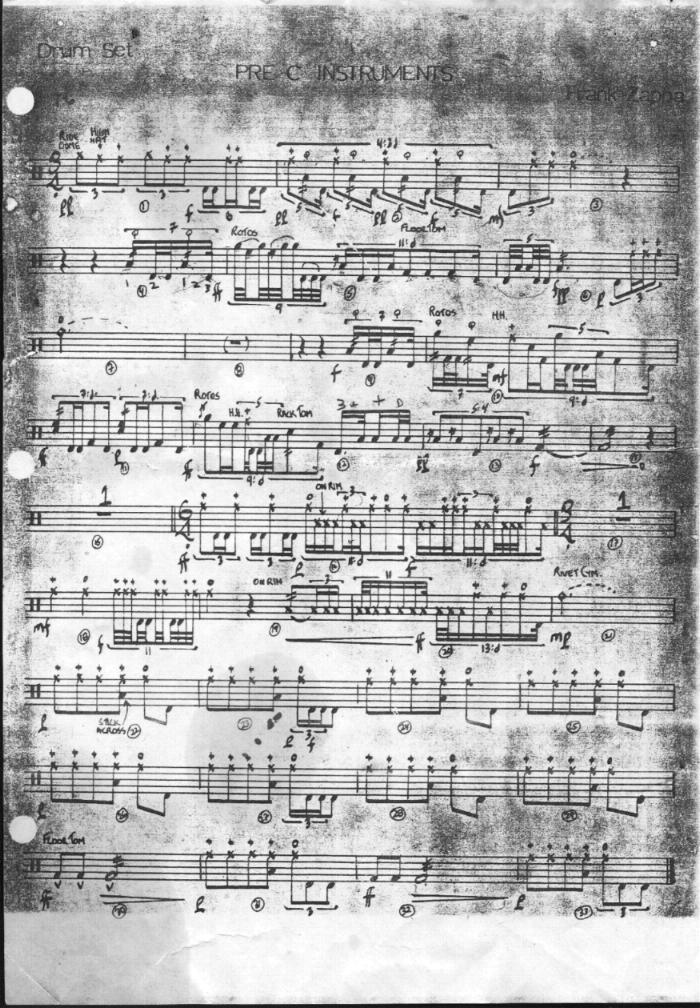
I wasted a long day trying to get this sequenced (Dorico is far, far too buggy to do it, it turns out, and w. MuseScore it can be done but it's not smooth sailing either due to its bugs) and decided I was better off doing it by hand anyway. Bar 2 is given as 4:3 rather than that in order to nest 5:1 on each of the 4, but if you know it's just dotted 8ths...
I internalized this language to the extent I do shit harder than this without knowing what it is until I have to draw barlines, is why I went here, you said barlines.
THIS, I just found has a whole life on the internet.

But the idea there in the Pre-C Instruments (Zappa put that in front of a drummer auditioning in 1981, who apparently didn't make it) is 'rhythmic dissonance'. This one band actually performed it around then, asked permission and FZ said, well so how are you gonna approach this? The tuplets don't mean anything in themselves, they have to refer to something (a pulse).
So the second picture shows a strictly academic exercise, 2/3rds - technically the remainder amounts to 1/6th - of a dotted pentuplet has no musical meaning per se, within one bar; however the awareness of the problem can help a crossing the bar situation in case the nominator ever agrees, upon repetition with 3. Now, we are back to compound time. In Cubase a pentuplet based on a triplet 8th for example (it will not nest tuplets) equals 15 in the time of 1 8th. So, if the barline occurs before the 8th is complete, it stymies you visually. Here one relies on having performed it by hand.
So, it is on one level 'just' an academic exercise, except in the first place those rhythms first happened in a live guitar solo.
It's speech rhythm, conversational speech analyzed has some real interest to me and I used to work that way in improvisation. I would listen to Chinese speech, rhythmically unlike western speech in some ways for pure rhythmic interest, which is abstract because I understand nothing being said.
To develop a vocabulary in order to approach technical mastery you have to practice. A good start is 4:3, turning 3:4 on its head. If you want 5:3, what is it exactly? Then, what are dotted pentuplets? 5 to 3/4 or 6/8 are dotted pentuplets.
But I'm looking at it as problems of dissonance resolving in this project. EG: one bit which happens throws me into a swing feel because of the relationship to a compound 5:3, which is very exciting as a discovery. The actual felt effect which I wasn't even looking for.
Here:
I wasted a long day trying to get this sequenced (Dorico is far, far too buggy to do it, it turns out, and w. MuseScore it can be done but it's not smooth sailing either due to its bugs) and decided I was better off doing it by hand anyway. Bar 2 is given as 4:3 rather than that in order to nest 5:1 on each of the 4, but if you know it's just dotted 8ths...
I internalized this language to the extent I do shit harder than this without knowing what it is until I have to draw barlines, is why I went here, you said barlines.
THIS, I just found has a whole life on the internet.
But the idea there in the Pre-C Instruments (Zappa put that in front of a drummer auditioning in 1981, who apparently didn't make it) is 'rhythmic dissonance'. This one band actually performed it around then, asked permission and FZ said, well so how are you gonna approach this? The tuplets don't mean anything in themselves, they have to refer to something (a pulse).
So the second picture shows a strictly academic exercise, 2/3rds - technically the remainder amounts to 1/6th - of a dotted pentuplet has no musical meaning per se, within one bar; however the awareness of the problem can help a crossing the bar situation in case the nominator ever agrees, upon repetition with 3. Now, we are back to compound time. In Cubase a pentuplet based on a triplet 8th for example (it will not nest tuplets) equals 15 in the time of 1 8th. So, if the barline occurs before the 8th is complete, it stymies you visually. Here one relies on having performed it by hand.
So, it is on one level 'just' an academic exercise, except in the first place those rhythms first happened in a live guitar solo.
It's speech rhythm, conversational speech analyzed has some real interest to me and I used to work that way in improvisation. I would listen to Chinese speech, rhythmically unlike western speech in some ways for pure rhythmic interest, which is abstract because I understand nothing being said.
To develop a vocabulary in order to approach technical mastery you have to practice. A good start is 4:3, turning 3:4 on its head. If you want 5:3, what is it exactly? Then, what are dotted pentuplets? 5 to 3/4 or 6/8 are dotted pentuplets.
But I'm looking at it as problems of dissonance resolving in this project. EG: one bit which happens throws me into a swing feel because of the relationship to a compound 5:3, which is very exciting as a discovery. The actual felt effect which I wasn't even looking for.
Last edited by jancivil on Mon Feb 25, 2019 7:00 pm, edited 2 times in total.


-

- KVRian
- 642 posts since 22 Jun, 2018
-
- Banned
- 3946 posts since 25 Jan, 2009
Jan, you are way ahead of me but it is some exciting and informative points. I just meant to say that when the counting is done and there are no more mental barlines but just one continual and unsegmented flow, I feel best. However, you gotta learn to count* to forget, so no anti-academics from where I stand.
* or rather; your have to learn your body to count by itself, so your thoughts don’t have to give a S, and you can enjoy the ride instead.
-
- KVRAF
- 26033 posts since 20 Oct, 2007 from gonesville
Cool. The discovery I mention btw is a 'resolution' of the tension, when ONE lands it has this swing feeling as it happens. It made a lot of 'busy work' worth it at the end of the day.
Yes, we're back to Sonny Rollins' "You can't think and play at the same time.". In practice, in a room, live.
Yes, we're back to Sonny Rollins' "You can't think and play at the same time.". In practice, in a room, live.
-

- addled muppet weed
- 111274 posts since 26 Jan, 2003 from through the looking glass
im worried about that mans eyes 

-
- KVRAF
- 26033 posts since 20 Oct, 2007 from gonesville
You could get stuck like that if you keep doing it.
for people that would obsess over the answer (I wouldn't, but someone has sorted it):
Call 1 quarter note "1". Four sixteenth notes fit into one quarter note, or five quintuplet sixteenth notes fit into one quarter note. So one quintuplet sixteenth note = 1/5 = .2
Next, a dotted quintuplet sixteenth = .2 * 1.5 = .3
Next, a 17/16 bar = four quarter notes and one 16th note. That = 4.25.
Next: how many dotted quintuplet 16ths (.3) can fit into a 17/16 bar (4.25)? 4.25/.3 = 14, remainder .05
The answer is 14.
For a bonus, the remainder is .05 quarter notes, which would be a quintuplet 64th note.
for people that would obsess over the answer (I wouldn't, but someone has sorted it):
Call 1 quarter note "1". Four sixteenth notes fit into one quarter note, or five quintuplet sixteenth notes fit into one quarter note. So one quintuplet sixteenth note = 1/5 = .2
Next, a dotted quintuplet sixteenth = .2 * 1.5 = .3
Next, a 17/16 bar = four quarter notes and one 16th note. That = 4.25.
Next: how many dotted quintuplet 16ths (.3) can fit into a 17/16 bar (4.25)? 4.25/.3 = 14, remainder .05
The answer is 14.
For a bonus, the remainder is .05 quarter notes, which would be a quintuplet 64th note.
-
- Banned
- 3946 posts since 25 Jan, 2009
^^^^Seems like something that could keep the autistic children I write about busy for months. 
-
- KVRAF
- 26033 posts since 20 Oct, 2007 from gonesville
I don't think this one is ever going to resolve.
I'm def. not obsessive about that, because even if you find that this happened, in 17/16 you're already hard up against perception because the brain, entrained, wants it to be 16 (as a time signature itself, fine, it may have its own identity but as a pulse to refer to, no), and at that further level of complexity it's all just completely negligible to a listener and even knowing it isn't going to help you care from one day to the next IME.
But sometimes things do happen and I'm up against the barline and I do get stubborn, I want to know where ONE is even when it's crossed [and vanishes]; it's the same as dissonance, you don't know from light if there's no such thing as dark.
What made for a horrible day for me is, I would think in 2019 there would be software capable of it. Dorico is a POS for it, it lost the plot almost immediately; it couldn't even sort it within the bar. It got confused so easily. I can actually figure out a way to do it in Nuendo which does_not nest tuplets, but it will calculate dotted pentuplets and triplet pentuplets etc.
(IE: you have to look at more than one grid)
I can't believe the same entity is responsible for something which works and the other thing using notation that just doesn't.
I spent a whole afternoon on one bar and it never happened.
I'm def. not obsessive about that, because even if you find that this happened, in 17/16 you're already hard up against perception because the brain, entrained, wants it to be 16 (as a time signature itself, fine, it may have its own identity but as a pulse to refer to, no), and at that further level of complexity it's all just completely negligible to a listener and even knowing it isn't going to help you care from one day to the next IME.
But sometimes things do happen and I'm up against the barline and I do get stubborn, I want to know where ONE is even when it's crossed [and vanishes]; it's the same as dissonance, you don't know from light if there's no such thing as dark.
What made for a horrible day for me is, I would think in 2019 there would be software capable of it. Dorico is a POS for it, it lost the plot almost immediately; it couldn't even sort it within the bar. It got confused so easily. I can actually figure out a way to do it in Nuendo which does_not nest tuplets, but it will calculate dotted pentuplets and triplet pentuplets etc.
(IE: you have to look at more than one grid)
I can't believe the same entity is responsible for something which works and the other thing using notation that just doesn't.
I spent a whole afternoon on one bar and it never happened.

-
- Banned
- 3946 posts since 25 Jan, 2009
You gotta be kidding me. I found my old percussion teacher on youtube. Seems that he managed to fullfill his dream of making an album. It is called “Harlem”.
Ladies and gentlemen, I hereby give you the most excentric black racist percussion teacher that have ever visited planet Earth:
EMMANUEL ABDUL-RAHIM!
And oh, have I drummed this one with him dozens of times until my palms where red and my wrists nothing but pain. Emmanuel’s feel are all over it. He is probably playing all drums and perc himself on the album.
Ladies and gentlemen, I hereby give you the most excentric black racist percussion teacher that have ever visited planet Earth:
EMMANUEL ABDUL-RAHIM!
And oh, have I drummed this one with him dozens of times until my palms where red and my wrists nothing but pain. Emmanuel’s feel are all over it. He is probably playing all drums and perc himself on the album.
Last edited by IncarnateX on Thu Feb 28, 2019 4:23 pm, edited 1 time in total.