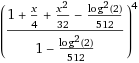
Of course taking sqrt makes it easier to approximate, because the function is closer to the straight line and repeated squaring of the result is evening out the errors of your approximation to an extent. That said, as I mentioned eariler, I tried to "properly" do this trick, by applying Remez algorithm for optimizing f^2(x)=F(x) rather than f(x)=F(x) (where F (x) is the target function f is the constructed approximation function). This resulted in a comparable error for the same order of the polynomial in f. Considering that squaring is an additional source of precision loss in least significant digits, I'm not sure if this approach is worth it. I mean to make it worth it, you need to have a significant benefit compared to f(x)=F(x), right? So, only if you want to stay within the domain of simple approximation tricks, such as Taylor, this is probably justified.juha_p wrote: Tue Mar 05, 2019 6:12 pm Is it ("phenomenon") just that taking n times sqrt() from 2^x (or multiplying x with 1/2^2n) before approximation makes it easier to approximate ... as triple sqrt() makes the response of original function ( 2^x in this case) close to straight line? Are there any drawbacks in doing this way?
Or maybe I missed something, and one can really build better approximations that way?