

Right! I've already begun to do this.imrae wrote: Wed Oct 02, 2019 7:57 am You have convolution plugins. What you need is IR samples. Grab a portable microphone and a drumstick and go record yourself hitting everything in the world.

Giving the timbre quality of a given material
-

- KVRist
- Topic Starter
- 495 posts since 18 Aug, 2006 from Italy
-
- KVRist
- Topic Starter
- 495 posts since 18 Aug, 2006 from Italy
True. I'd like to make some presets, but one should have precise and reliable charts with frequencies decay time and frequencies absorption values corresponding to different materials in order to try and build them (and one should take into account shapes, thickness, sizes, resonances and so on – very complex matter).
-
- KVRian
- 629 posts since 15 Jun, 2017
Free and 32-bit only. But versatile and great sounding:
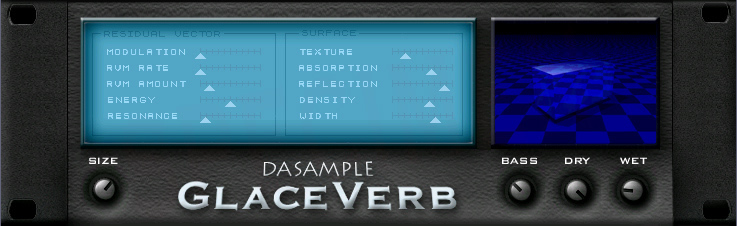
DaSample - GlaceVerb
https://www.kvraudio.com/product/glaceverb_by_dasample
GlaceVerb has Surface parameters (Texture, Absorption, Reflection). You will then have to determine your own material properties.
DaSample - GlaceVerb
https://www.kvraudio.com/product/glaceverb_by_dasample
GlaceVerb has Surface parameters (Texture, Absorption, Reflection). You will then have to determine your own material properties.
GlaceVerb is Dasample's first attempt to implement its works on Residual Vector Modulation (RVM) in a VST plug-in. RVM is a proprietary algorithm developed to calculate the deformations, the vibrations and the acoustic response of surfaces and materials.
Imagine a big orchestra playing in a giant box built with thin metal sheets. As the panels are not very rigid, the box will vibrate according to the energy of music and produce an audible spectral deformation. RVM algorithm is able to simulate such deformations and vibrations and apply them to the original signal.
Key Features:
Residual Vector Modulation (RVM) reverberation engine.
Reverberation time : up to 20s.
Improved reflections algorithms for more natural sounding.
Surface parameters (Texture, Absorption, Reflection).
Density control (from Flat to Extreme reverberation).
Size, Bass, Dry and Wet quick access controls.
Very easy to use and ultra functional interface with large LCD screen.
All functions and controls are fully automatable.
64 hi-quality presets.
-
- KVRist
- Topic Starter
- 495 posts since 18 Aug, 2006 from Italy
Yes, I know and appreciate it, but it's old and runs only on Windows, while I work on a Mac.
-
 ChamomileShark ChamomileShark https://www.kvraudio.com/forum/memberlist.php?mode=viewprofile&u=25116
 - KVRAF
- 3243 posts since 12 May, 2004 from Oxford, UK
Pastoral, Kosmiche, Ambient Music https://markgriffiths.bandcamp.com/
Experimental Music https://markdaltongriffiths.bandcamp.com/
Experimental Music https://markdaltongriffiths.bandcamp.com/
-
- KVRist
- Topic Starter
- 495 posts since 18 Aug, 2006 from Italy
Yes, I have it, I love it and I use it a lot, though in the context of this thread it is not exactly something that does what I was explaining ("Something where an external sound - any sample, usually not a guitar - , enters, then it comes out colored with the timbre of a resonator with a given shape and material." By "shape" I mean sphere, bell, tube, flat wall, square box, etc… By "material" I mean glass, wood, felt, brass, plastic, etc…)
-
experimental.crow experimental.crow https://www.kvraudio.com/forum/memberlist.php?mode=viewprofile&u=6258
- KVRAF
- 6895 posts since 9 Mar, 2003 from the bridge of sighs
not really what you're looking for , but something you might enjoy ,
if you are not aware of it , is kaivo ...
if you are not aware of it , is kaivo ...

-

- KVRAF
- 4571 posts since 12 Jan, 2019
Ableton's Collision has Beam, Marimba, String, Membrane, Plate, Pipe, and Tube setting for both resonators, and some tweakable parameters. I read on a forum that it is based on an earlier version of AAS Chromophone (https://www.applied-acoustics.com/chromaphone-2/). They are synths, not effects, though.
Edit: also Ableton's Corpus effect has Beam, Marimba, String, Membrane, Plate, Pipe, and Tube settings.
Edit: also Ableton's Corpus effect has Beam, Marimba, String, Membrane, Plate, Pipe, and Tube settings.
Last edited by Dirtgrain on Sun Oct 06, 2019 1:10 am, edited 1 time in total.
Doing nothing is only fun when you have something you are supposed to do.
-
- KVRAF
- 4571 posts since 12 Jan, 2019
AAS has a delay you might check out: "Objeq Delay is a creative delay unit with unique filtering options thanks to our acoustic object models. Going beyond traditional delay duties, Objeq Delay delivers modulator type effects, drum track layering, one-shot re-crafting, dynamic loop mangling, and drones" https://www.applied-acoustics.com/objeq-delay/
Never tried it.
Edit: Watched a video, and it only has 4 object sounds that you can filter the delay through.
Never tried it.
Edit: Watched a video, and it only has 4 object sounds that you can filter the delay through.
Doing nothing is only fun when you have something you are supposed to do.
-
- KVRAF
- 2066 posts since 11 Aug, 2012 from omfr morf form romf frmo
Objec Delay is surprisingly great, but if you want the control I'm seeing desired, you may be better served with Tassman. Though it is no longer supported and sold "as-is". It's basically the Reaktor of physical modelling... circa 2004. Workflow and ease-wise, +1 for Moodal.
Also, there's Voxgengo Impulse Modeler https://www.voxengo.com/product/imodeler/ but it's on the room-sized scale.
Honestly, you're probably better off trying something in CSound, Max, Supercollider, or if you know what you're doing just make your own plugin. Otherwise you're at the mercy of whatever happened to come to market and simplified for adoption.
Also, there's Voxgengo Impulse Modeler https://www.voxengo.com/product/imodeler/ but it's on the room-sized scale.
Honestly, you're probably better off trying something in CSound, Max, Supercollider, or if you know what you're doing just make your own plugin. Otherwise you're at the mercy of whatever happened to come to market and simplified for adoption.
-
- KVRist
- Topic Starter
- 495 posts since 18 Aug, 2006 from Italy
Well, thanks to all of you for the answers. I discovered two other beautiful softwares of great quality.
One is Substantia (www.giorgiosancristoforo.net, then scroll the page until you find Substantia), which is fantastically close to what I had in my mind when I started this topic. Available objects may have 17 different shapes and 23 different materials, ranging from marble to copper and from granite to gold.
The other is Eigen (https://lese.io/plugin/eigen/) which is more a room simulator that generates impulse responses, so not really an object simulator, but though these spaces can be large, they can also be as small as 1 meter (boxes, so to speak) and the materials covering their sides can be chosen from a list (the demo generates only early reflections, while the paid version generates also complete IRs with all the reverb tails).
I am also enjoying Objeq Delay greatly, it's nice (especially, for my purpose… excluding the delay section). Some resonators with available materials are still present (as already mentioned in this topic) also in Integra Live, Aether, Fog Convolver, Integra Live, MConvolution, MTurboReverb. Moodal is also very useful. And IRs are still my main resource for this task.
Superchord (https://www.lmdsp.com/products/superchord/) is also a really great resonator software (I prefer it to Supermodal), but one should know the precise frequencies to tune its resonators in order to reproduce the precise resonance of a given object made of a given material.
One is Substantia (www.giorgiosancristoforo.net, then scroll the page until you find Substantia), which is fantastically close to what I had in my mind when I started this topic. Available objects may have 17 different shapes and 23 different materials, ranging from marble to copper and from granite to gold.
The other is Eigen (https://lese.io/plugin/eigen/) which is more a room simulator that generates impulse responses, so not really an object simulator, but though these spaces can be large, they can also be as small as 1 meter (boxes, so to speak) and the materials covering their sides can be chosen from a list (the demo generates only early reflections, while the paid version generates also complete IRs with all the reverb tails).
I am also enjoying Objeq Delay greatly, it's nice (especially, for my purpose… excluding the delay section). Some resonators with available materials are still present (as already mentioned in this topic) also in Integra Live, Aether, Fog Convolver, Integra Live, MConvolution, MTurboReverb. Moodal is also very useful. And IRs are still my main resource for this task.
Superchord (https://www.lmdsp.com/products/superchord/) is also a really great resonator software (I prefer it to Supermodal), but one should know the precise frequencies to tune its resonators in order to reproduce the precise resonance of a given object made of a given material.
-
- KVRian
- 1030 posts since 15 Feb, 2005
quikquak has a filter that uses a physics engine doing raytracing of sound reflections against obstacles...it has an air absorption algo that varying would seem to model somewhat the impact of different materials of the obstacles...but the values of the absorption have not been pre-mapped to common materials like voxengo impulse modeler...also tassman allows using their object based modal filters as an effect...as does MXXX I believe where you can design the harmonic profile of the filter from scratch or have it analyze a sample to give you a profile to start from
Music had a one night stand with sound design.....And the condom broke