

just demo it, really. It's impossible to sample realistic sympathetic resonance, it's not how it works.VladK wrote: Sun Apr 26, 2020 10:16 pmA lot of sampled pianos have sympathetic resonance samples.jamcat wrote: Sun Apr 26, 2020 8:28 pm Now understand that that is at work with every note you play on Pianoteq. It’s called sympathetic resonance, and real pianos have it. This is why you are wasting your time if you are using samples.
Best virtual piano?
-
- KVRAF
- 6780 posts since 17 Dec, 2009

-

- KVRist
- 165 posts since 21 Apr, 2020
Pianoteq 6 Studio is definitely best modeled piano library you can buy. You can generate and mix any sound you want, and have full control over every note. But it is still modeled piano, sound is not as natural as with best sampled libraries.
If money is no object then these sampled libaries will have you fully covered for pretty much any grand and upright piano sound:
1. VSL Synchron
2. Garritan CFX
With these libs you may need to look around only if you are after something specific (beaten saloon piano, etc.).
If money is no object then these sampled libaries will have you fully covered for pretty much any grand and upright piano sound:
1. VSL Synchron
2. Garritan CFX
With these libs you may need to look around only if you are after something specific (beaten saloon piano, etc.).
-
- KVRAF
- 6780 posts since 17 Dec, 2009
i don't know, it feels more natural than a sampled library to me.
Especially the open keys thing . it's magical.
it responds like a real piano. When you use pianoteq and you switch to samples, it sounds like you put plugs into your ears
to "sample" real sympathetic resonance you'd have to sample every open key how it reacts to another key - at different velocities.
Especially the open keys thing . it's magical.
it responds like a real piano. When you use pianoteq and you switch to samples, it sounds like you put plugs into your ears
to "sample" real sympathetic resonance you'd have to sample every open key how it reacts to another key - at different velocities.
-

- KVRAF
- 7681 posts since 2 Sep, 2019
I know some try. I imagine it's possible to create some basic resonance responses through KSP scripting in Kontakt for octaves like I described. But things get quite complicated quickly when you start stacking multiple notes with shared partials or introduce notes that have only certain partials in common. At that point, I just don't see how that is possible with a finite number of resonance samples andVladK wrote: Sun Apr 26, 2020 10:16 pmA lot of sampled pianos have sympathetic resonance samples.jamcat wrote: Sun Apr 26, 2020 8:28 pm Now understand that that is at work with every note you play on Pianoteq. It’s called sympathetic resonance, and real pianos have it. This is why you are wasting your time if you are using samples.
Things only get worse when you try it with a 97 key Bösendorfer.
THIS MUSIC HAS BEEN MIXED TO BE PLAYED LOUD SO TURN IT UP
-

- KVRAF
- 2147 posts since 30 Oct, 2006 from Australia, NSW
Pianoteq Pro by Modartt IMHO.There also some great Kontakt instruments.
Join PianoBook .Its a cool community and has lots of free Kontakt Piano's as well as other instruments, some for EXS24 as well.
Join PianoBook .Its a cool community and has lots of free Kontakt Piano's as well as other instruments, some for EXS24 as well.
http://www.voltagedisciple.com
Patches for PHASEPLANT ACE,PREDATOR, SYNPLANT, SUB BOOM BASS2,PUNCH , PUNCH BD
AALTO,CIRCLE,BLADE and V-Haus Card For Tiptop Audio ONE Module
https://soundcloud.com/somerville-1i
Patches for PHASEPLANT ACE,PREDATOR, SYNPLANT, SUB BOOM BASS2,PUNCH , PUNCH BD
AALTO,CIRCLE,BLADE and V-Haus Card For Tiptop Audio ONE Module
https://soundcloud.com/somerville-1i
-
- KVRAF
- 7681 posts since 2 Sep, 2019
BTW...
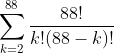 = 309,485,009,821,345,068,724,780,967 or 3.09 × 10²⁶ possible note combinations.
For a 97-key Bösendorfer:
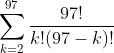 = 158,456,325,028,528,675,187,087,900,574 or 1.58 × 10²⁹ possible combinations.
These are very large numbers, and would require quite a bit of hard drive space for that many sympathetic resonance samples. It might also be somewhat time consuming to sample and script.
This dynamic, organic resonance is why Pianoteq sounds alive, while sampled pianos sound dead, as Ploki observed.
For a 97-key Bösendorfer:
These are very large numbers, and would require quite a bit of hard drive space for that many sympathetic resonance samples. It might also be somewhat time consuming to sample and script.
This dynamic, organic resonance is why Pianoteq sounds alive, while sampled pianos sound dead, as Ploki observed.
THIS MUSIC HAS BEEN MIXED TO BE PLAYED LOUD SO TURN IT UP
-
- KVRAF
- 7681 posts since 2 Sep, 2019
Also, if you want more "character" from Pianoteq, just dial the Condition slider up a bit.
Or play with the hammer hardness, move the mics around.
And be sure to check out some of the historical pianos. Lots of character there.
It's like having infinite sample libraries at your disposal.
Or play with the hammer hardness, move the mics around.
And be sure to check out some of the historical pianos. Lots of character there.
It's like having infinite sample libraries at your disposal.
THIS MUSIC HAS BEEN MIXED TO BE PLAYED LOUD SO TURN IT UP
-
- KVRAF
- 6780 posts since 17 Dec, 2009
i've last demoed it at V4 or V5 i think, and it was pretty good but not quite there. V6 is beautiful and lively. Waiting for a sale tho 
Playing with Pianoteq for 5 minutes than switching to a sampled library is all you need to do really.
Bechstein from Kremsegg has very nice flavour by the way. It's very close to some of the more "organic" samples libraries.
Thinking of getting Kremsegg because of it, then K2 and YC5 (or maybe Bechstein digital)
Playing with Pianoteq for 5 minutes than switching to a sampled library is all you need to do really.
Bechstein from Kremsegg has very nice flavour by the way. It's very close to some of the more "organic" samples libraries.
Thinking of getting Kremsegg because of it, then K2 and YC5 (or maybe Bechstein digital)
-

- Banned
- 2288 posts since 24 Mar, 2015 from Toronto, Canada
TBH.. i use Alicia's Keys from Komplete the most. I was turned off by it for the longest time just becuase of its tie in with the celebrity name, but its proven to be a great jack of all trades piano.chk071 wrote: Sun Apr 26, 2020 8:33 pm I like NI The Grandeur. As has been mentioned though, it really depends on your personal preference. So many different pianos.
 Spotify
  Soundcloud
  Soundclick
Gear & Setup: Windows 10, Dual Xeon, 32GB RAM, Cubase 10.5/9.5, NI Komplete Audio 6, NI Maschine, NI Jam, NI Kontakt
-

- KVRAF
- 16136 posts since 13 Nov, 2012
Another Pianoteq user here, it has lots of tweak-ability so you can customize the instrument the way you like.


-
- KVRAF
- 7681 posts since 2 Sep, 2019
It would be exactly 2⁸⁸ if we included each single note and no notes as possible combinations. (k=0)

THIS MUSIC HAS BEEN MIXED TO BE PLAYED LOUD SO TURN IT UP
-
- KVRist
- 165 posts since 21 Apr, 2020
It looks like you do not understand how good sampled libraries work. They all have scripting involved to approximate missing velocity layers, etc. And programming is as important as quality samples to make a good library.
So you can just stop counting sand in universe.
So you can just stop counting sand in universe.
-
- KVRAF
- 9114 posts since 28 Apr, 2013
And that confirms the problems with sample libraries while trying to excuse them!
Thank you?

I don't know about everyone else, but that "missing sand" is the reason I ended up dumping most of them.
-
- KVRAF
- 7681 posts since 2 Sep, 2019
Missing velocity layers is one thing.
It's the missing interactions within the instrument where samples really fall flat.
The possible note combinations that I illustrated only begin to scratch the surface of all of the unique mathematical interactions that are taking place within a real piano as it is being played.
No amount of crude snapshots and interpolations can fill that gap. Only living, breathing physics can. Samples will always be missing that crucial component which is the sum of all interactions that can only be generated at the very moment they occur.
It's the missing interactions within the instrument where samples really fall flat.
The possible note combinations that I illustrated only begin to scratch the surface of all of the unique mathematical interactions that are taking place within a real piano as it is being played.
No amount of crude snapshots and interpolations can fill that gap. Only living, breathing physics can. Samples will always be missing that crucial component which is the sum of all interactions that can only be generated at the very moment they occur.
THIS MUSIC HAS BEEN MIXED TO BE PLAYED LOUD SO TURN IT UP