Swanky Amp (release 1.4.0)

VST, AU, AAX, CLAP, etc. Plugin Virtual Effects Discussion
Post Reply New Topic
RELATED
PRODUCTS
Swanky Amp

Post

I'll play around with a grit control, but it might take second seat to trying to get rectifier sag into the model, so no specific timeline on that just yet.
sounds good...

as for the "touch" controls, I think for lots of users the preferred setting will be low.
I'm glad to hear that. I never know if I'm approaching this like a "normal" user or not ;)

And it occurs to me that 1) the first thing you want to know with hardware (or well, hardware emulation in this case) is to turn up the knobs an 2) it seems touch sensitivity is desirable so turning it down feels kind of wrong. So as a pure user experience thing I'm contemplating renaming those knobs to "tighten" and switching the way they work. I think it'll be clearer this way, when you crank the drive the sound gets sloppy, so you want to turn up those knobs to tighten the sound.
That sounds good - so call it "Tight" and then you'll turn it "up" to get what we now call "low" settings?
(I hope that makes sense)
John Braner
http://johnbraner.bandcamp.com
http://www.soundclick.com/johnbraner
and all the major streaming/download sites.

Post

Here's a description of the amp parameters. I forgot to mention that I put this up in the README which is what you see if you visit the GitHub page:

https://github.com/resonantdsp/ResonantAmp

Set the levels (gain staging):
Set the input control such that a strummed open chord just reaches the S tick mark for a single coil pickeup, or H for a hummbucker.
Set the output control to get the desired volume. Generally the -15 dB range is typical.
Note: these are suggested values. You can safely increase the input level to mimick the use of a clean boost pedal, or if you know your pickups are hotter than typical.

Generally speaking, you'll want to leave the cabinet control to on, unless you'd rather use your own cabinet plugin downstream of the amp.

Set the pre amp section
Set the drive control (a.k.a. gain) to get the desired pre amp distortion.
Tune the touch control to get the desired touch sensitivity. Larger values are less stable but exhibit more vintage tube behaviour. Smaller values lead to more modern sounding distortion.
Tune the grit control to get different distortion tones. This effectively changes the overhead available in the pre amp tubes.
Note: the plugin will attempt to maintain an even perceived loudness when modyfing the drive. This way you can use the drive to set the desired distortion, and then use the output level to adjust... well the output level.

Set the staging:
Set the stages control to determine the number of pre amp tubes the signal is routed to. Increase this for a more even high gain distortion.
Tune the slope control to determine how much harder each successive tube is pushed (smaller values can help even out the distortion).
Increase filter control to remove low end build up in the pre-amp stage. A lower value can lead to a fuller sound, but it can be less stable.

Set the low, mid, high controls as you normally would.

Set the power amp section:
See the notes on the pre amp section
The drive control here has the same effect on distortion as the volume knob of an amp, but the plugin maintains an even loudness.
Note that the power amp can act as a compressor: try setting the drive to the point where softly picked notes don't distort, but heavily picked ones do. You should notice the notes souding a bit fuller as the transiet hits the distortion ceiling, and then the note rings through as the bias point shifts.

Post

garrinm wrote: Mon Jun 08, 2020 1:27 pm So as a pure user experience thing I'm contemplating renaming [touch] to "tighten" and switching the way they work. I think it'll be clearer this way, when you crank the drive the sound gets sloppy, so you want to turn up those knobs to tighten the sound.
At the risk of revealing I have no idea what I'm doing, could someone chime in and explain what "sloppy" and "tight" actually mean in this context?

FYI I'm in the camp of loving the pre-amp and getting GREAT clean/slightly broken up sounds, but not really able to get a pleasing sound on a HB neck pup for leads and power chord type stuff.

However I'm loving the experience of alpha-testing this plugin.

Post

explain what "sloppy" and "tight" actually mean in this context?
I'll leave that to Garrin ;)

loving the pre-amp and getting GREAT clean/slightly broken up sounds, but not really able to get a pleasing sound on a HB neck pup for leads and power chord type stuff.
I've been in exactly the same place (although no HB here - except one strat that is HSS) but I spent a little time on it yesterday - and feel like I made some progress.
It struck me that this isn't really like any of my other amp sims though - when you turn up the gain, it's kind of dark and gnarley (non technical terms completely made up in my head) ;)
John Braner
http://johnbraner.bandcamp.com
http://www.soundclick.com/johnbraner
and all the major streaming/download sites.

Post

guitarzan wrote: Sun Jun 07, 2020 5:42 am I just checked out 0.2.0 and the overdrive in Resonant Amp really does react to picking dynamics extremely well and it does guitar volume knob cleanup as well as a good overdrive pedal or maybe even some amps. It opened with some overly blown-out settings that really didn't show off those abilities, but that may be from the previous version's settings or something.

Still missing that overt compression bit (sag, bloom, etc.) though. Even clean Fender silverfaces have it to some extent when cranked up to volume. Should be able to feel the threshold point trigger the envelope, sustain then release, just like some kind of compressor.
Hi guitarzan,

I'm glad 0.2.0 got some desirable characteristics right. My next focus for the model is to incorporate some rectifier sag. But I also want to move forward with some quality of life improvements regarding the cabinet and presets, so I'm not sure when I'll be able to get that sag in there.

It's also possible it's very difficult to correctly simulate and/or fit he model for the rectifier sag. In that case I will explore some techniques like those you described (e.g. using envelope following). I think letting spice kind of indicate what that sag should look like is preferable to going at it from purely heuristics, but we'll see. I'll drop updates here as I progress on that issue.

I'm trying to set the amp to be on the edge of distortion by default (for a single coil staged correctly). But I think I've got the pre-amp drive set too high. I'll keep reviewing the defaults with each update.

Thanks for all the material to look over,
Garrin

Post

prodigal_sounds wrote: Mon Jun 08, 2020 2:47 pm At the risk of revealing I have no idea what I'm doing, could someone chime in and explain what "sloppy" and "tight" actually mean in this context?

FYI I'm in the camp of loving the pre-amp and getting GREAT clean/slightly broken up sounds, but not really able to get a pleasing sound on a HB neck pup for leads and power chord type stuff.

However I'm loving the experience of alpha-testing this plugin.
I also have no idea what I'm saying half the time xD, but that hasn't stopped me yet. These were highly non-technical terms I was using there, but basically what it comes down to is this plugin models (or at least attempts to) the details of tube amp dynamics. In particular, there's a focus on capturing all this drift that happens to the voltages in the amp in reaction to your playing. And if those dynamics are very audible (think long time scales), then heavy drive will push those drifting values into regions where the amp does things that you don't normally associate with amps.

It can be fun to play with, and near the edge of breakup its those dynamics that lead to pleasant sounding compression and note bloom (still room for improvement on that).

But as you crank the drive, it's best to "tighten" those dynamics, sort of like shortening compressor time scales, so that the amp pumps less and spends less time in these wonky settings where all the voltages have drifted way far from their normal values.

Hopefully that made some sense.

Thanks for trying the plugin and chiming into the discussion,
Garrin

EDIT: I claim it's "best to tighten the dynamics" but that's highly subjective. I think to get a really gnarly tone (highly technical term there), the drive would be set on medium-high drive and have the touch controls about midway. Then it sounds more like you're pushing a tube amp really hard, which can be a desirable tone. I'll admit that the tone will be only as good as the model, and the model is certainly not a 1:1 fit a real tube amp, so you're mileage will vary.

Post

and the model is certainly not a 1:1 fit a real tube amp
because it's a *model* and it's software (not a real thing with tubes in it and a speaker - that plugs in to a wall socket) ;)
EDIT: - and gets hot!


Your model is good!
Last edited by jbraner on Mon Jun 08, 2020 7:40 pm, edited 1 time in total.
John Braner
http://johnbraner.bandcamp.com
http://www.soundclick.com/johnbraner
and all the major streaming/download sites.

Post

garrinm wrote: Mon Jun 08, 2020 6:45 pm It's also possible it's very difficult to correctly simulate and/or fit he model for the rectifier sag. In that case I will explore some techniques like those you described (e.g. using envelope following). I think letting spice kind of indicate what that sag should look like is preferable to going at it from purely heuristics, but we'll see. I'll drop updates here as I progress on that issue.
Yeah...SPICE...meh :wink: Everybody is using SPICE models but nobody has gotten sag right yet (not in software anyway, some modeling hardware, but Yamaha and Kemper both emphasize that their models are greatly modified "by ear", I think Kemper was specifically talking about compression in the thing I read).
garrinm wrote: Mon Jun 08, 2020 1:41 pm Note that the power amp can act as a compressor: try setting the drive to the point where softly picked notes don't distort, but heavily picked ones do. You should notice the notes souding a bit fuller as the transiet hits the distortion ceiling, and then the note rings through as the bias point shifts.
OK, I see a problem. Compression that doesn't involve gain reduction isn't compression — statistical analysis aside, that's not going to have any feel because nothing is happening.

You seem to have modeled every form of guitar distortion I can imagine (and more) and the touch and volume knob cleanup is amazing for software, but as it is I get no sense of compression at all.

Consider this — once a guitar amp is starved of voltage, it basically becomes a Voltage Controlled Amplifier (VCA), so the whole Envelope Follower / VCA thing is a nearly perfect analogue.

Back to the pedalboard for now, I'll check back later to find out what a sag equation feels like. :tu:

EDIT 6-12: The main point being that however you accomplish it, gain actually needs to vary and produce audible compression artifacts in a way that is plausibly consistent with various actual amplifier power drain and recovery characteristics. To me, this would be where "by ear" would be best, but I'd guess that you (being much more data driven) would disagree. Just leave some room for user tweaks and everybody is happy.

If you do decide to try the VCA thing, the ADSR and Envelope Follower / VCA I posted links to might be too limited to produce the kind of detailed power drain / recovery envelopes that you might prefer, but I thought open source would be best to give you a look under the hood. I'm pretty sure you'd need to be able to at least invert the envelope (I don't remember if that's possible with the ndc one). There were ADSR plugins available (free even) that let you add control points, splines, the whole works, but I don't know what's currently available [another thread I was just reading makes me think that the type of envelope generator I am describing here may actually be called a Multiple Segment Envelope Generator or MSEG].

Sorry I don't remember the routing [probably not even all the right components], but what you'd be looking to build is pretty much a VCA Compressor with the fancy ADSR [or MSEG] in place of the normal Attack and Release envelope controls.

Then tweak the envelope [& threshold, ratio…] to play nice with your overdrive, or map your power-amp overdrive behavior directly to the envelope if that's possible. With guitar pedals, overdrive into compressor always sounds and behaves more amp-like than having the compressor first (which is more effect-like — tele chicken-pickin', etc), but maybe you have access to even better options inside the amp sim.

It may be possible to dynamically tie together the entire system with those same envelopes (transformer behavior, dynamic cab modeling…) — worth a thought.

EDIT 6-13: What the world really needs is an analog VCA Compressor with a digital Envelope Generator — does such a thing exist?

Post

guitarzan wrote: Mon Jun 08, 2020 7:26 pm To me, this would be where "by ear" would be best, but I'd guess that you (being much more data driven) would disagree. Just leave some room for user tweaks and everybody is happy.

If you do decide to try the VCA thing, the ADSR and Envelope Follower / VCA I posted links to might be too limited to produce the kind of detailed power drain / recovery envelopes that you might prefer, but I thought open source would be best to give you a look under the hood. I'm pretty sure you'd need to be able to at least invert the envelope (I don't remember if that's possible with the ndc one). There were ADSR plugins available (free even) that let you add control points, splines, the whole works, but I don't know what's currently available [another thread I was just reading makes me think that the type of envelope generator I am describing here may actually be called a Multiple Segment Envelope Generator or MSEG].
Hi guitarzan,

Thanks again for this material to think on.

I'm data driven when it's convenient xD. In this case I'm seeing a lot of difficulties correctly simulating the dual rectifier to get proper power starvation. Instead I went through the circuit and looked a bit more heuristically at what parts of the plugin's model will be affected by a change to the plate voltage.

I'm more inclined to follow your direction of treating it like a VCA. There's a fair bit of room for picking time constants and whatnot, I'm not sure a full ADSR treatment is necessary (that will introduce a lot of free parameters which would be hard to pin down, plus that kind of envelope will hopefully just arise from the model if I correctly connect the voltage sag to the rest of it).

I'm experimenting with this right now, we'll see if I can get something satisfactory out of it. As for the tuning by ear, I'll leave it to people who've have more experience with tube amps than me to tell me how far off the mark I am haha (last time I played a tube amp was probably a year ago).

Garrin

Post

Version 0.3.0 is out. The main feature is a new cabinet model. I've also tweak the UI slightly and changed the "Touch" controls to "Tight" controls which work in the opposite way as the old touch controls did.

As usual, you can find the release notes and updated instructions about the parameters on the github page:

https://github.com/resonantdsp/ResonantAmp

The old download links still work:

Installer: https://drive.google.com/file/d/1aOKUJy ... sp=sharing
VST3: https://drive.google.com/file/d/1BrrAsj ... sp=sharing

Once I introduce preset management I will ensure to add versioning to the file names and have new download links for new versions, this way you can keep your older versions around.

(Sorry guitarzan, no sag yet, that will be the next update assuming I get it working to a level I'm happy with)

Post

So... nice....

I had to tweak my previous patches but soon had them adjusted and dialed in the same tones I had with the earlier version.

Good news: with 0.3.0 I can get some nice "creamy crunch" tones from manipulating the power amp parameters. This is the most capable release yet, in my experience.

The TIGHT parameter is still a bit of a mystery to me. Depending on what tone I'm going for with the other parameters, I then end up twisting the TIGHT through the range until I find the one setting it sounds good on. Varying from that "sweet spot" seems detrimental to the tone goal.
This is probably completely by design and expected.

One thing I LOVE about this plugin is that I can play quietly and get sweet sparkly goodness, but hit a chord with more vigour and it breaks up into wonderful crunch, with no detrimental change to the overall volume. I wonder if this is what "real tube amp" players experience by default? This current setting I've found is joyous.

Post

garrinm wrote: Sun Jun 14, 2020 12:00 pmI'm more inclined to follow your direction of treating it like a VCA. There's a fair bit of room for picking time constants and whatnot, I'm not sure a full ADSR treatment is necessary (that will introduce a lot of free parameters which would be hard to pin down, plus that kind of envelope will hopefully just arise from the model if I correctly connect the voltage sag to the rest of it).
I feel like I'm failing to communicate something important about compression and why it is best described as an envelope.

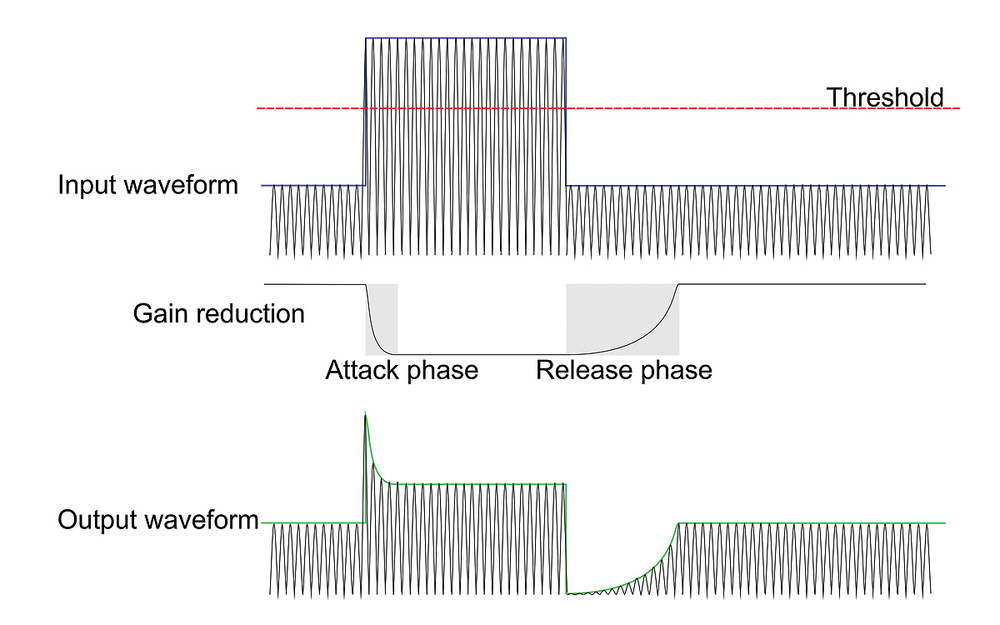
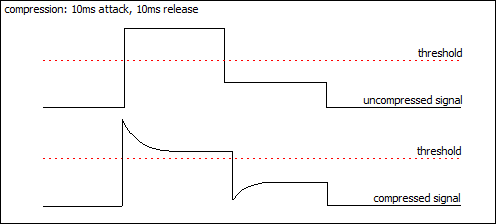
Here are a couple of pictures that shows the normal attack and release envelope of compression — Threshold would represent the power-amp clean headroom ceiling - Attack would relate to power drain rate and Release relates to power recovery. Notice the time lags. The affected section of the Output Waveform would represent sag.
Image
Image
Maybe you are just saying that this same thing can be accomplished more directly without need for an actual compressor, which I don't doubt, but I am left feeling that you aren't accounting the time it takes to happen. The recovery (Release) time on a sagging tweed Deluxe is very slow, faster on a Plexi, but still much longer than a single cycle. The envelope represents gain change over time. One little pluck near the clean headroom ceiling triggers an envelope with duration (20ms minimum for the example settings in the illustration above, 10ms Attack, 10ms Release), more plucks keep it from recovering , etc.

Guitar amps also do not compress transparently — they produce quite audible compression artifacts that muscle memory translates as "feel".

In trying to remember what I used in energyXT ten+ years ago and how it was routed and how it all behaved, I have come to the conclusion that all I really ended up with was a VCA compressor with extended envelope control — but it worked well. So, yeah, maybe you don't want the whole ADSR thing, but you still need a way to produce and control at least the Attack and Release envelope, or what am I missing?

Post

guitarzan wrote: Sun Jun 14, 2020 10:38 pm So, yeah, maybe you don't want the whole ADSR thing, but you still need a way to produce and control at least the Attack and Release envelope, or what am I missing?
Hi guitarzan,

That's exactly right, I'm reluctant to use a full ADSR envelope as it adds quite a few degrees of freedom to the problem which would be hard to pin down in the model. Right now the model does use compression that follows nearly the scheme you described (for example you can see it in action here https://github.com/resonantdsp/Resonant ... id.dsp#L57) where there is an attack time constant and a release time constant. This compression is used in a few different parts of the signal chain, and all the time scales are fairly short as they were fit to the observed signals from simulating the amplifier circuit (though the simulation uses an ideal voltage source for the plate, hence why it doesn't capture the slow dynamics of rectifier sag).

You're right to observe that right now there are no "slow" effects in the signal at the moment. All the compression happening is fairly quick and is also happening *too far from the final signal to sound like an audible compression*. They are accounting for things like grid conduction and other such tube effects, as well a drifting voltages due to capacitances charging and discharging.

So the signal is getting little bits of compression here and there, but then it goes through another tube which might change that dynamic, and the end result is *not* that rectifer-sag-like compression.

I'm working from everything you've been saying to introduce some sag-like compression. It's not straight forward to get right though since I don't have the simulation data to instruct my modeling choices, and since it's not as straight forward as just compressing final signal with two time constants (or even with a full ADSR envelope).

I've taken a more heuristic approach here and after looking over mathematical descriptions of tetrode tubes for entirely too many hours this weekend, I think I've worked out which *parts of the current model* should be affected by changing the plate voltage. I'm working from the point of view that the power amp plate voltage will undergo some straightforward compression with slow attack and release time scales.

* the drop in plate voltage will reduce the scaling factor on the signal, which looks like normal compression on the final signal
* but the drop will also decrease the amount of headroom before screen conduction starts hacking away at the signal, so the clip level also needs to come down
* there might be a non-trivial effect where once the power drops, the signal amplitude drops, and its drain on the power is reduced, leading to a different equilibrium point for a different strength of signal
* I don't think the cross over distortion will be affected by the power amp plate voltage changing

Thanks,
Garrin

Post

OK, now I'm convinced you know what compression is — I'm not so sure about any of the other amp sim developers, though. Carry on, then. :)
garrinm wrote: Mon Jun 15, 2020 12:38 am * the drop in plate voltage will reduce the scaling factor on the signal, which looks like normal compression on the final signal
* but the drop will also decrease the amount of headroom before screen conduction starts hacking away at the signal, so the clip level also needs to come down
* there might be a non-trivial effect where once the power drops, the signal amplitude drops, and its drain on the power is reduced, leading to a different equilibrium point for a different strength of signal
* I don't think the cross over distortion will be affected by the power amp plate voltage changing
Yeah, this is cool stuff — these are the kind of things I hoped you would come up with by looking at the VCA angle from the inside of the amp-sim instead of just as an addon like I was. I knew the overdrive changed character during sag in real amps, but I had no idea how to get there.

To be fair, I do think some of this is the sort of stuff that some other amp sims are calling "sag", but they all miss the more standard compression type artifacts that are an essential part of the "feel", where it seems like you may be on track to get it all if it works out like you're currently thinking :pray:. This should be interesting if nothing else.

If you need more vintage real life examples of power amp grind and fun with sag than just Neil Young, check out some early ZZ Top…


Post

I like how it's coming along!
The tight control makes a lot more sense. I don't really like under 5 or 6 and mostly keep it at 7-9 - but that's just me. ;-)
One thing I LOVE about this plugin is that I can play quietly and get sweet sparkly goodness, but hit a chord with more vigour and it breaks up into wonderful crunch, with no detrimental change to the overall volume.
Yep - I'm getting this with my Strat too ;-)

I'm not really using the cab either - as I prefer my WOS cabinets for everything...
John Braner
http://johnbraner.bandcamp.com
http://www.soundclick.com/johnbraner
and all the major streaming/download sites.

Post Reply

Return to “Effects”