U-he Hardware - CVilization Eurorack Module

Anything about hardware musical instruments.
Post Reply New Topic
RELATED
PRODUCTS

Post

justin3am wrote: Mon Oct 19, 2020 11:39 pm No, only one power cable is needed. The module does require 5v in addition to the normal -/+12v and 0v but most PSUs offer that these days. Select Bus and Gate Bus stuff is also handled via the power cable.
The other header hasn't been discussed in any detail as far as I know. I figured it was a programming header but I gather that is not the whole story.
I would be surprised if units can be cascaded. Most matrix mixer modules work in the analog domain, where you can just sum another set of channels together but CVz works in the digital domain, so more channels would increase MCU load, or at least that would be my assumption.

Presets can be used as a starting point. For example, in the sequential switch mode, I have presets with different configurations of the Clock Source and Clock Divider modes.
However, I find that I'm mostly using the presets to quickly switch between configurations which would normally require a lot of encoder turning. This is particularly useful in the Matrix Mixer mode, where I can switch between a preset where input 1-3 are routed to output 1, to a preset where only input 4 is routed to output 1 and inputs 1-3 are routed to output 2, without having to turn the encoders and switch programming pages to get there.
Thanks justin :tu:

Post

justin3am wrote: Mon Oct 19, 2020 11:39 pm No, only one power cable is needed. The module does require 5v in addition to the normal -/+12v and 0v but most PSUs offer that these days.
Yeah, I thought that rather odd, and so that is what I figured. (thanks)

... vurt! :dog: :wink:
justin3am wrote: Mon Oct 19, 2020 11:39 pm Select Bus and Gate Bus stuff is also handled via the power cable.
Interesting. That's part of the Doepfer spec, I'm assuming? I know his system 100 stuff (with his case/power supply) does behind the module 'rail related' stuff, but I've not looked into it at all, though I have a dozen or so Doepfer modules, I assumed it was a spec particular/integrated into his specific system.
justin3am wrote: Mon Oct 19, 2020 11:39 pm The other header hasn't been discussed in any detail as far as I know. I figured it was a programming header but I gather that is not the whole story.
Programming was my first assumption as well. But, we shall see. 8)
justin3am wrote: Mon Oct 19, 2020 11:39 pm I would be surprised if units can be cascaded. Most matrix mixer modules work in the analog domain, where you can just sum another set of channels together but CVz works in the digital domain, so more channels would increase MCU load, or at least that would be my assumption.
Interesting. I have all analog matrix mixers, and was not aware of that disparity with digital.
justin3am wrote: Mon Oct 19, 2020 11:39 pm Presets can be used as a starting point. For example, in the sequential switch mode, I have presets with different configurations of the Clock Source and Clock Divider modes.
However, I find that I'm mostly using the presets to quickly switch between configurations which would normally require a lot of encoder turning. This is particularly useful in the Matrix Mixer mode, where I can switch between a preset where input 1-3 are routed to output 1, to a preset where only input 4 is routed to output 1 and inputs 1-3 are routed to output 2, without having to turn the encoders and switch programming pages to get there.
Cool stuff. Thanks for the update. :tu:
I'm not a musician, but I've designed sounds that others use to make music. http://soundcloud.com/obsidiananvil

Post

Shabdahbriah wrote: Tue Oct 20, 2020 12:09 am
justin3am wrote: Mon Oct 19, 2020 11:39 pm Select Bus and Gate Bus stuff is also handled via the power cable.
Interesting. That's part of the Doepfer spec, I'm assuming? I know his system 100 stuff (with his case/power supply) does behind the module 'rail related' stuff, but I've not looked into it at all, though I have a dozen or so Doepfer modules, I assumed it was a spec particular/integrated into his specific system.
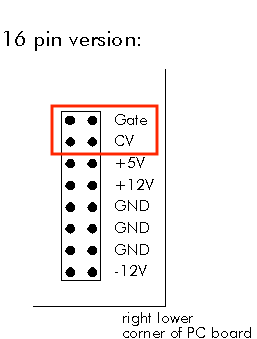
Gate Bus:
Doepfer's spec says the first two rows of pins are for CV and Gate...
Image
I started with a Doepfer Basic system, when there wasn't much else, and my A-190-1 MIDI>CV converter could control any oscillators and trigger envelopes which were on the same bus board. CVz ignores the CV bus but listens to the Gate Bus, when a Clock Source is set to the color teal.

Select Bus:
At some point people started repurposing the CV and Gate bus pins on Dopefer bus boards for other stuff. If I remember correctly, Mungo was the first company to use the the CV/Gate buses to transmit data between modules. Later Macro Machines, made their Storage Strip module which could be used to initiate save and load functions on compatible modules, remotely (as well as control the Zoom function on Mungo modules). Malekko, WMD, Expert Sleepers and Make Noise (forgive me if I'm forgetting anyone) have since implemented Select Bus support for some of their modules.

In terms of the data being used, Select Bus is basically MIDI for your eurorack modular. In practice, it works more like the preset system in Buchla's 200e series. Only one Select Bus module can be configured to transmit, the rest are receivers. The transmitter module can initiate save and load functions, transmit tempo data, etc. for any receiving modules. I use Expert Sleeper's Select Bus breakout module, so I can send MIDI from my Octatrack to my Select Bus compatible modules but you can also use Make Noise's Rene v2, Malekko's Varigate8 or WMD's Meteron as Select Bus transmitters. There may be others.

Anyway, there is a setting in the CVz configuration file (discussed toward the end of the manual) which allows you to have CVz listen for Select Bus messages, rather than just getting gates from the Gate Bus. With this configuration you can save/load Presets on CVz from a Select Bus transmitter or by sending program change messages to a Select Bus breakout module. With the Select Bus option selected, setting the Clock Sources on CVz to Teal will allow you to sync to MIDI Clock (or the clock of the Select Bus transmitter). It will also listen to MIDI start/stop messages in Modes 2 and 3.

Other stuff:
I think TipTop Audio has used these bus lines for sending audio from their drum modules to some kind of summing/mixer module. I can't remember the details.

Post

The small additional jack gives us an option to add things. Most obviously we could add an expander module, e.g. for Gate outputs, or we could add another set of CV inputs. We could add a display, a fine tune knob, etc. or we could interconnect multiple CVilizations. I think of it as a wildcard in case people widely adopt "CVilization would be great if only it had this one more thing".

Interconnection with audio rate signals is however not an option, there's simply not enough bandwidth/CPU left to do that.

Post

Shabdahbriah wrote: Tue Oct 20, 2020 12:09 am
justin3am wrote: Mon Oct 19, 2020 11:39 pm No, only one power cable is needed. The module does require 5v in addition to the normal -/+12v and 0v but most PSUs offer that these days.
Yeah, I thought that rather odd, and so that is what I figured. (thanks)

... vurt! :dog: :wink:
it is for 5v.
as both a beginner and idiot, thats where my knowledge ends :hihi:
what that 5v is for, then you need someone else :)

tbh, even reading whats been said by justin and urs, the best i can tell you, its 5v :shrug:
im hoping it will all make sense, if i keep reading it, and more on the subject, then there will be an ahhh moment of clarity :)
for now, i do as im told and thats all i need :hihi:
:ud:

Post

pekbro wrote: Mon Oct 19, 2020 10:17 pm Lotta times you can hook matrix mixers together to increase the capacity. Maze can do that.
Dunno if that's what it is, certainly it would be useful if one wanted to get 2 of em.

Not having read the manual, I'm still kind of curious about the preset thing, I'm just wondering if it's like MATHS in that maybe you can accomplish things with it, that might not be immediately obvious, like how you can use MATHS as a clock divider or compressor (I think) for those super brainiac types with the required technical know how.

In that case, 3rd party presets might be useful.
its not so complicated.
maths still has things i need to dig the manual for, because theres no real visual feedback.
here, you get the colours, the blinks, so you can see where you are.

the manual is easy to follow too.
if i can get going with it, i domt see many people being confused by it 8)
:ud:

Post

I don't think 3rd party presets make much sense... we haven't even added any export/import functionality yet.

Post

Urs wrote: Tue Oct 20, 2020 1:30 pm I don't think 3rd party presets make much sense... we haven't even added any export/import functionality yet.
if it was overly complicated, i could see a reason for demo presets. but its not at all!
:ud:

Post

Urs wrote: Tue Oct 20, 2020 8:43 am The small additional jack gives us an option to add things. Most obviously we could add an expander module, e.g. for Gate outputs, or we could add another set of CV inputs. We could add a display, a fine tune knob, etc. or we could interconnect multiple CVilizations. I think of it as a wildcard in case people widely adopt "CVilization would be great if only it had this one more thing".

Interconnection with audio rate signals is however not an option, there's simply not enough bandwidth/CPU left to do that.
Thanks! I didn't want to relay anything that isn't public. ;-)

What would a Gate Output expander do? Something similar to the transient>trigger module you mentioned before? If you were going to do an output expander, envelope followers and comparators/trigger generators would be incredibly useful.

I definitely found myself wanting more Gate/CV inputs. A display might be nice for more visual feedback, maybe something like the screen saver modes for O_c? Like oscilloscopes on the outputs maybe?

If the expander were able to link two modules together so either module could be used to change presets on both. It would also be cool if two modules could share CV inputs.
Last edited by justin3am on Wed Oct 21, 2020 4:37 pm, edited 1 time in total.

Post

Ok I got word from Schneidersladen that mine will ship out today, even though I got pushed to the back
of the line for some reason. I don't expect they get too many orders from Hawaii, maybe that's it. :shrug:

Post

Mine arrived just now. First impressions:

Someone at Schneidersladen drew me a vampire :hihi:

Image

I'm happy it uses the 5V rail -- too few modules have that option and it seems everyone wants to burden the -12V rail instead. My PSUs are rated for crazy amounts of +5V current and are weak on the -12V...

The lights are pretty! :love:

I set up a stereo ping-pong delay feedback patch very easily. Tweaking it in matrix mixer mode is indeed easy and logical. Being back up to 4x4 and having inversion again means fun things like cross-inverting the feedback that I couldn't do with my AI008 and didn't even realize I had missed.

Switching it to mono so I can use Ch 3 in/out as an quantizer and S+H, it took me a minute to realize I still had some of the audio inputs dialed in to channel 3 output as well... but I figured out how it indicates a zero by very quickly switching off the "all lights match the currently turning knob" mode. However... I also accidentally found that using S+H and a quantizer while feeding some of the audio into the pitch input can be a fun way to randomize my phrases a bit! :clap:

And since I'm using it with the 0-Ctrl, I can patch another knob's CV output into input 4, also dial that into my output 3 where it gets quantized, and then mute or enable the two inputs for variations on the fly...

And then I was like "I'm not using output 4, what can I do with that?" Patch it to Mimeophon's u input and mix input 3 and a little input 1 into it, so it affects resonator tuning as well as FMing it a little. :clap:

If it didn't have any other modes I would already be very happy I bought it! I'm going to save exploring other modes for another time though and just say, well done Urs and the rest of the u-he team :)
Last edited by foosnark on Wed Oct 21, 2020 9:51 pm, edited 1 time in total.

Post

:party:
:ud:

Post

Congrats!
foosnark wrote: Wed Oct 21, 2020 9:23 pm I'm happy it uses the 5V rail -- too few modules have that option and it seems everyone wants to burden the -12V rail instead. My PSUs are rated for crazy amounts of +5V current and are weak on the -12V...
I totally agree. I have a huge 5A supply for my 5v lines and I only have 3 modules which can actually draw from it. lol

Unfortunately a lot of PSUs just put a linear voltage regulator on the -12v line, to get their 5v. Anytime you see a 7805 on the bus board, that is the case. I would venture to guess that is why some PSUs rate the -12v at a smaller voltage than the +12v. Uneven draw from the +12v is one of the quickest ways to get current leakage on the 0v line, which leads to noise issues and cross talk. I really wish there were any easy way to distribute the load better. Like having an option on modules that draw heavily from +12v, to draw from -12v instead. Just one of my many gripes about eurorack power.

Post

^ Yeah, I don't get why they do that. I have one case where I chose to eliminate the 5v completely.
It has never been an issue even once.

Post

My thoughts on mode 2, the sequential switch: At first I didn't think I was going to like it that much, and thought it was a little awkward as a sequencer... but then I got into it a bit more and got a better feel for it. It works very well with a multi-channel sequencer (like 0-Ctrl) especially if it's set either on a clock divider to string multiple sequences together, or set to a different number of steps so it creates longer permutations from them. And of course interposing its own fixed or random steps can be very effective too. :tu:

Mode 3, the Mucorder: less like Marbles than I had made myself expect, but brilliant. Again, it's a really good friend to a basic sequencer, but more for just taking some really simple arpeggio and rearranging it into something to feed multiple oscillators.
Lots of fun :)

Mode 4, quad panner: since stereo is more common than quad, on my wishlist for this is an option for each input to set the channels it can pan between: 1-4, 1-2 or 3-4. On the other hand, I found if I run stereo into and out of 1-2, I can use 3-4 for feedback through an effect. The feedback rises/falls and pans with the pan positions in a fun way. :party: Or run outputs 3-4 through an LPF (and maybe a short delay, no feedback) to get something like a "behind you" circular effect.

And I feel like this is just basic usage...

Post Reply

Return to “Hardware (Instruments and Effects)”