Free Phase Alignment Tools

VST, AU, AAX, CLAP, etc. Plugin Virtual Effects Discussion
RELATED
PRODUCTS

Post

Kang wrote: Tue Feb 16, 2021 2:46 pm
raysaul wrote: Tue Feb 16, 2021 1:28 pm
Kang wrote: Tue Feb 16, 2021 7:42 am
raysaul wrote: Tue Feb 16, 2021 7:38 am
Kang wrote: Tue Feb 16, 2021 6:59 am The free Voxengo Sound Delay works well if you just need to move stuff forward. Personally I still prefer the age old method of manually moving stuff around in the DAW.

You're mixing up phase alignment and time correction, as many people do.
These are two different things.
Not really. While I understand the logic behind what you're saying, time aligning also effects phase and generally is how most people are performing phase adjustments.
Not true, sorry.
It is true that time alignment affects phase relationships, but it is not the same as phase rotation, as achieved by allpass filtering. It is perfectly possible for two parallel sounds to be time aligned, but still out of phase with each other.
This is, for example, why plugins such as Voxengo PHA979 have separate time and phase alignment sections.
As I said, I know that.

Change the timing of some tracks on a DAW and tell me that is not adjusting the phase. In practice you'll find many (I'm willing to say most, but I won't) pro's use this as their primary phase correction technique, often with a plugin like eventide precision time align (since that's a common one to use in pro tools). Back in the day they would use a delay to do the same thing. You'll see way less people using actual phase adjustment tools as you describe.

Note: I'm talking about time adjustment, not specifically time 'aligning'.


You obviously didn't read what I wrote there.

Post

OK. OP Please change title to PHASE ROTATION plugins.

(sarcasm)

Post

Kang wrote: Tue Feb 16, 2021 2:58 pm OK. OP Please change title to PHASE ROTATION plugins.

(sarcasm)
I do apologize if I misunderstood the op.
But if he's talking about time delaying a track/sound in a project, he doesn't even need a plugin for that since most DAWs have that feature as a standard per-track control, e.g. a time slider in Cubase's track inspector.

But if he actually wanted to manually rotate the phase of two parallel sounds so that they fit better with each other, then what I spoke about is quite correct. Often you need to keep the temporal position of a sound, e.g. to have transients correctly timed/aligned, but flip or rotate the phase to fix issues. In such cases, simply moving a sound will not do what you want.

Many processes change/affect phase relationships between sounds, including time adjustments, but they are not the same as phase rotation nor do they give same results.

Post

raysaul wrote: Tue Feb 16, 2021 3:15 pm
Kang wrote: Tue Feb 16, 2021 2:58 pm OK. OP Please change title to PHASE ROTATION plugins.

(sarcasm)
I do apologize if I misunderstood the op.
But if he's talking about time delaying a track/sound in a project, he doesn't even need a plugin for that since most DAWs have that feature as a standard per-track control, e.g. a time slider in Cubase's track inspector.

But if he actually wanted to manually rotate the phase of two parallel sounds so that they fit better with each other, then what I spoke about is quite correct. Often you need to keep the temporal position of a sound, e.g. to have transients correctly timed/aligned, but flip or rotate the phase to fix issues. In such cases, simply moving a sound will not do what you want.

Many processes change/affect phase relationships between sounds, including time adjustments, but they are not the same as phase rotation nor do they give same results.
I'm happy about the tech-talk. Nice to learn new things. Well I mainly ask for fine adjusting a vocal track in time. Sure I can use move the track in the DAW (Live) or use the track-delay function but I like to test different approaches if this is possible.

About phase rotation: is Disperser the only vst able to do this? Is Phase-Nudge similar. Good sound sources of before after phase rotation or the effect? As far as I understand it should work a bit similar to a phaser but on a broader band of frequencies?
rabbit in a hole

Post

Autobot wrote: Tue Feb 16, 2021 3:31 pmAbout phase rotation: is Disperser the only vst able to do this?
Have you tried my free VST phase rotator plugin suggestion?
Etienne1973 wrote: Mon Feb 15, 2021 3:35 pm Free Phase Rotator for Windows: Audiocation Phase AP1

Post

They can all do what you want, but in different ways.
Voxengo would be my choice, but the free Airwindows will do the same thing, basically.
Voxengo does a broadband rotation (all frequencies) while Disperser and SSL are frequency specific, e. g. you can pinpoint a specific bass frequency and rotate it to your need/taste.

My experience with the Audiocation one as mentioned above is that it is very buggy. That was a few years ago, they might have updated it in the meantime.

I feel the Airwindows is your safest bet, if you don't mind the absence of GUI.

Post

Interesting...I use time delay (+/-) to make things in phase, apperently "phase rotation" does other things?
I use Eventide Time Align or Cubase own micro delay. Exact same result (both visually in a oscilloscope and sound wise). What plugins use other techniques to rotate phase without time shifting the audio?
What Airwindows plug does this (and how does this work)?

Post

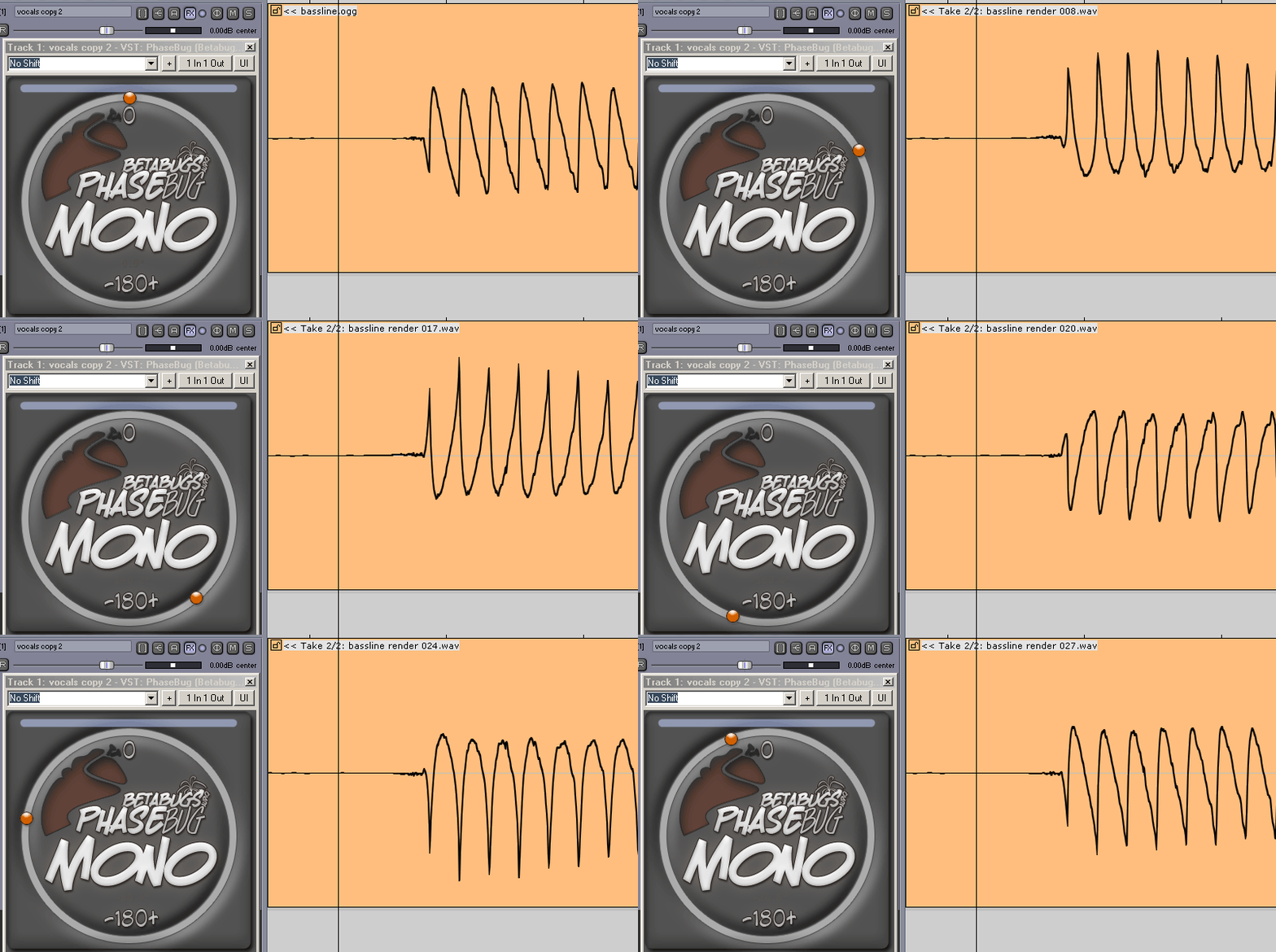
Image


Phase rotation means that waveform signal stays on the time line stationary but polarization changes. That's how I understand it.

Post

raysaul wrote: Tue Feb 16, 2021 3:15 pm
Kang wrote: Tue Feb 16, 2021 2:58 pm OK. OP Please change title to PHASE ROTATION plugins.

(sarcasm)
I do apologize if I misunderstood the op.
But if he's talking about time delaying a track/sound in a project, he doesn't even need a plugin for that since most DAWs have that feature as a standard per-track control, e.g. a time slider in Cubase's track inspector.

But if he actually wanted to manually rotate the phase of two parallel sounds so that they fit better with each other, then what I spoke about is quite correct. Often you need to keep the temporal position of a sound, e.g. to have transients correctly timed/aligned, but flip or rotate the phase to fix issues. In such cases, simply moving a sound will not do what you want.

Many processes change/affect phase relationships between sounds, including time adjustments, but they are not the same as phase rotation nor do they give same results.
It's not misunderstanding as much as it is just arguing semantics. You are correct in what you say, but in practice time-alignment is used more often to adjust phase relationships, which is just to say, make something sound better. I've seen it countless times in the studio (including in the analog realm) and I've never once seen someone use a specialized phase adjustment tool.

Moving clips in the DAW is easy and free, but I understand why people would use a plugin for this as it keeps your stems lined up, it's easier to audition, and has other advantages as well.

By all means, experiment with both and decide for yourself.

Post

Kang wrote: Tue Feb 16, 2021 5:32 pm ... it is just arguing semantics.
Let's agree to disagree.

Post

A delay no matter how small is always going to be a partial phase alignment as the shift is the same for all frequencies. Whilst it is correct using allpass filters and FIR filters to do what is generally considered phase alignment isn't as common practice in comparison to simple sample delays, It's not semantics to be particular about the differences between the two. technically, sample or time alignment is not phase rotation or phase alignment. phase alignment is just a consequence of shifting two waveforms relative to eachother, but the shift is generally too broad a stroke to positively effect phase because all the frequencies are delayed by the exact same amount and this is more likely to produce a comb like distribution in the high end. I've always chose to see them as separate things, and they definitely do not yield similar results for obvious reasons, unless by happenstance you find two composite samples that happen to have their frequencies occur on the same angle and position in time as the other sample...errr, yeah. Highly unlikely with even the most accurate of rooms and monitors :)

Often with time alignment the focus is purely on transients or low end, but never both (because you can't have both aligned in the same sound with a simple sample delay)you are generally just deciding which creates the greatest amount of correlation based on how visually in alignment the cycles are, but just because they are visually aligned, does not mean that they are correlated well, which you can also verify with a correlation meter. because there are constituent frequencies within those cycles that have been shifted out alignment in order to favour other frequencies, so with a sample delay you are ever only aligning one or two frequencies at a time and mostly hiding the comb filtering in other parts of the spectrum you deem to be less important to the resulting sounds, or the waveform doesn't obviously display in any meaningful way and your monitoring setup is none the wiser

Sample delays are more common practice, but there is no debating a combination of the two yields the punchiest results. usually with the least amount of contribution from the sample delay. Anything greater than a few 10's of samples (less than 1ms) i wouldn't consider doing anything worthwhile for phase relationships, and the allpass filter should be first order for the least amount of group delay introduction and also to insure better correlation. More group delay=more comb filtered distribution in the frequencies and your transients will get sloppy too. This is why Disperser is not particularly useful as a phase utility IMO as it starts from the point of being a 2nd order allpass filter. Straight away you are getting over 180° of rotation(not a complete rotation as the allpass filter is non-linear in how it delays frequencies)depending on the corner frequency. That's too much for a lot of phase relationship jobs as the objective is to apply it deftly if you want it to be effective

Now, to the crux of it. Does it matter? Not sure i can say whether it does or not unless you know what to listen for..there's tonnes of music out there with really poor phase correlation between kick and bass for instance and people don't seem to mind as long as they are not "masking"one another too much which is usually accomplished by utilising sidechain triggering, or triggered, or drawn volume envelopes. Take everybody's favourite production poster children Noisia. They use very high order filters everywhere, so there is literally no chance anything in their stuff is correlated and the punch instead is mostly created via the methods i just mentioned and the levels. The bigger the system though, the more obvious phase anomalies become, possibly because of the brutally steep crossovers used in a lot of PA and line arrays if i was to guess? and the transition curves of those huge bass bins which are very high order from most of the specs i have seen.

To narrow it down. It's kind of a taste thing if it matters to you or not, but it's certainly not a requirement. Would depend on who you ask though and the music you hold in regard to using as references.
I

Post

Ahh got it, partial phase alignment. Yeah not semantics at all... partial. OP please change title to Free Broadband Phase Alignment Tools (no partial).

Post

TIMT wrote: Tue Feb 16, 2021 6:51 pm A delay no matter how small is always going to be a partial phase alignment as the shift is the same for all frequencies. Whilst it is correct using allpass filters and FIR filters to do what is generally considered phase alignment isn't as common practice in comparison to simple sample delays, [ snip... < see orinial post > ]
Of all the tools I know of to work with this, Waves InPhase is the only one that has tools to manipulate the aspects TIMT mentions. But it takes some knowledge to use it effectively. It would be interesting know of other tools that have a similar suite as InPhase.

Post

I tried "phase rotation" using Airwindows PhaseNudge, but the result is crap (Phasenudge is more of a sound fx than a "phase fixer"). Using Waves InPhase with only delay is the same. Then I tried using the filters in InPhase, but it just sounds bad to me. The transient gets affected and the snappy-ness of my bassline example was gone (although in phase!).

To be honest, I don't understand in what scenarios "phase rotation" or a "allpass-filter" plugin would be a better option better to use on the case of phase correlation?

Post

plexuss wrote: Wed Feb 17, 2021 1:37 am
TIMT wrote: Tue Feb 16, 2021 6:51 pm A delay no matter how small is always going to be a partial phase alignment as the shift is the same for all frequencies. Whilst it is correct using allpass filters and FIR filters to do what is generally considered phase alignment isn't as common practice in comparison to simple sample delays, [ snip... < see orinial post > ]
Of all the tools I know of to work with this, Waves InPhase is the only one that has tools to manipulate the aspects TIMT mentions. But it takes some knowledge to use it effectively. It would be interesting know of other tools that have a similar suite as InPhase.
I'm not that familiar with Inphase. i mostly just use EQuilibrium for all my phase rotation needs. i've got the Maat one too, but that was more of an impulse buy. i thought, maybe an "analog modelled phase rotator"might be special :?: , but i can null it entirely with EQuilibrium :party:

got PHA too for linear phase rotation, but mostly use the Forward Audio one for the time delaying as it can do sub sample shifts if you change the maximum amount of samples that the dial can go to. for those times when you wanna be extra precious about it

Scaling of the delay on PHA is too brutal even with a key control for fine tune i find

But in relation to the topic at hand. i'm not aware of any free minimum phase phase rotators, besides the things that Bootsy/VoS put out e.g Nasty VCS, and Prefix
I

Post Reply

Return to “Effects”