

Hardware mixer >> ableton 11 >> eurorack > analog synth
-
- KVRist
- 172 posts since 18 Aug, 2020
Hi guys I'm looking to getting a hardware mixer for hardware synths and further down the line for eurorack modules with my arturia Minibrute 2 .>> I was looking at the soundcraft signature mtk 12 >> which has a audio interface which is what I'm looking into getting. Any opinions would be great.
-
 Constructed Identity Constructed Identity https://www.kvraudio.com/forum/memberlist.php?mode=viewprofile&u=288890
 - KVRian
- 1351 posts since 29 Sep, 2012 from Minnesota
It seems like a better solution to get a mixer that is also a eurorack module.Influx808 wrote: Tue Mar 30, 2021 6:48 pm Hi guys I'm looking to getting a hardware mixer for hardware synths and further down the line for eurorack modules with my arturia Minibrute 2 .>> I was looking at the soundcraft signature mtk 12 >> which has a audio interface which is what I'm looking into getting. Any opinions would be great.
But which one? Have to consider how many channels; the interface; and the price.
I want a mixer with cv in for pan as well so here are some options:

Bartender: only 4 channels but you can double them
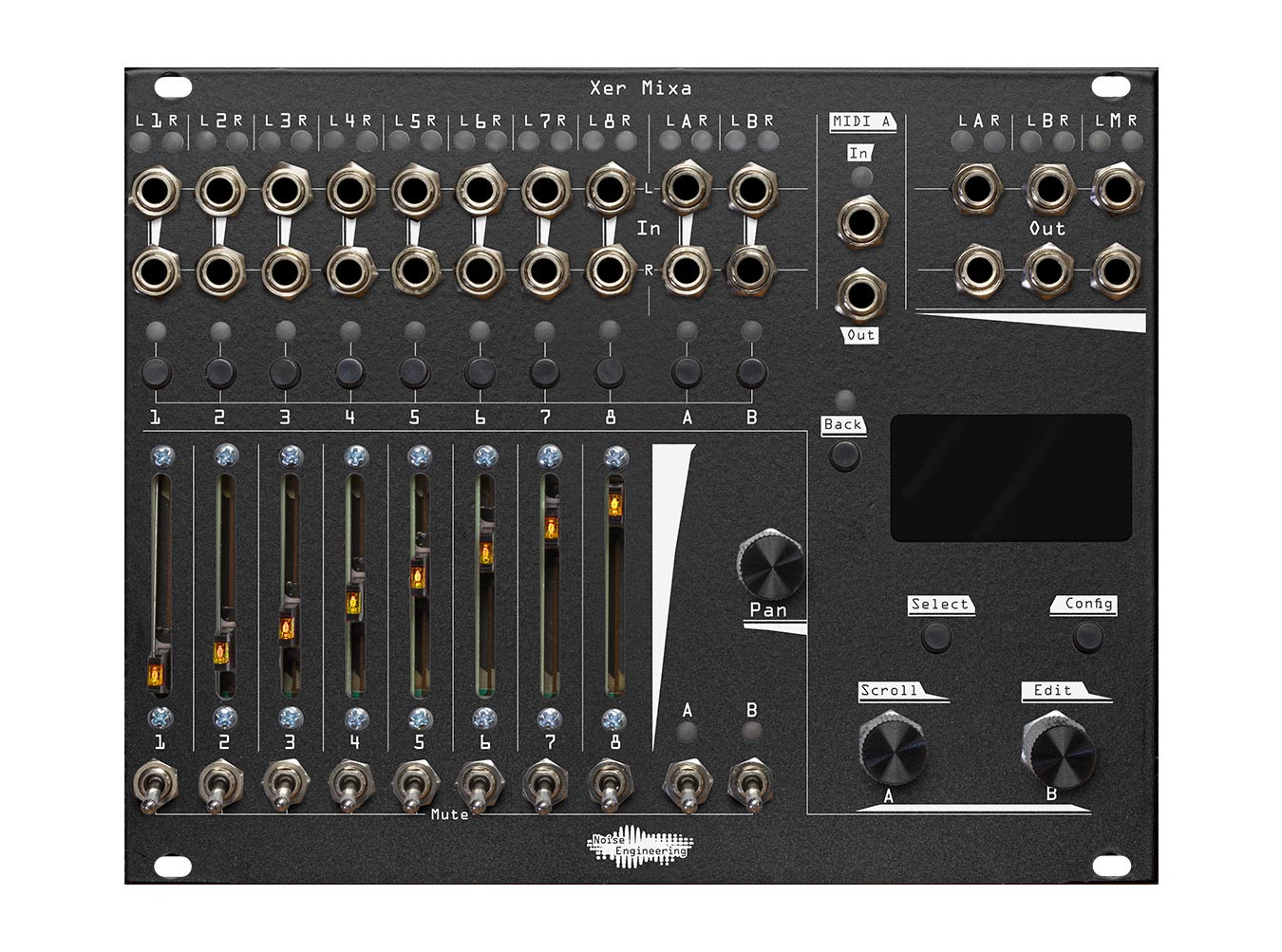
Xer mixa: 10 channels w/2 stereo outs and 32 cv modulation slots, BUT expensive +32hp

Nano Modules performance mixer: 4 channels w/ 2 aux sends and knob recording
-
- KVRAF
- 2263 posts since 6 Aug, 2007
I have been mixer shopping lately as well, so I'm fairly fresh on this. Those Presonus mixers have pretty mixed reviews—personally, I would stay away. The big question is, do you need multi-track recording in the interface, or just 2-track? Unfortunately, most of the mixer/interfaces only have 2 (or 4) track recording.
Ones that I know have multi-tracking:
- The Tascam Model 12/16/24 line is really solid, albeit slightly pricier—bonus, they also include multi-track recording straight to an SD card. I have the 16, and I love it, but I'm upgrading currently—notes on that below.
- The Mackie Onyx ones have multi-tracking and pretty decent reviews, although I have no experience myself. (To be honest, they're so ugly, I wouldn't want to look at it everyday in my studio.)
I would also recommend staying from the Behringer Xenyx mixers, if that had crossed your mind—they are feature-packed, but kind of junky in both build quality and sound. I bought one, and I'm in the process of returning it—my Sweetwater dude even told me they get a lot of returns/disappointment on them.
After obsessing over this for a while, the conclusion I came to was that I was better off with a good analog mixer with direct outs, and then just get a dedicated interface to record them. Too many compromises with the interface/mixer combos. (e.g. I wanted stereo returns for the aux busses, and that is really hard to find in a mixer/interface.) So I am picking up a Soundcraft FX16ii, and I will just run direct outs for whatever I need to record (I usually only record the main mix anyway).
Ones that I know have multi-tracking:
- The Tascam Model 12/16/24 line is really solid, albeit slightly pricier—bonus, they also include multi-track recording straight to an SD card. I have the 16, and I love it, but I'm upgrading currently—notes on that below.
- The Mackie Onyx ones have multi-tracking and pretty decent reviews, although I have no experience myself. (To be honest, they're so ugly, I wouldn't want to look at it everyday in my studio.)
I would also recommend staying from the Behringer Xenyx mixers, if that had crossed your mind—they are feature-packed, but kind of junky in both build quality and sound. I bought one, and I'm in the process of returning it—my Sweetwater dude even told me they get a lot of returns/disappointment on them.
After obsessing over this for a while, the conclusion I came to was that I was better off with a good analog mixer with direct outs, and then just get a dedicated interface to record them. Too many compromises with the interface/mixer combos. (e.g. I wanted stereo returns for the aux busses, and that is really hard to find in a mixer/interface.) So I am picking up a Soundcraft FX16ii, and I will just run direct outs for whatever I need to record (I usually only record the main mix anyway).
-

- KVRAF
- 13140 posts since 7 May, 2006 from Southern California
I tend to agree with sockofgold.
I've done a lot of consultation work for folks who are getting into hybrid setups (software and hardware) and many start with the idea that they need a mixer which can also be an audio interface but then run into limitations which lead them to get a separate interface anyway.
I'd add that it helps to think about what you are trying to do, so you can visualize the signal flow. Think about how you are going to monitor your outboard instruments and your DAW and whether you will need to do both at the same time. Will latency be any issue?
My preference is to have a mixer and a separate audio interface, along with a patch bay or two. This approach gives me a lot of flexibility, as I can patch instruments through the mixer and on to my monitors when I don't need to have my computer involved but I can patch right into the interface, when I want to record.
I've done a lot of consultation work for folks who are getting into hybrid setups (software and hardware) and many start with the idea that they need a mixer which can also be an audio interface but then run into limitations which lead them to get a separate interface anyway.
I'd add that it helps to think about what you are trying to do, so you can visualize the signal flow. Think about how you are going to monitor your outboard instruments and your DAW and whether you will need to do both at the same time. Will latency be any issue?
My preference is to have a mixer and a separate audio interface, along with a patch bay or two. This approach gives me a lot of flexibility, as I can patch instruments through the mixer and on to my monitors when I don't need to have my computer involved but I can patch right into the interface, when I want to record.
-

- KVRAF
- 16867 posts since 8 Mar, 2005 from Utrecht, Holland
I use (a pair of) regular inputs for aux returns.sockofgold wrote: Thu Jun 06, 2024 4:40 pm I wanted stereo returns for the aux busses, and that is really hard to find in a mixer/interface.
Benefits: you get panning, regular eq, inserts, and option to send the return to another aux send.
We are the KVR collective. Resistance is futile. You will be assimilated. 
My MusicCalc is served over https!!
My MusicCalc is served over https!!
-
- KVRAF
- 2263 posts since 6 Aug, 2007
Very good points, and I definitely considered that. The only real downside for me there is that it would require me to bump from 16 to 24 channels, and the size kind of starts to become an issue. (But since the Soundcraft mixer I wanted is on backorder, I am still sort of considering it.)BertKoor wrote: Fri Jun 07, 2024 7:34 am I use (a pair of) regular inputs for aux returns.
Benefits: you get panning, regular eq, inserts, and option to send the return to another aux send.
-
- KVRAF
- 8734 posts since 24 May, 2002 from Tutukaka, New Zealand
Pretty much what sockofgold and justin said. I dithered about last year and finally got a one of the bigger sized Behringer Xenyx. They are packed with way more features than any competition for sure, but quality is a bit ho-hum. Build quality is fine for me, but they're still too noisy imo. I thought they'd improved that, but no. But great KlarkTeknik fx, direct outs, more inserts and aux than all equivalent competition, even have 1-knob comps on most channels that are surprisingly good. The multitrack USB desks look like Tascam is the best option I could see for the price. I don't think I could work with less than the 16channel, though even those were a bit short on features IMO. Poor on the auxes and can't remember of it was direct outs or inserts that they seemed lacking etc - there seems to be levels of compromise that you have to live with for any of those type mixers.
Behringer still worth considering imo as they are superb value. You get way more but questionable quality. My caveat is - great for general duties, sketchpadding ideas and I don't regret buying it for exactly that, but I wouldn't record through it...too noisy. I considered mixer/interfaces but you have to really do your homework. As sockofgold mentioned, most are only 2buss, not multitrack. Many are severely limited to 44.1khz and even 16bit. Nowhere near as good quality as a dedicated interface. Bert mentioned interface with multi in/out - I still do that but it doesn't give you the flexibility and function of a mixer.
Ultimately I still do what Justin says. Patchbays/interface/mixer. Patchbays are for all the connectivity and for recording into the interface direct (and/or through outboard processing). Mixer is for playing, scratch mixing, dicking around with ability for multiple instruments before you finalize and record. Interface because it's better quality than any mixer I could afford at the time. Imo you can go the integrated mixer/interface route or the digital mixer but you need to double the budget from any budget mixer. In my language that would have been NZ$3 k bare minimum. Probably nearer to $5k to get the quality I'd be happy with. Whereas a decent interface can be had for 300-400 easy. A budget mixer was $800 (Behringer 22 channel) and Behringer patchbays were sub $100.
Patchbays. You would not regret buying. They are INVALUABLE studio gems, often ignored, neglected. Please consider it. I lived for years with patchbays/dedicated interface after going from big studio with 24channel in-line mixer (I had patchbays even then). And it didn't feel too constraining. Yes I did miss the mixer, and I'm relieved to get a mixer back finally but patchbays + multi in/out interface is easily and happily doable. Now I've got a mixer I only need a simple 2 in interface so that keeps the expense way down.
Behringer Ultrapatch - cheap as chips, build quality is no less than far more expensive pro studio ones I have had that failed, will even do balanced and the standard 3 routing options that are actually easier than many. I had patchbays that needed physically taking out and turning to route, whereas Behringers have a simple switch on every channel. You will not get balanced option patchbays for 3x the price. I wish I'd found Behringer patchbays yrs ago.
My opinion is:
1. Multirecord mixer is nice to have but too constraining. A decent one puts the price up to other better options.
2. Big quality mixer with simple interface. Good but price of mixer bumps it up. Should use patchbays with this setup.
3. Small but quality mixer with multi interface. Better option but interface bumps up price and patchbay still required.
4. Cheap mixer with multi interface. Better option, cheaper, still need patchbay
5. Cheap mixer simple interface. Good option, cheapest, absolutely need patchbay
6. Big digital mixer. Very good option but expensive. Could omit patchbay if mixer big enough, don't even need interface.
I chose big cheap mixer + simple interface + patchbays. You don’t yet know it but you need a patchhbay or 2. The more gear you have the nore essential it becomes. You can use the mixer for everything but recording, then you use the patchbay to get noiseless quality direct recording into your interface.
Having said that, if I had the budget and more importantly, the space then I'd go back to a big f**k off quality mixer at the centre of studio. Possibly even a big f**k off digital one. But that's piein the sky, if only for space...I can afford the studio but not the bigger house that I'd need to put it in.
Sorry for the essay...
Behringer still worth considering imo as they are superb value. You get way more but questionable quality. My caveat is - great for general duties, sketchpadding ideas and I don't regret buying it for exactly that, but I wouldn't record through it...too noisy. I considered mixer/interfaces but you have to really do your homework. As sockofgold mentioned, most are only 2buss, not multitrack. Many are severely limited to 44.1khz and even 16bit. Nowhere near as good quality as a dedicated interface. Bert mentioned interface with multi in/out - I still do that but it doesn't give you the flexibility and function of a mixer.
Ultimately I still do what Justin says. Patchbays/interface/mixer. Patchbays are for all the connectivity and for recording into the interface direct (and/or through outboard processing). Mixer is for playing, scratch mixing, dicking around with ability for multiple instruments before you finalize and record. Interface because it's better quality than any mixer I could afford at the time. Imo you can go the integrated mixer/interface route or the digital mixer but you need to double the budget from any budget mixer. In my language that would have been NZ$3 k bare minimum. Probably nearer to $5k to get the quality I'd be happy with. Whereas a decent interface can be had for 300-400 easy. A budget mixer was $800 (Behringer 22 channel) and Behringer patchbays were sub $100.
Patchbays. You would not regret buying. They are INVALUABLE studio gems, often ignored, neglected. Please consider it. I lived for years with patchbays/dedicated interface after going from big studio with 24channel in-line mixer (I had patchbays even then). And it didn't feel too constraining. Yes I did miss the mixer, and I'm relieved to get a mixer back finally but patchbays + multi in/out interface is easily and happily doable. Now I've got a mixer I only need a simple 2 in interface so that keeps the expense way down.
Behringer Ultrapatch - cheap as chips, build quality is no less than far more expensive pro studio ones I have had that failed, will even do balanced and the standard 3 routing options that are actually easier than many. I had patchbays that needed physically taking out and turning to route, whereas Behringers have a simple switch on every channel. You will not get balanced option patchbays for 3x the price. I wish I'd found Behringer patchbays yrs ago.
My opinion is:
1. Multirecord mixer is nice to have but too constraining. A decent one puts the price up to other better options.
2. Big quality mixer with simple interface. Good but price of mixer bumps it up. Should use patchbays with this setup.
3. Small but quality mixer with multi interface. Better option but interface bumps up price and patchbay still required.
4. Cheap mixer with multi interface. Better option, cheaper, still need patchbay
5. Cheap mixer simple interface. Good option, cheapest, absolutely need patchbay
6. Big digital mixer. Very good option but expensive. Could omit patchbay if mixer big enough, don't even need interface.
I chose big cheap mixer + simple interface + patchbays. You don’t yet know it but you need a patchhbay or 2. The more gear you have the nore essential it becomes. You can use the mixer for everything but recording, then you use the patchbay to get noiseless quality direct recording into your interface.
Having said that, if I had the budget and more importantly, the space then I'd go back to a big f**k off quality mixer at the centre of studio. Possibly even a big f**k off digital one. But that's piein the sky, if only for space...I can afford the studio but not the bigger house that I'd need to put it in.
Sorry for the essay...