

I love dub but i find it quite hard to find. I don't have many examples of the types of dub i'd like to make.
First of all, what sort of BPM is normal for dub?
What sort of key/scale?
Here is one i've made
https://soundcloud.com/springgoose/dub- ... zy2vZzG7i3
The rhythm is ok, but the notes and maybe the tempo/BPM are not ok.
Here is another
https://soundcloud.com/springgoose/idub ... VAMJQPsBrL
The rhythm is ok, but maybe the notes are not ok.
Any sort of tips are welcome!

making dub basslines
-

- KVRAF
- 2990 posts since 31 Jan, 2020
-
- KVRAF
- Topic Starter
- 2990 posts since 31 Jan, 2020
I was listening to a dub/reggae cover version yesterday of Bee Gees - To Love Somebody, and man did it have the phattest dancehall dub bassline! Unfortunately i can't find it online to share with you. Any information on who performed/recorded/and or produced that song would be gratefully recieved cos my cd doesn't have any information with it and i can't find anything online about it. I think dancehall dub is the type i like.
I have this playlist of how far i've got (unfinished) with making dub so far. I'm not necessarily looking to make any generic dub. I've got vague ideas of what i'd like to make.
https://soundcloud.com/springgoose/sets ... LOOYo4v8By
I have this playlist of how far i've got (unfinished) with making dub so far. I'm not necessarily looking to make any generic dub. I've got vague ideas of what i'd like to make.
https://soundcloud.com/springgoose/sets ... LOOYo4v8By
-

- KVRian
- 873 posts since 9 Jun, 2020
Sort of depends what you mean by dub. I'd say Prince Far I, King Tubby and the Mad Professor are the main dub reggae artists of the 70s and onwards to look for. But there's more recent stuff and Andy Weatherall injected a large amount of dub into Screamadelica, and obviously a lot of house has lots of dub elements. We're probably talking a range of about 70bpm to 100bpm for dub reggae.
To me, the second bassline you've made (edit - in the first post) sounds better than the first, which has too sharp an attack - bass players would typically use their fingers for a dub bass line rather than a pick and turn down the tone so it's almost entirely bass. This is a pretty good example of a modern take:
My personal taste is that the notes should blend into each other, not quite legato necessarily but close to that.
To me, the second bassline you've made (edit - in the first post) sounds better than the first, which has too sharp an attack - bass players would typically use their fingers for a dub bass line rather than a pick and turn down the tone so it's almost entirely bass. This is a pretty good example of a modern take:
My personal taste is that the notes should blend into each other, not quite legato necessarily but close to that.
-
- KVRian
- 873 posts since 9 Jun, 2020
There's some good stuff in there I thinkSpring Goose wrote: Sun Jun 27, 2021 2:15 pm I was listening to a dub/reggae cover version yesterday of Bee Gees - To Love Somebody, and man did it have the phattest dancehall dub bassline! Unfortunately i can't find it online to share with you. Any information on who performed/recorded/and or produced that song would be gratefully recieved cos my cd doesn't have any information with it and i can't find anything online about it. I think dancehall dub is the type i like.
I have this playlist of how far i've got (unfinished) with making dub so far. I'm not necessarily looking to make any generic dub. I've got vague ideas of what i'd like to make.
https://soundcloud.com/springgoose/sets ... LOOYo4v8By

-
- KVRAF
- Topic Starter
- 2990 posts since 31 Jan, 2020
Hiya, thanks for the reply DoubleTap. Yeah i've had Screamadelica since the 1990s. Yeah i know Prince Far I, King Tubby, and Mad Professor, but i can't find examples of what i'd like to be making. I used to have a brilliant dancehall Adrian Sherwood mix, but then somebody nicked it, and i can't find it on discogs. I think the songs i liked on that mix were King Tubby dancehall dub remix/version of a reggae song but obviously King Tubby made a lot of remix/version and not all are documented or findable.Double Tap wrote: Sun Jun 27, 2021 2:24 pm Sort of depends what you mean by dub. I'd say Prince Far I, King Tubby and the Mad Professor are the main dub reggae artists of the 70s and onwards to look for. But there's more recent stuff and Andy Weatherall injected a large amount of dub into Screamadelica, and obviously a lot of house has lots of dub elements. We're probably talking a range of about 70bpm to 100bpm for dub reggae.
To me, the second bassline you've made (edit - in the first post) sounds better than the first, which has too sharp an attack - bass players would typically use their fingers for a dub bass line rather than a pick and turn down the tone so it's almost entirely bass. This is a pretty good example of a modern take:
My personal taste is that the notes should blend into each other, not quite legato necessarily but close to that.
Last edited by Spring Goose on Sun Jun 27, 2021 2:32 pm, edited 1 time in total.
-
- KVRAF
- Topic Starter
- 2990 posts since 31 Jan, 2020
ThanksDouble Tap wrote: Sun Jun 27, 2021 2:27 pmThere's some good stuff in there I thinkSpring Goose wrote: Sun Jun 27, 2021 2:15 pm I was listening to a dub/reggae cover version yesterday of Bee Gees - To Love Somebody, and man did it have the phattest dancehall dub bassline! Unfortunately i can't find it online to share with you. Any information on who performed/recorded/and or produced that song would be gratefully recieved cos my cd doesn't have any information with it and i can't find anything online about it. I think dancehall dub is the type i like.
I have this playlist of how far i've got (unfinished) with making dub so far. I'm not necessarily looking to make any generic dub. I've got vague ideas of what i'd like to make.
https://soundcloud.com/springgoose/sets ... LOOYo4v8By
It isn't as funky as what i've heard tho'-
- KVRAF
- Topic Starter
- 2990 posts since 31 Jan, 2020
I've found the song i was listening to yesterday:
-
- KVRAF
- Topic Starter
- 2990 posts since 31 Jan, 2020
It's Jimmy Somerville, apparently.
-
 thecontrolcentre thecontrolcentre https://www.kvraudio.com/forum/memberlist.php?mode=viewprofile&u=76240
 - KVRAF
- 37262 posts since 27 Jul, 2005 from Scottish Borders
You might like some Trojan Records stuff. There are tons of compilation albums out there. Check out early Scientist too. Maybe UB40's first couple of albums. So far as BPM for dub it tends to be around 80bpm, with the bass really pushing it along (playing double time pretty much). Some more "modern" dub that I love is by Rhythm & Sound.
Last edited by thecontrolcentre on Sun Jun 27, 2021 4:16 pm, edited 1 time in total.
-
- KVRAF
- Topic Starter
- 2990 posts since 31 Jan, 2020
Thanks thecontrolcentrethecontrolcentre wrote: Sun Jun 27, 2021 4:11 pm You might like some Trojan Records stuff. There are tons of compilation albums out there. Check out early Scientist too. Maybe UB40's first album. So far as BPM for dub it tends to be around 80bpm, with the bass really pushing it along (playing double time pretty much). Some "modern" dub that I love is by Rhythm & Sound.
i'll check these out-
- KVRAF
- 4584 posts since 21 Sep, 2005
-
- KVRAF
- 4584 posts since 21 Sep, 2005
-
- KVRAF
- Topic Starter
- 2990 posts since 31 Jan, 2020
Thanks man! Thank you very much for taking the time to listen and reply. I wasn't planning on playing the bass but maybe i'll have to reconsider! Now dub isn't the only music i make, or even the first choice of music i make, but much of the music i make is influenced by dub. I don't know whether i have enough drive to succeed but at the least i've got something to do with my time.codec_spurt wrote: Sun Jun 27, 2021 7:57 pm In dub music, the bass guitar is really the lead guitar, and the six strings are usually on rhythm duties, and when they do get a bit more adventurous they will often mimic and follow what the bass is doing.
I think it was Sergio Leone who said of Clint Eastwood's cigar: It's playing the lead! The bass player is the lead guitarist in any dub outfit (the roles are reversed).
Typical tempos for dub are around 85bpm, and it's no coincidence that typical tempos for drum and bass are exactly twice that at 170bpm. When people first got their hands on samplers they would sample old dub records and play them back double tempo, and genres like jungle were born, often incorporating snippets of the vocal toasting on top. But you can go a lot slower than that and a lot faster, no rules really as long as it sounds good.
For a good dub bass sound you can't beat the typical rounded P-Bass (Fender Precision), but as others have mentioned you would roll off most of that high end with the tone control. Again no rules. I bought my girlfriend a very nice headless Hohner bass that was active when I taught her how to play dub bass. It was perfect for dub and really punched but of course most of the high end was rolled off.
I taught her the minor pentatonic (yeah the same scale that Angus Young from AC/DC nearly always uses) and gave here a couple of Black Uhuru records to jam with. You can't beat Sly and Robbie when it comes to learning dub bass. All the same rules apply.
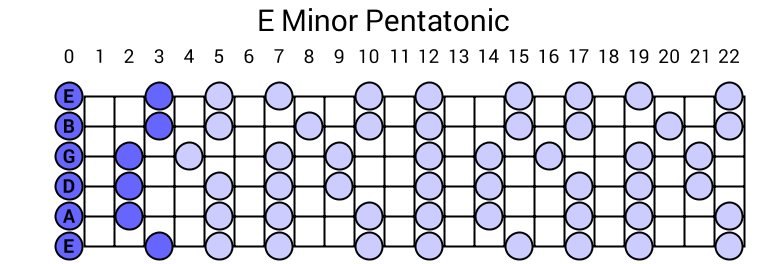
Most dub is based around minor pentatonic. Here is the minor pentatonic in E:
https://jguitar.com/scale/E/Minor%20Pentatonic
E is a good place to start with learning scales if you want to play dub because so much use is made of the open strings. It's easier as well because all open strings are in the E minor pentatonic key. Obviously forget about the two extra strings, as it's just EADG that you will be using unless you play a 6 string bass, and even then you might tune it differently. You get the picture though.
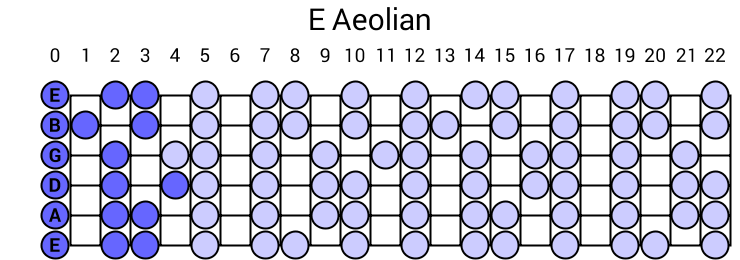
As with rock guitar, the minor pentatonic is the cornerstone foundation of pretty much everything you will learn with regard to harmonic theory. It sounds fancy but is actually very simple. Next up you will want to learn about certain modes, and I would say the most commonly used mode of all would be the Aeolian.
The Aeolian scale is also known by the following names: Minor, Natural Minor, Pure Minor.
https://jguitar.com/scale?root=E&scale= ... tes=sharps
Notice how they overlap. In fact they are the exact same scales with just an added note or two!
I would say that those two scales would cover you for just about 90 percent of most dub bass lines you could ever wish to play. But no harm in branching out and learning certain of the other 'minor' modes, for example, Dorian. Dorian is pretty much the same as the E Aeolian except it has a major sixth employed. Don't worry about these things for now if you are new to this. All it means is it's the same scale but one of the notes is played a fret higher/lower.
If you play along and jam to your Black Uhuru records, you will find that every now and then even though all the notes in the scale are correct there is one that is a bit off - this is when a mode has been employed. Don't worry about it. Your ear will pick it up.
Two records by Black Uhuru I would Recommend are 'Red' and 'Chill Out' - considered to be two of their masterpieces, and they are. Also their work with Grace Jones is a good, easy practice point to learn from. They don't credit them as Robbie Basspeare and Sly Drumbar for nothing!
https://www.factmag.com/2016/06/01/sly- ... est-songs/
These two fellas have an almost, no, an actual telepathic connection to each other's playing, locking in and out and around the groove. Dub is all about the groove. It's very close to Funk as a genre. And I forget what famous musician said it now, but to paraphrase, when commenting on Kraftwerk he said: It's so damn straight and on the beat it's just funky!
And that's right, don't be afraid to play very on the beat. It's the little syncopations and flourishes outside that solid foundation that give it the funk or the feel and groove you are going for.
In rock music, and most other forms of contemporary music such as pop, the snare falls on the 5th and 13th of every bar, so it occurs twice in a 16 beat bar. In dub, the snare falls on the 9th beat and occurs only once in a 16 beat bar. That leaves a lot of space. It's the bass guitar that fills that space. And you really want to be tight about hitting the first beat of the bar to assert musical dominance for everything that comes after.
The chanka chanka guitars play and fill the spaces where the snare drum would be in a rock song: on the 5th and 13th position of a 16 beat bar. A good dub bass player knows when to play on the beat, exactly and when to play off it and fill in the space that the drums and the rhythm guitar leave for you.
Don't be afraid to add little chromatic flourishes or cadences when seguing between different sections. That is only to be expected. But probably best to not over do it. Again, you will know what sounds good and make up your own style. The minor pentatonic leaves this space for you and it's more easily employed here say, than in a specific mode as we talked about earlier. Still, if it sounds right it is right!
Rhythm and timing is very important with dub bass playing but melody is just as important. It is no coincidence that they often employ minor scales which give a sense of foreboding, of mystery, of suffering, of deep religious meaning for some.
Start with the E minor pentatonic and learn how to transpose the root note to whatever key the song is in. IIRC Sly and Robbie (and others) often root the song in keys like A and G and B or whatever. Apart from the ubiquitous E. You will want to become proficient enough to do this without thinking. Different singers employ different keys to fit their vocal range. So you will always encounter different keys when jamming with other people's records.
But if it's pure dub you are after and with no major vocals, E will probably be the key you play in most the time. It's got the lowest note that is possible to play on a bass guitar (E) and sometimes like in drum and bass you just want that drop or boom that lingers like an 808 kick detuned right down. Sub bass almost when it's shifting out of 18" Sub-Woofers. I was the guy standing in front of them with his flares flapping and his dreads blowing in the wind.
I had a couple of very talented students that went on to play in kind of famous bands. They all had one thing in common: absolute passion for the instrument. Oh and one other thing as well: natural rhythm and swing and funk. I never had that. You can't make it up - you either have it or you don't. It didn't stop me from becoming a fairly accomplished dub producer though, but you would never find me playing bass for a serious band. Learn your limitations. Always. From there you can grow and become good. I did, even without a natural sense of rhythm. People used to make fun of me and laugh at me in the studio, and this drove me on to become better and better. No excuses. You can do it if you really want it and are hungry enough. My students had that natural talent I never had, but we did share one thing in common: absolute dedication to learning an instrument to a more than adequate level.
I listened to your stuff and it's not bad. I think you could make a go of it if you really want to dedicate yourself to the craft. A lot of this advice I give as well is for others listening in and not directly pointed at you as you seem to have got a decent grasp of things to start with.
One final thing I would suggest is to make up your own rhythm tracks. Don't have to be complicated, but something with that dub 'space' that you can lock in to and play around. I'm the world's worst drummer when it comes to playing a kit, but I can program like a demon and hold my own with the best of them when it comes to laying down a dub rhythm track.
I strongly advise you to do this. Just 3 or 4 tracks. 64 bars or whatever. Not too little and not too much. It's not a track you are building it's a backing track. Create different spaces with those tracks, slightly different tempos from what feels just slightly uncomfortable because it is a bit too slow, to what feels slightly uncomfortable because it is a little too fast. The happy medium will be in the middle. But pushing yourself outside the boundaries will only better your playing. You will find that it's harder to play slow than it is to play fast. Whilst maintaining groove and rhythm, that is. YMMV.
And one final thing: Practice, practice, practice.
 Also i'm already 41
-

- KVRAF
- 2384 posts since 23 Sep, 2004 from Kocmoc
THE SCIENTIST *AHHAHHAHAHAHAH*
Soft Knees - Live 12, Diva, Omnisphere, Slate Digital VSX, TDR, Kush Audio, U-He, PA, Valhalla, Fuse, Pulsar AUDIO, NI, OekSound etc. on Win11Pro R7950X & RME AiO Pro
https://www.youtube.com/@softknees/videos Music & Demoscene
https://www.youtube.com/@softknees/videos Music & Demoscene
-
- KVRAF
- Topic Starter
- 2990 posts since 31 Jan, 2020