


Best channel strip plugin that's NOT emulation of SSL, Neve, API, Amek, etc.
-

- KVRist
- 80 posts since 17 Apr, 2019
new analog obsession CHANNEV is heavy (oops neve)

-

- GRRRRRRR!
- 17849 posts since 14 Jun, 2001 from Somewhere you're not!
I just realised I have something concrete to contribute here - Focus One. It's amazing! Just a few simple controls that make anything sound better.

https://focusone-plugin.com/
https://focusone-plugin.com/
NOVAkILL : Legion GO, AMD Z1x, 16GB RAM, Win11 | Audient EVO 8 | Lumi Keys | Studio Pro 8
Korg Odyssey, bx-oberhausen, Proxima, PolyMax, GR8, JP6K, Union, Atomika,
Invader 2, Flow Motion, Olga, TRK 01, Thorn, Spire, VG Iron
Korg Odyssey, bx-oberhausen, Proxima, PolyMax, GR8, JP6K, Union, Atomika,
Invader 2, Flow Motion, Olga, TRK 01, Thorn, Spire, VG Iron
-

- KVRAF
- 6282 posts since 8 Jul, 2009
This is not a channel strip.BONES wrote: Sat Jul 10, 2021 11:33 am I just realised I have something concrete to contribute here - Focus One. It's amazing! Just a few simple controls that make anything sound better.
#NONFR Check out my music at Bandcamp  Free Streaming!
Free music with your support on Patreon | Youtube: Music of Plexus Videos (music videos) | Youtube: Plexus Productions (audio related) Stop whining. Make music.
Free Streaming! Free music with your support on Patreon | Youtube: Music of Plexus Videos (music videos) | Youtube: Plexus Productions (audio related) Stop whining. Make music.
-
- KVRAF
- 16794 posts since 13 Oct, 2009
I'm not really a fan of this, I don't care for the U/I and I'd just as soon use a chainer with the plugins that I already have. However, I'm curious if people think that in the quest for the best channel strip that some kind of modular approach is useful?
https://lvcaudio.com/plugins/t-chain/
This plugin allows you to arrange the modules in any order, but as I say, it's really just a chainer with proprietary plugins. I also like having all of the modules on the same screen/page, but, I find that modularity requires that the U/I also has to rearrange to not break intuition when you're working on your sounds. IOW, if the EQ is before the compressor then the EQ needs to be above or to the left of the compressor.
The problem with that kind of modularity is that it induces a certain uniformity in the U/I. You can get around this somewhat if the total modules are fixed, but simply rearranged, e.g., Ultrachannel.
https://lvcaudio.com/plugins/t-chain/
This plugin allows you to arrange the modules in any order, but as I say, it's really just a chainer with proprietary plugins. I also like having all of the modules on the same screen/page, but, I find that modularity requires that the U/I also has to rearrange to not break intuition when you're working on your sounds. IOW, if the EQ is before the compressor then the EQ needs to be above or to the left of the compressor.
The problem with that kind of modularity is that it induces a certain uniformity in the U/I. You can get around this somewhat if the total modules are fixed, but simply rearranged, e.g., Ultrachannel.
-
- KVRAF
- 6282 posts since 8 Jul, 2009
I forgot about T-Chain! yes the UX/UI is not that great but it sounds pretty good. I do like the sound of LVC preamp distortion and T-Chain allows for a lot of combinations of colouration. It's worth looking at if you aren't bothered by the UX/UI (as are LVC's other products)ghettosynth wrote: Sat Jul 10, 2021 7:07 pm I'm not really a fan of this, I don't care for the U/I ...
https://lvcaudio.com/plugins/t-chain/
#NONFR Check out my music at Bandcamp Free Streaming!
Free music with your support on Patreon | Youtube: Music of Plexus Videos (music videos) | Youtube: Plexus Productions (audio related) Stop whining. Make music.
Free Streaming! Free music with your support on Patreon | Youtube: Music of Plexus Videos (music videos) | Youtube: Plexus Productions (audio related) Stop whining. Make music.
-

- Banned
- Topic Starter
- 11467 posts since 4 Jan, 2017 from Warsaw, Poland
BONES wrote: Sat Jul 10, 2021 11:33 amI just realised I have something concrete to contribute here - Focus One...

-
- KVRAF
- 4584 posts since 21 Sep, 2005
-

- KVRAF
- 3821 posts since 20 Apr, 2005
For a strip type tool I think it's all about usability, with a consistent interface. I'm not trying to imply a non emulated is strip is bad, just that they kind have to be judged against emus.ghettosynth wrote: Thu Jul 08, 2021 10:15 pm There is a valid point to be made about the tradeoff between complexity and usability, so I'm not arguing that you should have everything and the kitchen sink. However, in terms of pure usability, I'm not convinced that emulations take the prize. Some aspects of their design related to belief that those were the right choices, but others were limitations of technology, cost, or simply opinion.
Which is why I asked the question that I did. If you're dismissing emulation as a driving concern, what features and level of complexity should make the cut. Do you need more than two mid bands with hi and lo shelf? Should you be able to select between different sets of EQ curves, compressor technologies? Should you have hipass/lopass? Should those have a limited range to make them useable in a more surgical context, or, should they be wide range to allow for creative use as well? Since the latter effects the control of the filters, should the range be switchable?
I think the Waves Scheps Omni Channel has super functionality - it's an excellent tool. Pretty much everything you need in a channel strip. I'm sure in the future even emulation strips will start to adopt similar things, otherwise emulated strips literally have no way to incrementally improve.
-Saturation
-HPF/LPF with three slopes - super useful
-a kind of bass boost option
-4 band EQ, with a few different curve options for different bands
-de esser - with two bands
-compressor - with several compression options
-limiter
-mono option
-input/output volumes
-
- KVRAF
- 3821 posts since 20 Apr, 2005
Well... this of course depends on the part. A main, lead or prominent part will likely get more TLC, tweaking or selecting sounds to just sound as good as possible. Less prominent parts still also are made to sound as good as possible, but sure this may also lean to making things sit right - clearly you know the intended role of most parts when adding them.BONES wrote: Fri Jul 09, 2021 1:15 amHow does that even work? You can't "make it as good as you can" until you put it in the mix because how it sounds on its own is irrelevant to the process. The instant I select a patch I start tweaking it to fit into the mix, not to sound as good as it can. And as I add more parts to the arrangement, I revisit it to ensure it continues to work in the mix. By the time I have my arrangement in shape, my mix is normally 80%-90% of the way there._leras wrote: Thu Jul 08, 2021 7:59 pm1. Sound design, get the sound and any fx that are part of the sound that you want and make it as good as you can
This is more like a process of tonal improvement. Character effects, nicerizers, parallel tracks to blend etc. Just making sounds a bit better than I could get them at source. Sometimes this can make a big difference, sometimes more subtle - but it all adds up.I'd be doing the opposite at this point - removing things that might have helped early in the process but are no longer necessary. The longer I work on a mix, the simpler it gets, not the other way around.2. Premix, use tools like saturation, compression, EQ, maybe fx here too also, to further enhance individual elements
Some can be to an extent right, in the sound design phase. But for me this is like the actual mixing phase, where as up to here was more 'mix prep'. So this phase is more about how things sit together, levels, automating parts that weren't done when writing, or tweaking automation. This phase ideall has to be done pretty much all in one go.Surely that's better done as you add things?3. Mix, more like channel strip stuff, lpf/hpf to make more space, EQ to stop clashing sounds, compression to help the groove/swing
Lol. Not sure I'd phrase it quite like that. For me it's just: tweak sources, polish sounds then mix.All seem like admissions of failure to me - "I can't get this sound right so I'll pile on the effects so no-one notices". Much tidier to fix it at source, as far as possible.Of course arrangement is number one choice for making space for sounds, but after that EQ, panning, compression and saturation can all help. For this, channels strips are great for working with sounds that you are already happy with to help them sit better together.
These channel strips type tools: saturation, eq, panning are just the essentials for mixing. By this point I'll have already piled all the effects on.

And also, it's never fully fixed. I might come to mix something and go back to source. And I haven't included buses really, but I'd say this is more just part of the polishing sound parts trying to make small improvements wherever possible.
Over time I've been able to get a bunch of tools that sound great and I am familiar with, so I use these. Somethings just make things sound better.I no longer need to put anywhere near the effort into my drums at the mixer because my drum VSTi's have a shitload of DSP built-in that takes care of most of it. Same with my softsynths - why add a compressor or EQ when most synths have full control over their dynamics and frequencies via their envelopes and filter(s), respectively? Surely it is much cleaner and simpler to make your changes at source than to add extra layers of obfuscation to what is a delicate process? To me that feels like simple common sense K-I-S-S!
Built in effects are not mutually exclusive to better quality effects, both can have a purpose.
The actual music is the most important thing anyway - but I do try and present those ideas as best possible.
-
- KVRAF
- 5272 posts since 2 Jul, 2005
I have always just saved a standard chain and variations on it for clients that I mix for often. It includes RChannel which gives nice flexibility to the whole chain. I never just use a single channel strip though. Usually I only use that chain for vocals.
I personally like waves for channel strips in general due to their super low cpu consumption.
I personally like waves for channel strips in general due to their super low cpu consumption.
Don't F**K with Mr. Zero.
-
- GRRRRRRR!
- 17849 posts since 14 Jun, 2001 from Somewhere you're not!
Says you, pal. It seems to do all the requisite shit to me. If you look, for example, at the image of Hornet Channel Strip Mk III that someone has posted, Focus One does all of those things and probably more.
... within the context of the mix. That's what mixing is._leras wrote: Sat Jul 10, 2021 11:53 pmA main, lead or prominent part will likely get more TLC, tweaking or selecting sounds to just sound as good as possible...
This is a good example of what I mean - I don't parallel/layers sounds, I find one sound that does the job. If it needs any nicerizing then, again, it's probably not the right sound and I'll find something better for the job.This is more like a process of tonal improvement. Character effects, nicerizers, parallel tracks to blend etc.
It's not a phase!!! It's a continuum. You don't stop your sound design to start mixing, you do both from one end of the process to the other. I don't even think of mastering as a separate process any more because if you render out a mix to master, it restricts what you can do far too much. e.g. If something you do while mastering to lift your mix makes the hi-hats too prominent, for example, you'll tend not to do it so I prefer to do most of my mastering while I am still mixing. For me, from the time I first put an idea down into my host, I am mixing and that doesn't stop until the song is finished and ready for release.Some can be to an extent right, in the sound design phase.
That process takes me six months, minimum, it is absolutely not something I could even contemplate doing "in one go". And during that time I am likely to replace several parts, change patches in other parts and keep adding and removing things as necessary. There is never a point in the process when I think "I am done with that, I will now start doing this". Seriously, why would you even add a part and not immediately try to sit it into the mix? Surely it is the very first thing you do after you add it? From there, you refine it as you add more parts and change others. It starts at the start and it does end until the song is finished, surely?But for me this is like the actual mixing phase, where as up to here was more 'mix prep'. So this phase is more about how things sit together, levels, automating parts that weren't done when writing, or tweaking automation. This phase ideall has to be done pretty much all in one go.
How can you polish a sound when you don't have your mix right? It simply wouldn't work. You get your mix right, then you tweak a part to give it that polish you want, then you readjust your mix if you need to. It's a back and forth process, you can't rule a line under one thing and the start another without seriously compromising your result.Lol. Not sure I'd phrase it quite like that. For me it's just: tweak sources, polish sounds then mix.
How many effects, in total, do you reckon you use in an average piece? I just had a look at the live version of UNDERGROUND, from our last album, which is about the most complicated song we do. There are 8 parts and I've used a total of four effects on the whole song - two on the drums and two in the master channel. That's it, including EQ and all the rest of it. There is zero automation, I use things like velocity instead. And guess what? I think it sounds at least as good as the recorded version on the album, where I undoubtedly used heaps more effects. Stripping out all those effects, which are applied like band-aids, has made the mix better in all the ways that I try so hard to make it good - more clarity, more punch and more aggression. It's incredible! And I haven't yet swapped Fat Channel for Focus One, so it's going to sound even better in a few minutes.These channel strips type tools: saturation, eq, panning are just the essentials for mixing. By this point I'll have already piled all the effects on.
And also, it's never fully fixed. I might come to mix something and go back to source. And I haven't included buses really, but I'd say this is more just part of the polishing sound parts trying to make small improvements wherever possible.
That's just a perceptual thing. Louder is better but we all learn that everything can't be loud and I think that if you took the time to reassess the way you work, you might find, as I have, that you can get the result you are after without having to endlessly pile on the effects. It becomes counter-productive a lot more easily than you probably realise.Over time I've been able to get a bunch of tools that sound great and I am familiar with, so I use these. Somethings just make things sound better.
NOVAkILL : Legion GO, AMD Z1x, 16GB RAM, Win11 | Audient EVO 8 | Lumi Keys | Studio Pro 8
Korg Odyssey, bx-oberhausen, Proxima, PolyMax, GR8, JP6K, Union, Atomika,
Invader 2, Flow Motion, Olga, TRK 01, Thorn, Spire, VG Iron
Korg Odyssey, bx-oberhausen, Proxima, PolyMax, GR8, JP6K, Union, Atomika,
Invader 2, Flow Motion, Olga, TRK 01, Thorn, Spire, VG Iron
-
- KVRian
- 1479 posts since 2 Mar, 2005
I'm an Omni Channel fan. Not only is everything simple to use, on 1 page & you can switch modules around, but also zero latency & almost invisible on the cpu. I have a lot of them (Waves SSL, IK White & British Channels, Ultrachannel, Neutron 3, Alloy, DD Channel 2, Nasty VCS, Acusitca Audio BIg Ceil & Ceries), but OmniChannel is my go to. I use the Ceries when I'm recording live instruments or vocals along with Omni Channel for more of a transformer behavior. I can honestly say for me personally, the other channel strips that I have I only keep for older project compatibility.
The debate on whether your mix needs a channel strip effect or not is a mute one. That's just personal preference. Whatever makes your music sounds better is what you should use. If one wants to have a more live sound & tweak at instrument level with barely any effects, that's fine. If someone wants to throw a channel strip on everything to make everything glue together, that's fine too. I don't know why we adults always debate over such trivial issues. Life is too short.
The debate on whether your mix needs a channel strip effect or not is a mute one. That's just personal preference. Whatever makes your music sounds better is what you should use. If one wants to have a more live sound & tweak at instrument level with barely any effects, that's fine. If someone wants to throw a channel strip on everything to make everything glue together, that's fine too. I don't know why we adults always debate over such trivial issues. Life is too short.
I read more than post = I listen more than I talk
-

- KVRAF
- 8037 posts since 28 Dec, 2015 from Atlantis Island
I just realised this does not contribute anything here...

https://sonograyn.bandcamp.com/music Experimental Ambient
https://martinjuenke.bandcamp.com/music Alternative Instrumental
https://martinjuenke.bandcamp.com/music Alternative Instrumental
-
- KVRAF
- 7042 posts since 28 Apr, 2004 from france
Hi,
Did anyone mentioned OSL Side Effects ? It's a very nice eq + comp + panning + saturation which is sold for a fair price...
https://oblivionsoundlab.com/product/osl-side-effects/
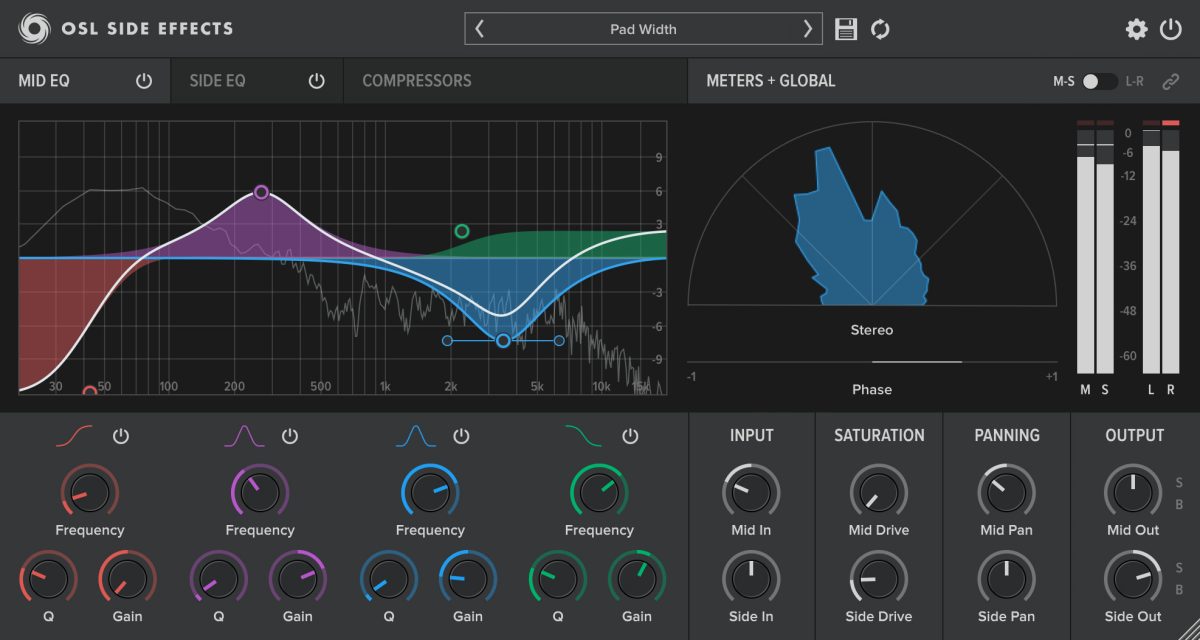
Did anyone mentioned OSL Side Effects ? It's a very nice eq + comp + panning + saturation which is sold for a fair price...
https://oblivionsoundlab.com/product/osl-side-effects/