Pashkuli: PMN (Plain Music Notation)

Chords, scales, harmony, melody, etc.
Locked New Topic
RELATED
PRODUCTS

Post

gaggle of hermits wrote: Tue Jan 04, 2022 1:04 pm I think there’s a misunderstanding here. The solfeggio “names” are just memory helpers (ie mnemonics).
I could not care less what some 'solfego' system tries to "teach" me.
I rejected them long time ago. I have created a better one.

Post

imrae wrote: Tue Jan 04, 2022 1:42 pm
gaggle of hermits wrote: Tue Jan 04, 2022 12:13 pm This is going to be fun. what were these names, for all the "tones" of 12tet, that is?
I would also be interested in the answer to this question.
Well, for that you will need to go search for books not only in English. Some have been translated into English, but... let's face it. Europe is not the centre of the world. Actually it has never been.


Pashkuli wrote: Tue Jan 04, 2022 12:24 pm Rewriting a score would be nuts.
imrae wrote: But if you don't rewrite the score the notes will be wrong! I thought it was your position that this would be a bad thing?
Ok, I am not a brass player. I do not know how they read a score and transpose the C to B♭.
I do not want to know. It is nuts to be done like that: seeing one note but playing another... but that is how key signature in "standard" music notation works, right? Ironic.

Post

gaggle of hermits wrote: Tue Jan 04, 2022 1:04 pm
fmr wrote: Tue Jan 04, 2022 12:30 pm If something, for latin countries C D E F G A B are the mnemonics (to read anglo-saxonic texts and fora). Do(Ut), Re, Mi, Fa, Sol, La, Si are the names, not mnemonics. Unless you consider any name as a mnemonic
I think there’s a misunderstanding here. The solfeggio “names” are just memory helpers (ie mnemonics). people can call the tones Dave, Dee, Dozey, Beaky, Mitch and Titch etc if they think it helps them get the right interval, though that might not be as useful as the regular systems: https://www.academia.edu/3715715/The_hi ... d_to_Japan
Forget the "solfeggio". I'm talking about the note names. Just take a look at this article, for example. Look at the starting paragraph:

"La Symphonie no 40 en sol mineur, K. 550 a été composée par Wolfgang Amadeus Mozart"

It will be the same in Italian, in Spanish, or in Portuguese.

https://fr.wikipedia.org/wiki/Symphonie_no_40_de_Mozart
Fernando (FMR)

Post

Pashkuli wrote: Tue Jan 04, 2022 1:56 pm Well, for that you will need to go search for books not only in English. Some have been translated into English, but... let's face it. Europe is not the centre of the world. Actually it has never been.
so, you don't know then. got it.

Post

fmr wrote: Tue Jan 04, 2022 2:03 pm Forget the "solfeggio". I'm talking about the note names. Just take a look at this article, for example. Look at the starting paragraph:
i interpreted pashkuli's objection to do, re, mi etc as being primarily to the movable-do solfege, basically because their objection to all fixed-do namings makes no sense as there are chromatic systems that have a distinct name for each pitch class – such as hullah's or sotorrio's – and which they could have easily adapted (and still could without affecting their proposed symbols though some of the choices would look a bit weird).
Last edited by gaggle of hermits on Tue Jan 04, 2022 3:00 pm, edited 1 time in total.

Post

gaggle of hermits wrote: Tue Jan 04, 2022 2:06 pm So, you don't know then. got it.
How could I, the world is so vast... :roll:
They even have rhythmic notation, spoken, no need to write. Pitch notation, no need to write.
Spoken\singing traditions from millennia ago. Music was not a privilege. It is universal.
Last edited by Pashkuli on Tue Jan 04, 2022 2:47 pm, edited 1 time in total.

Post

fmr wrote: Tue Jan 04, 2022 2:03 pm It will be the same in Italian, in Spanish, or in Portuguese.
https://fr.wikipedia.org/wiki/Symphonie_no_40_de_Mozart
Did not see any music note names. What is sol mineur?
Great "G minor" symphony? Соль минор? Σολ ελάσσονα...
What does it mean?
Did not see any music note names.

Post

Pashkuli wrote: Tue Jan 04, 2022 2:46 pm
fmr wrote: Tue Jan 04, 2022 2:03 pm It will be the same in Italian, in Spanish, or in Portuguese.
https://fr.wikipedia.org/wiki/Symphonie_no_40_de_Mozart
Did not see any music note names. What is sol mineur?
Great "G minor" symphony? Соль минор? Σολ ελάσσονα...
What does it mean?
Did not see any music note names.
There's a link on the 'sol mineur' text on that wikipedia page:
La tonalité de sol mineur se développe en partant de la note tonique sol. Elle est appelée G minor en anglais et g-Moll dans l'Europe centrale.
It's called "G minor" in English.

Post

fmr wrote: Tue Jan 04, 2022 2:03 pm "La Symphonie no 40 en sol mineur, K. 550 a été composée par Wolfgang Amadeus Mozart"

It will be the same in Italian, in Spanish, or in Portuguese.

https://fr.wikipedia.org/wiki/Symphonie_no_40_de_Mozart
In Dutch we call it Symfonie nr. 40 in G mineur, KV 550 :shrug:
I thought that Do could be any note. But sure when Do = C then Sol = G.
Pashkuli wrote: Соль минор? Σολ ελάσσονα...
Ironically google translates that (from Bulgarian) as "G minor? Very nice"

this is getting silly.
We are the KVR collective. Resistance is futile. You will be assimilated. Image
My MusicCalc is served over https!!

Post

Isn't that sad...
I bet they never tell the pupils why those syllables have been chosen. Maybe the children can find it easily online... some of the more hungry for knowledge and understanding.
But I doubt even one of the students to refuse learning it as it is.
Because... well, the exam is next month, so better do what they told you.

Indoctrination 1:1.
Solfege_Ireland.jpg
You do not have the required permissions to view the files attached to this post.

Post

gaggle of hermits wrote: Tue Jan 04, 2022 2:20 pm
fmr wrote: Tue Jan 04, 2022 2:03 pm Forget the "solfeggio". I'm talking about the note names. Just take a look at this article, for example. Look at the starting paragraph:
i interpreted pashkuli's objection to do, re, mi etc as being primarily to the movable-do solfege, basically because their objection to all fixed-do namings makes no sense as there are chromatic systems that have a distinct name for each pitch class – such as hullah's or sotorrio's – and which they could have easily adapted (and still could without affecting their proposed symbolsm though some of the choices would look a bit weird).
Ah... OK, got it now :tu:
Fernando (FMR)

Post

BertKoor wrote: Tue Jan 04, 2022 2:53 pm I thought that Do could be any note.
Excuse me. WHAT DID YOU SAY?!?
Man, this inherited nonsense is endless. I am speechless... :D

Post

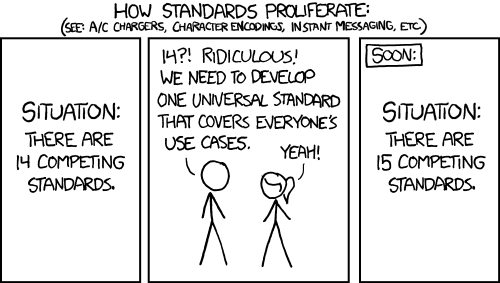
So now we're at xkcd-927 again

Image
We are the KVR collective. Resistance is futile. You will be assimilated. Image
My MusicCalc is served over https!!

Post

Ah, I got it now. Google search helped.
Apparently some "genius" (actually an idiot, let's face it), sometime ago decided to invent:
movable Do, Re, Mi...

This whole nonsense has to stop.
Honestly.

The dumbification of the young generation of musicians has to stop!
For the older ones it is too late, I'm afraid.

Post

Pashkuli wrote: Tue Jan 04, 2022 2:58 pm
BertKoor wrote: Tue Jan 04, 2022 2:53 pm I thought that Do could be any note.
Excuse me. WHAT DID YOU SAY?!?
Man, this inherited nonsense is endless. I am speechless... :D
wait until you find out that notes need not be fixed to a specific pitch as measured in hertz. it'll blow your mind.

Locked

Return to “Music Theory”