

Often when watching or reading a review of an EQ the person will comment about how the EQ is "musical", that it is "smooth" or that it adds "colour" or "sizzle".
I always thought an EQ is just a (complex, or simple) curve that via FFT calculations alters the frequency makeup of the sound, so e.g. a 18dB/octave high-pass filter placed at 60Hz or a high-shelf of +6dB at 10k should sound the same in every EQ, as long as the shapes of the curves match (and other features, such as anti-cramping, oversampling, etc. are a match in both).
So is this only about the shapes? About how wide, curved and symmetric the bell "arms" are? About the "bump" in front of the low- and high-pass filters? About the severity of S-shape of the shelves?
Or is there some additional "magic" going on?
How do you tell if EQ isn't "clean"?
-

- Banned
- 11467 posts since 4 Jan, 2017 from Warsaw, Poland
-

- KVRAF
- 16805 posts since 8 Mar, 2005 from Utrecht, Holland
Apart from the obvious effect an EQ has by design, there's also phenomena such as distortion & saturation taken from their analog brothers in the real world. These effects can be very subtle but do add significantly to the character of an EQ plugin.
We are the KVR collective. Resistance is futile. You will be assimilated. 
My MusicCalc is served over https!!
My MusicCalc is served over https!!
-
- Banned
- Topic Starter
- 11467 posts since 4 Jan, 2017 from Warsaw, Poland
Thanks! Which EQs do that in a way that can be controlled by user and therefore heard as a difference?BertKoor wrote: Wed Dec 29, 2021 10:58 amApart from the obvious effect an EQ has by design, there's also phenomena such as distortion & saturation taken from their analog brothers in the real world. These effects can be very subtle but do add significantly to the character of an EQ plugin.
-
- KVRAF
- 3506 posts since 27 Dec, 2002 from North East England
The only one that immediately springs to mind is SlickEQ from TDR/VoS.antic604 wrote: Wed Dec 29, 2021 12:52 pmWhich EQs do that in a way that can be controlled by user and therefore heard as a difference?
My feeling is that most sonic qualities ascribed to various EQs are really workflow qualities in disguise. When people say an EQ is 'musical,' what I'm hearing is that it doesn't get in the way of making music. I expect it's possible to recreate any curve in a sufficiently powerful paragraphic EQ, but it's not probable that you'll stumble into the curve from an old classic, and it's not going to come with that inspirational, near-revelatory quality of getting a desired result very quickly.
A friend once told me about an engineer he worked with who would say something like "make a thin 2 dB notch at 780 Hz." He'd do as told, and the track would immediately sound amazing. I dare say absolutely any EQ would be musical for this guy because he's not even thinking about topology, just describing exactly what the sound needs. But for us mere mortals, the make-up artists to his plastic surgeon, well designed preset curves that give us a bit of leeway when trying to achieve a particular result can be very helpful.
-

- KVRist
- 195 posts since 14 Dec, 2013
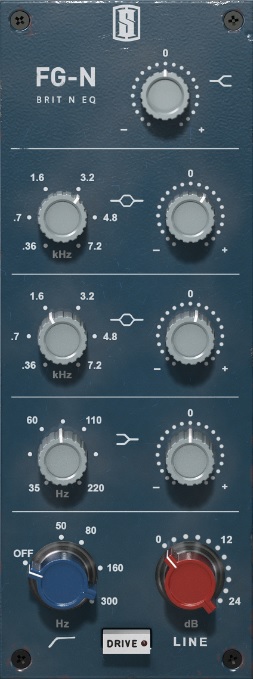
I think the most "colorful" EQ I ever used in my life was FG-N from Slate Digital VMR system. It sounds very obviously saturated. I'm pretty sure you won't be able to replicate results with your standard "clean" eq. There is no wet/dry controls for the saturation itself however.antic604 wrote: Wed Dec 29, 2021 12:52 pm Thanks! Which EQs do that in a way that can be controlled by user and therefore heard as a difference?
-

- KVRist
- 352 posts since 24 Aug, 2017
Waves hybrid eq has different choices for saturation that can be added separately.Several eqs have a separate drive function, like some of the PSP eq:santic604 wrote: Wed Dec 29, 2021 12:52 pmThanks! Which EQs do that in a way that can be controlled by user and therefore heard as a difference?BertKoor wrote: Wed Dec 29, 2021 10:58 amApart from the obvious effect an EQ has by design, there's also phenomena such as distortion & saturation taken from their analog brothers in the real world. These effects can be very subtle but do add significantly to the character of an EQ plugin.
-
- Banned
- 47 posts since 7 Oct, 2021
I personally like the "sound" of the IKM EQ PB and PG and you can control how much of it's sound you want with the preamp controls. A good sound is whatever a person happens to think is good to them.antic604 wrote: Wed Dec 29, 2021 12:52 pm Thanks! Which EQs do that in a way that can be controlled by user and therefore heard as a difference?
-
- KVRAF
- 1894 posts since 9 Jul, 2014 from UK
An EQ is basically just a filter for cutting or boosting frequencies. Use it at its simplest and add other effects if needed. I mainly use the channel EQ in my DAW.
I wonder what happens if I press this button...
-

- KVRAF
- 3017 posts since 8 Jun, 2018
an EQ is not FFT, with exceptions, of course. the spectrum is FFT, mostly, i think.
but filters (there are FFT base eq's, but a small minority), are simply; filters, and can come with there own character.
but even a 'clean' eq, can give you filter results, so to speak.
not really an eq, but i do eq in soft synths, by the way, the filter(s), no eq needed afterwards.. the shape the sound of course, but back not really an eq;
https://www.reasonstudios.com/shop/rack ... convolver/
but can be used as an eq, as i did recently, well it is a filter shape...
there are indeed channel strips, that really give a character to a sound, beyond clean filters.
that is why there are so many different filters, within a modular you can use several filters, parallel, serial, to sculpt in a eq way.
the difference isn't that big... althought in the end, an EQ is build for another reason, than a filter. so many things are streamlined for eq-ing, of course. but still, use a EQ, with a touchscreen, or midi controller, and you sculpt it like with filters..
but filters (there are FFT base eq's, but a small minority), are simply; filters, and can come with there own character.
but even a 'clean' eq, can give you filter results, so to speak.
not really an eq, but i do eq in soft synths, by the way, the filter(s), no eq needed afterwards.. the shape the sound of course, but back not really an eq;
https://www.reasonstudios.com/shop/rack ... convolver/
but can be used as an eq, as i did recently, well it is a filter shape...
there are indeed channel strips, that really give a character to a sound, beyond clean filters.
that is why there are so many different filters, within a modular you can use several filters, parallel, serial, to sculpt in a eq way.
the difference isn't that big... althought in the end, an EQ is build for another reason, than a filter. so many things are streamlined for eq-ing, of course. but still, use a EQ, with a touchscreen, or midi controller, and you sculpt it like with filters..
Primoridal Music: sadà\exposadà - Indusrial & Expanding Your Mind Hurts: Sound Brut
-
- KVRAF
- 1894 posts since 9 Jul, 2014 from UK
There are so many hypocrisies in the above post, I don't know where to begin 

I wonder what happens if I press this button...
-
- KVRAF
- 3086 posts since 4 May, 2012
Filters are filters.ramseysounds wrote: Sun Jan 09, 2022 9:51 am There are so many hypocrisies in the above post, I don't know where to begin
This is my last Fuse Audio Labs plug for the day. Maybe.antic604 wrote: Wed Dec 29, 2021 12:52 pmThanks! Which EQs do that in a way that can be controlled by user and therefore heard as a difference?BertKoor wrote: Wed Dec 29, 2021 10:58 amApart from the obvious effect an EQ has by design, there's also phenomena such as distortion & saturation taken from their analog brothers in the real world. These effects can be very subtle but do add significantly to the character of an EQ plugin.
https://fuseaudiolabs.de/#/pages/product?id=300965965
A free model of a Baxandall EQ - that sounds beautiful. There is a drive control but you can boost into it harder with gain ahead of the plugin to hear how it breaks up.
-
- KVRAF
- 6780 posts since 17 Dec, 2009
99% software EQs are just bog standard filters with waveshaper attached.
And yes you’re right, you can make a lot of them null themselves out (saturation aside). The difference is mostly in workflow and control. (Filter Q is not a standard unit so each eq does its own)
There’s also different hipass/lopass filter implementations but most eqs use butterworth because it has the flattest pass band of all toplogies
And yes you’re right, you can make a lot of them null themselves out (saturation aside). The difference is mostly in workflow and control. (Filter Q is not a standard unit so each eq does its own)
There’s also different hipass/lopass filter implementations but most eqs use butterworth because it has the flattest pass band of all toplogies

-
- KVRian
- 1365 posts since 2 Mar, 2018
I suggest you start by looking up the word "hypocrisy."ramseysounds wrote: Sun Jan 09, 2022 9:51 am There are so many hypocrisies in the above post, I don't know where to begin
Anyway
It is a mistake to say all EQs are the same other than at a very (very) basic way, i.e. a way to adjust frequencies. For example, a parametric EQ has much more ability and flexibility than a graphical one. etc
As for adjectives like "clean" or "musical," I think it's mostly pretentious nonsense. An EQ has no degree of "cleanliness." Or godliness.

-
- KVRAF
- 1637 posts since 28 Jul, 2006
Seems weird if a regular EQ was using FFT. Maybe something like soothe or gulfoss uses FFT (no clue), if you want to call those EQs?
-
- Banned
- Topic Starter
- 11467 posts since 4 Jan, 2017 from Warsaw, Poland
Is it? If you want to make a dip of -6dB at 1kHz, you somehow have to "extract" from the complete audio waveform within the time window the EQ uses the part that creates the sound around 1kHz from everything else. Going by Wikipedia "... Fourier analysis converts a signal from its original domain (often time or space) to a representation in the frequency domain and vice versa."briefcasemanx wrote: Thu Feb 03, 2022 10:07 am Seems weird if a regular EQ was using FFT. Maybe something like soothe or gulfoss uses FFT (no clue), if you want to call those EQs?
But I'm completely clueless about the details, so I might be wrong.