


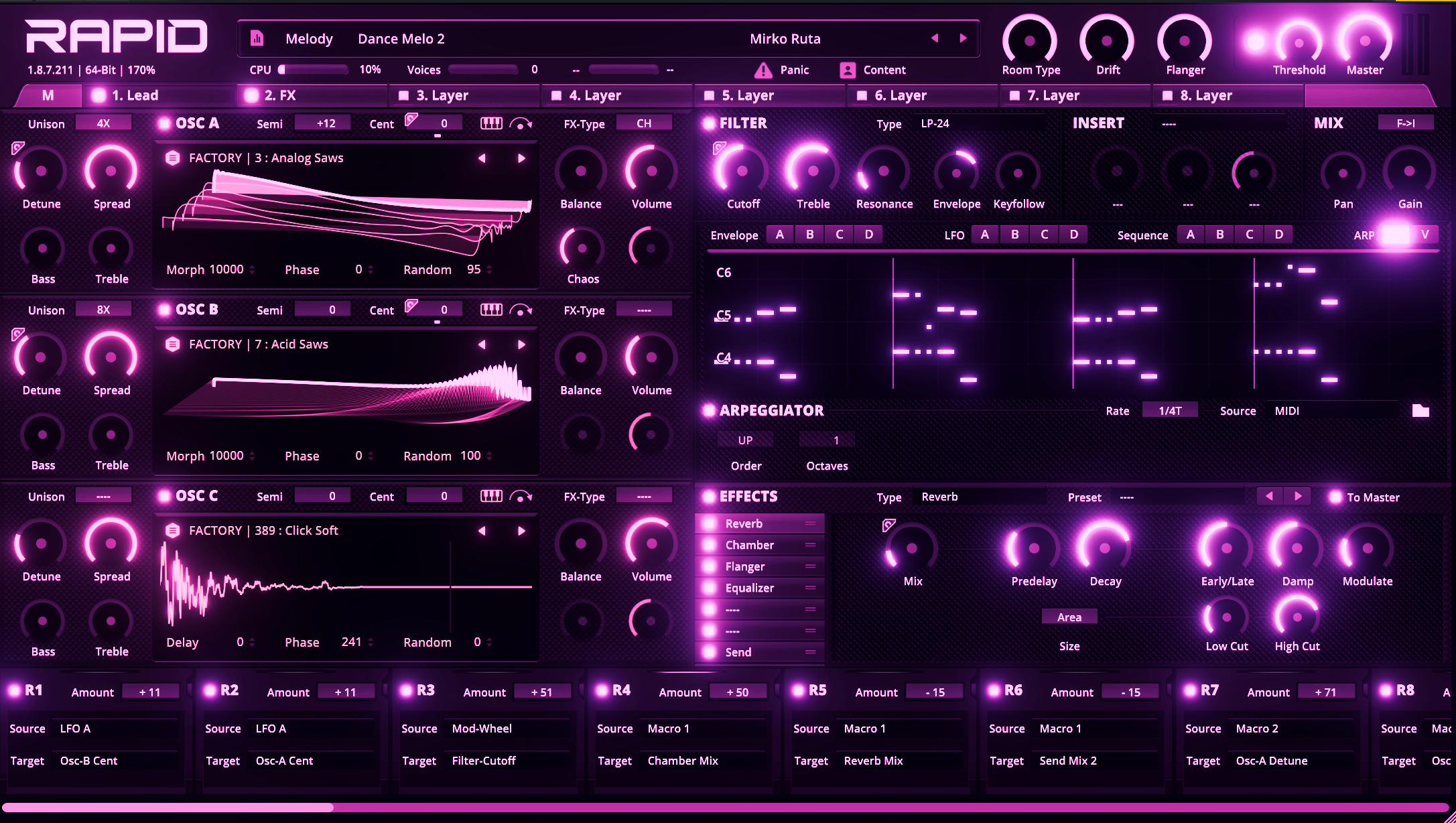
Following in the same vain of the Dune 3.5 v Hive thread and yes whilst Dune 3 would have been an obvious choice here with it having 8 layers, I've chosen these two so one can compare other different aspects they share and don't share.
Graphically, they are so different in many ways, that comparing them would take a bit of a while. So highlighting some of the things that pop out at me, first would be that the scaling of things that are significantly bigger in Rapid. You're probably not going to struggle to see things as you might when compared with the standard skins that come with Hive 2 by default.
The number of third-party skins out there for Hive 2, are few and far between and don't really address the size of elements despite the capabilities in which to do so. One could argue that Hive 2 is a far more complex synth when it comes to the number of features, in a way that it is predominantly a one-screen affair. To counter that argument would be to highlight some technical omissions. For one, the ability to fold aspects or sections/panels that simplify the visual information that is shown to you including the aspect of making the overall GUI smaller as a result.
Hiding controls is possible as is changing them through the scripting process but it's limited and more of an advanced aspect that many wouldn't take the time to explore script-wise. Additionally, you can use a more basic skin of an earlier version of Hive should you feel there is too much in complexity and visual information with Hive 2. The possibility of having a skin that singles out different sections of Hive 2 itself would be an interesting one should it be possible.
Back to Rapid... Rapid like Hive has both user scripting and graphics functions where you can change the GUI in a dramatic way but they differ significantly in the process in which you as a user is able to control that. Rapids functions as in knobs, fields, sliders and so forth are fixed where they are and there is no way to create new ones that actually move so one could create a new UI design. The prospect of doing so, would be quite a challenge without the ability to scale the graphical elements oneself.
You have control script-wise over many of the colour aspects which is essential to allow one to change the bitmap graphics provided. Changing certain graphics in a manual way is not an easy process when compared to what one is allowed to do with Hive, due to how they are laid out and because like Hive, Rapids GUI is fully scalable, you've not only to draw / design things once but three times. By that, I mean re-scale everything down to the appropriate dimensions exactly as they should be.
There is no advanced editor function that is accessible in a particular way that Hive has. If you want skins for Hive, you'll find plenty of the old kind, but very few for Hive 2. Whilst Rapid has far more included by default to choose from, you will be lucky to find any others created by users of Rapid online and for free unless you find those listed under my user name here.
When it comes to usability, Rapid has the edge here and it has a few visual tricks up its sleeve, for example, it can show a 3D representation of waveforms it is able to scan through where as Hive can't currently do this and probably not without a significant CPU hit.
Rapid doesn't have a way in which to adjust the brightness or gamma like in which Hive is able to do, so you would need to create different skins manually but it does give you access to enabling OpenGL to assist with the general GUI speed. Speaking of OpenGL, it is possible to inject colour-altering functionality and effects to that of Rapid using certain utilities such as the one in the video below should that be an alternative one would like.
Rapid like in the previous comparison to Dune 3.5 has a 32-step arpeggiator which is rather simplistic and somewhat limited in seeing a complete overview of the values that one has with certain skins that Hive provides you with. Depending on how you operate it, it can be either slow or quick to work with unless you are proficient at juggling between the two. Changing things on a step-to-step basis and adjusting values with your mouse or programming in a grid-like way where each note is fixed.
Alternatively, you can choose from many of the excellent created presets provided and edit them to suit you. The presets for the arpeggiator are properly organised and much better than the way in which Hive presents them. Arp presets are a core feature of Rapid rather than a per-patch affair that Hive has, so you are more likely to become used to your favourites in remembering them and actually using them.
Rapid can also use MIDI files like what Dune 3.5 provides so you can get some really complex and musical sequences going on to trigger a set of sounds on a per layer basis. Hive does have an intricate shape sequencer to modulate things with in addition to the main sequencer but it is a little complex to use although useful in some sound design cases.
Whilst Rapids arpeggiator isn't programmable from a keyboard like Hive is, it does feel generally more fun to work with, (being bigger) and provides more steps. The ability to play polyphonic arpeggiation in addition to other play modes, normal, triplet, and dotted, as well as different play speeds/shuffle. Hive in this respect is more complicated and so is not as clear control wise and are thus you are really left to judge by ear, on what's happening.
When it comes to the modulation aspect, both Hive and Rapid do these equally well and in a similar way, both visually and practically with drag and dropping of source and destination parameters. Rapid has an edge in a visual way that the parameters in which are modulated are actually animated. With Hive and its knobs, this isn't the case, and any modulation of the knobs is static. The exception to this is in regard to the waveform screens of Hive 2 and the sequencers/shape sequencers/lights it has.
Both these synths have visual keyboard sections that serve different purposes.
...whilst the sound engine creation differences of these two synths are aspects I'll leave for now. There are many other aspects I'll leave for you to compare between these two little monsters of the synth world.
For now I'll wish you a happy new year....


