Ooh, I like This Modular Rack...

Anything about hardware musical instruments.
Post Reply New Topic
RELATED
PRODUCTS

Post

ghettosynth wrote: Mon Apr 10, 2023 9:31 pm I will have more detailed comments, and maybe a rack-in-response later, but, I would very much try to get the 1047 in there. The 297 looks good on paper, but, the slew sliders are virtually useless and the tiny trim pots are really stiff. I may buy another one now that they're cheap, but I may not.
Yeah the 297 does look a bit of a pain all round! As I say there are far better options outside Behringer here.

The 1047 looks a lot of fun, in general the 2500 stuff looks cool but needs a larger rack!
Post

imrae wrote: Tue Apr 11, 2023 11:54 am
ghettosynth wrote: Mon Apr 10, 2023 9:31 pm I will have more detailed comments, and maybe a rack-in-response later, but, I would very much try to get the 1047 in there. The 297 looks good on paper, but, the slew sliders are virtually useless and the tiny trim pots are really stiff. I may buy another one now that they're cheap, but I may not.
Yeah the 297 does look a bit of a pain all round! As I say there are far better options outside Behringer here.

The 1047 looks a lot of fun, in general the 2500 stuff looks cool but needs a larger rack!
Which leads to a great question: What is 16HP or less and is a swiss army knife of CV. Are there low cost alternatives to the 297 that are more interesting and/or less annoyingly bad?

Post

That price and density are hard to beat, for sure. Among the first modules in my rack were Befaco Rampage and Fonitronik Cascade, which provide a great set of utility with a good user interface. Money was saved by assembling them from kits!

Post

FYI

Some interesting and affordable mixers that caught my attention, with each one having some specific tricks up their sleeve. They all do both audio and cv and the Mixwitch can be set to lineair or logarithmic mode.

* https://www.modulargrid.net/e/klavis-mixwitch
* https://www.modulargrid.net/e/doepfer-a-138m
* https://www.modulargrid.net/e/nano-modules-mar

The trim pots on the Behringers are really stiff. Yeah, they are cheap, but i appreciate some decent knob handling.

Post

News that Behringer’s $249 Grandmother could be close to release.

https://www.musicradar.com/news/behrin ... t-model-15

Fuller description from the original announcement:
https://www.synthtopia.com/content/202 ... andmother/

Post

ghettosynth wrote: Tue Apr 11, 2023 1:22 pm
imrae wrote: Tue Apr 11, 2023 11:54 am
ghettosynth wrote: Mon Apr 10, 2023 9:31 pm I will have more detailed comments, and maybe a rack-in-response later, but, I would very much try to get the 1047 in there. The 297 looks good on paper, but, the slew sliders are virtually useless and the tiny trim pots are really stiff. I may buy another one now that they're cheap, but I may not.
Yeah the 297 does look a bit of a pain all round! As I say there are far better options outside Behringer here.

The 1047 looks a lot of fun, in general the 2500 stuff looks cool but needs a larger rack!
Which leads to a great question: What is 16HP or less and is a swiss army knife of CV. Are there low cost alternatives to the 297 that are more interesting and/or less annoyingly bad?

The Samara II looks pretty neat.


Post

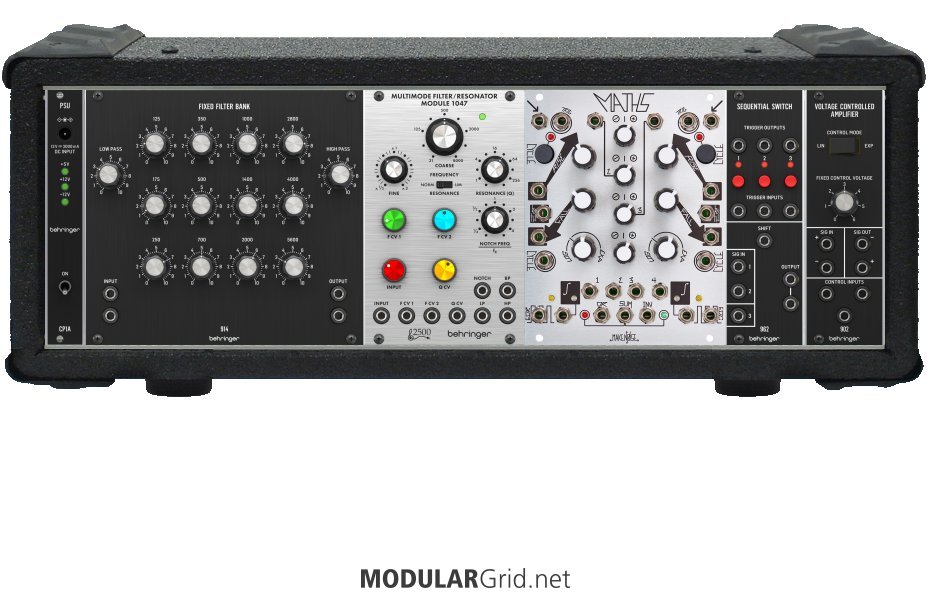
Ok, here's my response to imrae's rack. This is not intended to be standalone, rather, it's a 2600 helper. My self-imposed rules were that I would allow only one non B module and that I must fill the entire rack.

https://www.modulargrid.net/e/racks/view/2223720

Image

For me, this represents a lot of what is excellent in the B line at the moment. I tried to identify modules that would add to the 2600 experience and incorporated elements that are definitely not in the 2600. That said, I also wanted to keep the entire rack mostly analog/classic so I left out any modern digital modules. I think that a key point of this selection is that, like the 2600, nothing is cramped. There is nothing here that is of the contemporary "let's cram it all into the least amount of HP possible" attitude.

From left to right:

B.914: You never knew you needed this until you get one. Do not stress over the HP. This is a really marvelous module to shape tones and you don't want it any smaller. This is my top choice which is why it went into the rack first.

B.1047: You do not have VC resonance nor a multimode in the 2600. This adds both including a really interesting notch filter. You have individual outs for the filter shapes so you can mix them further. It has a lot of character but is not as aggressive as a Steiner Parker or a Wasp filter. I think that it might be the best filter currently in the B lineup. Independent level control on the input allows you to control how you drive the filter without using an attenuator. I will probably buy a second one of these for stereo

Make Noise Maths: Sorry, I don't think that there is a module on the market that offers a better, or even equal, balance of flexibility and usability in fewer HP. I hate to say that I think that this trendy module is all that, but it is. I will probably get a second one of these as well. You get so much from this, but, in particular, you get attenuversion, mixing, and voltage controllable EGs with variable shape. This really adds something to the 2600. I'm not convinced that more ADSRs are as useful here, and in trying to get the right balance, this is my top choice.

This leaves 16HP and there are a number of choices here. But in focusing on what is missing from the 2600, I went with the following two choices.

B.962: In all honesty this is, IMO, my weakest selection. The issue is what are you going to add to the 2600 that isn't already there. I think that this adds something and has nice spacing on the panel. There are definitely better choices for this HP that aren't Behringer. But, I've used up my one non-B selection so this does add some fun.

B.902: The choice here is limited because it's Behringer and 8HP. A 921B would be an ok choice for another oscillator with LFO mode, but, the 2600 has three oscillators and Maths will make LFOs. You could put in a Moog EG, but again, Maths, and also, S-triggers. So, I went with a real 2600 limitation and put in the Moog VCA. This gives you a lin/exp switchable VCA that is definitely classic and will definitely contribute to the tone of the 2600. It can be used as a pseudo-ring mod that will sound different from the 2600 ring mod. I will say that this is the only module in this rack that I don't own.
Last edited by ghettosynth on Wed Apr 12, 2023 5:46 pm, edited 1 time in total.

Post

Wow Ghetto, lot of thought gone into this. I priced it up with a Titop skiff at £645!
My immediate reaction is that it doesn’t look that exciting but I need to explore the 914 more in terms of sound sculpting potential and I must admit that I have no idea how to use the 962.
Looks like I can’t escape a Maths.
Totally get the space/accessibility point. Any attempt to inject more “excitement” would almost certainly compromise on cost and accessibility/tweak ability.

Post

SHall1000 wrote: Wed Apr 12, 2023 3:43 pm Looks like I can’t escape a Maths.
You can 't :D . I just bought mine after going back and forth through a large series of modules.

I ll probably put a Behringer Batumi next to it, when it is released. They should play nicely together but the Maths will give me plenty of options in the mean time.

Post

SHall1000 wrote: Wed Apr 12, 2023 3:43 pm Wow Ghetto, lot of thought gone into this. I priced it up with a Titop skiff at £645!
My immediate reaction is that it doesn’t look that exciting but I need to explore the 914 more in terms of sound sculpting potential and I must admit that I have no idea how to use the 962.
Looks like I can’t escape a Maths.
Totally get the space/accessibility point. Any attempt to inject more “excitement” would almost certainly compromise on cost and accessibility/tweak ability.
The 962 gets demo'd mostly as a way to turn the 960 into a 16 or 24 step sequencer, yawn. It is an audio/cv multiplexer. Plug two two or three inputs in and you can manually, or by trigger, route one of them to the output.

Simple applications include using it as a crude sequencer. Use the attenuverted outputs of the Maths to drive two or three inputs and feed the shift input with an LFO and you have a two or three step sequencer.

Or, anytime you want to switch between two or three inputs under trigger control, this can work. So you could, for example, route different oscillator shapes into the inputs and then shift between then using an LFO. (They must be offset to remain undistorted) You could also use this as a performance device by routing say a sin/square/saw into the inputs and then using the buttons to choose the waveform that you want at the moment.

However, and this is an important point, this device operates at very high frequency. One cool trick is to feed the same VCO signal into input one and to the shift input. Feed nothing into input two or three. This will give you a crude octave divider/sub bass that works through the audio range. Shifting the oscillator type and/or the pulse width will give you some interesting effects.

Taking this further, if you now feed a second oscillator into the second input, especially one that's synced to the first, you get all kinds of interesting wave shaping happening as the switch chooses between the two inputs at audio rate.

There is an almost unlimited number of things that you can do with CV here. Switching between two or three modulation sources, static or not, that provides that signal as a modulation source to something else can yield interesting results.
Last edited by ghettosynth on Wed Apr 12, 2023 7:42 pm, edited 2 times in total.

Post

Thanks. That makes it sound very interesting. One question. The Behringer product video states that “it only switches positive waveforms so is not suitable for switching between audio signals”. I do not understand this in the context of your description, or maybe it refers to the input to the shift function?

Post

What I'm hearing is "half-rectifies the audio" which is a legit oscillator effect in its own right. And you can neutralise it by using Maths to scale/shift the signal.

That looks like a fun 2600 support rack to me, and I appreciate the ergonomics!

Post

Ok, so let me correct this post with some more detail.

The 962 is designed for positive voltages so you cannot cleanly switch bipolar voltages. If, as imrae points out, you offset them so that they are no longer negative, then you can indeed switch them cleanly, or reasonably so given the technology limitations.

However, the trick that I point out above will not work unless the voltage on the advance input drops beneath the low point of the static discipline of the 74HC series chips. So, you won't get a crude sub-oscillator without that.

Generally, the current input to any logic chips should be limited because of output resistors. I cannot believe that Behringer did not assume that people are going to plug any oscillator that they want to into the advance inputs. I believe that they are using a 74HC14 Schmidt trigger to process the trigger inputs. Again, I don't know, but, you can see it on the board and that seems like the most logical use for the chip. I could trace it out, but that sounds like work. This would make sense why you can feed any waveform in to the trigger and still get it to switch. However, it also means that the chips themselves have input clamping diodes.

In short, given that most oscillators have output current limiting resistors, and that all of the inputs appear to be diode protected, I think that it's completely safe to feed negative voltages into the 962 and, to be clear, I've been doing this with mine before checking that it's safe.
Last edited by ghettosynth on Wed Apr 12, 2023 8:25 pm, edited 3 times in total.

Post

imrae wrote: Wed Apr 12, 2023 7:26 pm What I'm hearing is "half-rectifies the audio" which is a legit oscillator effect in its own right. And you can neutralise it by using Maths to scale/shift the signal.

That looks like a fun 2600 support rack to me, and I appreciate the ergonomics!
Yes, this is correct. You just need to shift the signals if you want it to process the full waveform. For square waves this isn't as necessary, as you are going to get half the waveform with a narrower pulse than the original.

In any case, the clipping just adds to the character of the output. As you say, if you don't want it, you can offset the input voltages such that the resulting waveform is all positive. AC coupling the output will restore the bipolar voltage. Many/Most filter inputs are AC coupled.

Post

:ud:
Stefken wrote: Tue Apr 11, 2023 6:30 pm FYI

Some interesting and affordable mixers that caught my attention, with each one having some specific tricks up their sleeve. They all do both audio and cv and the Mixwitch can be set to lineair or logarithmic mode.

* https://www.modulargrid.net/e/klavis-mixwitch
* https://www.modulargrid.net/e/doepfer-a-138m
* https://www.modulargrid.net/e/nano-modules-mar

The trim pots on the Behringers are really stiff. Yeah, they are cheap, but i appreciate some decent knob handling.
So I've also thought about the a-138m, but I haven't pulled the trigger yet. The Mar looks useful and compact, but not all that flexible. Now, the Klavis-mixswitch, holy shit, that looks great! They've really identified some of the things that I find annoying with attenuvereters, sometimes, in a performance context. Also, because of the clocked switching functionality, it's both a sequential switch as well as a four channel sequencer. That's a lot of nice functionality packed behind a narrow panel. Since the manual states that it can be used as a sub-octave generator, I assume that it also runs pretty fast.

Post Reply

Return to “Hardware (Instruments and Effects)”