

This video shows the Mixwitch switcher running at audio rates and generating “granular” synthesis patch.
Ooh, I like This Modular Rack...
-
- KVRAF
- Topic Starter
- 16758 posts since 13 Oct, 2009
Not particularly related to anything, but, a nice video (not mine) that I posted in another thread some years ago with Batumi, Rings, and two other XAOC modules.
-
- KVRAF
- 2719 posts since 2 Jul, 2010
A lot of useful CMOS chips support 0-15V or so. So to safely use them with +/- 12V Eurorack signals you need to either:
I am currently toying with a design for a sequencing/clock/logic system so have been thinking about this stuff! But now sidetracked into analog (i.e. continuous) bipolar logic...
- Half-rectify the input and power with ground and 12V
- Create new power supply rails at +/- 5-7V, and clip the input to that range
- Setup power as above, scale down the input signal and re-amplify at output
I am currently toying with a design for a sequencing/clock/logic system so have been thinking about this stuff! But now sidetracked into analog (i.e. continuous) bipolar logic...
-
- KVRAF
- Topic Starter
- 16758 posts since 13 Oct, 2009
For sure, but, in this case, other than clamping the advance input, the concern with the signal inputs is not related to digital logic. There we just have what are, in essence, crude VCAs that are turned on by a positive voltage. You could implement this easily with relays. That would be great; a clicking sequential switch, even better, it would be bipolar!imrae wrote: Thu Apr 13, 2023 6:10 am A lot of useful CMOS chips support 0-15V or so. So to safely use them with +/- 12V Eurorack signals you need to either:Clearly the first option is the simplest and cheapest!
- Half-rectify the input and power with ground and 12V
- Create new power supply rails at +/- 5-7V, and clip the input to that range
- Setup power as above, scale down the input signal and re-amplify at output
I am currently toying with a design for a sequencing/clock/logic system so have been thinking about this stuff! But now sidetracked into analog (i.e. continuous) bipolar logic...
You could also use three VCAs along with the the "trigger" outputs that are really gate outputs. You could then just mult sum the outputs and you have a fully bipolar sequential switch with the logic still working off of the positive rail only. The choice to not implement negative switching is, I suspect, about controlling the complexity and cost of the module.
Here's a picture:
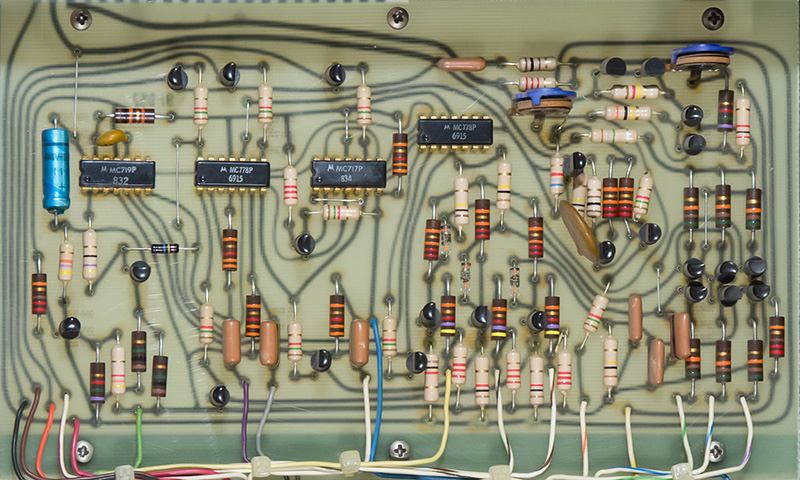
You can see the input processing circuits over to the right. It's a few transistors per channel. On edit, I found the schematics and it's a dead simple passive mixer with input muting. Ah, it's quite clever: each channel has two muting transistors with the base connected to the two channels that aren't active. No inverter required, each channel is active whenever the other two aren't muting it. I assume that it wasn't often used to switch audio because people didn't use Moogs so much in that way. I imagine it was mostly used with the sequencer.
Behringer did follow that part of the circuit fairly faithfully because, in fact, you can cleanly switch bipolar signals as long as they don't exceed 2v peak to peak. Also, as it says there, you just get clipping on the negative waveform if you exceed that. So, yay, free distortion.
-
- KVRAF
- 2418 posts since 9 Nov, 2016
Yes, it s a nice little bugger and won t break the bank, giving you various functionality.ghettosynth wrote: Wed Apr 12, 2023 9:21 pm Now, the Klavis-mixswitch, holy shit, that looks great! They've really identified some of the things that I find annoying with attenuvereters, sometimes, in a performance context. Also, because of the clocked switching functionality, it's both a sequential switch as well as a four channel sequencer. That's a lot of nice functionality packed behind a narrow panel. Since the manual states that it can be used as a sub-octave generator, I assume that it also runs pretty fast.
The switch also works according to cv level and random, so not only sequential. Can be two 2-1 mixers or 4-1 mixer, does both cv and audio, sequence, function as an osc or suboctave, etc...
Decent mixer knobs too. They pay attention to usability.
Klavis has interesting stuff (made in Belgium
 ) and their modules are always a bit different from other companies. Their grainity is also interesting. It is labelled as a filter (it can filter) but i see it more as a sound processor that can sort of oomph and unison/harmonise your voice according to different grain patterns. Has a lot of character as a 'filter'.
 It s better to watch the video, as it is something on it s own.
-
- KVRAF
- 2418 posts since 9 Nov, 2016
This thing is deep 
-
- KVRAF
- Topic Starter
- 16758 posts since 13 Oct, 2009
In the sprit of Maths alternatives, LA67 has an interesting new module, it's a dual modulator with shared trigger. A little pricey at $199, but then, my mind is getting warped about what is good value and what isn't with this shit. Thank god I'm not really into photography.

This is related to Maths and friends in that it is derived from the famous Serge DUSG. I have this module in my rack, it's a clunky design in my opinion, but it does some things well enough. It's flakey though and makes for a terrible VCO. That said, I think that all of the DUSG based designs make a terrible VCO and would never use them for that.

I think I spent $65 on this from Synthrotek some time ago when I was just buying easy to get my hands on kits.
This is related to Maths and friends in that it is derived from the famous Serge DUSG. I have this module in my rack, it's a clunky design in my opinion, but it does some things well enough. It's flakey though and makes for a terrible VCO. That said, I think that all of the DUSG based designs make a terrible VCO and would never use them for that.
I think I spent $65 on this from Synthrotek some time ago when I was just buying easy to get my hands on kits.
-
- KVRAF
- 2418 posts since 9 Nov, 2016
That Vietcong modulator  seems like an interesting little bugger. I have put it on my moodboard.
It has controls for decay and duration, issues that are somewhat lost in Maths, so i guess it has a place in conjunction with maths. Can do some interesting modulations.
If money and place were no object, i d go for one. But since they do, and in eurorack all these modules with a narrow scope really add up, it s going on my moodboard.
BTW : i really like modular grid to create 'collections' but i regularly encountered that modules I saved in a rack, just fall off without any reason... and you lost your reference. It s really starting to annoy me.
seems like an interesting little bugger. I have put it on my moodboard. It has controls for decay and duration, issues that are somewhat lost in Maths, so i guess it has a place in conjunction with maths. Can do some interesting modulations.
If money and place were no object, i d go for one. But since they do, and in eurorack all these modules with a narrow scope really add up, it s going on my moodboard.
BTW : i really like modular grid to create 'collections' but i regularly encountered that modules I saved in a rack, just fall off without any reason... and you lost your reference. It s really starting to annoy me.
-
- KVRAF
- Topic Starter
- 16758 posts since 13 Oct, 2009
So the LA67 bit, which I have more faith in, appears to allow you to control the duration of "a" gate, I assume generated from a trigger? I don't know. I do know that Event is very sensitive to gate/pulse width and works best with a gate input that you can control the width of. It's finicky, but not useless. It has a lot of range for very short A/D times which can be useful for drums. You can get shapes from it by feeding the outputs to the inputs, but, it really needs an attenuverter to control the shape, like Maths.
It's fun with the B.ARP sequencer because that sequencer has a built in pulse width control.
It's fun with the B.ARP sequencer because that sequencer has a built in pulse width control.
Last edited by ghettosynth on Sun Apr 16, 2023 2:04 pm, edited 1 time in total.
-
- KVRAF
- 2418 posts since 9 Nov, 2016
-
- KVRAF
- 2418 posts since 9 Nov, 2016
-

- addled muppet weed
- 111294 posts since 26 Jan, 2003 from through the looking glass
not seen this guy before, thanks, i like his presentation style, although the fact he looks like a very young version, of one of my friends, is a bit offputting
 makes me realise, we are not so young anymore
-
- KVRAF
- Topic Starter
- 16758 posts since 13 Oct, 2009
I like that the includes patch block diagrams. I don't find anything really surprising in that video, but I think that's a good way to quickly get the point across. Which takes me to a pet peeve: I've become more and more irritated with vendors who keep too much under wraps because of a fear of their designs being knocked off.
At minimum, you should include a block diagram of the sub-modules in your module. You move to the front of the line if you include actual schematics.
It doesn't have to be complex, the Maleko Anti-Oscillator makes it clear that it's a triangle core sine wave oscillator driving a wave folder. Cool, I know what's going on with that "chaos" knob now. You can call shit whatever dumb name you want, but tell me what it's doing so that it makes sense.
I'm also getting pickier but how modules are powered. There is not enough use of the 5v rail for powering the digital core of CPU based modules. Noise Engineering gets points here for allowing you to switch the digital core onto the 5v rail. In a lot of ways, the current Eurorack market reminds me a bit of the plugin market about 15 years or so ago, there are a lot of small players who can half-ass shit and get away with it.
/rant
At minimum, you should include a block diagram of the sub-modules in your module. You move to the front of the line if you include actual schematics.
It doesn't have to be complex, the Maleko Anti-Oscillator makes it clear that it's a triangle core sine wave oscillator driving a wave folder. Cool, I know what's going on with that "chaos" knob now. You can call shit whatever dumb name you want, but tell me what it's doing so that it makes sense.
I'm also getting pickier but how modules are powered. There is not enough use of the 5v rail for powering the digital core of CPU based modules. Noise Engineering gets points here for allowing you to switch the digital core onto the 5v rail. In a lot of ways, the current Eurorack market reminds me a bit of the plugin market about 15 years or so ago, there are a lot of small players who can half-ass shit and get away with it.
/rant
-
- KVRAF
- Topic Starter
- 16758 posts since 13 Oct, 2009
Not rushing out to buy this, but, god damn if those aren't some good looking panels. Definitely on the quirkier side.
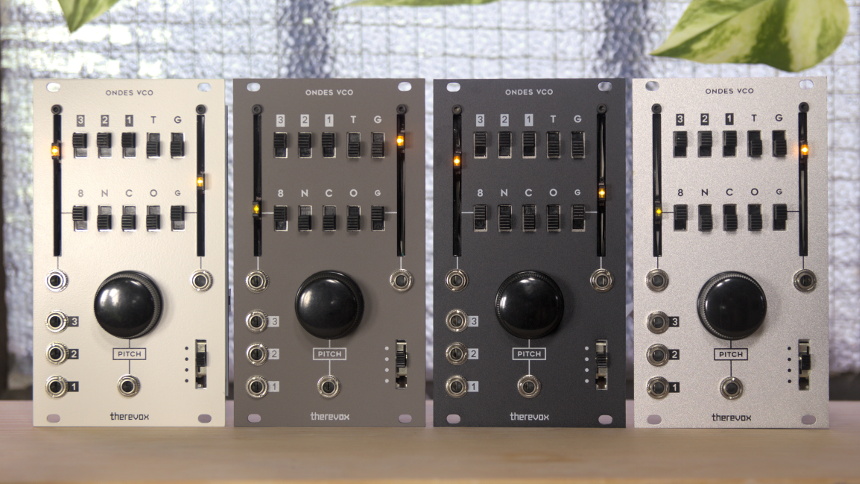
-
- addled muppet weed
- 111294 posts since 26 Jan, 2003 from through the looking glass
good, good, good, vibrations.