

And something looked a little off when I placed it immediately following a Toneboosters plugin in the effect chain.
Normal (other plugins):

Toneboosters:
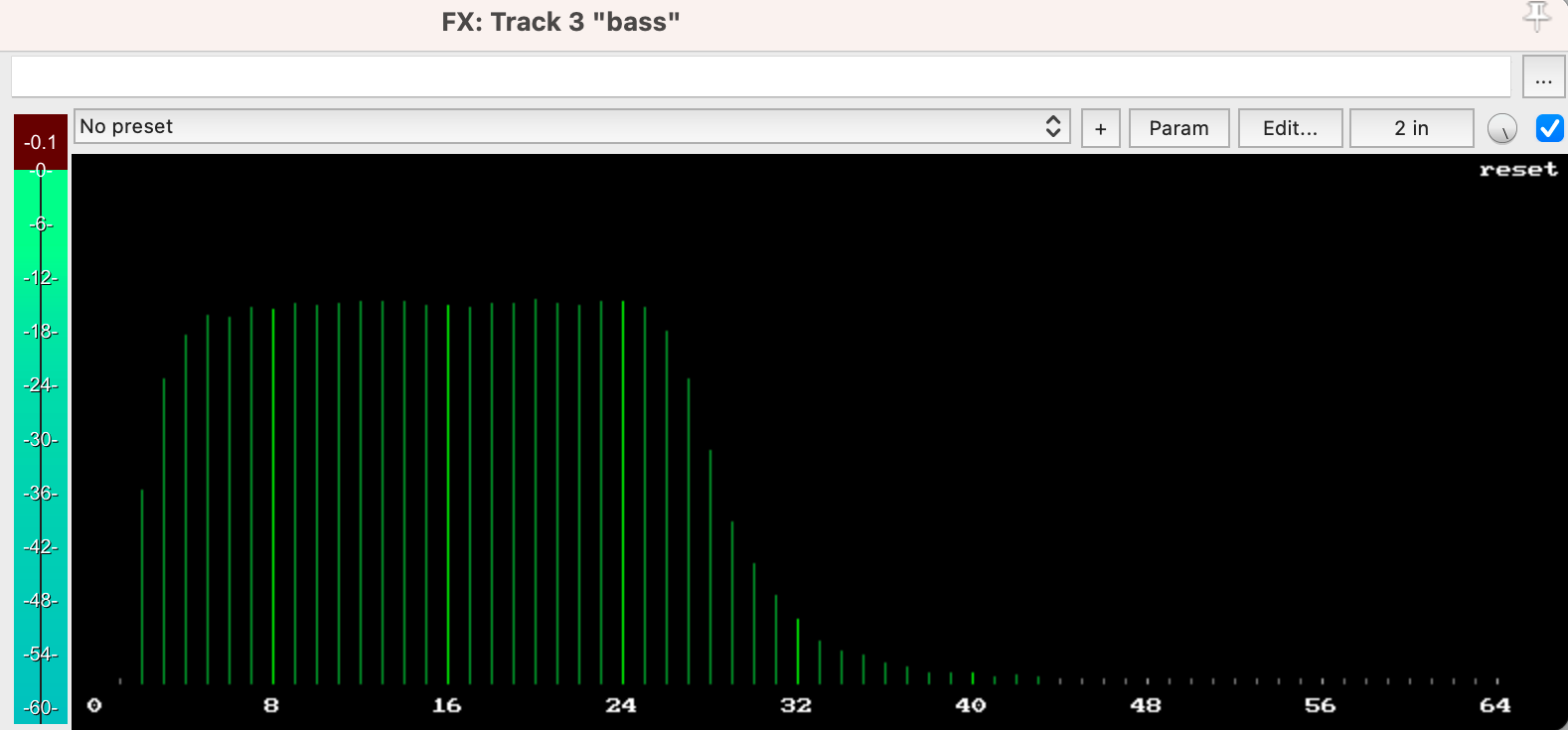
Any idea if this is something that has any real-world consequences?

badass_billy wrote: Thu May 25, 2023 9:29 pm Got a technical question on a topic I know very little about. After doing some more in-depth technical reading on bit-depth, I started taking a closer look at my projects in Reaper, and came across a tool, Bit Meter, that comes stock.
And something looked a little off when I placed it immediately following a Toneboosters plugin in the effect chain.
Normal (other plugins):
Toneboosters:
Any idea if this is something that has any real-world consequences?
Same deal with every plugin I tried, v3 and v4. No dither. Not really worried. Always get great results from their tools, so I doubt it has any real impact on sound quality.aberration123 wrote: Thu May 25, 2023 9:45 pm Barricade by any chance? does it say no dither in the bottom right hand corner? or are you applying 24 bit dither?

That's some very outdated opinion. Doubles are practically not slower than floats on modern x64 CPUs.MogwaiBoy wrote: Fri May 26, 2023 6:02 am They argue that they are doing your CPU and harddrive space a favour.

If convolution and FFT are concerned, 64-bit FP is much better as 32-bit FP peak error is very large.Ploki wrote: Fri May 26, 2023 1:44 pm What could possibly be gained by 64bit fp?
-250dB noise floor?
This means to me 64bitFP makes perhaps sense in speciallized plugins but what shall a 64bitFP mixing engine do in a DAW (compared to 32bitFP)?? ... In practice = hearable result... not in pure theory...Aleksey Vaneev wrote: Fri May 26, 2023 3:44 pmIf convolution and FFT are concerned, 64-bit FP is much better as 32-bit FP peak error is very large.Ploki wrote: Fri May 26, 2023 1:44 pm What could possibly be gained by 64bit fp?
-250dB noise floor?

Pure theory usually does not consider peak error, or distribution of error. In average, 32-fp is adequate, but its peak error can be huge. That's what one hears when comparing 64-fp and 32-fp.Trancit wrote: Fri May 26, 2023 4:43 pm This means to me 64bitFP makes perhaps sense in speciallized plugins but what shall a 64bitFP mixing engine do in a DAW (compared to 32bitFP)?? ... In practice = hearable result... not in pure theory...
Tbh, I have no clue what "peak errors" are and I am personally not able to hear any difference between switching in a DAW 64bit engine on/off... but perhaps I don´t know what to listen for...Aleksey Vaneev wrote: Fri May 26, 2023 5:11 pmPure theory usually does not consider peak error, or distribution of error. In average, 32-fp is adequate, but its peak error can be huge. That's what one hears when comparing 64-fp and 32-fp.Trancit wrote: Fri May 26, 2023 4:43 pm This means to me 64bitFP makes perhaps sense in speciallized plugins but what shall a 64bitFP mixing engine do in a DAW (compared to 32bitFP)?? ... In practice = hearable result... not in pure theory...


Yea, I found a few more. Waves and Fabfilter (oddly). Most of my collection is 64.MogwaiBoy wrote: Fri May 26, 2023 6:02 am Try some other non-Toneboosters plugins too if you have any.
E.g. you could make two renders - in 64-fp and 32-fp. Then subtraction of one from the other produces a delta signal whose RMS is considered an average error. But this delta signal also has its peak values. The thing usually overlooked is that peak error spectrum is not just some sort of white-noise sound - it may be a spectrally-rich noise like the one produced by bit-depth truncation. That's why one may hear it, even though on average it's almost non-existent.Trancit wrote: Fri May 26, 2023 6:52 pm Tbh, I have no clue what "peak errors" are and I am personally not able to hear any difference between switching in a DAW 64bit engine on/off...
Submit: News, Plugins, Hosts & Apps | Advertise @ KVR | Developer Account | About KVR / Contact Us | Privacy Statement
© KVR Audio, Inc. 2000-2026

