



Obxd synthesizer
-
- KVRer
- 16 posts since 22 Apr, 2020
This is a question for discoDSP.
Out of curiosity, have subsequent releases of OB-Xd after version 2.10 used any of the source code (modified or not) from release 2.10?
Also, since the source code of OB-Xd was under the GPL-3 License from both 2Dat and Reales (according to Github), if I was to purchase a Binary of OB-Xd, would I also be provided the corresponding source code that was used to compile that binary of OB-Xd?
Out of curiosity, have subsequent releases of OB-Xd after version 2.10 used any of the source code (modified or not) from release 2.10?
Also, since the source code of OB-Xd was under the GPL-3 License from both 2Dat and Reales (according to Github), if I was to purchase a Binary of OB-Xd, would I also be provided the corresponding source code that was used to compile that binary of OB-Xd?
-

- KVRAF
- 24463 posts since 7 Jan, 2009 from Croatia
Yeah obviously, releases after 2.10 were based on the same code as before. But then George got the rights to all the code from 2DaT and he could relicense it, while keeping 2.10 GPL code available. However any new modifications after that point do not fall under GPL so don't need to be provided along with the binary.
-
- KVRAF
- 5648 posts since 18 Jul, 2002
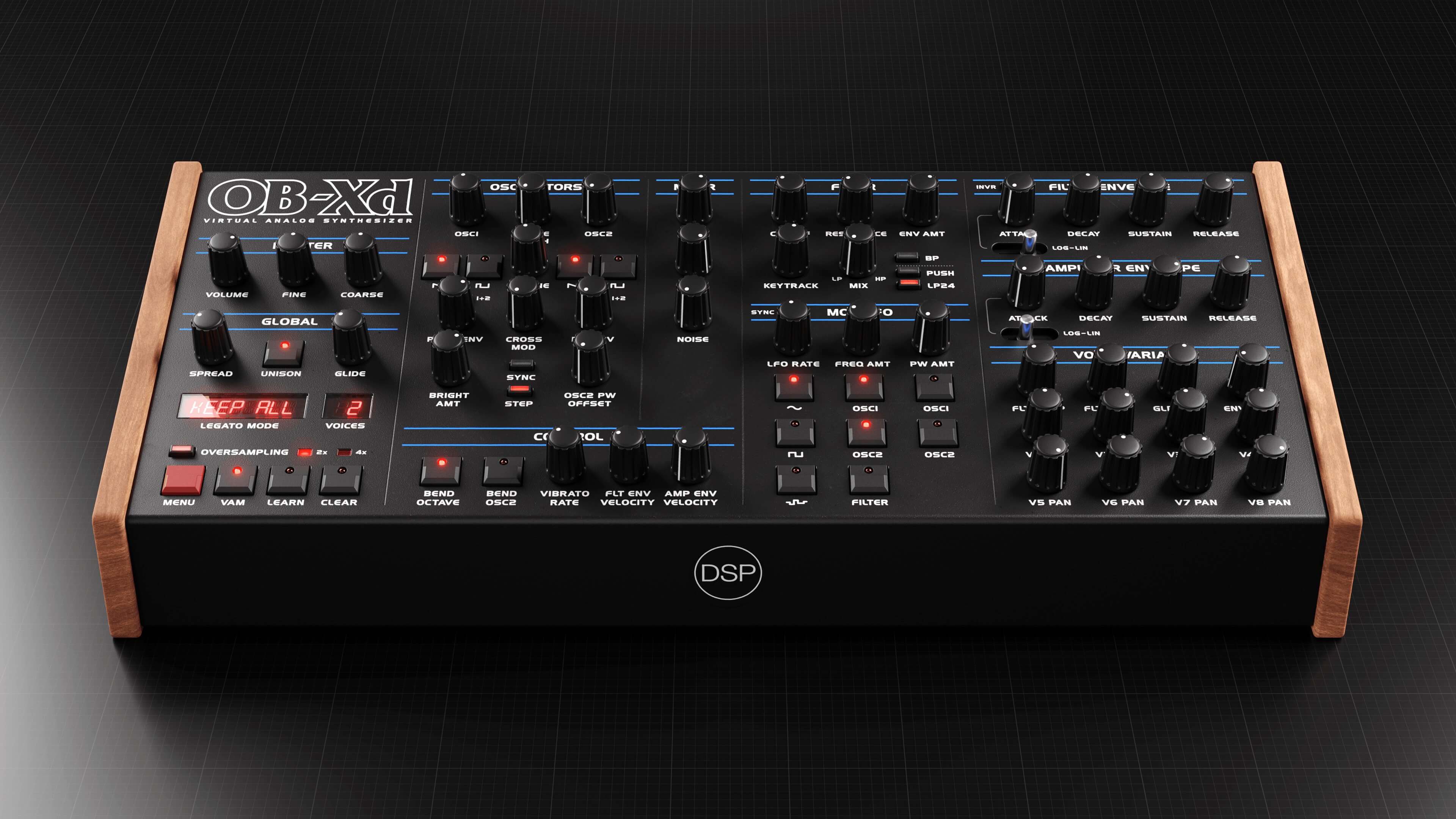
OB-Xd 3.1 is out now!
What's New
- Fixed GFX GUI CPU Issues in macOS: Significant reduction in CPU usage, especially for ARM systems, now operating at about 4% CPU usage compared to the previous 60%.
- LFO Tempo Sync Fix: Resolved issues with LFO tempo synchronization for smoother and more accurate performance.
- Properly Code Signed Windows AAX Plugins: Enhanced security and trust with properly code-signed AAX plugins for Windows users.
- Save Preset to Disk with Correct .FXP File Extension: Ensuring the 'Save Preset to Disk' function uses the correct .FXP file extension.
- Look and Feel Color Tweaks: Enhanced visual aesthetics with a new color scheme for improved user interface readability and experience.
- Better Popup Menu Behavior: Improved display in popup menus.
- Popup Menus on Windows HiDPI Displays: Correct scaling on high-resolution displays for clearer and more accessible interface.
- Revised PDF Manual: Updated and revised manual for clarity and comprehensiveness. OB-Xd PDF Manual.
- Minor Stability Enhancements: Further improvements focusing on user experience across different operating systems.
- Framework Update: An update to the underlying framework to enhance functionality and compatibility.
- Enhancements in Performance for all Platforms: Overall performance improvements across Windows, macOS, and Linux.
- For Registered Users: OB-Xd 3.1 available in the Members Area for the latest features and improvements.
- Free Version on OB-Xd Page: Free version of OB-Xd 3.1 downloadable from the OB-Xd page on our website.
-
- KVRer
- 16 posts since 22 Apr, 2020
Welp, good thing I know how to compile Binaries from source. And, it seems that some people have forked 2.10 and have made the code available. It's been a while since I have compiled OB-Xd from source on my Debian rig, but I am up to the challenge.EvilDragon wrote: Fri Dec 15, 2023 8:08 am Yeah obviously, releases after 2.10 were based on the same code as before. But then George got the rights to all the code from 2DaT and he could relicense it, while keeping 2.10 GPL code available. However any new modifications after that point do not fall under GPL so don't need to be provided along with the binary.
And if I get one of the forked versions up and running within Ardour on Debian, I will be sure to do a video tutorial which will be pushed out to Youtube, Rumble, Locals.com, etc. And will be shared here.
And why can I do that? Because I am a free and private citizen who is engaging in FREE SPEECH with source code that was released under the GPL-3 License. And furthermore, I believe it is my duty to show everyone how to compile that OB-Xd source code so that they can use that software without any restriction (other than the restrictions of GPL-3) to make great music (or even really bad music in my case), including using that piece of software to create a track and then release it for profit regardless of the whims and desires of the developer (This is stated in the FAQs at GNU.org and has been confirmed by DiscoDSP himself in previous posts on this thread with respect to compiling the OB-Xd code released under GPL-3).
I am expecting to get a response from DiscoDSP's bot with some canned response of "You have every right to do that with source code released under a GPL license, however think of the developer and the time, effort, resources, my employed staff, and blah blah blah."
To respond to that expected response from the bot, I honestly don't care. I am most definitely an awful person who has the absolute worst intentions for the OB-Xd source code that has been released under the GPL-3 license. The worst of those intentions is to show other users how to be a github leech so that they themselves can become github leeches. And hopefully they will REVEL in being a github leech. And by being a github leech who knows how to compile source code released under a FREE SOFTWARE LICENSE, they can mitigate any decisions (including ridiculous decisions) made by developers upstream.
I also anticipate an argument from the bot to be of the nature, "think also of the future enhancements and improvements of OB-Xd, wouldn't you want the software to be continually updated and supported?"
To that I say, believe it or not OB-Xd version 2.10 was and still is excellent. In fact it is so excellent at emulating an actual Oberheim Synth that I had a video get flagged and removed off of Facebook simply for recreating the detuned dual saw sound of Van Halen's Jump (in fact, Facebook thought I was using the 2004 remastered version of Jump when they cited me for a copyright violation). How much more improved do I need OB-Xd to be when I can faithfully recreate EVH's synth on Jump with OB-Xd by adding Dragonfly Reverb and a Chorus Effect? I understand the argument of support on newer systems, but I am a Linux user with the source code, I'll get by like every other Linux user.
And as far as improvement to an already great thing. Does the Juno 60 from 1982 need to be improved? Does the Jupiter 8 from the early 80's (I believe 81) need to be improved? Does the Prophet 5 or an OB-8 need to be improved? Last time I checked reverb.com, Jupiter 8's were going for $20-$30 Thousand Dollars. OB-8's were going from $8-$10 Thousand. Seems that the demand for retro synths is based on capturing that old, nostalgic, and unimproved sound.
My apologies to everyone on this thread for the long post. Obviously I am very unhappy that DiscoDSP has decided to close the source code for new releases of OB-Xd (in fact, I didn't know about this decision until I started getting youtube videos pushed to me for the latest release of OB-Xd at which point I went to search for the source code on github). I have spent the better part of 15 years being a Free and Open Source Software advocate (I am more for the Free/Libre part as opposed to the Open Source part) But rest assured that I will make a video tutorial for how to compile the GPL'd source code in Linux and then import the software into Ardour.
And when I figure out how to compile in Windows, I will make a step by step tutorial for that as well and share it with everyone.
Sorry Mac Users, I won't be able to help you. Since Apple Started soldering their ram to their logic boards, gluing their computers shut, and all around preventing their customers from being able to crack open and upgrade/fix their products, I refuse to buy their computers. I don't believe in planned obsolescence. In fact, my main Debian rig is a Dell T7500 Dual Intel Xeon Processor computer manufactured in 2012 and sporting 48 gigs of ram. I bought this computer used 6 years ago and it still runs the latest version of Debian and it still runs incredibly fast. I can still easily max out my computer to 192 gigs of ram and I can even upgrade the dual processors to the fastest processor that was made for that computer. And if a SSD or HDD goes bad, I can swap it out, reinstall any Linux distro of my choice onto a newly installed SSD or HDD, and be up and running in less than 2 hours while importing all my files (including Ardour Music Projects) from my own personal Nextcloud Server (Nextcloud Software is released under the AGPL-3 license by the way and didn't cost me a dime) that I have running in my house.
And to close out, I will say this. RICHARD STALLMAN WAS RIGHT!
-

- KVRian
- 1209 posts since 28 Jun, 2005
Not only that it also did not recall the setting of anything after reloading a project.Vortifex wrote: Fri Dec 15, 2023 6:42 pmAlso there's a bug with VST2 version in Windows. Enabling Step will make the oscillator tuning step between semitones as it's supposed to, but when you close and re-open the interface it no longer steps between semitones even though the button is still enabled.
vst2 version on Win10 FLStudio.
EDIT Reaper recalls the settings OK, but the step bug is there also.
-
- KVRian
- 1399 posts since 24 Sep, 2021
I dont use anything by DiscoDSP, but i see recurring people that mostly post here in various kvr threads, you sound like horrible, grumpy unfurfiled with life people, get a grip and let DiscoDSP do its thing.
On the topic, is having overampling a huge improvement over not having?
On the topic, is having overampling a huge improvement over not having?
-

- KVRAF
- 3824 posts since 8 Dec, 2008 from Global Cowboy
Overampling is essentialLbdunequest wrote: Fri Dec 15, 2023 9:42 pm I dont use anything by DiscoDSP, but i see recurring people that mostly post here in various kvr threads, you sound like horrible, grumpy unfurfiled with life people, get a grip and let DiscoDSP do its thing.
On the topic, is having overampling a huge improvement over not having?

No auto tune...
-
- KVRer
- 16 posts since 22 Apr, 2020
Update on compiling release 2.10 of OB-Xd github source code. This has been accomplished. I had to obtain and compile the source code for the latest version of JUCE. But once I had JUCE and Projucer, compiling OB-Xd from source on Linux was pretty straightforward.
I fired up Ardour, found the OB-Xd Plugin that I had just compiled from source. Threw it into a track with some TAL Chorus and Dragonfly Reverb. Needless to say it sounded absolutely amazing. I was able to create and save a preset in a bank that I created.
Only one hiccup that I noticed is that my compiled program of OB-Xd points to the Linux Document folder where the themes/skins are to be located. I found that with my compiled program, I was able to access the "Copywritten Themes" from DiscoDSP's non-free release. However, when I completely removed the folder with the copywritten assets, I got the expected "Assets Not Found Reinstall OB-XD or give access to documents folder".
The lack of skins DID NOT prevent me from being able to play the synth as I could control the synth from the Generic Controls found within Ardour.
So, after all said and done, I now have a version of OB-Xd compiled from Source that was released under GPL-3 which is a Free Software License that doesn't restrict me from using my compiled version to create Music that I can sell for a profit/commercial use (please refer to GPL FAQ on "Commercial Uses" at GNU.org on why I am able to do that with source code released under a GNU Public License).
And I didn't have to pay a single cent!!!! Isn't the GPL absolutely awesome?
Next Step is to see if I can compile a binary on Windows.
I fired up Ardour, found the OB-Xd Plugin that I had just compiled from source. Threw it into a track with some TAL Chorus and Dragonfly Reverb. Needless to say it sounded absolutely amazing. I was able to create and save a preset in a bank that I created.
Only one hiccup that I noticed is that my compiled program of OB-Xd points to the Linux Document folder where the themes/skins are to be located. I found that with my compiled program, I was able to access the "Copywritten Themes" from DiscoDSP's non-free release. However, when I completely removed the folder with the copywritten assets, I got the expected "Assets Not Found Reinstall OB-XD or give access to documents folder".
The lack of skins DID NOT prevent me from being able to play the synth as I could control the synth from the Generic Controls found within Ardour.
So, after all said and done, I now have a version of OB-Xd compiled from Source that was released under GPL-3 which is a Free Software License that doesn't restrict me from using my compiled version to create Music that I can sell for a profit/commercial use (please refer to GPL FAQ on "Commercial Uses" at GNU.org on why I am able to do that with source code released under a GNU Public License).
And I didn't have to pay a single cent!!!! Isn't the GPL absolutely awesome?
Next Step is to see if I can compile a binary on Windows.
-
- KVRAF
- 3824 posts since 8 Dec, 2008 from Global Cowboy
rfawcett wrote: Sat Dec 16, 2023 4:06 am Update on compiling release 2.10 of OB-Xd github source code. This has been accomplished. I had to obtain and compile the source code for the latest version of JUCE. But once I had JUCE and Projucer, compiling OB-Xd from source on Linux was pretty straightforward.
I fired up Ardour, found the OB-Xd Plugin that I had just compiled from source. Threw it into a track with some TAL Chorus and Dragonfly Reverb. Needless to say it sounded absolutely amazing. I was able to create and save a preset in a bank that I created.
Only one hiccup that I noticed is that my compiled program of OB-Xd points to the Linux Document folder where the themes/skins are to be located. I found that with my compiled program, I was able to access the "Copywritten Themes" from DiscoDSP's non-free release. However, when I completely removed the folder with the copywritten assets, I got the expected "Assets Not Found Reinstall OB-XD or give access to documents folder".
The lack of skins DID NOT prevent me from being able to play the synth as I could control the synth from the Generic Controls found within Ardour.
So, after all said and done, I now have a version of OB-Xd compiled from Source that was released under GPL-3 which is a Free Software License that doesn't restrict me from using my compiled version to create Music that I can sell for a profit/commercial use (please refer to GPL FAQ on "Commercial Uses" at GNU.org on why I am able to do that with source code released under a GNU Public License).
And I didn't have to pay a single cent!!!! Isn't the GPL absolutely awesome?
Next Step is to see if I can compile a binary on Windows.


No auto tune...