

Rebuilding combo amps into ampheads?
-

- KVRAF
- 20910 posts since 22 Nov, 2000 from Southern California
Yes, as everyone else has said, don't do it. Amp electronics can kill you.
-
- KVRian
- Topic Starter
- 693 posts since 18 Apr, 2021
I have no intention of touching anything inside the amps, why would I need to do that? It seems this thread has derailed somewhat. I just want to remove the speaker and part of the cab on a combo, in some cases I wouldn't even have to remove the amp from the cab. The only reason is to make it easier and to avoid the risk damaging the amp while working on the cab. I don't have to touch anything not already in the open though
This is on the way and the amp I'm thinking of converting first, a Hughes & Kettner Warp 7 212 for 150 quid. I might make a cab out of it as well. I recently got a Hughes & Kettner Warp 4x12 cab which was all plywood, I guess it's hoping for too much if the cab for this amp is plywood as well, it had a retail price of 900 quid when new though. I don't know what kind of speakers it have, the 4x12 have 25 watt Rockdriver Junior, this must have 50 watt speakers. I really like the amp, and would have liked an amphead instead, this is what is availaible though
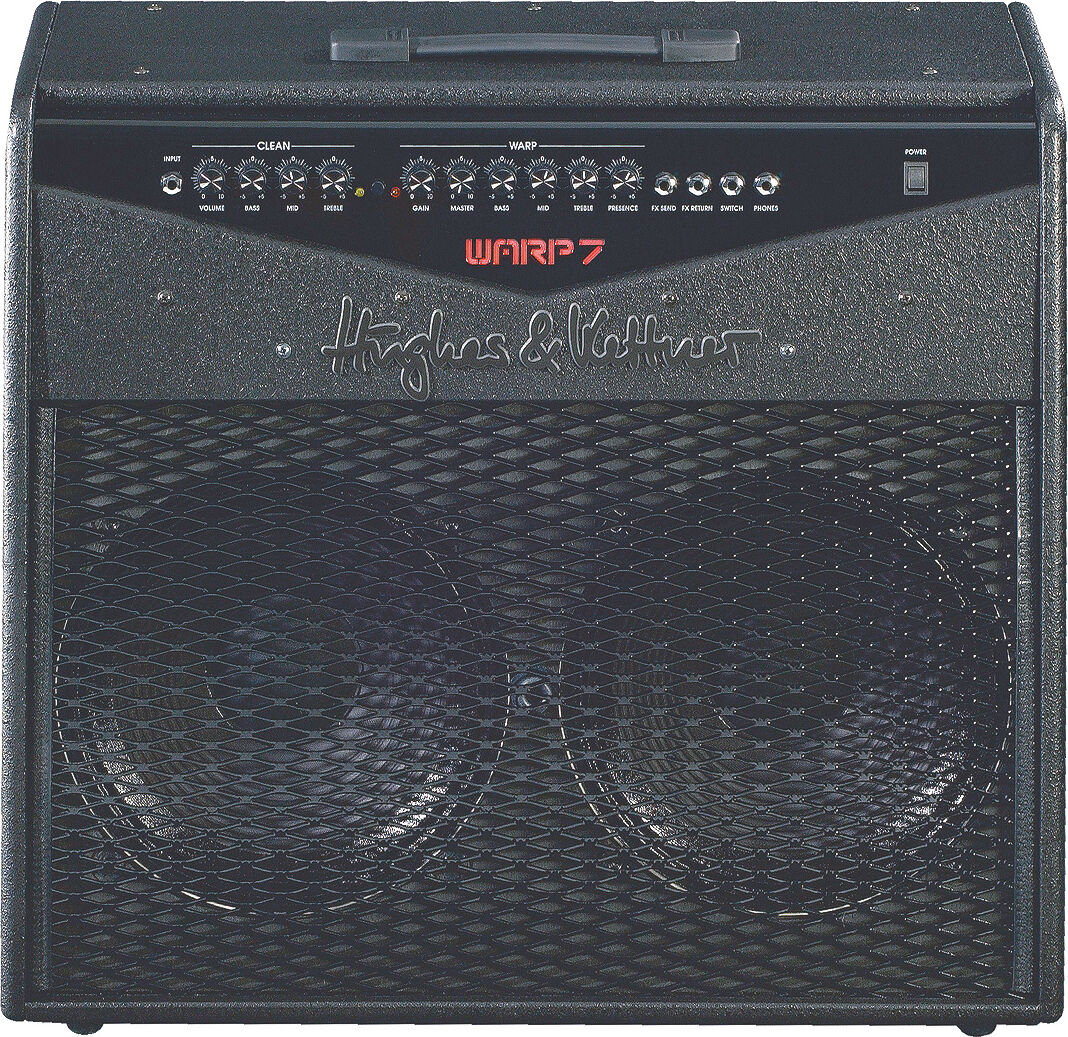
This is on the way and the amp I'm thinking of converting first, a Hughes & Kettner Warp 7 212 for 150 quid. I might make a cab out of it as well. I recently got a Hughes & Kettner Warp 4x12 cab which was all plywood, I guess it's hoping for too much if the cab for this amp is plywood as well, it had a retail price of 900 quid when new though. I don't know what kind of speakers it have, the 4x12 have 25 watt Rockdriver Junior, this must have 50 watt speakers. I really like the amp, and would have liked an amphead instead, this is what is availaible though
-
- KVRAF
- 16815 posts since 13 Oct, 2009
That's a solid state amp. Unplugged it's highly unlikely to contain lethal high voltages. I say unlikely because there is some very small chance that it runs from a bipolar supply in the 60v range as many hifi amps of similar wattage do. That is nothing like the 10x of that voltage you will find in tube amps.
You are overconfident however. You completely missed the point that you touch those points inadvertently, not intentionally. Also, not disassembling prior to cutting the wood must be the most noob thing I've heard in a long time.
This thread hasn't derailed, you asked us what we think, we're telling you. You have no idea what you're doing and thus, for you, it's a terrible idea.
You are overconfident however. You completely missed the point that you touch those points inadvertently, not intentionally. Also, not disassembling prior to cutting the wood must be the most noob thing I've heard in a long time.
This thread hasn't derailed, you asked us what we think, we're telling you. You have no idea what you're doing and thus, for you, it's a terrible idea.
-
- KVRAF
- 20910 posts since 22 Nov, 2000 from Southern California
It will look cool as a head. Definitely more work than it's worth and you'll need proper tools to make it look good. And yes, like ghettosynth said, you'll need to remove the chassis to do the work, that's unavoidable.
You do not have the required permissions to view the files attached to this post.
-
- KVRian
- Topic Starter
- 693 posts since 18 Apr, 2021
If I could get my hands on an amphead I would, this is the only Warp amp I've seen for sale for years though. And quite inexpensive as well. Of course I will remove the chassis, I was only making a point. I will have to wait for the amp to get here to see how difficult it will be. The actual amp looks identical to the amphead, the connection to the speakers is inside the chassis though, and it depends on how this is done. I would assume that the amp has some kind of bottom and nothing of the inside of the amp exposed, I'll find out when I remove the backplate for the speaker cabinet part. I might not be very experienced when it comes to electronics, I'm actually relatively decent at woodworking and have the proper tools though
-
- KVRian
- Topic Starter
- 693 posts since 18 Apr, 2021
I have removed amps from their chassis numerous times, even tube amps. The tech who used to do maintenance on my amps always wanted me to remove the amp from the chassis when delivering it to him. He never warned me about any dangers, perhaps it's a Marshall thing or just stricter regulations when it comes to electronics in Norway. I managed to do it without touching anything inside or on top of the amp anyway
-
- KVRAF
- 20910 posts since 22 Nov, 2000 from Southern California
Leave it unplugged for a week. The caps will discharge on their own, at least enough to not be lethal.
-
- KVRian
- Topic Starter
- 693 posts since 18 Apr, 2021
Had a look at it and it seems pretty straightforward. I can remove the amp and use it as an amphead as is. Of course, if I want it to look more like the actual amphead I have to cut the side panels, fit them to the amp and find something to use as a lower plate with amp feets. The amp sounds pretty good for metal. You get the heavy, very chuggy, full and precise sound for fast riffing, and a supringsly decent lead tone for a solid state amp. Nice lows and mids, even with the combo speakers
The speaker cab was slightly disappointing. The first thing I saw when I opened it, which I had to do from the front, was the baffle plate, which is really thick plywood. As it turned out though, that is the only plywood in the amp, the rest is presswood. I had also hoped for Rockdriver Junior speakers, instead I got Celestion Hot 100 speakers. These are the original speakers, they are not that good though. The amp sounded much better straight away when I plugged it into a single Texas Heat in my cheap 2x12 stereo test cab. Also the cab has no top plate as the amp is placed directly on top of it. I can still turn it into a cab, as it isn't plywood it's not something I'll prioritize though
The speaker cab was slightly disappointing. The first thing I saw when I opened it, which I had to do from the front, was the baffle plate, which is really thick plywood. As it turned out though, that is the only plywood in the amp, the rest is presswood. I had also hoped for Rockdriver Junior speakers, instead I got Celestion Hot 100 speakers. These are the original speakers, they are not that good though. The amp sounded much better straight away when I plugged it into a single Texas Heat in my cheap 2x12 stereo test cab. Also the cab has no top plate as the amp is placed directly on top of it. I can still turn it into a cab, as it isn't plywood it's not something I'll prioritize though
-
- KVRian
- Topic Starter
- 693 posts since 18 Apr, 2021
Perhaps a stupid question, since we have already established I'm not particurarly skilled when it comes to electronics I'm going to ask anyway though
The amp part on the Warp 7 has an output for an external cab on the backside. This is partly connected to the speakers inside the chassis with one set of wires, and a single wire going directly from the amp to the speakers inside. Can I cut the wires to the speakers, and only use the output from the amp with an external cab, or should I make a primary output from the wires going to the speakers and use that when used with a single cab? Just cutting the wires and use the output already there is obviously the easiest and most practical solution, I just want to make sure I don't destroy anything
The amp part on the Warp 7 has an output for an external cab on the backside. This is partly connected to the speakers inside the chassis with one set of wires, and a single wire going directly from the amp to the speakers inside. Can I cut the wires to the speakers, and only use the output from the amp with an external cab, or should I make a primary output from the wires going to the speakers and use that when used with a single cab? Just cutting the wires and use the output already there is obviously the easiest and most practical solution, I just want to make sure I don't destroy anything
-

- KVRAF
- 16861 posts since 8 Mar, 2005 from Utrecht, Holland
If you cut a wire, then you destroyed something 
[/stupidAnswer]
It is possible that the 'ext.speaker' connector has an internal switch which disconnects the internal speaker when a plug is inserted. This really is impossible to know without either studying the manual, schema, or close inspection of the wires & parts.
[/stupidAnswer]
It is possible that the 'ext.speaker' connector has an internal switch which disconnects the internal speaker when a plug is inserted. This really is impossible to know without either studying the manual, schema, or close inspection of the wires & parts.
We are the KVR collective. Resistance is futile. You will be assimilated. 
My MusicCalc is served over https!!
My MusicCalc is served over https!!
-
- KVRAF
- 20910 posts since 22 Nov, 2000 from Southern California
For clarity, does the external jack have 2 wires going directly to the amp? Or are you saying the wire goes to the speaker, then out from the speaker to the external jack? The second way would be unusual.
-
- KVRAF
- 16815 posts since 13 Oct, 2009
It would be great if you could film your work on the amp. I'll never forget our bass player who arrogantly thought himself an expert and brought a relatively expensive solid state amp into practice that he was going to chain with his tube combo amp for a better sound. Right, that was totally necessary in our tiny practice room with his potato bass playing. At any rate, he proceeded to plug the speaker out of one amp into the external speaker jack of the other amp. I said "that's not the correct way to do that" he, literally yelled, "I know what I'm doing." Ok, big boy, you do you. To say that I gloated the second that he turned it on and we heard a solid pop as both amps went silent would be an understatement. He wasn't convinced, yet, believe it or not. He thought that he could just replace the fuses with tin foil wrapped around the now blown fuse. I said "that's a bad idea, it will likely do more damage." Our resident amp expert was having none of it. According to him, fuses were intentionally underrated and real musicians weren't afraid to go all punk rock. Well, the tube amp survived his "experiments", but, after he turned the solid state amp back on the band saw his best performance ever as we heard and watched the magic working pixies dancing out onto the carpet in a shower of performance sparks, smoke, and crackle. Even the smell was delicious.
Jokes for days.
Jokes for days.
-
- KVRian
- Topic Starter
- 693 posts since 18 Apr, 2021
It doesn't disconnect the internal speakers, I know as I have connected an external cab to the output and sound is still coming from the internal speakersBertKoor wrote: Tue Sep 30, 2025 12:32 pm It is possible that the 'ext.speaker' connector has an internal switch which disconnects the internal speaker when a plug is inserted. This really is impossible to know without either studying the manual, schema, or close inspection of the wires & parts
I removed the output for the external speaker from the cab, not completely, it's still connected. I had to remove the lower plate to get access to the inside of the amp. Don't worry, I only touched the output. The thick black wire in the middle is from the amp, and seems to be connected to both sides of the output, two wires inside I guess. The thinner black wire goes from the output to the speakers, and the red wire passes the output and goes from the amp to the speakersUncle E wrote: Tue Sep 30, 2025 5:37 pm For clarity, does the external jack have 2 wires going directly to the amp? Or are you saying the wire goes to the speaker, then out from the speaker to the external jack? The second way would be unusual

click here for larger image
-
- KVRAF
- 16861 posts since 8 Mar, 2005 from Utrecht, Holland
This confirms what's stated in the manual, namely that the external speaker output of the combo model is serial. The connector has some clevery bent parts inside which perform the magic of disconnecting the two top pins when a plug is inserted.
I could give detailed instructions how to "mod" this into whatever you fancy, but I won't. I assume you have a soldering iron and multimeter and know how to operate it, and have enough brains to reason about electical wiring. To be honest, I don't know what you want from us. You're doing this at your own risk and me thinks you have to figure this out by yourself. You are accepting the risk of electrocution and/or permanently damaging any of the involved equipment. The decision to continue or abort this mission is all yours.
I could give detailed instructions how to "mod" this into whatever you fancy, but I won't. I assume you have a soldering iron and multimeter and know how to operate it, and have enough brains to reason about electical wiring. To be honest, I don't know what you want from us. You're doing this at your own risk and me thinks you have to figure this out by yourself. You are accepting the risk of electrocution and/or permanently damaging any of the involved equipment. The decision to continue or abort this mission is all yours.
We are the KVR collective. Resistance is futile. You will be assimilated.
My MusicCalc is served over https!!
My MusicCalc is served over https!!