

Bright. Windows isn't going anywhere. x86 hasn't run out of road. Linux is also great.
Plenty of Mac users are diehard evangelists to justify thier current continued expenditure to remain compatible and current.
Some Mac users are normal people. Some.
Future of Windows in pro audio
-

- KVRAF
- 7026 posts since 19 Apr, 2002 from Utah
I haven’t checked up on this in a while, so I may be a bit outdated on this, but I was under the impression and understanding that while technology and physics has been approaching the maximum top performance on a single CPU (due to the limitations on how densely silicon can be packed), there had been the discovery of a better material than silicon, and that this was going to be able to extend single core speeds.jamcat wrote: Sat Jan 17, 2026 10:43 pm Right. They have to. The x86_64 architecture has run out of road.
Yes, Apple had to break a few eggs to make an omelette. But that omelette is here now, and it is delicious.
You're going to lose some old plugins no matter which OS you're on. But you have to let go of the past before you can embrace the future.
Also, I was under the impression that the plan to get beyond the single core speed problem, was through massive parallelization and threadin—through the expansion of the number of cores.
Supposedly, x86-64 has somehow managed to keep up with Moore’s law through yearly increasing the number of cores included in a single CPU.
Also, I was under the impression that the chief benefit of ARM vs X86-64 architectures is that while CISC instruction sets are designed for performance, RISC instruction sets are designed for power efficiency—thus making X86-64 likely to remain the choice for servers, while ARM was expected to rule the mobile market.
Granted, as I mentioned, I haven’t read up on developments of the last two or three years, so I may be wrong, but isn’t this all still the case? And if so, doesn’t that mean that X86-64 will continue to dominate the server realm, while ARM dominates the mobile/desktop realm? This would explain the desire to move Windows to ARM—to be like MacOS and Linux. ARM dominates when it comes to extending battery life.
Personally, I’m not too bothered either way, because Linux runs on everything—including Apple hardware. But I do like to keep up on the current events in computing technology, and I’m wondering if I may have missed some technological developments.

Vendor‑Dependent Copy Protection: Customers lose. Pirates win.
(Also: I'm Accused of lying about Linux—it boots, runs my pro audio workflow, stays stable, updates--though yearly dismissed as “niche”. Yet I'm the deluded one.)
(Also: I'm Accused of lying about Linux—it boots, runs my pro audio workflow, stays stable, updates--though yearly dismissed as “niche”. Yet I'm the deluded one.)
-
- KVRAF
- 7026 posts since 19 Apr, 2002 from Utah
I don’t think that TOPS shows the whole picture though—there are several other considerations that come into play too.
https://snuc.com/blog/what-is-tops-and- ... -you-care/
But I want to understand your point better, so I’m going to have to read more about this before I can agree or disagree at this point. What’s your source link?
Edit: Nevermind, I found it:
https://thecuberesearch.com/breaking-an ... el-newman/
I’ll read up and give my opinion.
Last edited by audiojunkie on Mon Jan 19, 2026 3:05 am, edited 2 times in total.
Vendor‑Dependent Copy Protection: Customers lose. Pirates win.
(Also: I'm Accused of lying about Linux—it boots, runs my pro audio workflow, stays stable, updates--though yearly dismissed as “niche”. Yet I'm the deluded one.)
(Also: I'm Accused of lying about Linux—it boots, runs my pro audio workflow, stays stable, updates--though yearly dismissed as “niche”. Yet I'm the deluded one.)
-

- KVRAF
- 7661 posts since 2 Sep, 2019
THIS MUSIC HAS BEEN MIXED TO BE PLAYED LOUD SO TURN IT UP
-
- KVRAF
- 7026 posts since 19 Apr, 2002 from Utah
Ha!! You must have posted this at the exact same time I was posting that I found it.
Vendor‑Dependent Copy Protection: Customers lose. Pirates win.
(Also: I'm Accused of lying about Linux—it boots, runs my pro audio workflow, stays stable, updates--though yearly dismissed as “niche”. Yet I'm the deluded one.)
(Also: I'm Accused of lying about Linux—it boots, runs my pro audio workflow, stays stable, updates--though yearly dismissed as “niche”. Yet I'm the deluded one.)
-
- KVRAF
- 7026 posts since 19 Apr, 2002 from Utah
Interesting discussion! I had never heard of Wright’s law. To sum up for this conversation, how it affects the silicon industry: the fiscal advantage goes to those who sell the most product. Selling the most product perpetuates the advantage through lowering costs, which continues to help keep the product popular, and help continue selling the most product. In short, ARM is well positioned, which is allowing it the fiscal advantage to further innovate.
However, I don’t think we can rule out X86-64 yet. There is too much at play. Too many variables. The article even states that. The US government just invested in Intel, which could be a fiscal boon to the company.
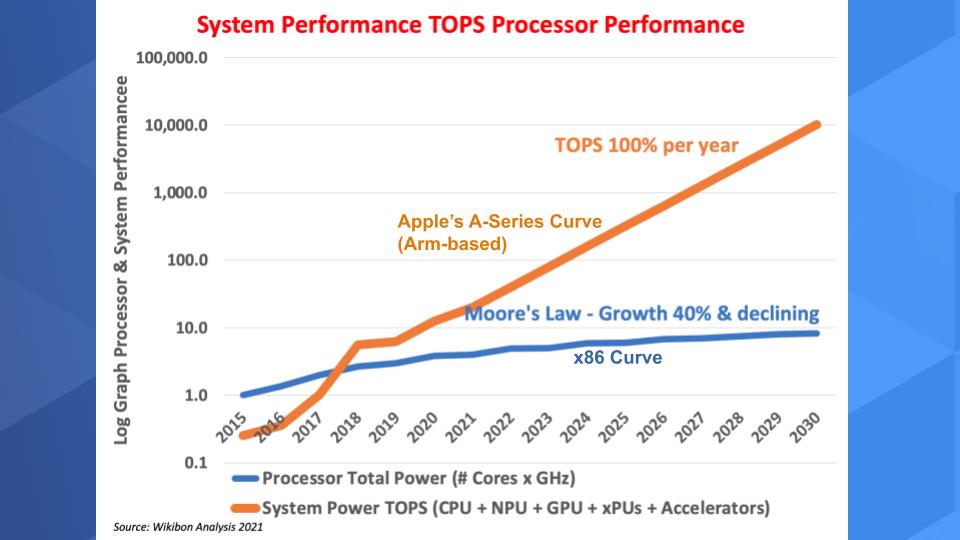
Also, the actual graph, which you posted compares single CPU vs the combined CPU+NPU+CPU. This isn’t a bad thing, but it shows the Apple chip (using ARM) vs the X86-64 chip alone. So chip vs chip. But the Apple chip contains more processing units of different types, so it doesn’t show the whole picture.
If comparing CPU vs CPU alone, the Apple M-series chips dominate (as seen in the picture), because they also contain the NPU and GPU. But to get a more fair comparison, one must remember that the PC GPU and any NPU would be separate from the CPU, but still included in the computer—in the form of video cards or neural processing units.
So it is all very much undecided in the X86-64 vs ARM debate. However, I will admit that Apple is very, very well positioned to do very well with their M-series chips, and the fact that Apple has its own manufacturing even further gives advantage to that position.
However, I don’t think we can rule out X86-64 yet. There is too much at play. Too many variables. The article even states that. The US government just invested in Intel, which could be a fiscal boon to the company.
Also, the actual graph, which you posted compares single CPU vs the combined CPU+NPU+CPU. This isn’t a bad thing, but it shows the Apple chip (using ARM) vs the X86-64 chip alone. So chip vs chip. But the Apple chip contains more processing units of different types, so it doesn’t show the whole picture.
If comparing CPU vs CPU alone, the Apple M-series chips dominate (as seen in the picture), because they also contain the NPU and GPU. But to get a more fair comparison, one must remember that the PC GPU and any NPU would be separate from the CPU, but still included in the computer—in the form of video cards or neural processing units.
So it is all very much undecided in the X86-64 vs ARM debate. However, I will admit that Apple is very, very well positioned to do very well with their M-series chips, and the fact that Apple has its own manufacturing even further gives advantage to that position.
Vendor‑Dependent Copy Protection: Customers lose. Pirates win.
(Also: I'm Accused of lying about Linux—it boots, runs my pro audio workflow, stays stable, updates--though yearly dismissed as “niche”. Yet I'm the deluded one.)
(Also: I'm Accused of lying about Linux—it boots, runs my pro audio workflow, stays stable, updates--though yearly dismissed as “niche”. Yet I'm the deluded one.)
-
- KVRian
- 877 posts since 9 May, 2005
Hmmm...jamcat wrote: Fri Jan 16, 2026 1:01 am
- Windows has no future.
- All your software is cross-platform. You already own if for Mac.
- You can't keep Windows as a local account anymore.
Are you sure about that?
The machine I'm typing on is running Windows 11 Pro... with only a local account.
Literally every machine I build for clients is running nothing but a local account.
Windows 11 is a fine DAW platform.
Anyone who says otherwise simply doesn't know what they're talking about.
My company builds custom PC DAWs professionally... and has done so for over 30 years.
The 9950x machine sitting to my right is faster than the fastest Mac Studio, has six internal M.2 SSDs that run at full speed, it's rock-solid stable, and runs extremely quiet.
It can run the likes of ToneX at 1ms total round-trip latency (96k using a 32-sample ASIO buffer).
It smokes the fastest Mac Studio... which I bought to run Lightkey (DMX software that's Mac only).
Apple's future?
Slower CPUs (than top-tier PC choices)
Zero internal expansion/upgrade (what you buy is what you're stuck with)
If you want to use more than a single drive, it has to be tethered via Thunderbolt.
About external Thunderbolt enclosures.
If you're running M.2 PCIe 4.0, you're leaving significant performance on-the-table.
PCIe 5.0? You're leaving massive performance on-the-table.
Internally:
PCIe 3.0 M.2 sustains ~3,500MB/Sec
PCIe 4.0 M.2 sustains ~7,000MB/Sec
PCIe 5.0 M.2 sustains ~14,000MB/Sec
Most fanless external M.2 enclosures top out at ~2,800-4,000MB/Sec.
The very best allow ~6,000MB/Sec (if connected to Thunderbolt 5).
Fast M.2 drives get very warm in tight external enclosures: some of the faster enclosures have loud fans... which totally negates the point of having a quiet machine.
If you love Apple, more power to you.
As for the future of Windows, 70+ percent of ALL computers are currently running Windows.
That's massive market-share... that won't be going away any time soon.
-
- KVRAF
- 2061 posts since 13 Dec, 2016
Bold move, Jim. Replying to forum prophecy with a workstation that actually exists. Those tend to complicate things and certain worldviews prefer not to be measured.
Its over for Bitwig--CUBASE WON !!!!!!!!!!!!!!!!!!!!!!!!!!!!!!!!!
-
- KVRAF
- 5444 posts since 15 Feb, 2020
It’s one Mac weirdo, let’s not over- egg it.
Personally I’ve made my peace with my proper slow Mac audio stack and don’t care what other folks use.
Personally I’ve made my peace with my proper slow Mac audio stack and don’t care what other folks use.
I lost my heart in Cap de Creus
-

- KVRAF
- 2318 posts since 23 Sep, 2004 from Kocmoc
Its not that slow anymore though what I hear, they've made strides since M1 came out. Still not as fast as ASIO and we do not talk about linux here at this table at the same time, sorry...revvy wrote: Mon Jan 19, 2026 5:08 pm It’s one Mac weirdo, let’s not over- egg it.
Personally I’ve made my peace with my proper slow Mac audio stack and don’t care what other folks use.
Soft Knees - Live 12, Diva, Omnisphere, Slate Digital VSX, TDR, Kush Audio, U-He, PA, Valhalla, Fuse, Pulsar AUDIO, NI, OekSound etc. on Win11Pro R7950X & RME AiO Pro
https://www.youtube.com/@softknees/videos Music & Demoscene
https://www.youtube.com/@softknees/videos Music & Demoscene
-
- KVRAF
- 7661 posts since 2 Sep, 2019
Then you owe it to your company and your clients to know what’s going on in Windows world. You seriously don’t know about the planned elimination of local accounts? You haven’t experimented at all with the Windows 26H1 previews since October?
Also, 26H1 will introduce a major shift towards ARM processors.
Last edited by jamcat on Mon Jan 19, 2026 8:01 pm, edited 1 time in total.
THIS MUSIC HAS BEEN MIXED TO BE PLAYED LOUD SO TURN IT UP
-
- KVRist
- 271 posts since 26 Jun, 2021
Okay. Run the TOPS on an old 12th gen i5 paired with a 5090/5080.
Find you've got over 10x the TOPS at 25% the cost. Macs just aren't there in regards to pure compute to $$$ spent.
In before "doesn't count. Apples to oranges. I was talking cpu only"
Show me the current Apple offering that offers 5090 compatability competitive pricing??
-

- KVRAF
- 26033 posts since 20 Oct, 2007 from gonesville
Cubase is ASIO on Mac. It was once seriously slower than it is today; it got better. I tend to doubt that this is because of ASIO improvements.legendCNCD wrote: Mon Jan 19, 2026 5:43 pmStill not as fast as ASIOrevvy wrote: Mon Jan 19, 2026 5:08 pm It’s one Mac weirdo, let’s not over- egg it.
Personally I’ve made my peace with my proper slow Mac audio stack and don’t care what other folks use.
-
- KVRAF
- 1767 posts since 20 Feb, 2003
Ok. This doesn’t change that Microsoft are taking away local accounts for Windows Home. Why would they be doing this?Jim Roseberry wrote: Mon Jan 19, 2026 4:42 pmThe machine I'm typing on is running Windows 11 Pro... with only a local account.
Literally every machine I build for clients is running nothing but a local account.
 And the most troubling aspect? Very few would’ve used those command lines hacks to keep local accounts. So it’s not even about the numbers. Rather it’s a statement of intent from Microsoft - Them laying down “this is how it’s gonna be..”
Just as LTSC Windows exists, to gain better control of updates and telemetry, so you’ll likely be able to use the Pro edition to keep local accounts. This ignores the actual issue at hand - Namely Microsoft’s general direction and their attitude and treatment towards “regular” consumers.
Statements like this aren’t true. From past interactions you seemed to like Cinebench as a benchmark. If you take Cinebench r23 the 9950X is faster. But guess what happens when you take the latest Cinebench 2026 benchmark? Why, would you look at that - An M3 Ultra is noticeably faster (12,082 Vs 9,625 Multicore, and 573 Vs 566 single core according to CPU Monkey). And that’s a nearing 2.5 year old chip. Even the 3D version of the 9950X is only about 3/4 the speed of M5, core for core.The 9950x machine sitting to my right is faster than the fastest Mac Studio
So ARM, or at least Apple's M5, is now out-performing X86-64 core for core purely on performance terms, before we even get into the massive power usage differences. Of course, Apple itself appears in no hurry to release anything more than the Max version of their latest cores. This, like everything lately, is partly thanks to the AI niche M3 Ultra fills thanks to the M-series’ huge memory bandwidth. Meaning they don't need to offer their best to sell in that market.
This is plenty fast for pretty much every DAW usage scenario..The very best allow ~6,000MB/Sec (if connected to Thunderbolt 5)
Last edited by PAK on Tue Jan 20, 2026 4:23 am, edited 1 time in total.