

The LLM created ideas. That has nothing to do with gawd or eliza. LLMs are useful, if you don't find them useful, I have nothing to say to that beyond I'm pretty sure I'm not alone when I say, IDGAF.Zeisner wrote: Tue Feb 17, 2026 10:38 pmThat "bubble" is reality (and science and engineering) while you're playing the same game as creationists.ghettosynth wrote: Tue Feb 17, 2026 10:14 pm You can hide out in that bubble all that you like. It doesn't change reality.

If AI replaces musicians, does the entire plugin industry die with them?
-
- KVRAF
- 16724 posts since 13 Oct, 2009
-
- KVRian
- 623 posts since 8 Dec, 2025
I can understand why LLMs must be fascinating for people who are incompetent in the particular field they're trying to work in. It looks like the solution to everything as long as you don't know what you're doing. But if you're an expert it's a completely different story. Only then you see how bad it really is with its horrendous error rates.
-
- KVRist
- 392 posts since 1 Jul, 2004
Is that the answer you were looking for? https://chatgpt.com/share/6994fd5a-a9b4 ... 5a29b21ac2Zeisner wrote: Tue Feb 17, 2026 10:38 pm Ask your precious LLM for ideas about how to create fully mono compatible (!) equivalence stereophony. You know, ILD+ITD+ISD.
AI still makes mistakes and doesn't know everything. But I don't think that making less mistakes or knowing more will be the areas where humans will stand out. It is more likely that humans might prefer human things because of being human and from humans, keeping human made stuff viable for humans even if AI should actually at some point do many things fasterbettercheapergreaterwhatever.
-

- KVRist
- 450 posts since 6 Sep, 2003
The music is pretty good but the heavily autotuned vocals ruin it.wagtunes wrote: Tue Feb 17, 2026 5:07 pmOMG, I just turned on Radio 1 and heard this amazing dance track that I'd never heard before. They sure don't play it here in NY.Vortifex wrote: Tue Feb 17, 2026 12:19 pmThat person is wrong. You don't need a licence to listen to BBC Radio. And if you're outside the UK you can listen to multiple BBC Radio stations using this link: https://help.bbc.com/hc/en-us/articles/ ... ide-the-UKwagtunes wrote: Tue Feb 17, 2026 12:07 pm Well that sucks because there are no good radio stations in the US. Oh well.
Just scroll down and you'll see a long list. I just tried via a USA VPN and it works.
6 Music is very eclectic and great for finding new underground acts. Radio 1 is the mainstream pop station. 1Xtra is 'urban' music. Radio 2 skews older with a more polite range of music and discussion. Radio 3 is classical. Radio 4 is a mix of news, current affairs, documentaries, plays and comedies.
-
- KVRian
- 623 posts since 8 Dec, 2025
Obviously not because the answer is garbage (as expected). It makes no sense. And obviously you're not familiar with the subject either, otherwise you would not have posted the link. The answer proves my point. LLMs can't think, they can't understand what stereophony is nor how audio engineering works nor anything about psychoacoustics (ILD/ITD/ISD) despite having access to the entire web. And because they can't think they can't come up with ideas. None of the points in the answer is an idea, it only looks like ideas if you have no knowledge about the topic.
Last edited by Zeisner on Wed Feb 18, 2026 12:36 am, edited 1 time in total.
-
- KVRist
- 392 posts since 1 Jul, 2004
Out of interest: What would be an answer that you would consider valid?Zeisner wrote: Wed Feb 18, 2026 12:12 am Obviously not because the answer is garbage (as expected). It makes no sense. And obviously you're not familiar with the subject either, otherwise you would not have posted the link. The answer proves my point.
-
- KVRAF
- 16724 posts since 13 Oct, 2009
I know that you think that you understand, but you really don't. I use them in fields where I am an expert because they shift cognitive burden away from tasks where it's not necessary to consume energy. The entire forum here is largely lacking in understanding of how they're useful and is focusing on something of a quaintly naive consumer framing dressed up in fear. Cognitive offloading is well studied and current thinking is that offloading reduces working memory load and can improve performance on other concurrent or subsequent tasks. To anyone that does knowledge work for a living, this is not really debatable. So, using LLMs to do things like writing bash scripts or to help build data processing pipelines isn't because those things are outside of the scope of the expert, rather, it's because the expert has better things to do with their cognitive energy.Zeisner wrote: Tue Feb 17, 2026 11:49 pm I can understand why LLMs must be fascinating for people who are incompetent in the particular field they're trying to work in. It looks like the solution to everything as long as you don't know what you're doing. But if you're an expert it's a completely different story. Only then you see how bad it really is with its horrendous error rates.
Risko, E. F., and Gilbert, S. J. 2016. “Cognitive Offloading.” Trends in Cognitive Sciences.
Risko, E. F., Medimorec, S., Chisholm, A., and Kingstone, A. 2014. “Cognitive offloading.” Cognitive Psychology.
If you set alarms or reminders then you are practicing cognitive offloading.
LLMs are definitely more useful in some contexts more than others. Understanding how they work allows you to not only make good choices, but properly define workflows that keep humans in the loop in the right places. However, if that's not what you do, and it's not a part of how you earn a living, it will be tough to get that perspective just from "chatting with a bot" or generating music with Suno. These are trivial engagements with LLMs.
This recent open access paper discusses many of the tasks in which they have shown to be useful and the associated references for that discussion. Here are the research questions in case you want to decide if the paper is worth reading.
From language to action: a review of large language models as autonomous agents and tool users, Chowa et. al.
RQ1: What core architectures and training mechanisms enable LLMs to exhibit agentlike behavior?
RQ2: How do LLMs interface with external tools, and what frameworks or paradigms
govern this interaction?
RQ3: What are the key frameworks and systems for building single- or multi-agent ecosystems using LLMs?
RQ4: In what ways can LLM agents demonstrate reasoning, planning, memory, and selfreflection, and how do they compare with classical agents?
RQ5: How do prompting techniques, fine-tuning strategies, and memory augmentation
impact the use and autonomy of tools in LLM agents?
RQ6: How is the performance of LLM agents evaluated, and what are the key benchmarks, metrics, and methodologies for measuring agent intelligence?
RQ7: What are the main challenges, limitations, and ethical concerns associated with the
development and deployment of LLM-based agents?
Last edited by ghettosynth on Wed Feb 18, 2026 12:27 am, edited 1 time in total.
-
- KVRAF
- 16724 posts since 13 Oct, 2009
You misquoted. I'm guessing that you were hoping that I would bite, but you were wrong.Zeisner wrote: Wed Feb 18, 2026 12:12 amObviously not because the answer is garbage (as expected). It makes no sense. And obviously you're not familiar with the subject either, otherwise you would not have posted the link. The answer proves my point. LLMs can't think, they can't understand what stereophony is nor how audio engineering works nor anything about psychoacoustics (ILD/ITD/ISD) despite having access to the entire web. And because they can't think they can't come up with ideas. None of the points in the answer is an idea, it only looks like ideas if you have no knowledge about the topic.
-
- KVRian
- 623 posts since 8 Dec, 2025
Keep in mind that was an easy test. I have more from other fields which require connecting even more dots. LLMs have access to the entire web with plenty of empirical data yet they can't use any of that to come up with ideas for algorithms. Because this requires the ability to think, to understand.
And no, I'm not an "AI hater", I know how useful deep learning can be, I already wrote about that. But this is completely different from all the LLM garbage. You need experts who carefully select training data and finetune/create models tailored to one particular task (like finding a particular protein), enabling them to have error rates below 0,5 % (!). Totally different thing. This is how smart people use deep learning in a meaningful way. This is how it's supposed to be done. Anything else is pointless at best.
And no, I'm not an "AI hater", I know how useful deep learning can be, I already wrote about that. But this is completely different from all the LLM garbage. You need experts who carefully select training data and finetune/create models tailored to one particular task (like finding a particular protein), enabling them to have error rates below 0,5 % (!). Totally different thing. This is how smart people use deep learning in a meaningful way. This is how it's supposed to be done. Anything else is pointless at best.
-
- KVRist
- 392 posts since 1 Jul, 2004
So, what would be the correct answer to that easy test?
-
- KVRAF
- 16724 posts since 13 Oct, 2009
This is not a technical claim, it is a value judgement. Stated correctly it would be "Anything else is pointless at best, to me." This is not true for a very large proportion of knowledge workers and you have not demonstrated at all that you really understand that. I'll paraphrase George Box here, "all models are wrong, some models are useful." If you don't know how to leverage the usefulness of LLMs, that's not the fault of the model.
-
- KVRian
- 623 posts since 8 Dec, 2025
For a signal that comes from the left:NothanUmber wrote: Wed Feb 18, 2026 12:18 am Out of interest: What would be an answer that you would consider valid?
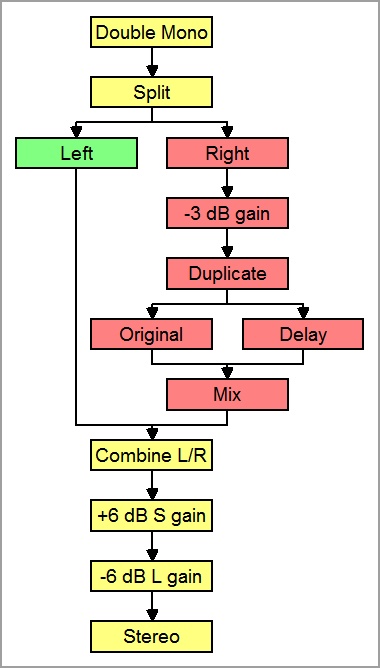
Creates a distored comb filter in the side signal/channel that acts like a ILD/ITD "zipper" when collapsing to mono, canceling out mono comb filtering caused by ITD.
-
- KVRian
- 623 posts since 8 Dec, 2025
I corrected that.ghettosynth wrote: Wed Feb 18, 2026 12:22 am You misquoted. I'm guessing that you were hoping that I would bite, but you were wrong.
I was hoping that you would try, that you would believe in your own claims. But you didn't. Conclusion: You are lying. You are well aware that I'm right and you're wrong.
-
- KVRist
- 392 posts since 1 Jul, 2004
I think that is the solution that was described in 2)
-
- KVRAF
- 16724 posts since 13 Oct, 2009
This is strong evidence of your limited experience with LLMs. Large language models respond to the structure and constraints of the prompt. If you ask a broad, underspecified question, you will get a broad, underspecified answer. That is not a failure of the model, it is a reflection of the query space you defined.Zeisner wrote: Wed Feb 18, 2026 12:51 amFor a signal that comes from the left:NothanUmber wrote: Wed Feb 18, 2026 12:18 am Out of interest: What would be an answer that you would consider valid?
Creates a distored comb filter in the side signal/channel that acts like a ILD/ITD "zipper" when collapsing to mono, canceling out mono comb filtering caused by ITD.
LLMs are not domain examiners that intuit the hidden criteria in someone’s head. They operate on the explicit structure of the prompt. A poorly constrained technical question will reliably produce a general technical response. That is predictable behavior, not incompetence.
Last edited by ghettosynth on Wed Feb 18, 2026 1:07 am, edited 1 time in total.