

AP Mastering said all DAC's that sell over 100 bucks are basically a scam, because it's the exact same component that does the job in every model.
I'm not sure how accurate that is, I always take this guy's advices with a BIG grain of salt.
How much of a difference does a high-end audio interface really make?
-

- KVRAF
- 3663 posts since 21 Nov, 2015
Exactly, the DX7 until this day is the warmest sounding FM on earth.stoopicus wrote: Sat Sep 06, 2025 11:43 pm14 bit!El°HYM wrote: Sat Sep 06, 2025 7:57 pm Man I love DACs, high end, older 96kHz ones, or even very old, like this one.
http://www.righto.com/2022/02/yamaha-dx ... ering.html
The DX7 is great for annoying FM purists too, as they tend to love it but it was actually phase modulation internally. Just like many modern soft synths.
You can be creative in any right place on Earth, and not only in the wealthiest cities. Bring the world feelings from everywhere, and not only feelings of capitalistic or jail environment.
― Aleksey Vaneev
https://linuxdaw.org
― Aleksey Vaneev
https://linuxdaw.org
-
- KVRer
- 5 posts since 14 Jan, 2026
I always wondered how much of a difference my Apogee makes in DA.. if I have to replace it I'm getting a 4th gen Scarlett 
-
- KVRist
- 87 posts since 5 Feb, 2021
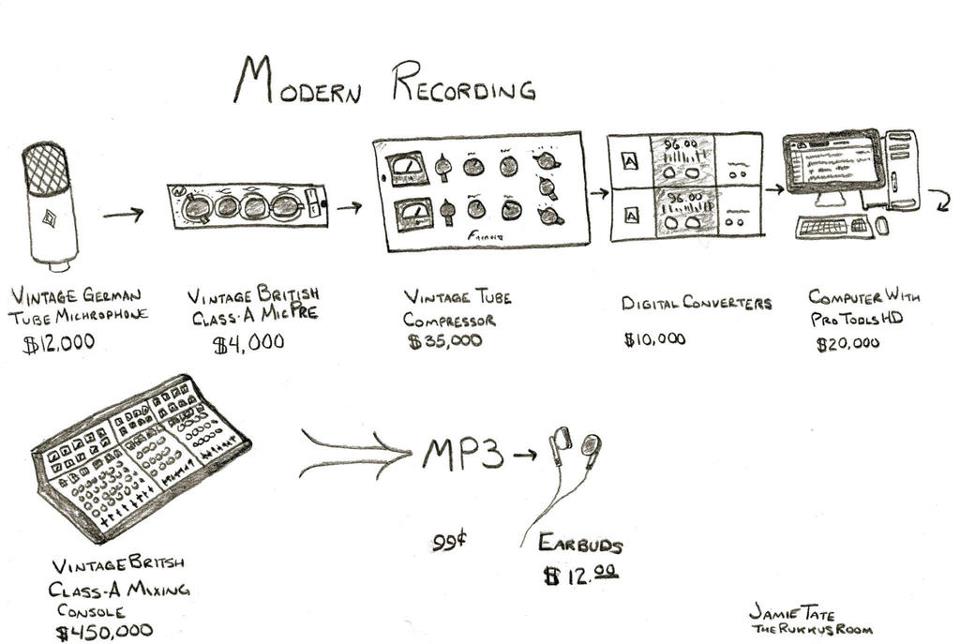
My snarky take on this topic is that you have to spend thousands of dollars to get the lowest THD possible and most pristine quality possible, then you must spend hundreds of dollars on all the channel strip plugins that recreate all the wonkiness and THD of old consoles. Then you have to spend hundreds of dollars on saturation plugins to get some warmth and character into your sound.
My unsnarky take on this is that a Behringer UMC202HD works and sounds great and no one is going to notice it wasn't a RME audio interface. If your music ever gets better than what a Behringer interface can manage, it's time to go into a real studio.
My unsnarky take on this is that a Behringer UMC202HD works and sounds great and no one is going to notice it wasn't a RME audio interface. If your music ever gets better than what a Behringer interface can manage, it's time to go into a real studio.
-
- KVRAF
- 7095 posts since 22 Jan, 2005 from Sweden
Tech Police commentPapuzzo wrote: Tue Feb 17, 2026 7:12 am My snarky take on this topic is that you have to spend thousands of dollars to get the lowest THD possible and most pristine quality possible, then you must spend hundreds of dollars on all the channel strip plugins that recreate all the wonkiness and THD of old consoles. Then you have to spend hundreds of dollars on saturation plugins to get some warmth and character into your sound.
THD is readout of odd order harmonics, which are harsch sounding.
- good to get rid of
- that is why it became one parameter that measure "hifi" quality
Even order harmonics are "warmth", like when you add octaves and so on.
- make it sound fuller
- to a degree, too much and too little destroys everything
- but doing with taste and just subtle, really nice
Why not strive for as good as it gets as "tools" become more affordable?My unsnarky take on this is that a Behringer UMC202HD works and sounds great and no one is going to notice it wasn't a RME audio interface. If your music ever gets better than what a Behringer interface can manage, it's time to go into a real studio.
But agree on that first attempts for making music might not be worth top dollar gear.
- you go by what you can afford
- if you did recording for a while, you want to improve and spend more since it became an interst and something you want to do
Many try out, and just lay off it if it wasn't "your thing".
I see two sides of making music
#1. the art quality of it, that anybody care to listen again
- listen to 30's and 40's recordings, sound quality was not that great, but "the art" come through
- if there is no "art" there is no point in finishing it
- or as Dave Grohl put it "it's all about the performance"
In the 60's, my early teen years, many of us dialed in radio stations with crappy sound
- AM frequencies like Luxenbourg station that played a lot of good music
- crackles and noise like crazy
- "internet" at the time, one could say
- it's the "art" that catch you
#2. other side is arrangement, production, mixing and sound quality
- the less crappy and nice and clean, the less there is to "fix" ITB later
- with so many tools available for home recording you can hear good sounding music
- but with so much more people not having to go through the audit of a recording company a lot not worth listening to again, did not make it to your playlist
I'd say no interfaces hold you back musically today.
- possibly if horrible latency that makes live performance difficult
- this is where RME as one shines
- if to look at preamps, RME is ok, but not special IMO
The more you "invest" in making music, and don't mean moneywise, the more you appreciate getting better preamps as well.
-

- KVRAF
- 16800 posts since 8 Mar, 2005 from Utrecht, Holland
You "police" is wrong. THD = Total Harmonic Distortion.
It does not discriminate the even from the odd harmonics.
It does not discriminate the even from the odd harmonics.
We are the KVR collective. Resistance is futile. You will be assimilated. 
My MusicCalc is served over https!!
My MusicCalc is served over https!!
-
- KVRist
- 87 posts since 5 Feb, 2021
Actually my reply was meant to get on the nerves of the gear junkies. All the best gear in the world really doesn't make much of a difference today in terms of quality of the mix and the master. It's still all about the music, not the gear. My usual advice to people getting started in music is to buy decent budget gear and spend the money saved on piano lessons, even if they never want to become a pianist. Once you can play the piano a little it opens a universe of musical possibilities that make gear irrelevant.
-
- KVRAF
- 7095 posts since 22 Jan, 2005 from Sweden
Agree fully, "the art" counts. I misread your intentionsPapuzzo wrote: Wed Feb 18, 2026 8:25 am Actually my reply was meant to get on the nerves of the gear junkies. All the best gear in the world really doesn't make much of a difference today in terms of quality of the mix and the master. It's still all about the music, not the gear. My usual advice to people getting started in music is to buy decent budget gear and spend the money saved on piano lessons, even if they never want to become a pianist. Once you can play the piano a little it opens a universe of musical possibilities that make gear irrelevant.

-
- KVRer
- 8 posts since 19 Feb, 2026
At the beginning, next to no difference at all. In fact pursing this is probably a distraction from focusing on what you should actually be working at.
As you get better, your ears are more dialed in, better monitors/headphones, finer resolution within the music you are working on and a good listening environment, then it makes a little difference. But really its a preference thing. The main point is flat and familiar - if its a fairly flat response then you learn how that translates and boom. ADC/DACs, cable types, transistors, neutron jacks and all that... its nice to have but you really really don't need it. What you do need is hours and hours and hours of direct practice using an EQ, for example. That will make your mixes sounds better
As you get better, your ears are more dialed in, better monitors/headphones, finer resolution within the music you are working on and a good listening environment, then it makes a little difference. But really its a preference thing. The main point is flat and familiar - if its a fairly flat response then you learn how that translates and boom. ADC/DACs, cable types, transistors, neutron jacks and all that... its nice to have but you really really don't need it. What you do need is hours and hours and hours of direct practice using an EQ, for example. That will make your mixes sounds better
-
- KVRer
- 8 posts since 19 Feb, 2026
Someone mentioned RME - I've been running RME for over 15 years, the converters are perfectly usable. But this does raise a good point, if you are going to worry about anything when it comes to your interface then maybe look for good drivers over good sound. Look for stability in your audio interface if you are going to chase anything

-

- KVRist
- 49 posts since 6 Feb, 2026 from Arizona
A little trick some use to get good mixes is to listen to your favorite mixes from other artists, that you like, on any device, and emulate what you hear with your mixes. It's simple and has worked well for me for many years.
-
- KVRian
- 623 posts since 8 Dec, 2025
A chain is only as strong as its weakest link. The weakest link is usually a lack of skill or room acoustics (Often combined). But yes, if you have highly skilled musicians in a room with a great sound and great speakers, then high-end audio interfaces will absolutely make a difference (if you have good ears).