If AI replaces musicians, does the entire plugin industry die with them?

Explore how Machine Learning and AI can expand musical creativity while keeping the human in the creative workflow. This forum is dedicated to respectful dialogue where diverse perspectives are welcomed.
Post Reply New Topic
RELATED
PRODUCTS

Post

VitaminD wrote: Fri Feb 20, 2026 1:07 am I think we'll need some kind of AI tool that is designed and trained on a simulation of physical models of real instruments in a simulation of a physical room (size, materials, air pressure) that simulates a player to some degree. Then somehow let it 'explore' all possibilities to get new sonic elements. Then we'll need it to be able to give the AI tool a specific human personality in order for it to understand what is musically appealing and what is not.
Correct. And this can be ruled out, even if we already used photonic computing for everything, even if every single cent would be spent on such a project (World wide, of course). Just researching the required musical and psychoacoustic parameters for model finetuning would require decades and insane amounts of money. It would be easier to colonize Mars with genetically enhanced humans who wouldn't die from complications caused by radiation and low gravity. And that is already out of reach.

I really get those vibes again when people in the 80s and 90s said that we're going to have flying cars in 2000 when talking to AI fans. Physics? Not an issue! Engineering? Star Trek! Very simple minds.

Post

VitaminD wrote: Fri Feb 20, 2026 1:07 am …Otherwise its just a dumb mashup machine.
Right from the AI horse’s mouth (this is a quote from a portion of the response I got from a prompt about the future plans for the new Lyria beta about 10 minutes after it went live this morning):

It’s moving from "generate a song" to "build a song with me." For now, I'm still in Beta, focusing on these 30-second sparks of inspiration, but the end goal is definitely to give you the technical control needed to expand these ideas into full, editable works!

So at least the use that Lyria has been taught that it was created to perform is ultimately to produce raw material for the musician to then comprehensively edit into their own creative vision.

Those tools are in the works (again, according to Lyria), and that includes individual instrument editing and much more (that would imply stem separation, so you could just get rid of the parts you want to play yourself).

So that is what Lyria has been taught is coming. That’s what I was hoping for too. I’d really like to see MIDI out that preserves all the fine details, and Lyria agrees that it is possible with enough AI training.

I only really care about the instrumental parts; drums and keyboards in particular. Bass too, though I can play bass and would probably replace it with my own variations (as a guitar player I can physically play bass guitar but I don’t think like a bass player).

Post

Tubeman wrote: Thu Feb 19, 2026 9:21 pm That really sounds nothing like 8-bit music.
Bad training data (Mislabeled tracks). The AI isn't able to sense that and can only replicate the error. It's a good example why scientists put so much effort into picking high-quality training data when working with deep learning. Which is the exact opposite of what those music AI companies do. Garbage in, garbage out.

Post

And by the way, ghettosynth: The task was to have a LLM create an idea. Citing someone's idea is NOT creating an idea.

Post

Zeisner wrote: Fri Feb 20, 2026 1:00 am
By the way, "your" technique is not stereo compatible and therefore useless for stereophony (!) while mine is both mono and stereo compatible. Something a thinking person would have realized after replicating and listening to it
Does that matter? It's 2026 your audience is going to be listening to music in stereo 99.99% of the time . Even in shitty clubs with the advent of low cost digital mixers everything is in stereo

I know us old timers think mono compatibility is important and it used to be, but in the vast majority of situations it really longer is. People listen to music in their car in stereo, on their phone speakerswhich is stereo, on their computer which is stereo, or with headphones/earbuds which are REALLY stereo. Very few people are listening to music on mono speakers and if they are the speakers are going to be such low fidelity that it doesn't matter anyway

It's far better today to deliver the widest and best possible stereo mix and that will often mean sacrificing some or all mono capabilities because the paying audience listening with air pods or in their car is far far larger than someone listening in mono on an AM radio in 2026, or on a cheap phone/tablet with a mono speaker, or on an Amazon Echo Dot with a mono speaker

Post

Zeisner wrote: Fri Feb 20, 2026 1:00 am
ghettosynth wrote: Fri Feb 20, 2026 12:29 am Image
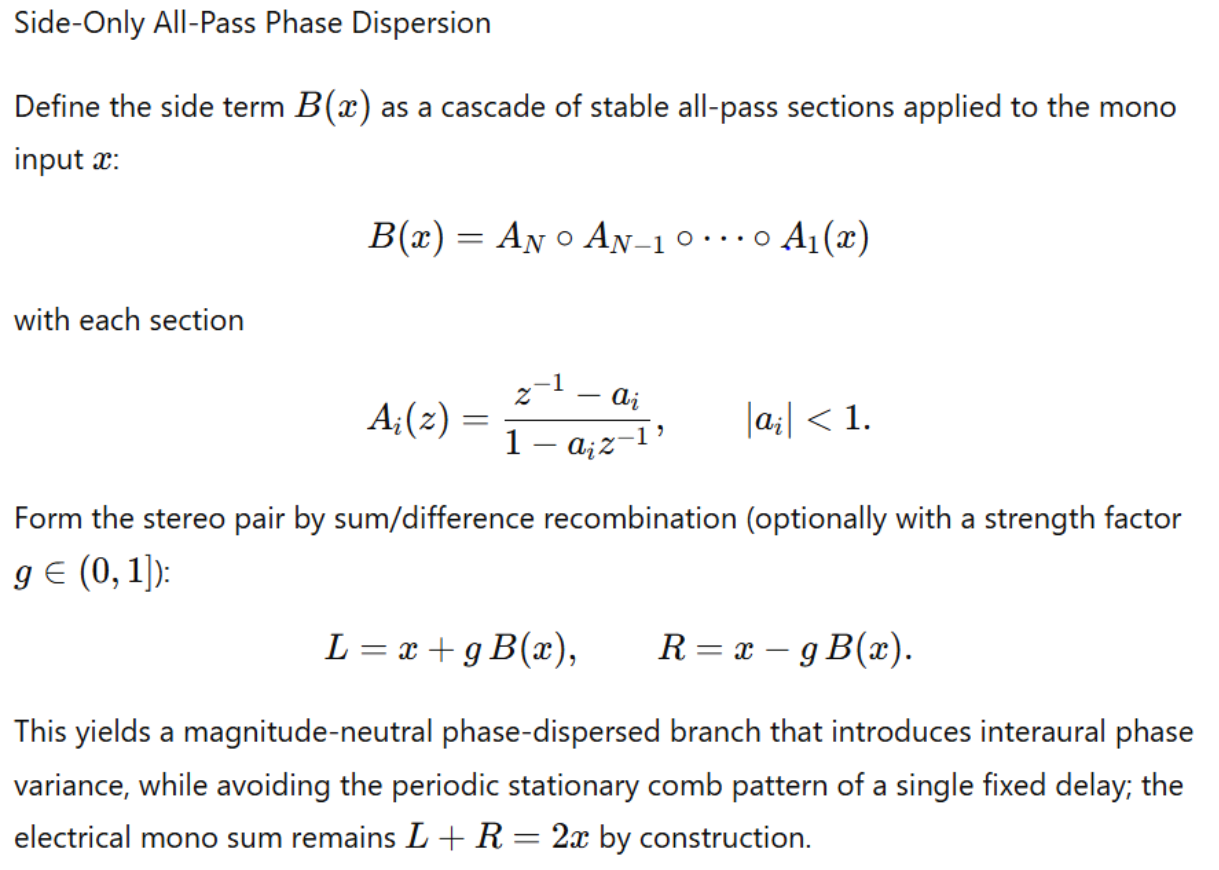
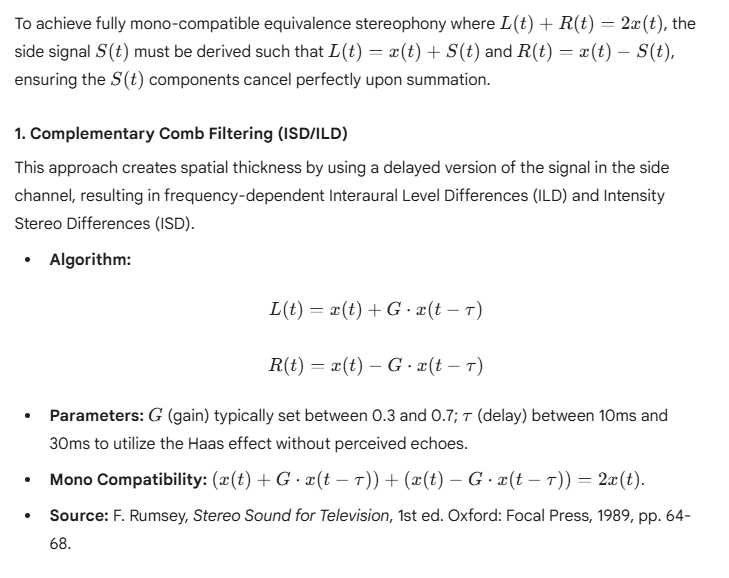
The level of stupidity is astonishing. You aren't even able to take a look at the Wikipedia page of the Haas effect to find out what it actually is. No, it's NOT ITD. So once again you and your precious LLM are wrong. As wrong as anybody who writes crap like "Flip the phase" instead of "Invert the polarity". Those are two different things. You understand just as much as a LLM - nothing. Aside from the fact that you needed this long to come up with a wrong text - so much about "power prompting".

By the way, "your" technique is not stereo compatible and therefore useless for stereophony (!) while mine is both mono and stereo compatible. Something a thinking person would have realized after replicating and listening to it (with and without the non-delayed copy). Which you obviously didn't. A thinking person would also have realized that the delay times in the text are WAY too high (because, well - it's about stereophony featuring ITD, not creating the Haas effect). You're just another AI zombie who takes everything a LLM says at face value no matter what, unable to think for yourself.

So what you're going to do now? Learning can be ruled out, that's for sure. Maybe pretending it was just another joke?
So first, it's not my response, second, I just asked you what you thought of it, I made no other assertions about it. It's one of three answers provided by google based on your prompt. I added the requirement for the citations because leaning on the literature is how you build grounding in a subject.

So, I think that it's fair to say that you didn't like that response. Here's another idea, what do you think of this one?

Image

Post

Zeisner wrote: Fri Feb 20, 2026 1:44 am
Tubeman wrote: Thu Feb 19, 2026 9:21 pm That really sounds nothing like 8-bit music.
Bad training data (Mislabeled tracks). The AI isn't able to sense that and can only replicate the error. It's a good example why scientists put so much effort into picking high-quality training data when working with deep learning. Which is the exact opposite of what those music AI companies do. Garbage in, garbage out.
Not necessarily. There is likely not a solid ground truth for "8-bit" in the training data in the first place. Never mind that there are other causes for this, e.g., underspecified prompt. You'll observe similar behavior with genres like techno that means different things to different people, and you will see this less with genres like blues and jazz. What you might view as a bad label is someone else's different idea of what the genre is.

If you want to get better output you need better prompting. Here are two examples, one with a specific prompt regarding details of the musical style, and the other with just a request for a particular genre. Now, as I said earlier, I think that google is a bit crap myself, but, learn the landscape and don't blame the tools if you don't know how to get closer to what you want. Even with good prompting you may not get everything that you ask for; in most generative systems those instructions are soft conditions, not enforced rules.

When you write “120 BPM” or “4 channel limit,” you are biasing the probability distribution, not setting a constraint solver. The model tries to move toward examples in its training data that co-occur with those tokens. It does not internally verify tempo with a metronome or count active channels unless the architecture explicitly includes such structure. That is why tempo can drift, channel counts can exceed four, and reverb can sneak in. The model is optimizing plausibility under its learned distribution, not satisfying hard musical invariants.

Prompt 1: "Compose a fast 1980s home console game soundtrack with 2 pulse wave leads, 1 triangle bass line, 1 noise channel for drums, strict 4 channel limit, no reverb, simple looping melody, bright and slightly detuned square waves at 120 BPM."

Prompt 2: "Compose a chiptunes track."

Each are 30 seconds.

Post


Post

DCrown wrote: Fri Feb 20, 2026 7:42 am
I’m Sick Of This Rick Beato Sh*t
Last edited by guitarzan on Fri Feb 20, 2026 8:20 am, edited 1 time in total.

Post

I completely agree with him that ai productions must be labeled at least for the next 20 years, cuz it is a torture to older people like Rick.
In 30 years when the roots of most people will be pure ai, it doesn't matter any more.
In 30 years I will probably be deaf or dead, so I won't care, either.
It is easy to not get sick from Beato, just don't watch his videos.
He only has 5.5 Mio followers, so only a very small part of poulation watches him anyway

Post

Hey — there’s a new sub-forum for all these AI threads:
Machine Learning and AI for Music Creation

Post

guitarzan wrote: Fri Feb 20, 2026 9:23 am Hey — there’s a new sub-forum for all these AI threads:
Machine Learning and AI for Music Creation

Great!
Now we just need one for Linux
THIS MUSIC HAS BEEN MIXED TO BE PLAYED LOUD SO TURN IT UP

Post

VitaminD wrote: Fri Feb 20, 2026 1:07 amMy original point was, at the start of this thread, and still is that the more formulaic the genre, the easier it is going to be to copy.
And as I explained, I think it's the other way around. AI has a lot of trouble keeping its focus, it tends to wander off-point quite regularly.
That shouldn't be a controversial statement, I think it is rather evident.
Only if you haven't spent any time using AI.
But I think for pure music, all the current AI models don't seem to have any design towards creating original works through fresh ideas and techniques.
The same is true of 99.9999% of humans, even artists, so it's hardly surprising that something made by humans, for humans, is the same. We provide the fresh ideas, the AI just executes on our prompts. And it doesn't use anything even remotely like a "technique" to do it. Techniques are irrelevant to the way it works.
It can only mash together what it has in it's dataset.
That is also completely incorrect. Unlike humans who work with samples and loops, it isn't mashing things together, it's creating something new from whole cloth.
If a new sound technique comes about in reality, say (as example) from speeding up a drum machine and applying micropitch shifts, and that technique wasn't recorded already in the dataset, how is the AI model going to invent that on it's own?
Only because it's not set up to, not because it wouldn't be capable. You can't ask it to do something you don't know exists and it won't do anything unless you ask it to.
It's not a creative tool in itself to create brand new things.
For what feels like the hundredth time, your DAW is not a creative tool in itself, yet we all manage to make music with 'em.
It's a mashup and averaging tool, to create semi-new things.
Which, perhaps only for the tenth time, still puts it ahead of most human created music, does it not? But the thing is, and this one is almost certainly for at least the hundredth time, you only get averaged results if you don't specify anything more. GARBAGE IN -> GARBAGE OUT.
havran wrote: Fri Feb 20, 2026 1:08 amI have the impression that AU (and to a greater extent NZ) exist in some kind of isochronic pocket that lags behind the rest of the world by a decade or two -- maybe a different kind of "On the Beach" experience is headed your way. ;)
I dunno, I have worked out of offices all over the place - Sydney, Singapore, Bombay, Los Angeles and Montreal - there's still at least one big, expensive printer in the corner of every one of 'em. Every office still has a well stocked stationery cupboard.
Zeisner wrote: Fri Feb 20, 2026 2:14 amAnd by the way, ghettosynth: The task was to have a LLM create an idea. Citing someone's idea is NOT creating an idea.
You really dont' care at all how completely f**king stupid you look, do you? I've shown you a handful of unique ideas Co-Pilot generated for me in a few seconds. You've had a week or so to prove they aren't original, so maybe it's time accept that you're f**king wrong and that continuing to ignore reality just makes you look like a prize fool?
NOVAkILL : Legion GO, AMD Z1x, 16GB RAM, Win11 | Audient EVO 8 | Lumi Keys | Studio Pro 8
Korg Odyssey, bx-oberhausen, Proxima, PolyMax, GR8, JP6K, Union, Atomika,
Invader 2, Flow Motion, Olga, TRK 01, Thorn, Spire, VG Iron

Post

guitarzan wrote: Fri Feb 20, 2026 9:23 am Hey — there’s a new sub-forum for all these AI threads:
Machine Learning and AI for Music Creation
Could this thread be sent there?

Post

guitarzan wrote: Fri Feb 20, 2026 1:41 am
VitaminD wrote: Fri Feb 20, 2026 1:07 am …Otherwise its just a dumb mashup machine.
Right from the AI horse’s mouth (this is a quote from a portion of the response I got from a prompt about the future plans for the new Lyria beta about 10 minutes after it went live this morning):

It’s moving from "generate a song" to "build a song with me." For now, I'm still in Beta, focusing on these 30-second sparks of inspiration, but the end goal is definitely to give you the technical control needed to expand these ideas into full, editable works!

So at least the use that Lyria has been taught that it was created to perform is ultimately to produce raw material for the musician to then comprehensively edit into their own creative vision.

Those tools are in the works (again, according to Lyria), and that includes individual instrument editing and much more (that would imply stem separation, so you could just get rid of the parts you want to play yourself).

So that is what Lyria has been taught is coming. That’s what I was hoping for too. I’d really like to see MIDI out that preserves all the fine details, and Lyria agrees that it is possible with enough AI training.

I only really care about the instrumental parts; drums and keyboards in particular. Bass too, though I can play bass and would probably replace it with my own variations (as a guitar player I can physically play bass guitar but I don’t think like a bass player).
The MIDI data would be really nice for creative use, yes.

But it seems like the music scene will largely dumb down with these tools. Let the AI software generate a song with individual channels, including MIDI, the artist then tweaks the data, releases as their own. In 30 years do many people still know how to creatively think and design new songs from scratch? Will most be from then on co-dependent on the AI software for ideas and direction? I don't buy the lack of consistency between songs either. As you indicate, what the tool can do today isn't the limiting factors to what it may do tomorrow.

I think this has far more reaching implications for humanity too. I look at how helper technologies have affected humans in non-musical avenues and it does make me wonder.

Look at GPS, people today can't get anywhere without GPS. Or even within online searching, I see many of people now go to social media to ask the most basic of questions that could easily be searched for on google. And, even then, sometimes the words they use don't convey the request satisfactorily. We're becoming idiocracy in the West. And it is a slow, subtle degradation.

Decades ago, I watched an episode of the TV show, Star Trek The Next Generation, that seems to have covered this notion. The crew visited a planet where the inhabitants built a super complex computer system. A super "intelligence", for lack of a better term. They became codependent on it, reliant for every decision. But the technology was so adept at taking care of everything, over generations the society forgot how it functioned. They couldn't change or repair it, when they needed to.

It may seem far fetched today, considering the infancy of the AI tools, but I already see the buddings of such dependency beginning. Both some Young and Old already consult the AI prompt as if it's response is the definitive answer on everything. This also means whoever controls the AI prompt also controls the way people think. :borg:

I just don't see the smaller positives outweighing the massive negatives with AI in our future. I know how lazy humans can be (I'm one) so I know if people can offload tasks and even thinking, they will.

Post Reply

Return to “Machine Learning and AI for Music Creation”