Making things mono compatible.

How to do this, that and the other. Share, learn, teach. How did X do that? How can I sound like Y?
RELATED
PRODUCTS

Post

whassup wrote: Tue Dec 23, 2025 1:34 pm What is ILD and ITD?
ILD = interaural level difference, ITD = interaural time difference.

https://biologyinsights.com/what-is-int ... alization/

The funny thing is that you can only use ILD or ITD to pan a signal. You're already familiar with the first if you ever used a pan pot, they're all based on pure ILD. Under natural conditions you'll always have both ILD and ITD combined.

Post

Thank you! I wasn't familiar with those abreviations.
ABX is enemy to GAS

Post

You're welcome. You can find more about it if you google "Duplex theory by Lord Rayleigh". I prefer to use ITD because it's more precise than "Haas effect" which involves ITD but includes another phenomenon (How time can "override" level). The Haas effect also starts at 2 ms ITD while "simple" ITD panning usually doesn't exceed 1,5 ms (if you want to stay in the safe zone and never pan further than what would be possible with ILD in stereo). It's all related but not the exact same thing.

Post

Zeisner wrote: Tue Dec 23, 2025 5:58 pm
whassup wrote: Tue Dec 23, 2025 1:34 pm What is ILD and ITD?
ILD = interaural level difference, ITD = interaural time difference.

https://biologyinsights.com/what-is-int ... alization/

The funny thing is that you can only use ILD or ITD to pan a signal. You're already familiar with the first if you ever used a pan pot, they're all based on pure ILD. Under natural conditions you'll always have both ILD and ITD combined.
I‘m currently playing around with Goodhertz‘s Panpot plug-in where you can pan based on level diferences, time differences, spectral- or phase differences OR several or even all of them.

Post

How do hard panned signals sound to you if you stack ILD and ITD?

Post

Honestly.... I have (since my goal is mono compatibility) not really focused on the delay panning (yet). Since the delay panning is the only one that's not 100% mono compatible.

But I will try and let you know. I'm guessing you have a reason why you are asking....

Post

so I have tried it now....
Bildschirmfoto 2025-12-24 um 09.09.40.png
and in stereo and on headphones it sounds great. It's spacious and not flat like ILD only. and further to the side than ITD only. don't like it in mono though.... it's just a little too comb filtered and messy imo (although it's way better than the delay panning on its own). I'm sure this could (potentially) sound great (although completely different than intended) on guitars but I just threw it on a drum loop I had running anyway.
You do not have the required permissions to view the files attached to this post.

Post

multree wrote: Wed Dec 24, 2025 8:13 am it's just a little too comb filtered and messy imo
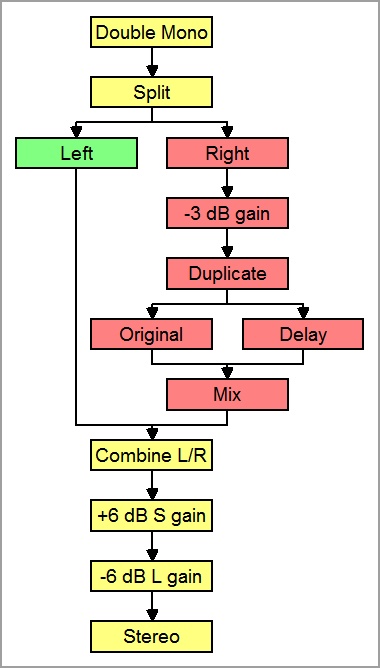
Try this (assuming you're panning to the left):

Image

Technically it's a mixture of level, time and spectral difference. Easy to control because you only need to change delay length to pan the output (up to 1,5 ms - beyond that it turns into a special effect). It only
works on mono signals but you shouldn't pan stereo
signals anyway, just rotate them (like Waves S1 Imager does) to preserve stereo information. The enhanced mono compatibility comes at the cost of stereo compatibility (side comb filtering) but this shouldn't be audible under normal conditions.

It might be worth giving parallel ITD panning a try as
well, using at least five instances (better eight). While difficult to handle (because you have to switch back and forth between monitoring in mono and stereo and use unique delay lengths for each instance) it can add some nice coloration in mono which might benefit center signals. Less mono compatible than the first techniqe but more than simple ILD+ITD panning.

Post

the LCR guitar problem multree describes isn't really a phase cancellation issue, it's simpler: a hard-panned mono guitar only feeds one channel. when you sum to mono, it drops 6dB (or 3dB if your DAW uses a compensated pan law). so yes, the guitars get quieter. the mid-side approach is the right solution there: fix your levels in mono first, then use the side attenuation to pull back the stereo loudness rather than trying to correct after the fact.

the place where things get messier is when you're combining LCR guitars with some stereo ambience processing or chorus. a spectral view of what's going wrong in mono can help identify whether the problem is a simple level gap or actual cancellation at specific frequencies. i built a free tool for this (CHECK at kernaudio.io) that shows mono compatibility per frequency band, which makes it easy to spot if it's just the ITD-based processing comb filtering something specific.

Post

kernaudioio wrote: Thu Apr 02, 2026 7:47 pm i built a free tool for this (CHECK at kernaudio.io) that shows mono compatibility per frequency band, which makes it easy to spot if it's just the ITD-based processing comb filtering something specific.
ERB bands are not suitable for this. For comb filtering visualization you need a high resolution spectral analyzer without any psychoacoustic weighting.

Post

fair point, Zeisner. CHECK's ERB bands are coarse on purpose: the use case is identifying which broad frequency regions lose energy when you sum to mono. that's the problem multree described: guitars going quiet across a whole range, not a comb-filtering artifact at a specific frequency.

for the ITD-based panning you're discussing, you're right that you need a high-res FFT analyzer to see the actual comb pattern. different questions, different tools.

where ERB resolution helps: spectral energy loss across a region (cancelled reverbs, wide synths folding to mono). where it falls short: diagnosing sub-millisecond delay panning artifacts at specific frequencies.

Post

kernaudioio wrote: Thu Apr 09, 2026 3:09 pm fair point, Zeisner. CHECK's ERB bands are coarse on purpose: the use case is identifying which broad frequency regions lose energy when you sum to mono.
No, ERB has nothing to do with monophony or stereophony. It relates to critical bandwidths. Loudness and masking, similar to Bark. Read about Blauert's ribbons, that's what you should use for your plugin instead of ERB.

Post

My personal opinion: don't bother too much. Making things mono-compatible is useful only if you think your music will be played a lot in clubs. (And even then, you usually make a "club mix" anyway). Mono-compatibility should just mean that the mix is decent in mono. By making things mono-friendly, you sacrifice width, space, depth and everything else. What you should do is just check the side levels and ensure that the side channel is about 6dB lower across the spectrum than the mid channel, and cut it off below anywhere between 60 and 120Hz (80Hz is my usual go-to, but I sometimes go higher for more "vintage-sounding" mixes). And anyway, if some stuff disappears or changes a lot in character once you go mono, if it's nothing particularly important, is it really an issue? Like, reverbs, background pads, that kind of stuff. (Probably, you actually want less reverb in the mono mix anyway, since you have to keep your track separation in check, and reverb makes it harder).

I personally avoid LCR mixing. To be honest, I find it stupid. The pan pot is there for a reason, and stuff is not always hard left and hard right. *And* it sounds annoying through headphones. Sometimes you can employ early reflections for added "3D-ness".

Post

ampetrosillo wrote: Mon Apr 13, 2026 6:29 pm *And* it sounds annoying through headphones.
I agree. That's why I prefer equivalence stereophony. It's the only way to get a stereo field that sounds similar to loudspeakers.

Post

that's a fair correction, Zeisner. you're right that ERB as a frequency scale originates from hearing research into critical bandwidth and masking, not from localization or stereo/mono theory.

the reason i chose ERB for CHECK is practical rather than principled: ERB bands give you a perceptually-weighted frequency axis where the resolution follows roughly how the ear integrates energy, which makes the mono correlation readout legible across the whole spectrum without drowning in low-end frequency bins. but you're right that this is a pragmatic compromise, not a theoretically motivated one for the mono/stereo question.

Blauert's ribbons (the directional bands where the HRTF creates predictable localization biases) are genuinely more relevant if you're trying to connect mono compatibility to where things will be perceived in space. i hadn't considered them for this use case, so that's a useful pointer.

whether Blauert bands would make a meaningfully better tool for multree's original question, i'm less certain, since the problem of "guitars go quiet in mono" is really about level relationships, not localization. but for a more complete mono/stereo diagnostic tool the ribbons would give you a more psychoacoustically grounded display. something to think about for a future version.

Post Reply

Return to “Production Techniques”