

When writing melodies, do you try to keep them within your chords
-
- KVRAF
- 1592 posts since 9 Jan, 2018
You don't even need to stay within the scale. Your melody should sound the way you want or need it to. Some melodies are simple, others discordant...it's up to you, provided it communicates the emotion you feel.
Spotify, Apple Music, YouTube, and even Deezer, whatever the hell Deezer is.
More fun at Twitter @watchfulactual
More fun at Twitter @watchfulactual
-

- KVRAF
- 3755 posts since 5 Mar, 2004 from Gold Coast Australia
The whole thing is that it needs to make sense to the listener - within the context of the Scene & Story of this Song.
Clearly, in most cases, it makes more sense for the melody to be within the surrounding structure. So if you're in C Maj, white keys will be easiest on the listener.
Until you have forced nothing but C, E, G over and over for the last 37 mins, in which case a well-placed A, D, B, or F could set their world on fire. And an even better placed G# might just nuke them (in a good way if it made sense).

Clearly, in most cases, it makes more sense for the melody to be within the surrounding structure. So if you're in C Maj, white keys will be easiest on the listener.
Until you have forced nothing but C, E, G over and over for the last 37 mins, in which case a well-placed A, D, B, or F could set their world on fire. And an even better placed G# might just nuke them (in a good way if it made sense).
Benedict Roff-Marsh
http://www.benedictroffmarsh.com
http://www.benedictroffmarsh.com
-
- KVRist
- 30 posts since 25 Feb, 2026
In vcv rack I have been able to shift all the notes sometimes to sorta tune it to something that sounds interesting.. I do have the option of being forced into a scale though.. I was playing around with one of those music theory plugins and liking the sounds though but would want to record it live..
-
a friend always a friend always https://www.kvraudio.com/forum/memberlist.php?mode=viewprofile&u=719811
- KVRer
- 24 posts since 15 Sep, 2024
yes
-
- KVRAF
- 5091 posts since 30 Aug, 2012 from Sweden
If you need to break the rules to make it sound interesting, do it. If you want to sound predictable and boring all the time, don’t break the rules. Don’t let anybody else limit yourself what you should do or not. Let them be predictable like at least 90% of the world population are.
-
ThoughtExperiment ThoughtExperiment https://www.kvraudio.com/forum/memberlist.php?mode=viewprofile&u=7790
- KVRian
- 1052 posts since 26 Jun, 2003 from UK
It's quite possible to stick within the rules and not be boring. Totally freeform music certainly isn't boring but it's also a challenging listen. But then some people like to be challenged so freeform works for them...
All I'm saying is breaking the rules is not a prerequisite for making interesting music.
Anyway, if you mean sticking to the chord tones of whichever chord you're playing over, that's probably going too far (unless the chord is a maj13b5#7 or something like that )
)
But sticking to the tones of the scale that all of your song's chords belong to should give you plenty of scope. You could always 'borrow' a chord from another scale if you need to spice things up.
All I'm saying is breaking the rules is not a prerequisite for making interesting music.
Anyway, if you mean sticking to the chord tones of whichever chord you're playing over, that's probably going too far (unless the chord is a maj13b5#7 or something like that
 )
) But sticking to the tones of the scale that all of your song's chords belong to should give you plenty of scope. You could always 'borrow' a chord from another scale if you need to spice things up.
-

- KVRist
- 60 posts since 6 May, 2007 from scandinavia
It's almost impossible to answer without context. Different genres have different conventions.
A jazz soloist may play 100% out of chord-scale relationship for a long time, before 'landing' on a chord-scale.
Or a common song, like this one ...
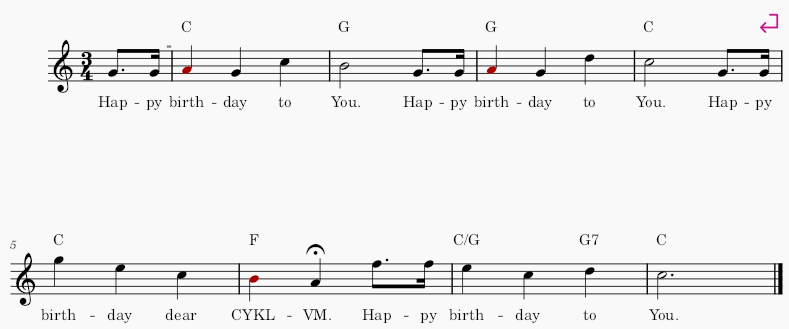
May have single notes which are not in the chord (marked with red)*.
A musical experiment for the red notes: Play the chords, sing the melody or program the lot in your DAW. Change the a's in the melodi to g's, and the b to a. This makes all notes in the melody belong to the chord at these moments. How does it change Your perception of the melody?
In both cases a common way to describe (and percieve) the effect, is a build-up of tension, leading to release. This may happen both in the 'microcosm' of one note to the next and in the 'macrocosm' of repeated melodic motives, chord progression etc.
All of the above with regard to western tradition.
BTW, I'm personally not too fond of the word 'rules' with regard to music and music theory. For me, 'conventions' is a better choice. A good metaphor for the whole thing is spoken language. We talk differently in different social context. And when we're listening, words/sentences that may surprise us in one context would be utterly ordinary in another.
* (as the chord and the melody together consists of 4 different notes, the triad + the melody, the melody may also be understood as a part of, so-called extension of the chord. In some genres it's common practice to reflect this in the chord symbols. In this example that would make them C6, Gadd9 and Fadd#11)
A jazz soloist may play 100% out of chord-scale relationship for a long time, before 'landing' on a chord-scale.
Or a common song, like this one ...
May have single notes which are not in the chord (marked with red)*.
A musical experiment for the red notes: Play the chords, sing the melody or program the lot in your DAW. Change the a's in the melodi to g's, and the b to a. This makes all notes in the melody belong to the chord at these moments. How does it change Your perception of the melody?
In both cases a common way to describe (and percieve) the effect, is a build-up of tension, leading to release. This may happen both in the 'microcosm' of one note to the next and in the 'macrocosm' of repeated melodic motives, chord progression etc.
All of the above with regard to western tradition.
BTW, I'm personally not too fond of the word 'rules' with regard to music and music theory. For me, 'conventions' is a better choice. A good metaphor for the whole thing is spoken language. We talk differently in different social context. And when we're listening, words/sentences that may surprise us in one context would be utterly ordinary in another.
* (as the chord and the melody together consists of 4 different notes, the triad + the melody, the melody may also be understood as a part of, so-called extension of the chord. In some genres it's common practice to reflect this in the chord symbols. In this example that would make them C6, Gadd9 and Fadd#11)