

Clear words, my friend, not angry words. You tried now every polemic trick. That's why.
You’re asking the wrong person the wrong question.
It’s not the job of every third party developer to come up with a grand roadmap for “fixing Linux”. That’s exactly the problem. You’re pushing a systemic ecosystem issue onto individual developers who have zero control over it.
If you want a concrete answer anyway, it’s not even mysterious:
You create a stable, long term supported platform target with a clearly defined ABI and runtime contract. You reduce variance instead of celebrating it. You stop treating fragmentation as a feature. That’s how every successful desktop platform works.
And here’s the thing: attempts at this already exist. AppImage, Flatpak and Snap are all trying to create a consistent distribution layer above the chaos. They exist because the underlying system is not a reliable target.
But even that proves the point rather than disproving it. Now you don’t have one platform, you have multiple competing solutions on top of an already fragmented base. Different runtimes, different ecosystems, different levels of adoption. It reduces some friction, but it doesn’t eliminate the core problem.
The reason none of this fully “solves” it is just as obvious. It directly conflicts with how the Linux ecosystem is structured. Distros differentiate. They patch. They move at different speeds. There is no central authority to enforce consistency, and culturally there’s resistance to that idea.
So no, it’s not “spite” or “incompetence”. It’s a structural outcome of a decentralized system with competing priorities. That’s fine in many areas, but it comes with tradeoffs.
And again, this is the part you keep circling around: those tradeoffs have consequences. One of them is higher integration cost for third party developers. Another is weaker commercial desktop software support.
You can’t have maximum fragmentation, maximum freedom, and at the same time expect a frictionless, unified target for developers.
That’s not an unsolved mystery. That’s a deliberate tradeoff.
So the situation isn’t unsolved because nobody thought about it. It’s unsolved because solving it would require giving up things a lot of people in the ecosystem explicitly don’t want to give up.
That’s the reality.
Future of Windows in pro audio
-

- KVRian
- 503 posts since 24 Feb, 2008 from Germany
“The biggest crime of a musician is to play notes instead of making music.”
Isaac Stern
Isaac Stern
-
- KVRist
- 413 posts since 26 May, 2018
And that was my whole point all along.
Many developers want to maintain control over their software. They want to ensure that their software works as intended. The world of Linux distros doesn't work that way. Among the Linux distros, not even Linus Torvalds has real authority. The distros take "his" kernel and use it (and sometimes patch it). Everybody does whatever they want to do, as they see fit. You devs are the "upstream", and they are the "downstream". Really, people do not use Linux. They use <name of distro>.
You clearly don't like this system, or you don't find it workable. A lot of other developers don't either. The link between proprietary software and dislike of the system is quite clear, though. I don't see many developers of open source projects (which, as you said, are often cross-platform) rail against the Linux way of doing things. They might rail against single distros (because they consistently package stuff badly and then the users complain to upstream, and upstream has to say "not my fault, take it up with your distro maintainer"), or single projects (for example, a library or DE, which usually leads to the developer not employing that library or DE anyway), but they accept things as they are. Sometimes they do not even package stuff for Linux themselves (while they may provide binaries for Windows and macOS), but say "contributors are welcome" (they offload this burden to other people). This is fine, I might even say "by design".
As you said yourself, there are things to address this for people who do not wish to conform to this fragmented/distributed way of doing things. As you said, containers. The issue of having different competing containers is a strawman, though. You are not required to support them all. You can pick one and go with one. I know why you complain. Ubuntu went with their own solution (snap), the rest of the Linux world went with another (Flatpak, and AppImage before that). By the way, Ubuntu is the kind of distro that is trying to do exactly what you ask for: provide *one*, clear, centralised, standardised desktop-oriented target (and they often do it by not playing along with the community and taking things into their own hands... something that has somewhat been dialed down, admittedly). By and large, Linux desktop users tend to use Ubuntu anyway, so you could just focus on Ubuntu. Just release a .snap and call it a day. But no, you gotta include even bloody AppImage (AFAIK, it has mostly been deprecated and never gained traction to begin with) to prove your point. (In reality, if you want to cover most Linux flavours, you would only need to make two: a Snap and a Flatpak. End of. Not the end of the world).
Many developers want to maintain control over their software. They want to ensure that their software works as intended. The world of Linux distros doesn't work that way. Among the Linux distros, not even Linus Torvalds has real authority. The distros take "his" kernel and use it (and sometimes patch it). Everybody does whatever they want to do, as they see fit. You devs are the "upstream", and they are the "downstream". Really, people do not use Linux. They use <name of distro>.
You clearly don't like this system, or you don't find it workable. A lot of other developers don't either. The link between proprietary software and dislike of the system is quite clear, though. I don't see many developers of open source projects (which, as you said, are often cross-platform) rail against the Linux way of doing things. They might rail against single distros (because they consistently package stuff badly and then the users complain to upstream, and upstream has to say "not my fault, take it up with your distro maintainer"), or single projects (for example, a library or DE, which usually leads to the developer not employing that library or DE anyway), but they accept things as they are. Sometimes they do not even package stuff for Linux themselves (while they may provide binaries for Windows and macOS), but say "contributors are welcome" (they offload this burden to other people). This is fine, I might even say "by design".
As you said yourself, there are things to address this for people who do not wish to conform to this fragmented/distributed way of doing things. As you said, containers. The issue of having different competing containers is a strawman, though. You are not required to support them all. You can pick one and go with one. I know why you complain. Ubuntu went with their own solution (snap), the rest of the Linux world went with another (Flatpak, and AppImage before that). By the way, Ubuntu is the kind of distro that is trying to do exactly what you ask for: provide *one*, clear, centralised, standardised desktop-oriented target (and they often do it by not playing along with the community and taking things into their own hands... something that has somewhat been dialed down, admittedly). By and large, Linux desktop users tend to use Ubuntu anyway, so you could just focus on Ubuntu. Just release a .snap and call it a day. But no, you gotta include even bloody AppImage (AFAIK, it has mostly been deprecated and never gained traction to begin with) to prove your point. (In reality, if you want to cover most Linux flavours, you would only need to make two: a Snap and a Flatpak. End of. Not the end of the world).
-
 Touch The Universe Touch The Universe https://www.kvraudio.com/forum/memberlist.php?mode=viewprofile&u=190615
 - KVRAF
- 5808 posts since 2 Oct, 2008
hopefully ai can somehow free these oses from tyranny and bridge whats working between them.
100 High Quality Soundsets: Omnisphere 2, Dune 3, Tone 2 Synths, Pigments, Uhe Synths, Halion, Spire, and others.
TTU Youtube
TTU Youtube
-
- KVRist
- 413 posts since 26 May, 2018
I'd like to post one screenshot.
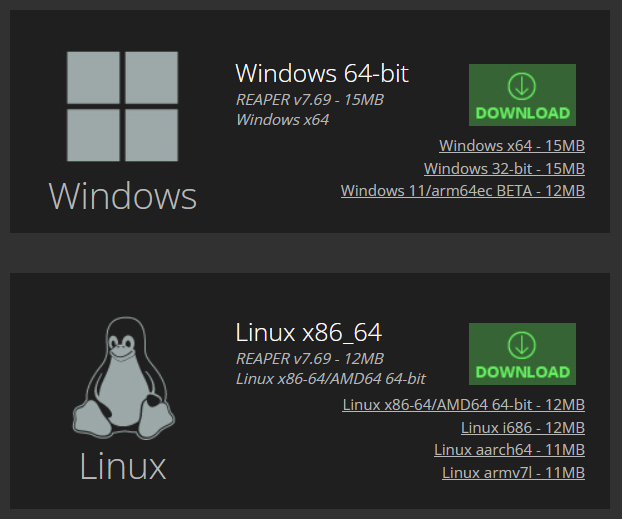
See there? Linux has four different builds. Including two different ARM architectures.
Windows has three. The Windows on ARM build is, I quote, BETA (block letters included). Not the Linux one (which they fully support).
See there? Linux has four different builds. Including two different ARM architectures.
Windows has three. The Windows on ARM build is, I quote, BETA (block letters included). Not the Linux one (which they fully support).
-
- KVRian
- 503 posts since 24 Feb, 2008 from Germany
Strawman, here we go again. Nice. And now open an Ableton project with it 
Back to topic. You’re finally describing the system accurately, but you repeat you draw the wrong conclusion from it.
Again, this is no question of liking it or not. I am a Linux user like you. For me it is simply a tool. It is the question of higher workload. Which leads as a conssequence to the lack of software at Linux. And that is what stops people from migrating. They don't get their job done. Causality.
Yes, Linux is downstream driven. Yes, distros do whatever they want. Yes, upstream loses control. That’s exactly the problem from a third party developer perspective, not some neutral characteristic you can just handwave away.
And your open source comparison doesn’t prove what you think it does. Open source projects “accept it” because they structurally can. They rely on contributors, distro maintainers, or simply don’t guarantee a polished, supported product experience across all environments. And there is always somebody willing to compile a Linux version. That’s a completely different bar than what commercial or end user facing software is expected to deliver.
Saying “contributors are welcome” is not a solution, it’s offloading responsibility. That works for community driven projects. It does not scale to software that is expected to just work.
Your container argument also glosses over reality. “Just pick one” sounds simple until you look at the ecosystem. Snap is effectively tied to Ubuntu and not universally accepted. Flatpak is widely used but not universal. AppImage still exists precisely because neither fully covers all use cases. So no, it’s not one clear path, it’s a compromise between multiple partial solutions.
And focusing on Ubuntu is not the silver bullet you make it out to be. Even if you target Ubuntu, you’re still dealing with different versions, different runtimes, and users on other distros who expect support. The moment you step outside that one box, the same fragmentation issues come right back.
What you’re really saying is “just accept reduced scope and live within one slice of the ecosystem”. That’s fine as a personal choice, but it doesn’t invalidate the underlying point. It confirms it.
The core issue hasn’t changed: there is no single, reliable, broadly accepted platform target for Linux desktop software. Everything else is a workaround with tradeoffs.
And again, that has consequences. One of them is exactly what we’ve been talking about the whole time: less software, or software that bypasses the ecosystem entirely.
Ubuntu is exactly the distro that makes me so enourmous lots of work and trouble since version 10 when i remember right. That's the place where one of my software has quit working after two weeks. Where i again and again run into dependency problems. Where i have big problems with GlibC in all variations, AppImage is one of it. Which leaded to a long distro hopping odyssey to find the right distribution for our needs then.
It is the place where Flatpak fails. I had now quite a few Flatpak versions that did simply not work since Ubuntu does everything to favour their crappy proprietary Snap.
Ubuntu is the place where i have to spend weeks to get things to work while the same thing just works with a mouse click at Windows. Like installing a new AMD driver. Or ComfyUI. What a battle. There is no portable of ComfyUI for example. I tried to install it natively but had to give up. The needed wheel was not available for my version. Means you have to use a docker here. This docker needs to be installed. And this docker needs to be maintained. And it can quickly eat gigabytes of space. LM Studio does simply not work proper at Ubuntu, the AppImage is broken. And so on. At Windows i turn on the pc and can work. At Ubuntu i usually spend the next half hour to get things to work. I turn around, again something is broken.
Ubuntu is the place where the developers does one wrong crazy decision after another. Like to make it virtually impossible to auto log in as root. Or that you now need your password to use your browser. And so on.
Here we are indeed at disliking. But not Linux, but some really bad decisions at Ubuntu that costs me my lifetime. Ubuntu is where your ideals hits reality, and it hits hard. Ubuntu has finally decided to do too much things different from the rest of the distros. Avoid it if you can. Use Debian, use Mint, use Fedora, everything but Ubuntu.
Back to topic. You’re finally describing the system accurately, but you repeat you draw the wrong conclusion from it.
Again, this is no question of liking it or not. I am a Linux user like you. For me it is simply a tool. It is the question of higher workload. Which leads as a conssequence to the lack of software at Linux. And that is what stops people from migrating. They don't get their job done. Causality.
Yes, Linux is downstream driven. Yes, distros do whatever they want. Yes, upstream loses control. That’s exactly the problem from a third party developer perspective, not some neutral characteristic you can just handwave away.
And your open source comparison doesn’t prove what you think it does. Open source projects “accept it” because they structurally can. They rely on contributors, distro maintainers, or simply don’t guarantee a polished, supported product experience across all environments. And there is always somebody willing to compile a Linux version. That’s a completely different bar than what commercial or end user facing software is expected to deliver.
Saying “contributors are welcome” is not a solution, it’s offloading responsibility. That works for community driven projects. It does not scale to software that is expected to just work.
Your container argument also glosses over reality. “Just pick one” sounds simple until you look at the ecosystem. Snap is effectively tied to Ubuntu and not universally accepted. Flatpak is widely used but not universal. AppImage still exists precisely because neither fully covers all use cases. So no, it’s not one clear path, it’s a compromise between multiple partial solutions.
And focusing on Ubuntu is not the silver bullet you make it out to be. Even if you target Ubuntu, you’re still dealing with different versions, different runtimes, and users on other distros who expect support. The moment you step outside that one box, the same fragmentation issues come right back.
What you’re really saying is “just accept reduced scope and live within one slice of the ecosystem”. That’s fine as a personal choice, but it doesn’t invalidate the underlying point. It confirms it.
The core issue hasn’t changed: there is no single, reliable, broadly accepted platform target for Linux desktop software. Everything else is a workaround with tradeoffs.
And again, that has consequences. One of them is exactly what we’ve been talking about the whole time: less software, or software that bypasses the ecosystem entirely.
No, Ubuntu is the one that does really everything wrong one can do. It was once the place and the hope that now a big distribution exists that can compete with Windows at one point. But it has perverted into one of the worst distros at all. I've seen it growing, I've seen it falling. And also here i talk about experience. I have unfortunately still installed Ubuntu here, and use it since many years. I have to, i need to know the beast since i have to give support. And i don't have another four weeks at the moment to install and set up yet another environment.By the way, Ubuntu is the kind of distro that is trying to do exactly what you ask for
Ubuntu is exactly the distro that makes me so enourmous lots of work and trouble since version 10 when i remember right. That's the place where one of my software has quit working after two weeks. Where i again and again run into dependency problems. Where i have big problems with GlibC in all variations, AppImage is one of it. Which leaded to a long distro hopping odyssey to find the right distribution for our needs then.
It is the place where Flatpak fails. I had now quite a few Flatpak versions that did simply not work since Ubuntu does everything to favour their crappy proprietary Snap.
Ubuntu is the place where i have to spend weeks to get things to work while the same thing just works with a mouse click at Windows. Like installing a new AMD driver. Or ComfyUI. What a battle. There is no portable of ComfyUI for example. I tried to install it natively but had to give up. The needed wheel was not available for my version. Means you have to use a docker here. This docker needs to be installed. And this docker needs to be maintained. And it can quickly eat gigabytes of space. LM Studio does simply not work proper at Ubuntu, the AppImage is broken. And so on. At Windows i turn on the pc and can work. At Ubuntu i usually spend the next half hour to get things to work. I turn around, again something is broken.
Ubuntu is the place where the developers does one wrong crazy decision after another. Like to make it virtually impossible to auto log in as root. Or that you now need your password to use your browser. And so on.
Here we are indeed at disliking. But not Linux, but some really bad decisions at Ubuntu that costs me my lifetime. Ubuntu is where your ideals hits reality, and it hits hard. Ubuntu has finally decided to do too much things different from the rest of the distros. Avoid it if you can. Use Debian, use Mint, use Fedora, everything but Ubuntu.
“The biggest crime of a musician is to play notes instead of making music.”
Isaac Stern
Isaac Stern
-
- KVRist
- 147 posts since 20 Jan, 2022
Dunno about zero control, some of these companies use Linux on their hardware but don't provide Linux binaries for their DAW's. Doesn't seem beyond the realms that companies could also follow Valve's lead and make a focal point for proprietary companies to develop for. They won't because the core audience for these products is lazy hobbyists.Tiles wrote: Thu Apr 16, 2026 5:22 pm It’s not the job of every third party developer to come up with a grand roadmap for “fixing Linux”. That’s exactly the problem. You’re pushing a systemic ecosystem issue onto individual developers who have zero control over it.
-
- KVRian
- 503 posts since 24 Feb, 2008 from Germany
That’s basically a nice idea, but it’s not very realistic.
Valve works because it’s a unique central actor: they control Steam, define the target runtime, and can maintain a compatibility layer like Proton at scale. DAW developers don’t have anything comparable. Here we are at the unified platform again.
There’s no equivalent “platform owner” for audio on Linux that could standardize the stack and absorb fragmentation. So even if a single DAW company tried to do it, they’d still be fighting distro differences, audio systems, drivers, and kernel variance on their own.
In that sense, a “Valve for DAWs” is more of a nice dream than a practical path, because the structural conditions simply aren’t there.
Valve works because it’s a unique central actor: they control Steam, define the target runtime, and can maintain a compatibility layer like Proton at scale. DAW developers don’t have anything comparable. Here we are at the unified platform again.
There’s no equivalent “platform owner” for audio on Linux that could standardize the stack and absorb fragmentation. So even if a single DAW company tried to do it, they’d still be fighting distro differences, audio systems, drivers, and kernel variance on their own.
In that sense, a “Valve for DAWs” is more of a nice dream than a practical path, because the structural conditions simply aren’t there.
“The biggest crime of a musician is to play notes instead of making music.”
Isaac Stern
Isaac Stern
-
- KVRist
- 413 posts since 26 May, 2018
Why do you keep dragging Ableton into the conversation? It's nowhere near a standard. It's very popular with one specific kind of musician. And the closest comparison is Bitwig anyway (also available on Linux), which I find more interesting by the way.Tiles wrote: Thu Apr 16, 2026 6:32 pm Strawman, here we go again. Nice. And now open an Ableton project with it
Something doesn't add up. If Linux is just "a tool", surely there must be a better alternative, since there is so much that's wrong with Linux. Like, literally. If it's about Unixisms, macOS provides a more polished experience and is perfectly fine. If you don't want to buy into the Apple ecosystem but still have the right hardware (basically nothing that is a laptop), even one of the BSDs is fine. Hey, even just a Linux distro on Windows, it gets you 90% of the way. The only real thing that's lacking there is the Linux desktop.Back to topic. You’re finally describing the system accurately, but you repeat you draw the wrong conclusion from it.
Again, this is no question of liking it or not. I am a Linux user like you. For me it is simply a tool.
And I still don't buy it. I refer to Reaper for two reasons: one, Cockos is a two-man concern. Two, Reaper on Linux just works. Even on a f**king RPi. I'm not suggesting you or anybody use Reaper. But I am suggesting you copy what Reaper is doing, since it seems to work so well for them. Look at the filesizes. They're *smaller* than the Windows packages. They're not carrying much along.It is the question of higher workload. Which leads as a conssequence to the lack of software at Linux. And that is what stops people from migrating. They don't get their job done. Causality.
The real big problem is elsewhere, at most. Namely, hardware support. If you're a game dev, then gaming on Linux was a huge headache until a few years ago (now with Proton, native video drivers and some other new kernel feature I can't remember right now it should be much easier). And yes, Wayland is the big headache now, and some things still do not work and probably never will.
But... that's by design. And that also applies to the kernel! Remember Linus's middle finger to nVidia? I mean. Linux (or GNU/Linux...) isn't just yet another OS. The very reason it exists is that open source is first citizen there and the sprawl is its very essence. The very reason it became popular is that there was a huge mass movement of developers coding for Linux precisely because of that bazaar idea, as opposed to the cathedral. You dismiss the politics and the ideology of it as if you can. That's why I'm saying: the things you say about Linux are missing the point. You're complaining about a penguin being a bird unable to fly.Yes, Linux is downstream driven. Yes, distros do whatever they want. Yes, upstream loses control. That’s exactly the problem from a third party developer perspective, not some neutral characteristic you can just handwave away.
And your open source comparison doesn’t prove what you think it does. Open source projects “accept it” because they structurally can. They rely on contributors, distro maintainers, or simply don’t guarantee a polished, supported product experience across all environments. And there is always somebody willing to compile a Linux version. That’s a completely different bar than what commercial or end user facing software is expected to deliver.
Saying “contributors are welcome” is not a solution, it’s offloading responsibility. That works for community driven projects. It does not scale to software that is expected to just work.
Linux, on the whole, is anarchy. It is an environment that assumes that the users are also developers or at least proficient at using computers. That's the whole history of it. That's why a lot of things go through the terminal. That's why you speak a lot in dot-acronyms when you deal with Linux. That's why there is a lot of stuff exposed, such as, gasp!, filesystems. That's also why there are <googles> between 300 and 600 active distributions. Linux is at odds with mainstream computing as it is today, but at the same time, it's the only viable place where a user who doesn't want to feel just like a consumer can be. I understand that this is also at odds with a "producer->consumer" model. But then again, if you want to enter a market, you adapt to its rules.
The freedom within the Linux ecosystem is to cut out whatever you prefer out of it because literally there is nobody forcing you to take it or leave it. An anarchy, after all, doesn't, nor can it force you to espouse an ideology, a way of doing things, whatever.Your container argument also glosses over reality. “Just pick one” sounds simple until you look at the ecosystem. Snap is effectively tied to Ubuntu and not universally accepted. Flatpak is widely used but not universal. AppImage still exists precisely because neither fully covers all use cases. So no, it’s not one clear path, it’s a compromise between multiple partial solutions.
And focusing on Ubuntu is not the silver bullet you make it out to be. Even if you target Ubuntu, you’re still dealing with different versions, different runtimes, and users on other distros who expect support. The moment you step outside that one box, the same fragmentation issues come right back.
What you’re really saying is “just accept reduced scope and live within one slice of the ecosystem”. That’s fine as a personal choice, but it doesn’t invalidate the underlying point. It confirms it.
Ubuntu is shit. We all know that. In my opinion, it doesn't even do a great job at being a polished desktop out of the box and using just the base software. I have had fewer problems using Arch, of all distros, than Ubuntu. But it has that critical massNo, Ubuntu is the one that does really everything wrong one can do. It was once the place and the hope that now a big distribution exists that can compete with Windows at one point. But it has perverted into one of the worst distros at all. I've seen it growing, I've seen it falling. And also here i talk about experience. I have unfortunately still installed Ubuntu here, and use it since many years. I have to, i need to know the beast since i have to give support. And i don't have another four weeks at the moment to install and set up yet another environment.By the way, Ubuntu is the kind of distro that is trying to do exactly what you ask for
Ubuntu is exactly the distro that makes me so enourmous lots of work and trouble since version 10 when i remember right. That's the place where one of my software has quit working after two weeks. Where i again and again run into dependency problems. Where i have big problems with GlibC in all variations, AppImage is one of it. Which leaded to a long distro hopping odyssey to find the right distribution for our needs then.
It is the place where Flatpak fails. I had now quite a few Flatpak versions that did simply not work since Ubuntu does everything to favour their crappy proprietary Snap.
Ubuntu is the place where i have to spend weeks to get things to work while the same thing just works with a mouse click at Windows. Like installing a new AMD driver. Or ComfyUI. What a battle. There is no portable of ComfyUI for example. I tried to install it natively but had to give up. The needed wheel was not available for my version. Means you have to use a docker here. This docker needs to be installed. And this docker needs to be maintained. And it can quickly eat gigabytes of space. LM Studio does simply not work proper at Ubuntu, the AppImage is broken. And so on. At Windows i turn on the pc and can work. At Ubuntu i usually spend the next half hour to get things to work. I turn around, again something is broken.
Ubuntu is the place where the developers does one wrong crazy decision after another. Like to make it virtually impossible to auto log in as root. Or that you now need your password to use your browser. And so on.
Here we are indeed at disliking. But not Linux, but some really bad decisions at Ubuntu that costs me my lifetime. Ubuntu is where your ideals hits reality, and it hits hard. Ubuntu has finally decided to do too much things different from the rest of the distros. Avoid it if you can. Use Debian, use Mint, use Fedora, everything but Ubuntu.

All OSes have a right to be shit. Windows was shit for years. It started getting things right with XP, and it's mostly a competent OS today (but it's unnecessarily bloated and it has all sorts of disagreeable stuff). OS 9 and then OS X were also shit for years. Ubuntu looks like it's never going to improve, but hey, on Linux, you don't have to take it or leave it.

-
- KVRian
- 503 posts since 24 Feb, 2008 from Germany
There’s a lot mixed together here, and some of it just doesn’t line up.
First, bringing up Ableton Live isn’t about calling it a “standard,” it’s about representing a major part of the actual market. You can swap it with Cubase, Pro Tools, or anything else in that tier, the point doesn’t change: the companies that define the professional space are largely absent on Linux. Bitwig Studio being available doesn’t contradict that, it’s the exception that proves the rule. And it is the youngest DAW, build with multiplatform support in mind already.
The “just use macOS or BSD or WSL” argument also misses the point. And is yet another strawman. Of course alternatives exist, that’s not the issue. The question is why Linux itself isn’t a viable target for many commercial vendors. Saying “just use something else” is basically admitting that Linux isn’t solving that problem today.
On REAPER: it’s always brought up as proof that “it just works,” but it’s actually a very specific outlier. REAPER is deliberately minimal, has very few external dependencies, and avoids deep system integration wherever possible. That’s exactly why it runs on a Raspberry Pi. But that design doesn’t translate to something like a full production suite with complex hardware integration, DRM, large plugin ecosystems, and tight timing guarantees. Copying REAPER isn’t a universal solution, it’s choosing a very particular set of trade-offs.
The “Linux is anarchy by design” point is where the argument really breaks down. That may be true philosophically, but from a developer perspective it’s not a defense, it’s the problem. If your platform is defined by fragmentation, lack of a stable target, and constantly shifting components, then you’re increasing the cost of building and supporting software on it. Calling that “missing the point” doesn’t change the engineering reality.
And the “adapt to the market” argument cuts both ways. Markets don’t just demand adaptation from vendors, they also compete for them. If supporting Linux is significantly more expensive for a smaller and harder-to-support user base, companies won’t adapt, they’ll go where the return is. That’s exactly what we see.
So no, this isn’t about complaining that “a penguin can’t fly.” It’s pointing out that if you want broad commercial software support, you need something closer to a predictable, stable target platform. Linux, by its own design, doesn’t currently provide that, and that’s why these gaps exist. And the bad news is, there is no solution to it. A reality that you don't want to accept.
And at this point, you keep throwing in new strawmen instead of addressing the actual argument. No matter how much this gets reframed or talked around, the core issue doesn’t change: developers still carry the overhead when targeting Linux, and that overhead doesn’t disappear just because it gets debated away.
Let's for a moment play it through with Ableton, and assume you want it to make Linux compatible.
A DAW like Ableton Live is the result of decades of development with a large and complex codebase covering audio engine, UI, DSP, plugins, and hardware integration. Even without Linux, you’re already looking at something like €5M–€20M per year in ongoing development costs.
Adding Linux isn’t a one-time port, it’s a permanent increase in complexity. You’d have to deal with different distros, kernels, drivers, and audio stacks like ALSA, JACK, or PipeWire, plus plugin compatibility and all the edge cases that come with it.Not to forget the idiocratic decisions of the individual linux distributions.
A realistic ballpark for the initial port is roughly €1M–€5M, and then another €1M–€3M per year just to maintain and support it properly. For you this might be peanuts. But a company needs to make money. And this investment would be loss. There is no market that would satisfy this development costs. Just count two and two together here. 2-8 million dollars, that's plenty of DAW's you need to sell to leave the red area.
That’s also why bringing up REAPER doesn’t really prove the point. REAPER is intentionally built to be extremely lean with minimal dependencies and less deep system integration, which makes this kind of portability much easier. That’s a very different set of tradeoffs compared to something like Ableton.
Also, Justin Frankel (the creator of REAPER) already made his money long before REAPER through Winamp and the AOL acquisition. That puts him in a very unusual position compared to companies like Ableton.
REAPER doesn’t have the same commercial pressure. It can afford to be cheap, lean, and even support niche platforms like Linux without needing to justify that with strong revenue. It’s a small team, low overhead, and they can make decisions that wouldn’t scale in a larger organization with employees, investors, and long-term revenue expectations.
So yeah, REAPER is not just a technical outlier, it’s also a business outlier. What works for them doesn’t translate 1:1 to companies that actually have to optimize for predictable return on investment.
So the issue isn’t that it’s impossible, it’s that you’re looking at a multi-million euro commitment with ongoing cost, and a loss, not a win. That's not how the market works.
Either way, the reality is how it is. Not how you want it to be. I have my development overhead when developing for Linux. I have my support overhead when developing for Linux. And most of the times it does not pay. And the result is the +-3-4% market share of Linux distros that we see since 25 years.
First, bringing up Ableton Live isn’t about calling it a “standard,” it’s about representing a major part of the actual market. You can swap it with Cubase, Pro Tools, or anything else in that tier, the point doesn’t change: the companies that define the professional space are largely absent on Linux. Bitwig Studio being available doesn’t contradict that, it’s the exception that proves the rule. And it is the youngest DAW, build with multiplatform support in mind already.
The “just use macOS or BSD or WSL” argument also misses the point. And is yet another strawman. Of course alternatives exist, that’s not the issue. The question is why Linux itself isn’t a viable target for many commercial vendors. Saying “just use something else” is basically admitting that Linux isn’t solving that problem today.
On REAPER: it’s always brought up as proof that “it just works,” but it’s actually a very specific outlier. REAPER is deliberately minimal, has very few external dependencies, and avoids deep system integration wherever possible. That’s exactly why it runs on a Raspberry Pi. But that design doesn’t translate to something like a full production suite with complex hardware integration, DRM, large plugin ecosystems, and tight timing guarantees. Copying REAPER isn’t a universal solution, it’s choosing a very particular set of trade-offs.
The “Linux is anarchy by design” point is where the argument really breaks down. That may be true philosophically, but from a developer perspective it’s not a defense, it’s the problem. If your platform is defined by fragmentation, lack of a stable target, and constantly shifting components, then you’re increasing the cost of building and supporting software on it. Calling that “missing the point” doesn’t change the engineering reality.
And the “adapt to the market” argument cuts both ways. Markets don’t just demand adaptation from vendors, they also compete for them. If supporting Linux is significantly more expensive for a smaller and harder-to-support user base, companies won’t adapt, they’ll go where the return is. That’s exactly what we see.
So no, this isn’t about complaining that “a penguin can’t fly.” It’s pointing out that if you want broad commercial software support, you need something closer to a predictable, stable target platform. Linux, by its own design, doesn’t currently provide that, and that’s why these gaps exist. And the bad news is, there is no solution to it. A reality that you don't want to accept.
And at this point, you keep throwing in new strawmen instead of addressing the actual argument. No matter how much this gets reframed or talked around, the core issue doesn’t change: developers still carry the overhead when targeting Linux, and that overhead doesn’t disappear just because it gets debated away.
Let's for a moment play it through with Ableton, and assume you want it to make Linux compatible.
A DAW like Ableton Live is the result of decades of development with a large and complex codebase covering audio engine, UI, DSP, plugins, and hardware integration. Even without Linux, you’re already looking at something like €5M–€20M per year in ongoing development costs.
Adding Linux isn’t a one-time port, it’s a permanent increase in complexity. You’d have to deal with different distros, kernels, drivers, and audio stacks like ALSA, JACK, or PipeWire, plus plugin compatibility and all the edge cases that come with it.Not to forget the idiocratic decisions of the individual linux distributions.
A realistic ballpark for the initial port is roughly €1M–€5M, and then another €1M–€3M per year just to maintain and support it properly. For you this might be peanuts. But a company needs to make money. And this investment would be loss. There is no market that would satisfy this development costs. Just count two and two together here. 2-8 million dollars, that's plenty of DAW's you need to sell to leave the red area.
That’s also why bringing up REAPER doesn’t really prove the point. REAPER is intentionally built to be extremely lean with minimal dependencies and less deep system integration, which makes this kind of portability much easier. That’s a very different set of tradeoffs compared to something like Ableton.
Also, Justin Frankel (the creator of REAPER) already made his money long before REAPER through Winamp and the AOL acquisition. That puts him in a very unusual position compared to companies like Ableton.
REAPER doesn’t have the same commercial pressure. It can afford to be cheap, lean, and even support niche platforms like Linux without needing to justify that with strong revenue. It’s a small team, low overhead, and they can make decisions that wouldn’t scale in a larger organization with employees, investors, and long-term revenue expectations.
So yeah, REAPER is not just a technical outlier, it’s also a business outlier. What works for them doesn’t translate 1:1 to companies that actually have to optimize for predictable return on investment.
So the issue isn’t that it’s impossible, it’s that you’re looking at a multi-million euro commitment with ongoing cost, and a loss, not a win. That's not how the market works.
Either way, the reality is how it is. Not how you want it to be. I have my development overhead when developing for Linux. I have my support overhead when developing for Linux. And most of the times it does not pay. And the result is the +-3-4% market share of Linux distros that we see since 25 years.
Last edited by Tiles on Fri Apr 17, 2026 6:51 am, edited 6 times in total.
“The biggest crime of a musician is to play notes instead of making music.”
Isaac Stern
Isaac Stern
-
- KVRian
- 503 posts since 24 Feb, 2008 from Germany
lunardigs wrote: Thu Apr 16, 2026 9:21 pm tiles-here-we-go-again-0.png
tiles-here-we-go-again-1.png
tiles-here-we-go-again-2.png
You do not have the required permissions to view the files attached to this post.
“The biggest crime of a musician is to play notes instead of making music.”
Isaac Stern
Isaac Stern
-
- KVRist
- 413 posts since 26 May, 2018
Meh, I have seen many incumbents succumb. It's not going to happen because of Linux support, of course, but a platform needn't be defined by which brands are available, "muscle memory" and all that. It should be defined by what is possible on that platform. Otherwise switching from Windows to macOS is potentially impossible. A substantial minority of plugins are not available on macOS, but most importantly, macOS is extremely irritating for a long-time Windows user to use. Little things like theTiles wrote: Fri Apr 17, 2026 6:27 am First, bringing up Ableton Live isn’t about calling it a “standard,” it’s about representing a major part of the actual market. You can swap it with Cubase, Pro Tools, or anything else in that tier, the point doesn’t change: the companies that define the professional space are largely absent on Linux. Bitwig Studio being available doesn’t contradict that, it’s the exception that proves the rule. And it is the youngest DAW, build with multiplatform support in mind already.
 not actually quitting the app, different shortcuts, etc.
What you say is still very true in graphic design. The Adobe suite is basically a monopoly, and not being available on Linux is a big showstopper. (No, GIMP/Inkscape/Krita are not enough). Already in video production the availability of DaVinci Resolve provides a top-rate professional alternative to other video production software.
You misread my point. What I meant is: if you ("you" you, meaning "Tiles") find Linux so lacking, why do you use it? Evidently there must be something good going on in the Linux world, otherwise you wouldn't touch it with a ten foot pole.The “just use macOS or BSD or WSL” argument also misses the point. And is yet another strawman. Of course alternatives exist, that’s not the issue. The question is why Linux itself isn’t a viable target for many commercial vendors. Saying “just use something else” is basically admitting that Linux isn’t solving that problem today.
As if Ableton, or Cubase, or whatever have deep system integration and DRM and "tight timing guarantees". (This reads like AI). Plugins are a standard (VST, only rarely AAX). Anyway, Fender Studio Pro is available on Linux too. It's not a minimal DAW like Reaper.On REAPER: it’s always brought up as proof that “it just works,” but it’s actually a very specific outlier. REAPER is deliberately minimal, has very few external dependencies, and avoids deep system integration wherever possible. That’s exactly why it runs on a Raspberry Pi. But that design doesn’t translate to something like a full production suite with complex hardware integration, DRM, large plugin ecosystems, and tight timing guarantees. Copying REAPER isn’t a universal solution, it’s choosing a very particular set of trade-offs.
Hey, if you release your product for a fee, you are getting money from it. We could already say that licence sales for software are a windfall, most of the time, because there is not that much need for ongoing support. A few bugfixes here and there. Maybe some new features. I seriously doubt that the added workload on Linux makes it a serious showstopper. (You talk about that Python regression as if it were the end of the world. It's a minor headache. You get setbacks on the job, it's why you have a job after all. Sometimes updates break computers, it happens on Windows all the time. Isn't there an industry term/meme for Update Tuesdays after all?). It's not that hard. Also, you can always sell a multiplatform licence and say that the Linux version is experimental (which is what many do, by the way).The “Linux is anarchy by design” point is where the argument really breaks down. That may be true philosophically, but from a developer perspective it’s not a defense, it’s the problem. If your platform is defined by fragmentation, lack of a stable target, and constantly shifting components, then you’re increasing the cost of building and supporting software on it. Calling that “missing the point” doesn’t change the engineering reality.
And yet there are companies who port their software to Linux, and not always right from the start. I realise technical debt is a thing. I would think that porting ProTools, of all DAWs, would be a *massive* undertaking. Nobody is even expecting them to do so. But not all software is that big and unwieldy.And the “adapt to the market” argument cuts both ways. Markets don’t just demand adaptation from vendors, they also compete for them. If supporting Linux is significantly more expensive for a smaller and harder-to-support user base, companies won’t adapt, they’ll go where the return is. That’s exactly what we see.
This is going round and round.So no, this isn’t about complaining that “a penguin can’t fly.” It’s pointing out that if you want broad commercial software support, you need something closer to a predictable, stable target platform. Linux, by its own design, doesn’t currently provide that, and that’s why these gaps exist. And the bad news is, there is no solution to it. A reality that you don't want to accept.
And at this point, you keep throwing in new strawmen instead of addressing the actual argument. No matter how much this gets reframed or talked around, the core issue doesn’t change: developers still carry the overhead when targeting Linux, and that overhead doesn’t disappear just because it gets debated away.
Again, what about Fender Studio Pro? Fender! Of all companies! They're not even a software company. (They bought Presonus, which is more of a hardware company as well).Let's for a moment play it through with Ableton, and assume you want it to make Linux compatible.
A DAW like Ableton Live is the result of decades of development with a large and complex codebase covering audio engine, UI, DSP, plugins, and hardware integration. Even without Linux, you’re already looking at something like €5M–€20M per year in ongoing development costs.
Adding Linux isn’t a one-time port, it’s a permanent increase in complexity. You’d have to deal with different distros, kernels, drivers, and audio stacks like ALSA, JACK, or PipeWire, plus plugin compatibility and all the edge cases that come with it.Not to forget the idiocratic decisions of the individual linux distributions.
A realistic ballpark for the initial port is roughly €1M–€5M, and then another €1M–€3M per year just to maintain and support it properly. For you this might be peanuts. But a company needs to make money. And this investment would be loss. There is no market that would satisfy this development costs. Just count two and two together here. 2-8 million dollars, that's plenty of DAW's you need to sell to leave the red area.
That’s also why bringing up REAPER doesn’t really prove the point. REAPER is intentionally built to be extremely lean with minimal dependencies and less deep system integration, which makes this kind of portability much easier. That’s a very different set of tradeoffs compared to something like Ableton.
Also, Justin Frankel (the creator of REAPER) already made his money long before REAPER through Winamp and the AOL acquisition. That puts him in a very unusual position compared to companies like Ableton.
REAPER doesn’t have the same commercial pressure. It can afford to be cheap, lean, and even support niche platforms like Linux without needing to justify that with strong revenue. It’s a small team, low overhead, and they can make decisions that wouldn’t scale in a larger organization with employees, investors, and long-term revenue expectations.
So yeah, REAPER is not just a technical outlier, it’s also a business outlier. What works for them doesn’t translate 1:1 to companies that actually have to optimize for predictable return on investment.
So the issue isn’t that it’s impossible, it’s that you’re looking at a multi-million euro commitment with ongoing cost, and a loss, not a win. That's not how the market works.
Either way, the reality is how it is. Not how you want it to be. I have my development overhead when developing for Linux. I have my support overhead when developing for Linux. And most of the times it does not pay. And the result is the +-3-4% market share of Linux distros that we see since 25 years.
-
- KVRian
- 503 posts since 24 Feb, 2008 from Germany
That’s a false assumption. I use Linux as a tool, where it makes sense. For me Linux is an AND, not either or. I’m fully aware of its strengths and limitations. I don’t use the wrong tool for the job, just like I wouldn’t use a spoon to dig a hole.You misread my point. What I meant is: if you ("you" you, meaning "Tiles") find Linux so lacking, why do you use it?
It’s not even that the “Linux spoon” is too small for Ableton, it’s that supporting that environment is simply not a priority given the product constraints, target audience, and cost/benefit structure.
This is drifting into whataboutism.
Yes, Linux ports exist. That was never the point. The question is about cost, complexity, and scalability across different classes of software.
Citing individual successful ports doesn’t address that. It provides an existence proof of viability in some cases, not evidence of general cost, scalability, or feasibility. It only shows that simpler cases are viable. It does not invalidate the structural differences in system integration, real time constraints, and support burden for more complex applications.
That’s the actual point being discussed. This is not about individual preference or my personal use, but about why the industry situation looks the way it does in practice.
We are talking about how things work in reality, not how it appears in selectively cherry picked examples.
We’re going in circles at this point.
The point I’m making is about practical cost and fit across different software classes and system assumptions, not theoretical possibility. This is about industry constraints, not individual choices. Individual examples don’t change that underlying distinction, so there’s not much left to add from my side.
“The biggest crime of a musician is to play notes instead of making music.”
Isaac Stern
Isaac Stern
-
- KVRist
- 147 posts since 20 Jan, 2022
It wouldn't be fighting anything, there would be a single operating system to develop for.Tiles wrote: Thu Apr 16, 2026 7:05 pm That’s basically a nice idea, but it’s not very realistic.
Valve works because it’s a unique central actor: they control Steam, define the target runtime, and can maintain a compatibility layer like Proton at scale. DAW developers don’t have anything comparable. Here we are at the unified platform again.
There’s no equivalent “platform owner” for audio on Linux that could standardize the stack and absorb fragmentation. So even if a single DAW company tried to do it, they’d still be fighting distro differences, audio systems, drivers, and kernel variance on their own.
In that sense, a “Valve for DAWs” is more of a nice dream than a practical path, because the structural conditions simply aren’t there.
-
- KVRist
- 413 posts since 26 May, 2018
That's what I'm objecting to. Your anecdotal experience is not relevant to the whole industry. Fender Studio Pro is not "a simpler case", just like Reaper (which, in my opinion, has nothing lacking compared to larger DAWs, just fewer processors within) or Bitwig (which is a spin on Ableton Live, in essence). Citing examples does disprove your thesis, just like in mathematics, one contrary example disproves an assertion. Things are more nuanced thank you make them. People port software to Linux basically when the following happens (individually or in combination):
- it is relatively easy, and this especially happens when you code using certain cross-platform libraries, such as JUCE (and this applies to a large amount of plugins, which we are indeed seeing released for Linux) and/or when the codebase is relatively small
- there is an economic motivation: a lot of potential clients use Linux and would purchase your software (DaVinci Resolve, which is an extremely complex piece of software)
- there is a willingness to do so, and this, I think, is what all boils down to. A lot of plugins could easily be ported to Linux, but aren't because the devs just can't be bothered.
Valve doesn't need Linux. Yes, they were leaving some money on the table to MS because they had to go through their store or something. That's not their main motivation, though, because Valve has gone through the trouble of entering the *hardware* market (which is not the software market, things work much differently there) and making their own Linux distro and graphics stack, with all that this entails. They didn't really *need* this. Valve was easily successful and rich with Windows, and Microsoft probably needed Valve anyway, and they would have granted them some special deal. I don't think Valve is making much money on their Linux operations, and I'd actually bet that it's causing them a small loss, but they are soldiering on, if only because having an alternative platform is hedging for the future.
- it is relatively easy, and this especially happens when you code using certain cross-platform libraries, such as JUCE (and this applies to a large amount of plugins, which we are indeed seeing released for Linux) and/or when the codebase is relatively small
- there is an economic motivation: a lot of potential clients use Linux and would purchase your software (DaVinci Resolve, which is an extremely complex piece of software)
- there is a willingness to do so, and this, I think, is what all boils down to. A lot of plugins could easily be ported to Linux, but aren't because the devs just can't be bothered.
Valve doesn't need Linux. Yes, they were leaving some money on the table to MS because they had to go through their store or something. That's not their main motivation, though, because Valve has gone through the trouble of entering the *hardware* market (which is not the software market, things work much differently there) and making their own Linux distro and graphics stack, with all that this entails. They didn't really *need* this. Valve was easily successful and rich with Windows, and Microsoft probably needed Valve anyway, and they would have granted them some special deal. I don't think Valve is making much money on their Linux operations, and I'd actually bet that it's causing them a small loss, but they are soldiering on, if only because having an alternative platform is hedging for the future.