



Twelve taps. Two channels. A world of possibilities.

More info at temeculadsp.com/msp-126
Not a Reverb. Not a Delay. Something Else Entirely.
The MSP-126 occupies a unique space in the signal processing world. With twelve independently controlled delay taps — six per channel — it can do things that neither a conventional delay line nor a reverberator can. Transparent mono-to-stereo conversion with perfect mono compatibility. Early reflection patterns that simulate acoustic spaces without the long decay tail. Delay-based panning that holds up off-center. Musically tuned comb filters. Stereo echo patterns that bounce between speakers. Eight distinct processing modes, each with 256 combinations of delay and gain settings — and an addictive sound you'll want to put on everything.
This plugin faithfully emulates the original's hardware PROM-driven architecture. Only about 70 units were ever made, so finding one today is almost impossible, but now you can have this rare piece of kit in your DAW 100% bit accurate to the original.
Listen to the MSP-126 sound demos on SoundCloud
Every track plays the Dry (unprocessed) loop first, followed by the Wet (processed) version.
Features
- 8 processing modes with 256 combinations each
- 12 independently controlled delay taps (6 per channel)
- Up to 376ms of delay at 44.1kHz
- 80+ dB dynamic range (15-bit PCM emulation)
- Mono input with automatic stereo upmixing
- Peak level metering with 5-segment indicator
- Authentic 16-segment LED display emulation
- Available as VST3, AU, and AAX
MSP11 — Stereo Processing
Converts mono to stereo with flat frequency response across left, right, and mono sum. The most transparent mode — ideal for general-purpose stereo enhancement.
CSP — Comb Filter Stereo
Complementary comb filters create dramatic stereo coloring while maintaining perfect mono compatibility. Like a static flanger with two mirror-image outputs.
ROOM — Early Reflections
Simulates the early reflection patterns of acoustic spaces with adjustable size and distance. Adds depth without the long tail of a reverberator.
DLAY — Delay Cluster
A cluster of short stereo delays after an adjustable pre-delay. Adds body and width with natural separation from the source.
PAN — Delay-Based Panning
Multi-tap delay patterns create robust stereo positioning that holds up off-center and maintains mono compatibility at higher width settings.
DDL — Digital Delay Line
A straightforward single-tap delay with selectable channel routing and up to 360ms of delay time. Simple, clean, and versatile.
RPTS — Repeats
Evenly spaced stereo repetitions that alternate between channels. Adjustable count, timing, and amplitude profile — including a reversed-tape effect.
SCALE — Musical Scale Filter
Comb filters tuned to musical intervals. The left channel locks to A=440Hz while the right steps through a chromatic scale. Dramatic on broadband material.
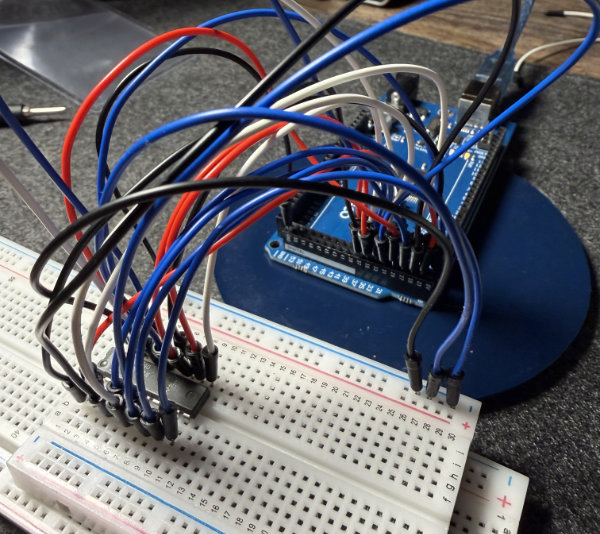
Bipolar ROM rig for extracting the timing ROMs of the MSP-126 in order to create a bit-accurate plugin.
The Story Behind the MSP-126
Christopher Moore founded Ursa Major in 1977 after four years at Lexicon, where he had grown frustrated with safe product design and dreamed of building innovative audio tools his own way. His first creation, the SST-282 Space Station, debuted in 1978 as a multi-tap delay unit that used a patented randomizing algorithm to synthesize reverberation from short delays — at a fraction of the cost of competitors like the EMT 250. It became a cult classic, used by everyone from ABBA to Frank Zappa.
Moore followed the Space Station with the StarGate 323 and 626 — wider bandwidth (15kHz vs 7kHz), true pitch stability throughout the decay, and far less modulation noise. But Moore's multi-tap delay architecture had another application beyond reverberation.
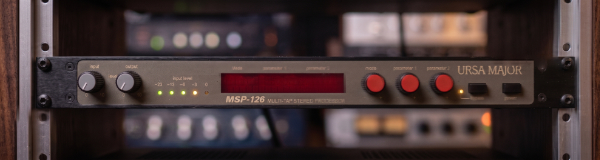
The Ursa Major MSP-126 Multi-Tap Stereo Processor. With only 70-80 units ever made, it is among the rarest pro audio processors of the 1980s.
The MSP-126, released in the twilight years of 1985-1986, stripped away the feedback path entirely and focused the twelve taps on spatial processing. With one input and two multi-tap outputs, it was designed specifically for stereo synthesis from mono sources — a problem that mattered deeply in an era when close-miked and electronic sources were severely monaural, yet all listening experiences were stereo. Moore described it as "a seemingly narrow province" that "contains a fascinating world of possibilities."
With only seventy to eighty units ever manufactured before AKG acquired Ursa Major in 1986, the MSP-126 is among the rarest of Moore's designs. Moore himself reflected: "Although only about seventy to eighty of the MSP-126s were made, I think it was a very useful processor with unique capabilities."
This plugin brings the MSP-126 back to life — every tap time, every gain value, every display character decoded from the original firmware ROMs — so that a new generation of engineers and musicians can explore the world that Christopher Moore built inside 376 milliseconds of memory.
Read more about Christopher Moore in this interview from Tape Op Magazine.
$25.00 USD
Demo Available
More info at temeculadsp.com/msp-126


 I would be in line to buy these if you provided Linux native binaries. I use Linux and try to stay as Linux native as possible with my software. Please consider providing support for Linux as well.


