
Experimental nonlinear preamp DSP prototype
-
- KVRer
- 24 posts since 21 May, 2026
Hi,
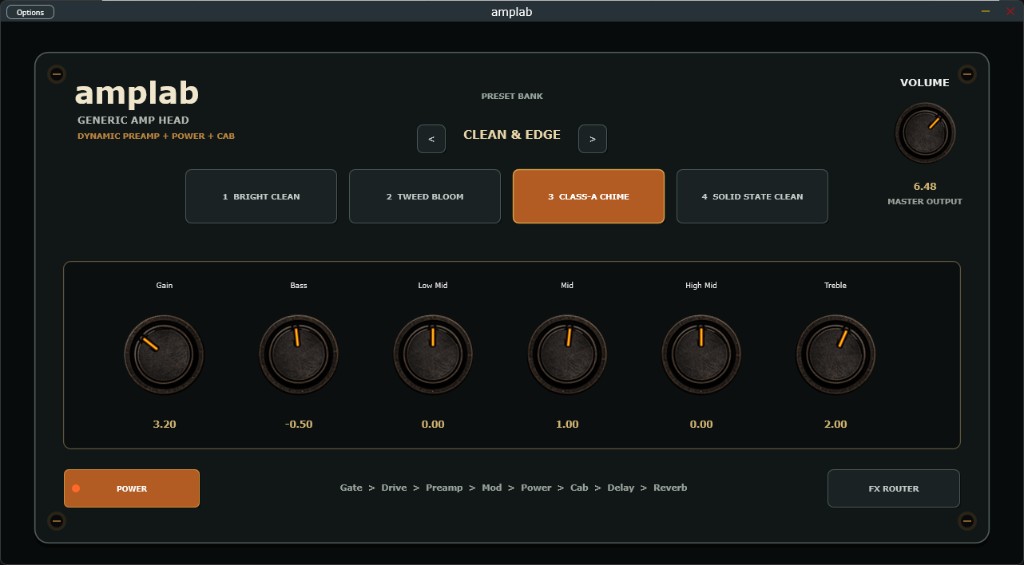
I’ve been experimenting with adaptive nonlinear DSP models inspired by some ideas from controllability and nonlinear simulation work, and ended up building an experimental guitar preamp plugin called amplab.
The core idea is to move away from a purely static waveshaper and introduce lightweight state-dependent behavior reacting to transient structure and signal intensity in real time.
Current focus is:
* dynamic response / playing feel,
* asymmetric nonlinear saturation,
* low CPU usage,
* lightweight architecture,
* experimental adaptive behavior rather than strict analog emulation.
Early build currently available for:
* Windows
* Linux
* macOS
Formats:
* VST3
Still an experimental release, but I thought the results were interesting enough to share.
Project page / demo records / downloads:
https://www.budrinlabs.com/amplab
https://www.budrinlabs.com/ironstack
Feedback is welcome.
Recent updates
v0.6.0
* More distinct amp character/voicing
* Improved nonlinear interstage behavior
* Updated power amp simulation
* Added lightweight dynamic cabinet simulation (algorithmic, not IR-based)
* Better transient response and pick attack sensitivity
* Improved gain interaction and saturation behavior
v0.6.1
* Dramatically improved feel and playability
* Much stronger pick attack response
* More lively interaction between amp stages
* Cabinet now reacts more clearly to Master level
* Master now drives the cabinet instead of acting only as output volume
* Improved speaker/cabinet movement under load
* Tighter and more controlled high-gain preset behavior
* Added plugin version display in the UI
* Renamed “Section” to “Power Clarity”
* Updated package README
v0.6.4
* Added standalone application builds
* Added ASIO support for Windows standalone builds
* Release archives now include standalone app, VST3 plugin, and README
* Improved gain behavior across existing amp presets
* Gain now pushes later stages more naturally
* More lively interaction between preamp, power amp, and cabinet
* Cabinet reacts more clearly to Gain, Power Drive, and Master
* Improved dynamic cabinet movement under load
* Better pick response and played feel across presets
v0.6.6
* Improved cabinet reaction under heavy load
* Reworked overload behavior in upper frequencies to reduce the fast “digital itch” that could appear during saturation
* Dual Modern preamp frequency response redesigned for a more believable real high-gain amp character
* Smoother and more elastic gain response under pressure
* Better dynamic interaction between power section and cabinet
v0.7.0
This update introduces a brand new Drive section with three built-in pedals:
* Green OD — classic mid-focused overdrive for tightening and pushing the front end
* Wall Fuzz — huge sustaining fuzz inspired by classic oversized fuzz walls
* Steel Band — aggressive modern distortion/fuzz hybrid built for chainsaw-level saturation
The new drive stage integrates directly into amplab’s nonlinear gain topology, making the pedals react dynamically with the amp and cabinet instead of behaving like isolated clipping blocks.
Other recent changes include:
* improved cabinet response under heavy load
* smoother high-frequency overload behavior
* more elastic and reactive gain feel
* reworked Dual Modern voicing for a more believable high-gain response
v0.8.0
* Reduced input level to handle hot humbuckers and boost pedals better
* Less unwanted distortion at lower Gain settings
* Removed clicks and crackling while turning controls
* Smoother real-time control changes
* Cleaner pick attack with less harsh high-frequency fizz
* Improved cabinet response under heavy load
* More consistent sound across different guitars and pickup outputs
Also, Iron Stack 0.2.0 is now available as a standalone release built on top of the amplab engine.
Iron Stack pushes the nonlinear side of the engine much further into doom/sludge/industrial territory with dynamic overload recovery, breathing gain behavior and reactive cabinet stress.
Related topic: viewtopic.php?t=630426
Demos&Download: https://www.budrinlabs.com/ironstack
I’ve been experimenting with adaptive nonlinear DSP models inspired by some ideas from controllability and nonlinear simulation work, and ended up building an experimental guitar preamp plugin called amplab.
The core idea is to move away from a purely static waveshaper and introduce lightweight state-dependent behavior reacting to transient structure and signal intensity in real time.
Current focus is:
* dynamic response / playing feel,
* asymmetric nonlinear saturation,
* low CPU usage,
* lightweight architecture,
* experimental adaptive behavior rather than strict analog emulation.
Early build currently available for:
* Windows
* Linux
* macOS
Formats:
* VST3
Still an experimental release, but I thought the results were interesting enough to share.
Project page / demo records / downloads:
https://www.budrinlabs.com/amplab
https://www.budrinlabs.com/ironstack
Feedback is welcome.
Recent updates
v0.6.0
* More distinct amp character/voicing
* Improved nonlinear interstage behavior
* Updated power amp simulation
* Added lightweight dynamic cabinet simulation (algorithmic, not IR-based)
* Better transient response and pick attack sensitivity
* Improved gain interaction and saturation behavior
v0.6.1
* Dramatically improved feel and playability
* Much stronger pick attack response
* More lively interaction between amp stages
* Cabinet now reacts more clearly to Master level
* Master now drives the cabinet instead of acting only as output volume
* Improved speaker/cabinet movement under load
* Tighter and more controlled high-gain preset behavior
* Added plugin version display in the UI
* Renamed “Section” to “Power Clarity”
* Updated package README
v0.6.4
* Added standalone application builds
* Added ASIO support for Windows standalone builds
* Release archives now include standalone app, VST3 plugin, and README
* Improved gain behavior across existing amp presets
* Gain now pushes later stages more naturally
* More lively interaction between preamp, power amp, and cabinet
* Cabinet reacts more clearly to Gain, Power Drive, and Master
* Improved dynamic cabinet movement under load
* Better pick response and played feel across presets
v0.6.6
* Improved cabinet reaction under heavy load
* Reworked overload behavior in upper frequencies to reduce the fast “digital itch” that could appear during saturation
* Dual Modern preamp frequency response redesigned for a more believable real high-gain amp character
* Smoother and more elastic gain response under pressure
* Better dynamic interaction between power section and cabinet
v0.7.0
This update introduces a brand new Drive section with three built-in pedals:
* Green OD — classic mid-focused overdrive for tightening and pushing the front end
* Wall Fuzz — huge sustaining fuzz inspired by classic oversized fuzz walls
* Steel Band — aggressive modern distortion/fuzz hybrid built for chainsaw-level saturation
The new drive stage integrates directly into amplab’s nonlinear gain topology, making the pedals react dynamically with the amp and cabinet instead of behaving like isolated clipping blocks.
Other recent changes include:
* improved cabinet response under heavy load
* smoother high-frequency overload behavior
* more elastic and reactive gain feel
* reworked Dual Modern voicing for a more believable high-gain response
v0.8.0
* Reduced input level to handle hot humbuckers and boost pedals better
* Less unwanted distortion at lower Gain settings
* Removed clicks and crackling while turning controls
* Smoother real-time control changes
* Cleaner pick attack with less harsh high-frequency fizz
* Improved cabinet response under heavy load
* More consistent sound across different guitars and pickup outputs
Also, Iron Stack 0.2.0 is now available as a standalone release built on top of the amplab engine.
Iron Stack pushes the nonlinear side of the engine much further into doom/sludge/industrial territory with dynamic overload recovery, breathing gain behavior and reactive cabinet stress.
Related topic: viewtopic.php?t=630426
Demos&Download: https://www.budrinlabs.com/ironstack
Last edited by kbudrin on Mon Jun 08, 2026 7:13 pm, edited 9 times in total.
-
- KVRian
- 818 posts since 28 Oct, 2014
This would be better in the effects forum: viewforum.php?f=6
- Beware the Quoth
- 35431 posts since 4 Sep, 2001 from R'lyeh Oceanic Amusement Park and Funfair
just report to the mods, they'll assess and shift it if appropriate..
An idiot on Set Theory:
"In some cases there is an object called red that contains everything that is red. In much the same way a pot is a plate."
-
- KVRist
- 128 posts since 18 Mar, 2007
Yes, would love some demo sounds. I'd be happy to toss some nominal $ your way for even working on this, I'm currently very interested in solutions that provide a responsive and dynamic playing feel but I'm really trying to focus my attention and time on playing and not chasing every shiny thing that comes along.
-
- KVRer
- Topic Starter
- 24 posts since 21 May, 2026
As requested, I finally recorded a few quick demos:
https://www.budrinlabs.com/amplab
One thing worth mentioning: preset names like “brit800” are currently more of a rough direction/reference than an attempt at strict amp modelling accuracy.
At the moment the plugin still behaves more like a single generalized amplifier pushed into different nonlinear regimes, although improving the distinct character of each model/preset is one of the main goals for future versions.
Also, the current “Drive” section is mostly a placeholder for now.
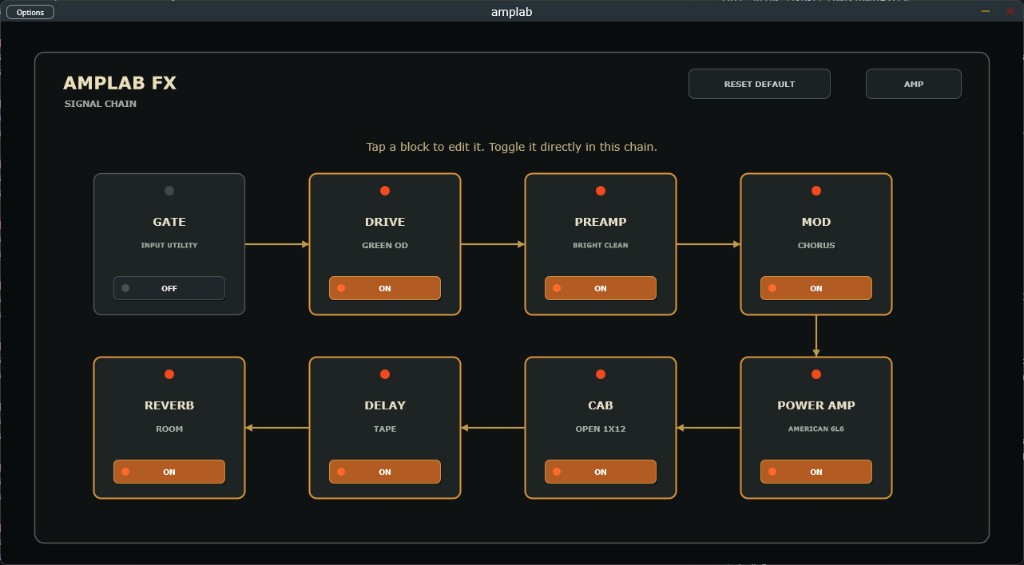
The signal chain is intentionally very lightweight at this stage:
preamp stage,
power amp stage,
simple cab simulation based on two frequency-domain filters,
no IR loading/convolution yet.
Right now the main focus is responsiveness, transient behavior and nonlinear interaction rather than full physical amp reproduction.
https://www.budrinlabs.com/amplab
One thing worth mentioning: preset names like “brit800” are currently more of a rough direction/reference than an attempt at strict amp modelling accuracy.
At the moment the plugin still behaves more like a single generalized amplifier pushed into different nonlinear regimes, although improving the distinct character of each model/preset is one of the main goals for future versions.
Also, the current “Drive” section is mostly a placeholder for now.
The signal chain is intentionally very lightweight at this stage:
preamp stage,
power amp stage,
simple cab simulation based on two frequency-domain filters,
no IR loading/convolution yet.
Right now the main focus is responsiveness, transient behavior and nonlinear interaction rather than full physical amp reproduction.
-
- KVRist
- 128 posts since 18 Mar, 2007
Thanks for posting the demos, it was enough to push me to try it out.
My quick 15-minute impression: Tone is good, you're on to something good here. It especially benefited from an IR. I'm curious to see where this goes as you push into some versions of distinct character. I'm not a purist for specific amps but appreciate a variety of sounds. I know that many people benefit from having some kind of familiar reference tone to start with.
I'd like to see more responsiveness. It is there but doesn't stand out for me switching from light fingerpicking to a heavier attack or with the pick.
Is there an input gain level that we should be adjusting to? (Edit: I see in the README: Keep your input level conservative. Guitar DI peaks around -12 dBFS are a good starting point.)
My quick 15-minute impression: Tone is good, you're on to something good here. It especially benefited from an IR. I'm curious to see where this goes as you push into some versions of distinct character. I'm not a purist for specific amps but appreciate a variety of sounds. I know that many people benefit from having some kind of familiar reference tone to start with.
I'd like to see more responsiveness. It is there but doesn't stand out for me switching from light fingerpicking to a heavier attack or with the pick.
Is there an input gain level that we should be adjusting to? (Edit: I see in the README: Keep your input level conservative. Guitar DI peaks around -12 dBFS are a good starting point.)
-
- KVRer
- Topic Starter
- 24 posts since 21 May, 2026
Thanks a lot for the first feedback. Right now I'm working on more "tone"-feel version. About a gain - right now it's just about experiments, so I don't really know)) I'm eager to release next version of more "character" next week so I'll keep this topic updated.
-
- KVRer
- Topic Starter
- 24 posts since 21 May, 2026
Released version 0.6.0
This update focuses mostly on responsiveness, nonlinear interaction and giving the different amp models more distinct character.
Changes in 0.6.0:
* Improved interstage nonlinear behavior
* More distinct voicing/character between amp models
* Updated power amp simulation with more dynamic response under load
* New lightweight dynamic cabinet simulation (not IR/convolution-based)
* Better transient response and pick attack sensitivity
* Improved saturation behavior across different gain levels
* General tuning and stability improvements
The new cabinet stage is still intentionally lightweight and algorithmic rather than IR-based. The goal is to model dynamic spectral response and damping behavior instead of reproducing a static captured snapshot.
This is still very much an experimental project, but the core direction is becoming clearer with every release.
As always, feedback is extremely appreciated — especially regarding responsiveness, playing feel and dynamic behavior.
This update focuses mostly on responsiveness, nonlinear interaction and giving the different amp models more distinct character.
Changes in 0.6.0:
* Improved interstage nonlinear behavior
* More distinct voicing/character between amp models
* Updated power amp simulation with more dynamic response under load
* New lightweight dynamic cabinet simulation (not IR/convolution-based)
* Better transient response and pick attack sensitivity
* Improved saturation behavior across different gain levels
* General tuning and stability improvements
The new cabinet stage is still intentionally lightweight and algorithmic rather than IR-based. The goal is to model dynamic spectral response and damping behavior instead of reproducing a static captured snapshot.
This is still very much an experimental project, but the core direction is becoming clearer with every release.
As always, feedback is extremely appreciated — especially regarding responsiveness, playing feel and dynamic behavior.
-
- KVRer
- Topic Starter
- 24 posts since 21 May, 2026
Also updated demo files on https://www.budrinlabs.com/amplab
-
- KVRer
- Topic Starter
- 24 posts since 21 May, 2026
amplab 0.6.1 is available.
This update focuses on feel: pick attack, stage interaction, and cabinet movement.
The interstage dynamics have been pushed much harder. Fast changes in the signal now drive the frequency-dependent response more aggressively, so the amp reacts more dramatically to attack and characteristic frequency bands. The result is a livelier, less static response where stages audibly push and pull against each other.
Also changed:
- Master now drives the cabinet model, not just output volume
- Cabinets react more strongly to load and transient movement
- Dual Modern has been tightened up
- Version is shown in the plugin UI
- “Section” is now “Power Clarity”
- README updated
amplab 0.6.x also adds selectable dynamic cabinet models, not IR convolution: the cabinet is part of the same stateful amp/speaker system.
Download/update:
https://ko-fi.com/s/b8d7e5715c
This update focuses on feel: pick attack, stage interaction, and cabinet movement.
The interstage dynamics have been pushed much harder. Fast changes in the signal now drive the frequency-dependent response more aggressively, so the amp reacts more dramatically to attack and characteristic frequency bands. The result is a livelier, less static response where stages audibly push and pull against each other.
Also changed:
- Master now drives the cabinet model, not just output volume
- Cabinets react more strongly to load and transient movement
- Dual Modern has been tightened up
- Version is shown in the plugin UI
- “Section” is now “Power Clarity”
- README updated
amplab 0.6.x also adds selectable dynamic cabinet models, not IR convolution: the cabinet is part of the same stateful amp/speaker system.
Download/update:
https://ko-fi.com/s/b8d7e5715c
-
- KVRer
- Topic Starter
- 24 posts since 21 May, 2026
Amplab v0.6.4 is available.
Changelog:
- Added standalone application builds alongside the VST3 plugin
- Windows standalone build now includes ASIO support for low-latency playing
- Improved dynamic gain behavior across the existing amp presets
- Gain now pushes later stages more naturally instead of only hitting the input stage
- More lively preamp-to-power-amp interaction
- More responsive dynamic cabinet behavior
- Cabinet response now reacts more clearly to Gain, Power Drive, and Master
- Improved pick response and “played feel” across the existing presets
- Updated release packages: each platform archive now includes the standalone app, VST3 plugin, and README
- Updated documentation and installation notes
Notes:
- Cabinet simulation remains algorithmic and dynamic, not IR-based
- Cab can still be disabled if you prefer using your own IR loader
- This update focuses on making the existing amplab amp models feel more alive and less static compared to v0.6.1
Download/update:
https://ko-fi.com/s/b8d7e5715c
Changelog:
- Added standalone application builds alongside the VST3 plugin
- Windows standalone build now includes ASIO support for low-latency playing
- Improved dynamic gain behavior across the existing amp presets
- Gain now pushes later stages more naturally instead of only hitting the input stage
- More lively preamp-to-power-amp interaction
- More responsive dynamic cabinet behavior
- Cabinet response now reacts more clearly to Gain, Power Drive, and Master
- Improved pick response and “played feel” across the existing presets
- Updated release packages: each platform archive now includes the standalone app, VST3 plugin, and README
- Updated documentation and installation notes
Notes:
- Cabinet simulation remains algorithmic and dynamic, not IR-based
- Cab can still be disabled if you prefer using your own IR loader
- This update focuses on making the existing amplab amp models feel more alive and less static compared to v0.6.1
Download/update:
https://ko-fi.com/s/b8d7e5715c
-
- KVRer
- Topic Starter
- 24 posts since 21 May, 2026
amplab 0.6.6 released
This update focuses heavily on overload behavior, cabinet response and high-gain feel.
Changes in 0.6.6:
* improved cabinet reaction under heavy load
* reworked overload behavior in upper frequencies to reduce the fast “digital itch” that could appear during saturation
* Dual Modern preamp frequency response redesigned for a more believable real high-gain amp character
* smoother and more elastic gain response under pressure
* better dynamic interaction between power section and cabinet
Download/update:
https://ko-fi.com/s/b8d7e5715c
This update focuses heavily on overload behavior, cabinet response and high-gain feel.
Changes in 0.6.6:
* improved cabinet reaction under heavy load
* reworked overload behavior in upper frequencies to reduce the fast “digital itch” that could appear during saturation
* Dual Modern preamp frequency response redesigned for a more believable real high-gain amp character
* smoother and more elastic gain response under pressure
* better dynamic interaction between power section and cabinet
Download/update:
https://ko-fi.com/s/b8d7e5715c
-
- KVRer
- Topic Starter
- 24 posts since 21 May, 2026
amplab 0.7.0 released
This update introduces a brand new Drive section with three built-in pedals:
- "Green OD" — classic mid-focused overdrive for tightening and pushing the front end
- "Wall Fuzz" — huge sustaining fuzz inspired by classic oversized fuzz walls
- "Steel Band" — aggressive modern distortion/fuzz hybrid built for chainsaw-level saturation
The new drive stage integrates directly into amplab’s nonlinear gain topology, making the pedals react dynamically with the amp and cabinet instead of behaving like isolated clipping blocks.
Other recent changes include:
- improved cabinet response under heavy load
- smoother high-frequency overload behavior
- more elastic and reactive gain feel
- reworked Dual Modern voicing for a more believable high-gain response
Also, Iron Stack 0.2.0 is now available as a standalone release built on top of the amplab engine.
Iron Stack pushes the nonlinear side of the engine much further into doom/sludge/industrial territory with dynamic overload recovery, breathing gain behavior and reactive cabinet stress.
Projects and demos:
https://www.budrinlabs.com/amplab
https://www.budrinlabs.com/ironstack
This update introduces a brand new Drive section with three built-in pedals:
- "Green OD" — classic mid-focused overdrive for tightening and pushing the front end
- "Wall Fuzz" — huge sustaining fuzz inspired by classic oversized fuzz walls
- "Steel Band" — aggressive modern distortion/fuzz hybrid built for chainsaw-level saturation
The new drive stage integrates directly into amplab’s nonlinear gain topology, making the pedals react dynamically with the amp and cabinet instead of behaving like isolated clipping blocks.
Other recent changes include:
- improved cabinet response under heavy load
- smoother high-frequency overload behavior
- more elastic and reactive gain feel
- reworked Dual Modern voicing for a more believable high-gain response
Also, Iron Stack 0.2.0 is now available as a standalone release built on top of the amplab engine.
Iron Stack pushes the nonlinear side of the engine much further into doom/sludge/industrial territory with dynamic overload recovery, breathing gain behavior and reactive cabinet stress.
Projects and demos:
https://www.budrinlabs.com/amplab
https://www.budrinlabs.com/ironstack
