
EightySix — Roland JUNO-6 Clone (v1.1 UPDATE - Velocity Response, Poly Aftertouch)

VST, AU, AAX, CLAP, etc. Plugin Virtual Instruments Discussion
Post Reply New Topic
RELATED
PRODUCTS

Post

Hey bois, I made another thing, this one has been in the making for a while.
— EightySix, a circuit-modeled Roland Juno-6 emulation. And I wonder what you think, does it sound better than the competition? Anyone care to compare? Did i get the chorus right?
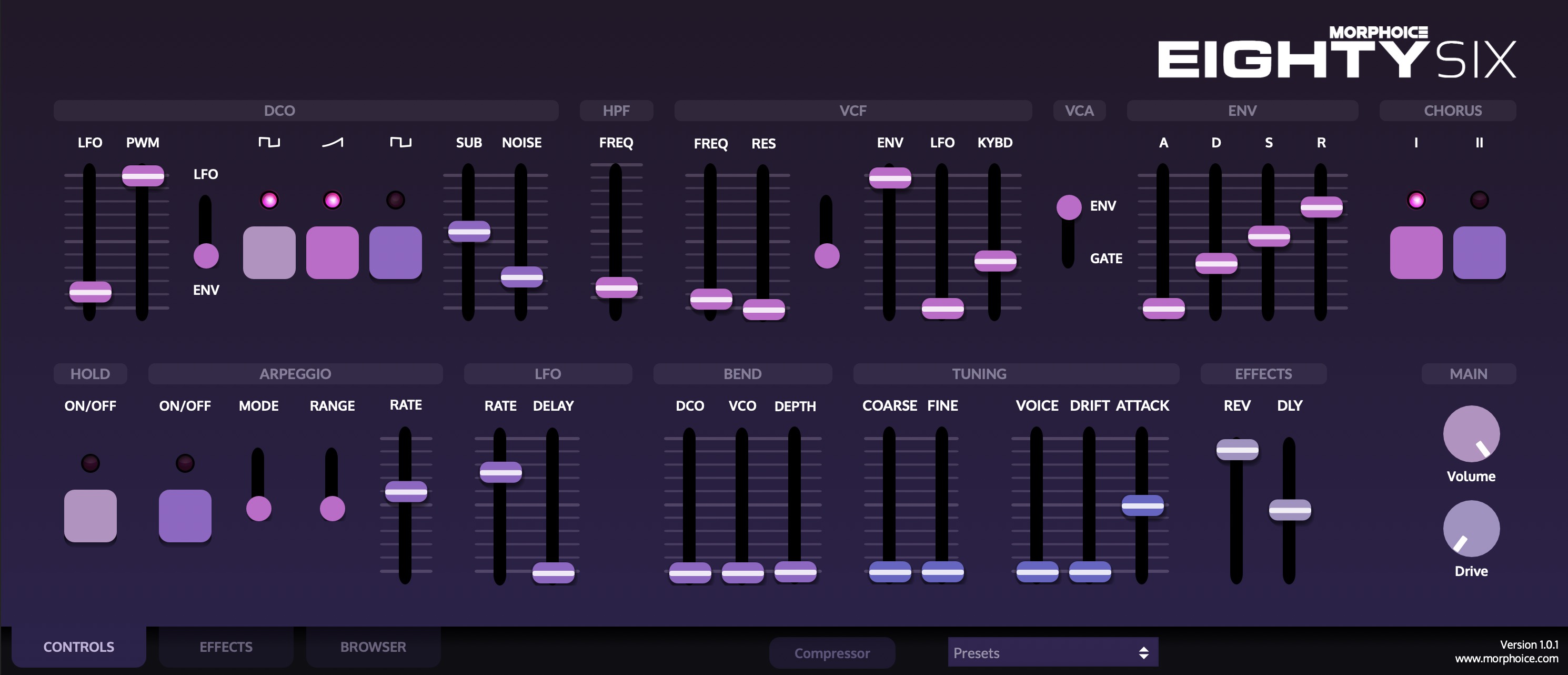
Image
I modeled it after my very own, meticulously restored Juno-6 hardware unit. The oscillators, the filter, the chorus — all measured and matched from the real thing. If you know the Juno sound, you know what you're getting: lush pads, shimmering choruses, and that unmistakable analog warmth.

What's in there:

Saw, pulse, and sub oscillators modeled after the real hardware
The classic Juno low-pass ladder filter with resonance + high-pass filter
The iconic Juno chorus with Mode I and Mode II, measured from my unit
ADSR envelope and sine LFO matched to original timings
PWM with three modes (envelope, manual, LFO) just like the front panel
DarkStar Reverb and Delay effects built in
What's NOT in there yet:
Arpeggio, Hold & Tuning — coming in a future update


Go grab it at https://www.morphoice.com/eightysix

Mac users: you may need to approve unsigned software in your system settings — check the download page for instructions.

As always, if you make something cool with it or find any bugs, let me know. And if you want to contribute presets, send them over to morphoice@gmail.com
Last edited by Morphoice on Wed Jun 03, 2026 4:25 pm, edited 2 times in total.

Post

Sound cuts off after 1-2 seconds. A new preset must be selected to get back the sound but it also cuts off. REAPER 7, Windows 11.

EDIT: Also, pressing keys star using more CPU and it doesn't go back down. Each repeated note adds more CPU usage until your machine can't take it.

Post

Just some issues I encountered and things I didn't like. Using in FL Studio, Windows 11. I don't have a hardware unit to compare to, but compared to other Juno emulations the envelope feels off. The attack and release behaviours are very different.

The default chorus wet setting is far too high, causing very bad stereo correlation/mono compatibility issues - to my ears it should be around 27%-ish. It doesn't remember when the chorus settings are changed - switching chorus models reverts the settings back to default.

There's no way to disable velocity sensitivity, and there's none for the filter/env.

No mono/legato option.

The more I play, the more the CPU keeps going up - one instance is now at 50% in FL's CPU meter.

In most of the sections I could click on the white lettering and enter my own text:
Screenshot 2026-05-25 160248.png

Lastly, I think it's bad form to suggest your product is better than that of a specific developer, especially when that developer has a long established reputation for quality, something which you've yet to attain.
You do not have the required permissions to view the files attached to this post.

Post

Better than TAL, that's pretty funny.

*Anyway talking to the OP is useless, he will not return to this thread IME. Just a lame
attempt to bring attention to his wares, which are not free.

Post

Hey everyone, thanks for trying EightySix and for the detailed feedback.

CPU usage: EightySix is a circuit-modeled synth, so it's heavier on the CPU than sample-based plugins. The polyphony is set high by default — if you're seeing CPU climb, try lowering your polyphony count or increasing your buffer size. Voices are released properly, but each active voice runs the full analog circuit model in real-time, which adds up on lower-spec systems. I'll look into adding a polyphony limit option to make this easier to manage.

Sound cutting off: This might be related to the CPU situation above — if your system is maxing out, audio dropouts will happen. Try a higher buffer size and see if that resolves it.

Chorus settings: Chorus I and II are preset modes that replicate the exact hardware switch positions on the original Juno-6 — that's how the real unit works. If you want full control over all chorus parameters, head to the Effects page where everything is tweakable.

Editable text on the UI: Noted, will lock those down in the next update.

Velocity sensitivity toggle / mono-legato mode: The original Juno-6 had no velocity sensitivity, so adding a toggle to disable it makes sense for authenticity. Mono/legato and the arpeggiator are planned for a future update.

Envelope behavior: The envelope curves were measured directly from my own restored Juno-6 hardware. Differences from other emulations are expected — we modeled the actual hardware, not other software. If something feels off compared to a real unit, I'd love to hear specifics.

Regarding TAL: I have a lot of respect for TAL and what they've done for the community. That said, circuit modeling has come a long way since TAL-U-NO-LX was released, and EightySix was built from the ground up using measurements from real hardware. It's a different approach and a different generation of technology. I believe the results speak for themselves.

This is a beta and feedback like this is exactly what helps me improve it. Keep it coming — I'm listening.

Post

While I'm happy to try a new Juno emulation, I agree about the clickbait title, which is quite disrespectful with a well regarded independent developer. I think you can promote your synth without trying to put TAL down.
Tal is [...] not really circuit modeled
Really? I think that on his website you can find a picture and a story of the gear he used to model his emulation (just like Audiothing or Samples from Mars does).
Each oscillator, filter, and envelope has been painstakingly modeled to capture the essence of the original hardware, delivering an unparalleled level of authenticity.
Image

Image

Post

How many threads are going to be made about your two plugins?

Post

Is this another AI created synth?

I see so many 1 user so called "created" synth plugins this year that it makes me think either some year had alot of coding geniuses had born or its just alot of people using AI for them to write plugins.

Post

Morphoice wrote: Mon May 25, 2026 7:00 pmCPU usage: EightySix is a circuit-modeled synth, so it's heavier on the CPU than sample-based plugins. The polyphony is set high by default — if you're seeing CPU climb, try lowering your polyphony count or increasing your buffer size. Voices are released properly, but each active voice runs the full analog circuit model in real-time, which adds up on lower-spec systems.
I'm using a Ryzen 7 9700X. It's not the top CPU but it's not low spec either. I shouldn't be seeing 50% CPU in my DAW when I'm not even playing a note. There is an issue here.
Chorus settings: Chorus I and II are preset modes that replicate the exact hardware switch positions on the original Juno-6 — that's how the real unit works. If you want full control over all chorus parameters, head to the Effects page where everything is tweakable.
Well something is wrong here. The stereo correlation is entirely negative, which has an audio characteristic unlike the Juno chorus, and which severely reduces the volume in mono playback. Bringing down the wet control from the default 60% to below 30% resolves this but it doesn't save the settings and reverts to default when the chorus models are selected.

Post

yeah, CPU goes up and stays climbing with each note you play. That's a bug, not a "high CPU plugin".

Post

Does it make sense to go circuit modelled?
Just model the envelopes, filters and osc. In fact, IMO any sound on a Juno can be made with Falcon because of this.

What does circuit modelled mean anyway? Modelling every resistor / capacitor?

Post

Essent wrote: Tue May 26, 2026 12:34 am Does it make sense to go circuit modelled?
Just model the envelopes, filters and osc. In fact, IMO any sound on a Juno can be made with Falcon because of this.

What does circuit modelled mean anyway? Modelling every resistor / capacitor?
that's kind of what it originally meant, as far as I know. Like, virtual models of the electronic circuits. It's been about 20 years since I first noticed that phrase being used in virtual instrument development circles, and sometimes terms start to encompass a wider interpretation.
resistors are futile you will be simulated
Soundcloud
T4M

Post

It is made with Faust, an open source DSP language from Grame.

https://github.com/grame-cncm/faust

It not known to me that it allows circuit modeling on component level.
Voices which are not active must not eat CPU, they should stop computing when a note has finished, or its level is beyond hearing range…

Post

Faust is just a language. Circuit modeling is about explaining what happens with formulae, it doesn't really depend on the language you use.

Post

Great! I've added that to https://virtualsynthesizers.com/synthes ... nd-juno-6/. Good job!

Post Reply

Return to “Instruments”