

Previously I called The Hot Summer + The Analog Molecule Deluxe the most “real” console emulation/analog summing system. That’s just my opinion!
Airwindows Console is impressive, no question. But the requirement to keep DAW faders at zero is a dealbreaker for a lot of people. For that reason alone, I rank TAMD + THS higher.
Beyond that, TAMD + THS feels more “alive” to me. The mix breathes and responds to fader moves in a way that feels like it's working with me. There also seems to be more inter-plugin communication, though Doc Shadrach would have to confirm that.
TAMD also includes an SSL-style channel strip with 4 compressor options(!), and that processing is part of the cross-plugin interaction... So it’s not just extra, it’s integral. Plus, it has a proper GUI, which helps when mixing. Airwindows’ slider-based UI is functional, but not as enjoyable to work with.
To my ears, TAMD + THS is an evolution beyond Airwindows Console. The fact it builds on some of Chris’s ideas is a good thing. That’s how progress happens. Maybe TAMD+THS will inspire Chris to take Airwindows Console in a similar direction, and solve the DAW fader limitation.

What is your favourite plugin for 'analog' style saturation?
-
- KVRist
- 33 posts since 25 Jul, 2020
-

- KVRAF
- 2386 posts since 23 Sep, 2004 from Kocmoc
Can't make music in Reaper, using AbletonBCollins wrote: Fri Jun 05, 2026 10:13 amOversampling THS (at least the summing bus) in Reaper makes a difference.legendCNCD wrote: Wed Jun 03, 2026 3:12 pm So, the question has landed: has anyone measured these (TAMD or THS), I am interested in aliasing and such, how much it imparts harmonics etc. ?
It seems the highend of spectrum is being dropped a bit, but thats how far I got.
Give it a try!
 but yeah thats what I heard from a friend too, needs OS in some parts.
Soft Knees - Live 12, Diva, Omnisphere, Slate Digital VSX, TDR, Kush Audio, U-He, PA, Valhalla, Fuse, Pulsar AUDIO, NI, OekSound etc. on Win11Pro R7950X & RME AiO Pro
https://www.youtube.com/@softknees/videos Music & Demoscene
https://www.youtube.com/@softknees/videos Music & Demoscene
-
- KVRist
- 255 posts since 4 Apr, 2020
Definitely, any distortion can sound very different and probably better with higher sample rates.
-
- KVRian
- 720 posts since 18 May, 2020
I know I'm way behind the times but I am trying the u-he Satin on every track thing. Can't decide if it should be last on every track in the production phase, or first-ish on every track in the mixing phase.
REAPER + Davinci Resolve Pro on Manjaro KDE. Neve 88m. Focusrite 18i20 2nd gen. Neumann NDH30 headphones. Mics: Telefunken TF39, AT4050, Miktek C7e, EV RE-15. VSTs: u-he Hive 2, F'em, Renoise Redux, Apisonic Speedrum 2.
-
simon.a.billington simon.a.billington https://www.kvraudio.com/forum/memberlist.php?mode=viewprofile&u=341278
- KVRAF
- 2605 posts since 12 Nov, 2014
It really comes down to freeing up the CPU, if you're the kind who bounces out your projects before mixing, versus having the most amount of options and control during the mix phase.TechHaus wrote: Sat Jun 06, 2026 3:54 pm I know I'm way behind the times but I am trying the u-he Satin on every track thing. Can't decide if it should be last on every track in the production phase, or first-ish on every track in the mixing phase.
One one hand it may sound like a great idea to commit to your choices and bounce it all out, but what if those choices end up getting in your way?? What if you were left washing you didn't distort this track so much or cut out too many of these frequencies on another track, things that can't be undone.
It's a tough choice, but often working on the side of caution leaves you free to add more processing if you need it. Sometimes decisions are more important to make in the context of a whole mix and using a pair of fresh ears because shooting yourself in the foot can be very problematic.
You can always take advantage of freeze functionality to get your CPU resources back.
-
simon.a.billington simon.a.billington https://www.kvraudio.com/forum/memberlist.php?mode=viewprofile&u=341278
- KVRAF
- 2605 posts since 12 Nov, 2014
Yeah I haven't used UAD's Culture Vulture either, bit I do like the Arturia one. I ave plenty of analogy style saturation plugins, all with their own distinct sounding they're all very good at what they do, given the right context. I do work at 96k though, so that does tend to open up how these plugins handle high frequencies just a little.AmoraMusica wrote: Tue Jun 02, 2026 2:27 amI haven't doodled with the UAD version but I'm curious if the differences are super obvious.simon.a.billington wrote: Mon Jun 01, 2026 4:13 amThat's another good one. Actually, I just found out recently that Arturia's Bus Force, as it turns out, seems to be an emulation of the Overstayer.AmoraMusica wrote: Fri May 29, 2026 2:16 pm Culture Vulture. I find it has something I can't get from blackbox or decapitator
Running your signal through a guitar amp emulation, with or without the cab is another good option. My top 3 choices here are Amplitude, Guitar Rig or PRS Supermodels/Voltage. The latter of the 3 is more straightforward and lacks all the unnecessary overkill found in Guitar Rig or Amplitude.
Though there are times when having access to additional distortion pedals also pose an advantage.
Other than higher sample rates and oversampling, one technique that also helps avoid aliasing is turning down the high frequencies prior to distortion/saturation, then bring back the high frequencies after. Some plugins even make this process a bit simpler.
If you look at the Waves Abbey Road Saturator it has a Pre EQ and a Post EQ built in to it. So it's just a matter of turning down the high shelf before the saturation process, then jacking it back up using the high shelf in the post eq. Where if you look at the aforementioned Arturia Tube Culture plugin it only offers HP and LP filters in the input and output section, so you'd have to sandwich it between two thirds part eqs to achieve the same effect.
-
- KVRer
- 5 posts since 29 May, 2026
I haven't doodled with the UAD version but I'm curious if the differences are super obvious.
[/quote]
Yeah I haven't used UAD's Culture Vulture either, bit I do like the Arturia one. I ave plenty of analogy style saturation plugins, all with their own distinct sounding they're all very good at what they do, given the right context. I do work at 96k though, so that does tend to open up how these plugins handle high frequencies just a little.
Other than higher sample rates and oversampling, one technique that also helps avoid aliasing is turning down the high frequencies prior to distortion/saturation, then bring back the high frequencies after. Some plugins even make this process a bit simpler.
If you look at the Waves Abbey Road Saturator it has a Pre EQ and a Post EQ built in to it. So it's just a matter of turning down the high shelf before the saturation process, then jacking it back up using the high shelf in the post eq. Where if you look at the aforementioned Arturia Tube Culture plugin it only offers HP and LP filters in the input and output section, so you'd have to sandwich it between two thirds part eqs to achieve the same effect.
[/quote]
I got Saturn recently. Quite surprising. I expected something very digital. I got it more for sound design. More like Thermal by Output but I like the work flow better. It really is a bit of a Swiss Army knife.
[/quote]
Yeah I haven't used UAD's Culture Vulture either, bit I do like the Arturia one. I ave plenty of analogy style saturation plugins, all with their own distinct sounding they're all very good at what they do, given the right context. I do work at 96k though, so that does tend to open up how these plugins handle high frequencies just a little.
Other than higher sample rates and oversampling, one technique that also helps avoid aliasing is turning down the high frequencies prior to distortion/saturation, then bring back the high frequencies after. Some plugins even make this process a bit simpler.
If you look at the Waves Abbey Road Saturator it has a Pre EQ and a Post EQ built in to it. So it's just a matter of turning down the high shelf before the saturation process, then jacking it back up using the high shelf in the post eq. Where if you look at the aforementioned Arturia Tube Culture plugin it only offers HP and LP filters in the input and output section, so you'd have to sandwich it between two thirds part eqs to achieve the same effect.
[/quote]
I got Saturn recently. Quite surprising. I expected something very digital. I got it more for sound design. More like Thermal by Output but I like the work flow better. It really is a bit of a Swiss Army knife.
-

- KVRAF
- 8695 posts since 29 Sep, 2010 from Maui
Now you can try/buy Sabol Hill Lacuna, some new possibly interesting type of modeling technique that mimics the idiosyncrasies of analog HW.
https://www.sabolhill.com/
Another Chowdhury developed plugin. So yeah, Stochastic Spectral Drift is a real thing.
Only $109 intro vs $199 msrp.
https://www.sabolhill.com/
Another Chowdhury developed plugin. So yeah, Stochastic Spectral Drift is a real thing.
Only $109 intro vs $199 msrp.
-
- KVRian
- 720 posts since 18 May, 2020
What else did he do?
REAPER + Davinci Resolve Pro on Manjaro KDE. Neve 88m. Focusrite 18i20 2nd gen. Neumann NDH30 headphones. Mics: Telefunken TF39, AT4050, Miktek C7e, EV RE-15. VSTs: u-he Hive 2, F'em, Renoise Redux, Apisonic Speedrum 2.
-
- KVRAF
- 8695 posts since 29 Sep, 2010 from Maui
-
simon.a.billington simon.a.billington https://www.kvraudio.com/forum/memberlist.php?mode=viewprofile&u=341278
- KVRAF
- 2605 posts since 12 Nov, 2014
AmoraMusica wrote: Tue Jun 09, 2026 3:04 pm I haven't doodled with the UAD version but I'm curious if the differences are super obvious.
Yeah I haven't used UAD's Culture Vulture either, bit I do like the Arturia one. I ave plenty of analogy style saturation plugins, all with their own distinct sounding they're all very good at what they do, given the right context. I do work at 96k though, so that does tend to open up how these plugins handle high frequencies just a little.
Other than higher sample rates and oversampling, one technique that also helps avoid aliasing is turning down the high frequencies prior to distortion/saturation, then bring back the high frequencies after. Some plugins even make this process a bit simpler.
If you look at the Waves Abbey Road Saturator it has a Pre EQ and a Post EQ built in to it. So it's just a matter of turning down the high shelf before the saturation process, then jacking it back up using the high shelf in the post eq. Where if you look at the aforementioned Arturia Tube Culture plugin it only offers HP and LP filters in the input and output section, so you'd have to sandwich it between two thirds part eqs to achieve the same effect.
Yeah, Saturn is quite popular, it's very flexible and does the whole multiband thing as well.I got Saturn recently. Quite surprising. I expected something very digital. I got it more for sound design. More like Thermal by Output but I like the work flow better. It really is a bit of a Swiss Army knife.
iZotope has something similar, I just can't remember if it's in Neutron, Ozone or both. Plugin Alliance/Brainworx have their bx_saturator. Ohmforce Ohmicide is back from the dead. IK has a multiband distortion plugin now, Actually, about the only dev I can think of at the moment who doesn't have one is Waves, ironically.
Not that multiband distortion is what the original topic was about. I just think it's useful to have that kind of flexible functionality in some instances. That's part of what makes Saturn so popular.
-
- KVRian
- 720 posts since 18 May, 2020
I tried Kazrog's synth warmer last night because it is their cheapest plugin, and I was really pleased with the saturation.
Then I wanted to compare it to a few other free tools, and tried blepfx filtrr which sounds amazing! Next I tried ViatorDSP Ripper and wooooo this also has some juicy saturation algorithms.
Then I wanted to compare it to a few other free tools, and tried blepfx filtrr which sounds amazing! Next I tried ViatorDSP Ripper and wooooo this also has some juicy saturation algorithms.
REAPER + Davinci Resolve Pro on Manjaro KDE. Neve 88m. Focusrite 18i20 2nd gen. Neumann NDH30 headphones. Mics: Telefunken TF39, AT4050, Miktek C7e, EV RE-15. VSTs: u-he Hive 2, F'em, Renoise Redux, Apisonic Speedrum 2.
-
- KVRAF
- 3392 posts since 19 Mar, 2008 from germany
I only get genuine saturation and warmth from the really old Bosch units,
which produce a vintage-style warm sound and authentic air compression:
which produce a vintage-style warm sound and authentic air compression:
You do not have the required permissions to view the files attached to this post.
free mp3s + info: andy-enroe.de songs + weird stuff: enroe.de
-
- KVRAF
- 8695 posts since 29 Sep, 2010 from Maui
A new and pretty good sounding saturator for free imo: https://rust-romance.com/product/drive-in-my-head/
Account is required...
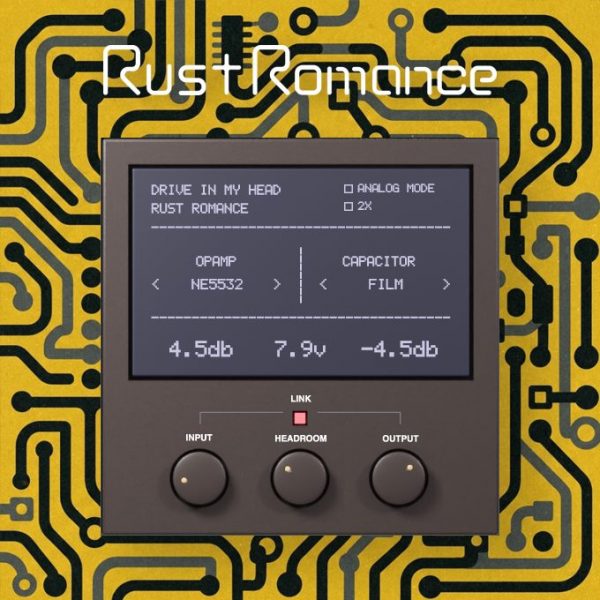
Account is required...
-

- KVRist
- 201 posts since 26 Aug, 2025