Forum for synthesis research?

How to make that sound...
Post Reply New Topic
RELATED
PRODUCTS

Post

AUTO-ADMIN: Non-MP3, WAV, OGG, SoundCloud, YouTube, Vimeo, Twitter and Facebook links in this post have been protected automatically. Once the member reaches 5 posts the links will function as normal.
So, the other day I wanted to figure out:
"How can I take an existing piece of music and analyze the spectrum and waves to reverse engineer the synth out of the spectrum?"

But I couldn't find many resources, that I just tried to figure it out by myself in some kind of way.

So, I imagine. "Okay, let's reverse engineer a simple sine wave"

So, you'd record a sine wave, and all you have to do is get the frequency and create a sine wave, so that concept works.


So, then what if there's 2 "lines" in the spectrum (Harmonics in this case, OR layered oscillators with fine tuning) So, I went in Sytrus and assigned two harmonics, and played a key.

Then exported it as a mp3 and then analyzed the mp3.

So, the goal was to figure out, how to figure out the harmonics through the spectrum.

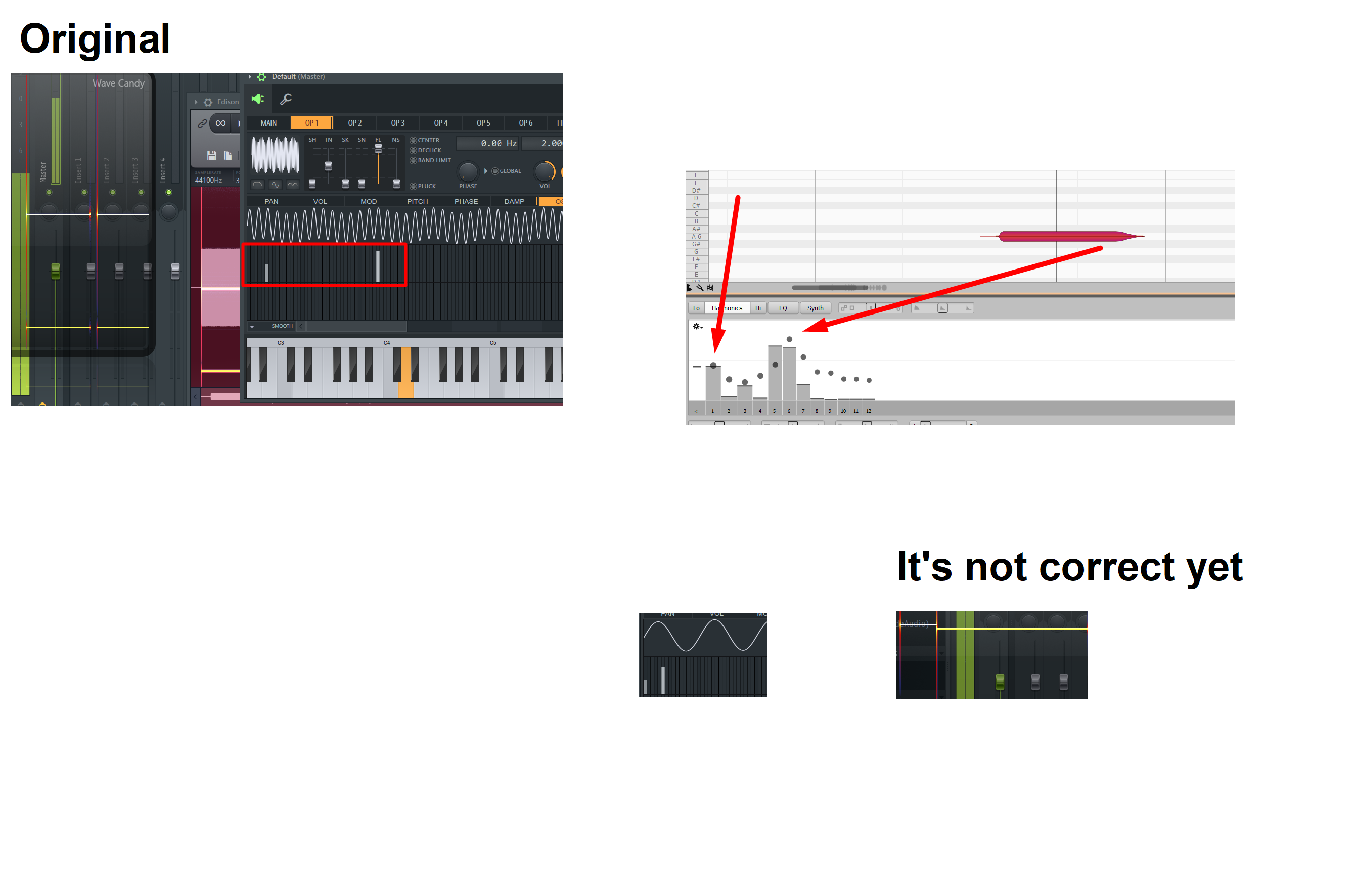
This was a bit more tricky, and I also did it in Sytrus.

First I tried it in Melodyne, but
Image

That wasn't accurate.


Next approach was to just look at the Spectrum.

So, I looked at this chart https://mixbutton.com/music-tools/frequ ... ency-chart (https://mixbutton.com/music-tools/frequency-and-pitch/music-note-to-frequency-chart) and I know that somewhere in Sytrus, there's a "Base Frequency" of some kind.


So, the approach was that I saw something like 1760 Hz and 10862 Hz.

So, I divided 1760 Hz by 6. Because it said that it was on a 6th octave. This gave me something like 293.33 Hz, which meant D4.

Then the next step was to divide 1760 Hz / 293.33 Hz = about 6
And then 10862 Hz / 293.33 Hz = about 37

And 6 and 37 in this case, were the ORIGINAL Harmonics, that I applied in Sytrus.


It is a strange approach though, but it is an approach that I figured out. But I think this only works if the harmonics are not detuned.


Now, there's more complicated synths, and I am wondering if there's some kind of Discord or Forum (maybe this one?) where people just talk about synths or something, like actively.

Post

I think you would do better to first have a more solid grounding in how sound and notes work. Then, of course, when a full recording exists, it is waaaaay more complex than you dream it is:

Even with one fiddle delivering pure monophonic lines, you have not seemed to account for bow noise, breathing noise, farting, goats bleating, echoes & reverb incl room reaction/nodes etc...

If we then add an underleg fiddler with a continuo, we have not only the increasingly complex harmonic interactions but more 'impure' (by your thinking) elements. Things like the underleg fiddler being less than mechanically locked in-time with the first fiddler. The very things that make music so complex and amazing.

And that is before we get to:


While I get your reductionist approach as it is uber-moderne, it can never work in the real world, as the Fourier people discovered when they could not recreate Mozart with any number of sine waves.

Not to say that there are not things to learn in pure science, but the pure and reality are far more separate then you want to admit - just as AI 'girlfriends' really do no resemble real girls at all. You may prefer the faux but what it explains is not the whole world; rather a made-up non-reality.

Go read up on real basics first like:
Harmonic Series (and not just to get cheat charts coz as the name says 'cheat'): https://en.wikipedia.org/wiki/Harmonic_series_(music)

A very real-world look: https://benedictroffmarsh.com/2022/01/1 ... s-to-work/

Have fun with it, but not too much.
:-)

Post

It's not about me tying it to science. But in my example I didn't had any resources, so my approach was to make a simple synth and then see if I can figure out the original configuration of the synth through a "baked file".

And the math did reveal the right harmonics, so there is a point here.

Of course, Distortion, Chorus, Compression, Phaser and Flanger would be more tricky to read out, but if I move a value from 0 to 100 I can see the difference in the spectrum.

But for other sounds, I think the only way is to just observe how frequencies change.


One issue I noticed is that, there are individual tools that generate sound, make distortion and etc.
Different tools that allow you to link modulation values to different knobs and everything. And I feel like these make a difference, because they make things more simple.

And I haven't seen a Plugin yet, that does all of that. Only ones I heard about were, Reaktor 6 and Falcon. Because both there let you insert a lot of things multiple times, and Reaktor 6 is basically the "you place and wire things" in a little more low-level way.


While exploring more resources, I started to think about Physics. Glass, Metal and everything else produce sound. We have video games today, that simulate physics. But sound is still played through Audio Files. People have to record audio and stuff, which is an interesting adventure.

But I've been wondering actually, that if Physics is math, maybe Audio has its math as well, and I know it definitely has. I feel like it is possible to generate any sound in the world with a CPU and math.


I also don't quite get why something was called Subtractive Synthesis. Because in all the examples, I haven't seen a Synth being used for subtraction. I've only seen Filters being used for subtraction because they weaken/cut frequencies.

I thought that there would be a YouTube video that explains why Sine #1 and Flipped-Sine #2, produce no sound, when played at the same time.
But I start to recognise that Synth does not equal Oscillator.

Post

karl-police wrote: Fri Jun 19, 2026 1:27 pm While exploring more resources, I started to think about Physics. Glass, Metal and everything else produce sound. We have video games today, that simulate physics. But sound is still played through Audio Files. People have to record audio and stuff, which is an interesting adventure.
Erm, no.
I also don't quite get why something was called Subtractive Synthesis. Because in all the examples, I haven't seen a Synth being used for subtraction. I've only seen Filters being used for subtraction because they weaken/cut frequencies.
This has all the hallmarks of someone taking the piss. Google 'subtractive synthesis.' Explore better resources.
An idiot on Set Theory:
"In some cases there is an object called red that contains everything that is red. In much the same way a pot is a plate."

Post Reply

Return to “Sound Design”