Pictures of your builds!
-
- Banned
- 34 posts since 17 Aug, 2025
This gives me some inspiration for my ‘mini’ studio! I mostly lurk on KVR too, but this might get me posting more.

-

- KVRAF
- 16881 posts since 8 Mar, 2005 from Utrecht, Holland
I thought, why not solder a 3.5mm trrs plug onto an old telephone receiver, and yep, it works! Got a very retro handheld "headset" for laptop or phone, in glorious mono.
You do not have the required permissions to view the files attached to this post.
We are the KVR collective. Resistance is futile. You will be assimilated. 
My MusicCalc is served over https!!
My MusicCalc is served over https!!
-

- KVRAF
- 13140 posts since 7 May, 2006 from Southern California
-

- KVRAF
- 14008 posts since 19 Jun, 2008 from Seattle
That phone receiver looks fabulous! Very cool.
I'm not a musician, but I've designed sounds that others use to make music. http://soundcloud.com/obsidiananvil
-

- Beware the Quoth
- 35523 posts since 4 Sep, 2001 from R'lyeh Oceanic Amusement Park and Funfair
Looks good. I have a bunch of cheap phone mic elements off AliExpress, with a couple soldered up 'bare', but not a whole handset.
An idiot on Set Theory:
"In some cases there is an object called red that contains everything that is red. In much the same way a pot is a plate."
"In some cases there is an object called red that contains everything that is red. In much the same way a pot is a plate."
-
- KVRAF
- 16881 posts since 8 Mar, 2005 from Utrecht, Holland
The speaker is somewhat soft, but the mic is obnoxiously loud. Easy fix (todo) two resistors.
I first had the speaker connected only to tip (left)
Phones understand an unconnected right speaker (or unexpected high impedance of left) as: the volume up button is being pressed.
Seems as, now tip+ring both are connected together, the volume is better.
I first had the speaker connected only to tip (left)
Phones understand an unconnected right speaker (or unexpected high impedance of left) as: the volume up button is being pressed.
Seems as, now tip+ring both are connected together, the volume is better.
We are the KVR collective. Resistance is futile. You will be assimilated.
My MusicCalc is served over https!!
My MusicCalc is served over https!!
-
Thomas123Selena Thomas123Selena https://www.kvraudio.com/forum/memberlist.php?mode=viewprofile&u=763838
- KVRer
- 8 posts since 25 Aug, 2025
Thanks for sharing the details! That makes a lot of sense about the speaker and mic levels, connecting tip and ring together is a neat workaround for the volume issue. I also like the “resistance is futile” nod, made me chuckle. Curious, when you get around to adding those resistors, do you have a plan for specific values to balance the mic and speaker, or are you just going to experiment?
-

- KVRAF
- 2876 posts since 10 Jul, 2008 from Orbit SW US
Very cool high tech.BertKoor wrote: Fri Dec 12, 2025 6:46 pm I thought, why not solder a 3.5mm trrs plug onto an old telephone receiver, and yep, it works! Got a very retro handheld "headset" for laptop or phone, in glorious mono.

Thanks everyone, this topic is loaded with cool projects. Inspiring me to get my workshop out of storage.
gadgets an gizmos..make noise~crystalawareness.bandcamp.com/ soundcloud.com/crystalawareness Restocked: 7/2026
if this post is edited -it was for punctuation, grammar, or to make it coherent (or make me seem coherent).
if this post is edited -it was for punctuation, grammar, or to make it coherent (or make me seem coherent).
-

- KVRAF
- 4801 posts since 1 Aug, 2005 from Warszawa, Poland
-

- KVRist
- 134 posts since 28 Mar, 2025 from Coventry, England
This may not look like much but will be a great help with circuit architecture and component layout. The DIY synth will have over a hundred onboard components, with connectors and wiring for 10 pots and 10 switches. This will be way more useful than plugblock and should go a long way to help get the job done.
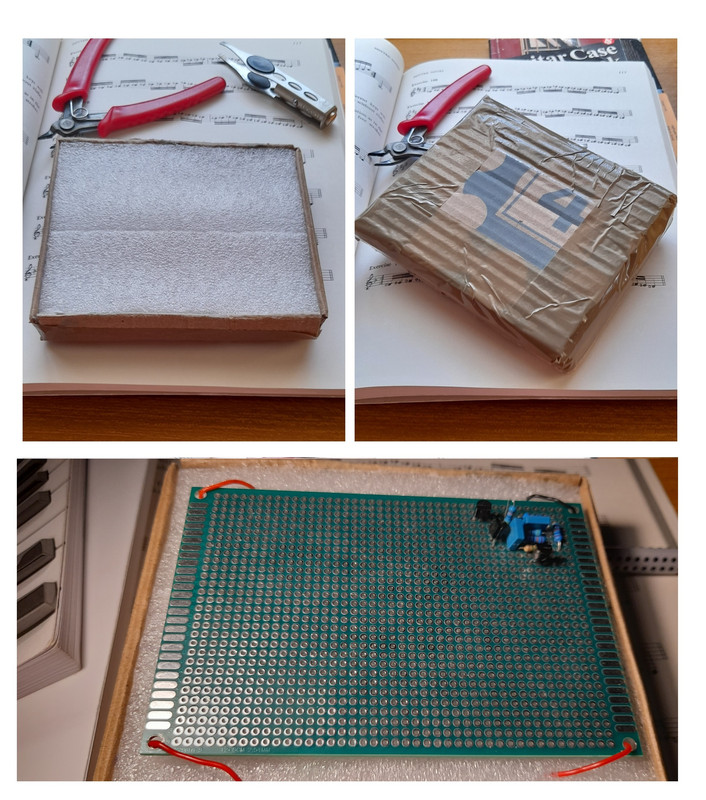
For anyone interested, I used packaging foam and cardboard, glue and sellotape, with a piece of plastic in the base I cut to shape from a DVD case, for rigidity.
The first circuit to populate the board is the white noise generator.
For anyone interested, I used packaging foam and cardboard, glue and sellotape, with a piece of plastic in the base I cut to shape from a DVD case, for rigidity.
The first circuit to populate the board is the white noise generator.
-
- KVRAF
- 14008 posts since 19 Jun, 2008 from Seattle
Oooo ^^^ p.r.e.t.t.y 


I'm not a musician, but I've designed sounds that others use to make music. http://soundcloud.com/obsidiananvil
-
- KVRAF
- 2876 posts since 10 Jul, 2008 from Orbit SW US
Entering the rabbit hole (of home building synths)Ciderwell wrote: Tue Jul 21, 2026 8:41 pm This may not look like much but will be a great help with circuit architecture and component layout. The DIY synth will have over a hundred onboard components, with connectors and wiring for 10 pots and 10 switches. This will be way more useful than plugblock and should go a long way to help get the job done.
For anyone interested, I used packaging foam and cardboard, glue and sellotape, with a piece of plastic in the base I cut to shape from a DVD case, for rigidity.
The first circuit to populate the board is the white noise generator.

Point to point wiring, brings me back to when i started. There are some simple BP filter circuits to convert that white noise into pink for starts. And then furthur LP filtering gives a good Random LFO (but perhaps you know this already?) Good luck with your builds.
Funny video.
I had built a bunch of CMOS fuzz circuits way back when (CD4007, CD4049 and CD4069), i never really liked them much
gadgets an gizmos..make noise~crystalawareness.bandcamp.com/ soundcloud.com/crystalawareness Restocked: 7/2026
if this post is edited -it was for punctuation, grammar, or to make it coherent (or make me seem coherent).
if this post is edited -it was for punctuation, grammar, or to make it coherent (or make me seem coherent).
-
- KVRist
- 134 posts since 28 Mar, 2025 from Coventry, England
Yep. I should mention that I prefer soldering diy electronics in the autumn-time. For now I'm buying the components I'll need and reading and investigating how the circuits work. The pin-cushion board (above) is ideal for the time being.CrystalWizard wrote: Tue Jul 21, 2026 11:47 pm Entering the rabbit hole (of home building synths)
Point to point wiring, brings me back to when i started. There are some simple BP filter circuits to convert that white noise into pink for starts. And then furthur LP filtering gives a good Random LFO (but perhaps you know this already?) Good luck with your builds.
Converting and improving and expanding on the original circuitry is the general idea, and the Random LFO is definitely something worth finding out about. Thanks
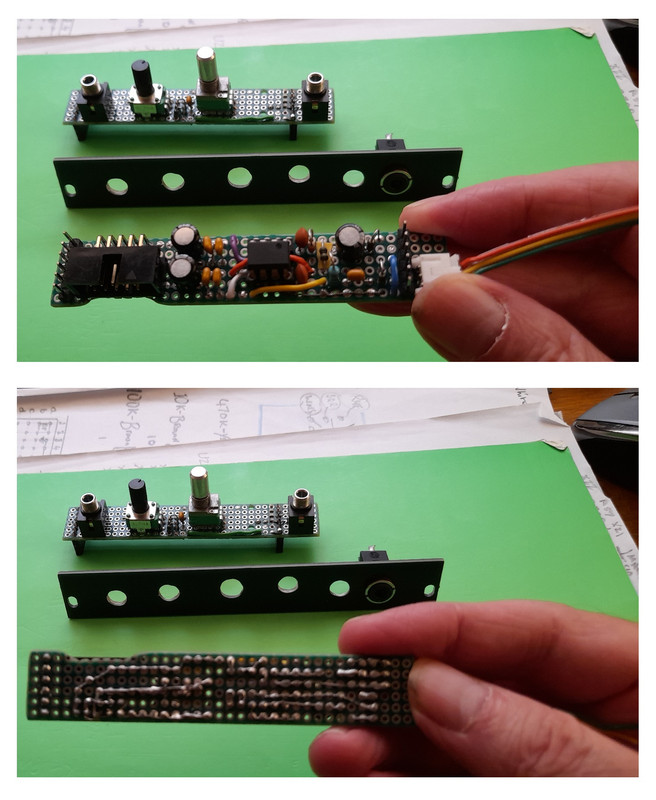
As for eurorack diy modules my attempts have been met with failure. My few modules, kick drum, effect pedal converter, bench power supply, are still unfinished and frozen in time. Keeping my build progress notes in order and comprehensible is toughest of all - there're like trying to decipher hieroglyphics.
- stomp box effects pedal converter *puzzle*