


AUTO-ADMIN: Non-MP3, WAV, OGG, SoundCloud, YouTube, Vimeo, Twitter and Facebook links in this post have been protected automatically. Once the member reaches 5 posts the links will function as normal.
Outboard Audio has released Outboard-60 L, a six-voice analog polysynth forWindows and macOS built around a single idea: one knob turns a classic poly
into a resonant acoustic instrument — and all the way back again.
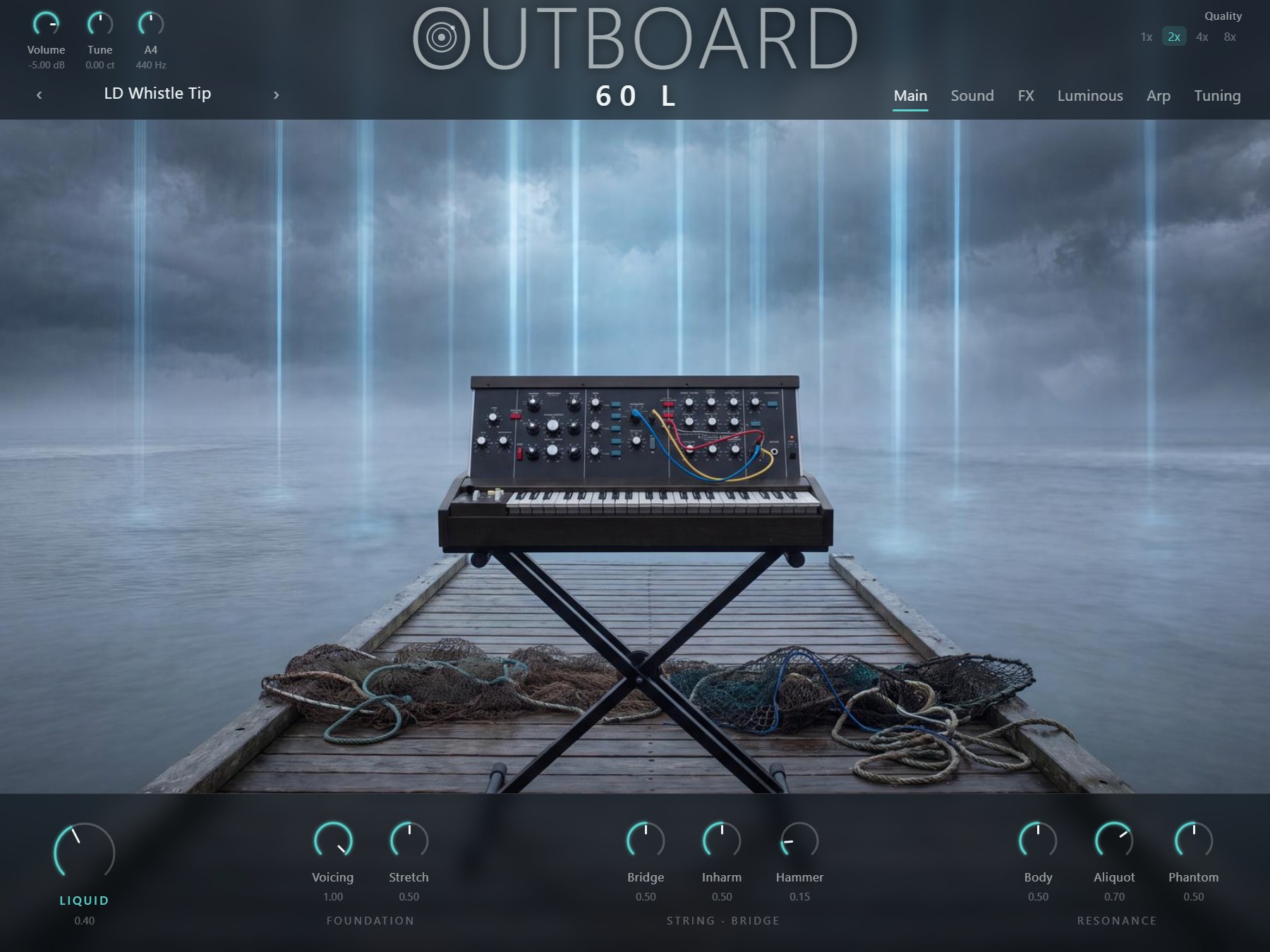
Outboard-60 L is an instrument, not a synth construction kit. The signal path
is deliberately the one you already know how to play: anti-aliased
oscillators, a four-pole resonant filter, one envelope, one LFO, and the
stereo chorus that made those old machines sing. What sits underneath is new.
A Liquid resonance engine turns every note into a breathing choir of strings
and soundboard — three detuned strings that beat against each other,
sympathetic neighbours ringing along, a modeled body behind all of it. Six
subtly-detuned voices, that stays out of
the way while you play.
One Knob, Two Instruments
LIQUID is a continuous crossfade between two natures, not a mode switch. At
zero you have the classic analog poly, bit for bit — the resonance engine is
not merely quiet, it is out of the path. Turn it up and the same patch grows a
body: the note blooms, the decay stops being a straight line, held chords
start to move on their own. Nine controls shape it — the string chorus,
bridge admittance, inharmonicity, hammer hardness, body, aliquot and phantom
partials, voicing, and a treble-to-bass stretch tuning. It is the physics of
a real acoustic instrument, tuned by ear rather than to a spec sheet, and it
sits on the same keyboard as the synth it grew out of.
Built Like an Instrument
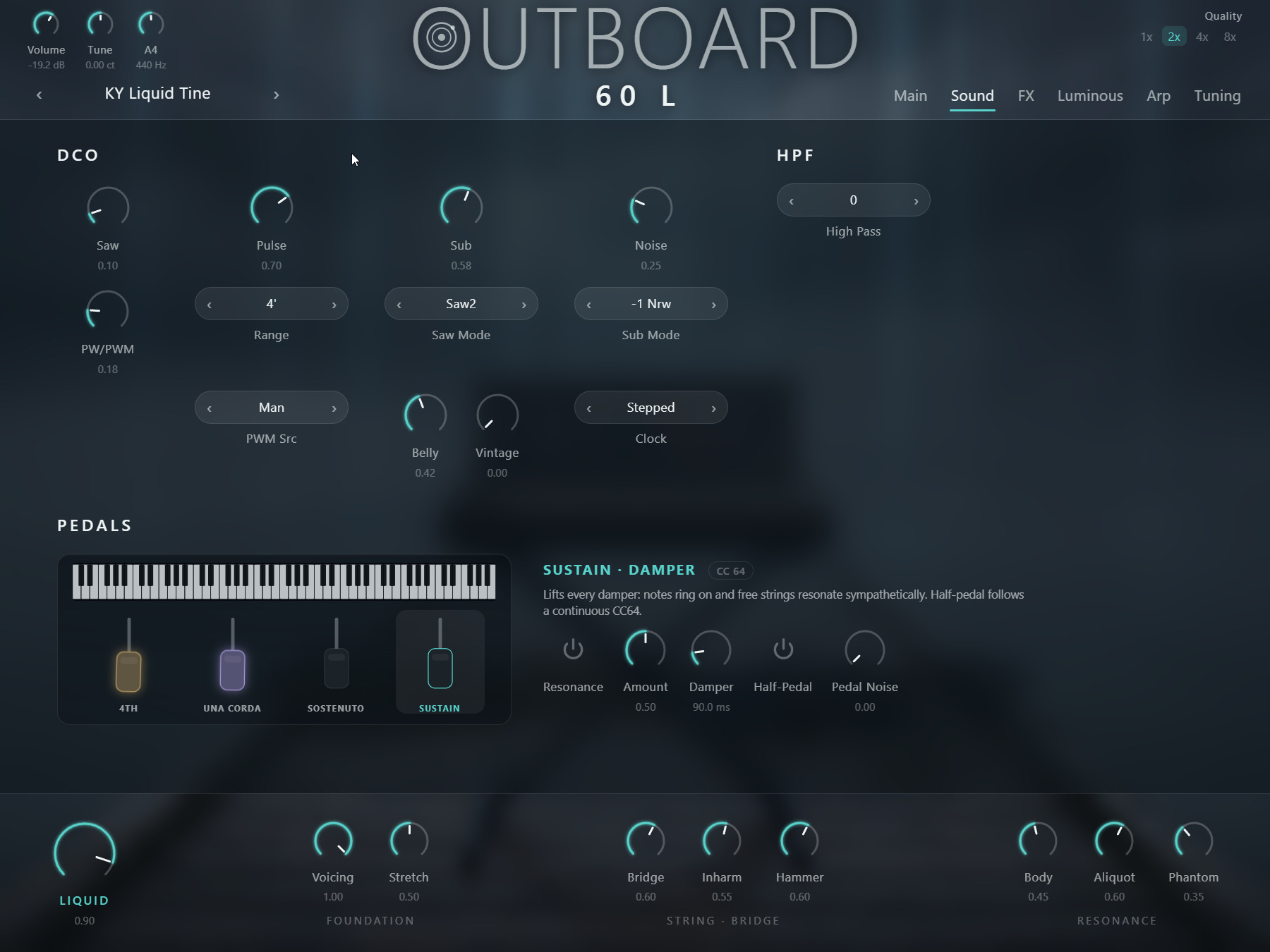
Oscillators: a full-range sawtooth, a pulse with breathing pulse-width modulation, a sub an octave below for weight, plus noise for the filter to chew on — band-limited and oversampled from 1x to 8x, with offline renders running at the highest quality automatically
Filter: a zero-delay-feedback four-pole ladder at 24 dB/oct, resonance that climbs into a clean self-oscillating sine, key tracking, and a soft-clipping drive that fattens as you push it — plus a four-stage high-pass in front
One envelope, one LFO: a single snappy ADSR shapes filter and amplitude with true analog-style exponential segments; a triangle LFO with fade-in delay adds vibrato, filter movement and pulse-width sweep
Bucket-brigade stereo chorus in modes I, II and I+II, modeled down to the dark, grainy tone of the original — from a gentle shimmer to a deep swirl
Six analog voices, each with its own tuning and character drift: Variance and Drift take the instrument from dead-clean to gently unstable
Luminous: a note-triggered grain layer that floats soft, shimmering tones above the voice — it stays inside the song's harmony, follows the plugin's own tuning, and blends from a faint halo to a full second instrument
Piano pedals: a sustain pedal that holds notes while a bank of sympathetic strings blooms in resonance, an una-corda-style softening, half-pedalling and audible pedal noise — pedal behaviour, not a note-off delay
Reverb and delay: a dual-network reverb with freeze, and a stereo ping-pong delay with crossfeed and tone, to place the instrument in a room
Microtuning that actually reaches the engine: A4 from 415 to 466 Hz, MTS-ESP support, and Scala .scl/.kbm import — the Liquid resonance and the grain layer follow the scale, not just the oscillators
75 factory presets organised by category and bank, machine-wide favorites, and a personal Default patch that loads on every new instance
High-contrast readouts around every dial, so settings stay legible in a dim room and a crowded session
Smart Arp — A Chord Becomes a Line
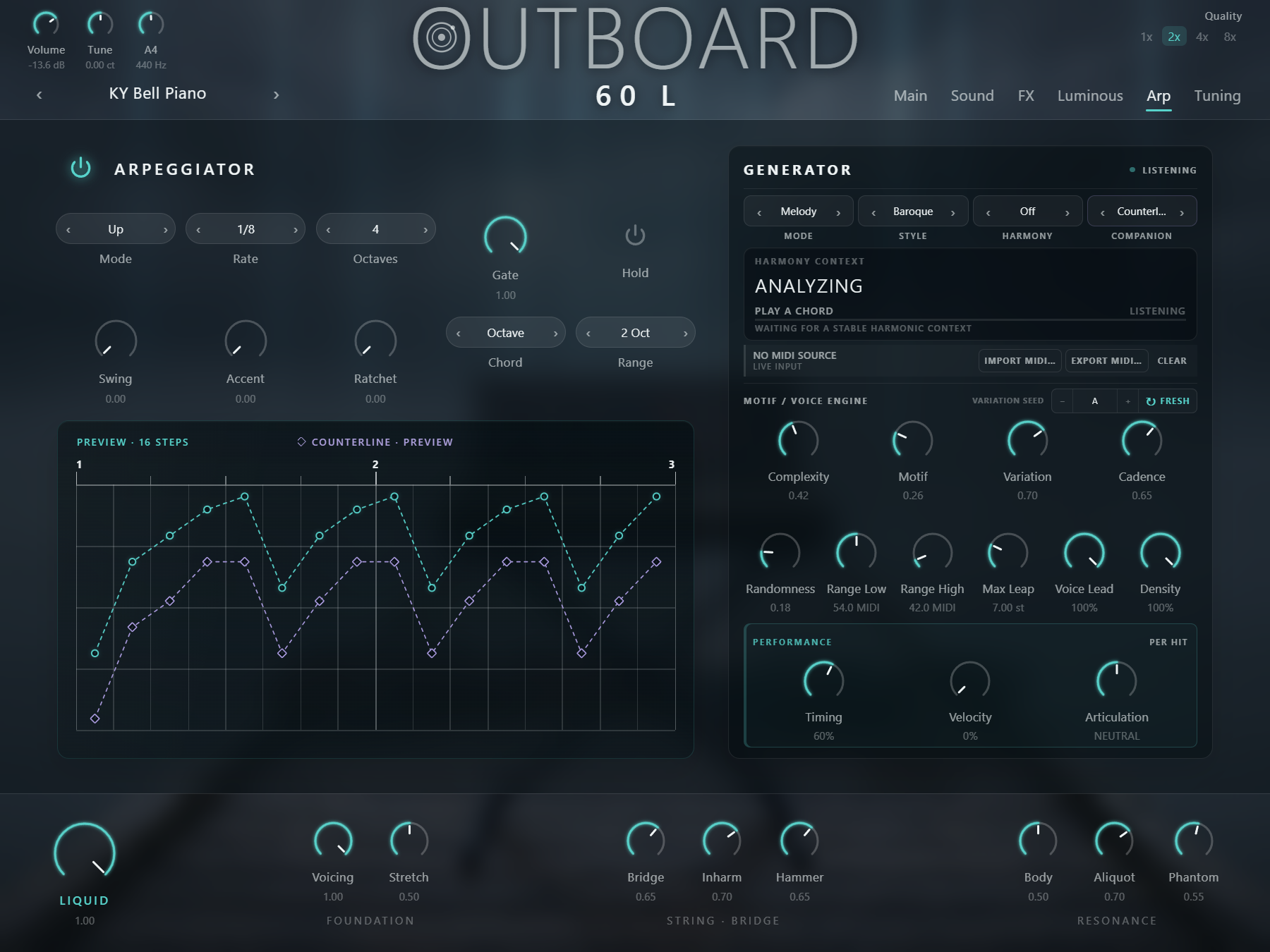
The classic arpeggiator is there, exactly as it should be: mode, range, rate,
gate, hold. One click further and Smart Arp stops repeating your chord and
starts writing from it. Phrase and Melody generators build an actual line —
with motif memory so a figure comes back, variation and cadence so it goes
somewhere, voice leading and a maximum-leap limit so it moves like a player
instead of a pattern, and humanize on both timing and velocity. Seven styles
(Neutral, Classical, Baroque, Pop, Electronic, Jazz, Cinematic) set the
vocabulary. A companion voice can run underneath as a Counterline or a Bass
Follow. And when it plays something you want to keep, drag the pattern
straight out of the monitor onto a DAW track as MIDI.
A Few Things To Try
_The Classic, First: LIQUID at zero, chorus I+II, resonance around a third.
This is the reference point — a straight, punchy analog poly. Play the part
you actually need here, then reach for LIQUID.
_The Bloom: same patch, LIQUID up to roughly 60%. The chord stops being six
oscillators and becomes an instrument with a body. Pull Hammer down for a
softer strike, push Inharmonicity for more metal in the decay.
_Pedal Piano: hold the sustain pedal and play staccato chords with the
sympathetic strings switched on. The notes you release keep ringing through
the strings you did not play — the room fills up between the phrases.
_A Halo Over a Pad: on a slow pad, blend Luminous in at about 30% with a low
density and a long decay. The grains stay inside your harmony, so it reads as
air around the chord rather than a second, arguing part.
_Write a Part You Did Not Play: Smart Arp in Melody, style Baroque, companion
set to Counterline. Hold a four-note chord and let it run for eight bars, then
drag the result onto a MIDI track and edit it like anything else.
_Unstable On Purpose: Variance and Drift past halfway, one voice per note.
Each of the six voices drifts on its own, so a repeated chord is never twice
the same — the thing that makes old hardware sound alive.
_Your Own Temperament: load a Scala scale (or run an MTS-ESP master) and turn
LIQUID up. The string model, the sympathetic bank and the grain layer all
retune with it, so the resonance stays consonant with the scale instead of
fighting it.
Availability
Outboard-60 L is available now for Windows (VST3, CLAP) and macOS (VST3, AU,
CLAP) at EUR 65, with a full 14-day trial — the complete instrument, every
feature unlocked, no account required to download. It has passed pluginval at
the highest strictness level.
Both Liquid-series instruments together — Outboard-60 L and the hybrid guitar
Outboard PalmML — are EUR 90 as the Liquid Bundle (EUR 40 off), and until
August 8, 2026 the fattener Outboard-Slab is included free.
More information, the trial download, and the full feature list:
https://outboard.audio/outboard-60l (https://outboard.audio/outboard-60l)