


Try a different key and the image will turn. Hive switches mip map table at different keys than Sylenth.ere2learn wrote:Hive Saw
Sylenth Saw
Hive preview (April 1 update)
-

- u-he
- Topic Starter
- 30189 posts since 8 Aug, 2002 from Berlin


-

- KVRAF
- 8237 posts since 22 Sep, 2008 from Windsor. UK
Is it possible to have EQ freq's displayed in hz rather than a numerical value?
Soundcloud | Facebook |
-

- KVRAF
- 24411 posts since 7 Jan, 2009 from Croatia
Yeah this should happen... same goes for gain.tehlord wrote:Is it possible to have EQ freq's displayed in hz rather than a numerical value?
-
- u-he
- Topic Starter
- 30189 posts since 8 Aug, 2002 from Berlin
Sure, we've recently added that feature, but it needs to be set up for each knob. Haven't done that for Hive's EQ yet.tehlord wrote:Is it possible to have EQ freq's displayed in hz rather than a numerical value?
-
- KVRAF
- 8237 posts since 22 Sep, 2008 from Windsor. UK
-
- u-he
- Topic Starter
- 30189 posts since 8 Aug, 2002 from Berlin
Now, about those oscillators…
Both Hive and Sylenth use the IMHO fastest possible way to render static waveforms. Its called mipmapping, or multisampled waveform cycles which are switched based on pitch. Depending on which key you press you get either the full spectrum, or a spectrum up to, say, 17kHz or something in-between. Sylenth has 2 zones per octave, Hive currently has 3. Therefore they switch at different keys, so that conparing waveforms at the same key yields results either in favour of one or the other. A fair comparison would use not just one pitch, but several.
Hier is such a fair comparison:
Sylenth Gs2:
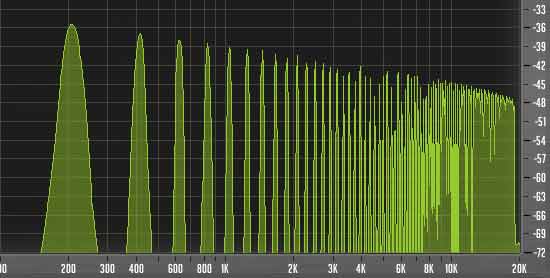
Here you see a nice full spectrum sawtooth form Sylenth.
Hive Gs2
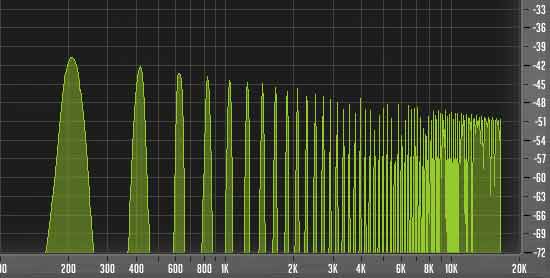
But what's that? - Something seems to miss in Hive. OMG, there'll be ringing on the edges of the waveform!
But what happens if we go 3 semitones down?
Sylenth F2:
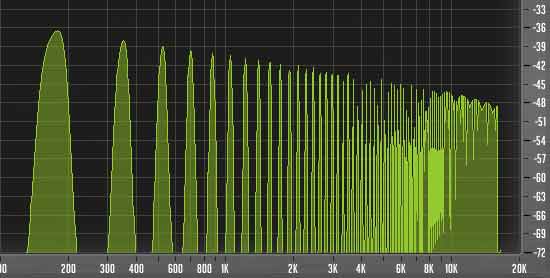
Ugh!
Hive F2
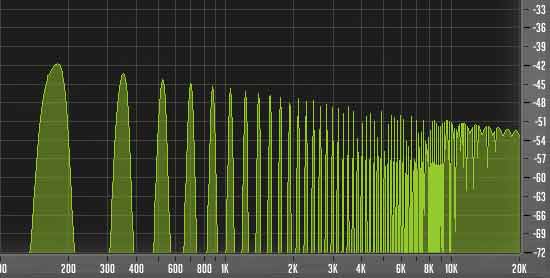
Ahhh! - Seems like at the F, the picture has turned the other way round
You see, it's the same basic technique. As it powers Sylenth, we think it's tried and tested and hasn't been in the way of making Sylenth one of the most popular synths out there. Therefore we think this technique is good enough for Hive. It btw. also powers the oscillators of many other synths out there.
Cheers,
- Urs
Both Hive and Sylenth use the IMHO fastest possible way to render static waveforms. Its called mipmapping, or multisampled waveform cycles which are switched based on pitch. Depending on which key you press you get either the full spectrum, or a spectrum up to, say, 17kHz or something in-between. Sylenth has 2 zones per octave, Hive currently has 3. Therefore they switch at different keys, so that conparing waveforms at the same key yields results either in favour of one or the other. A fair comparison would use not just one pitch, but several.
Hier is such a fair comparison:
Sylenth Gs2:
Here you see a nice full spectrum sawtooth form Sylenth.
Hive Gs2
But what's that? - Something seems to miss in Hive. OMG, there'll be ringing on the edges of the waveform!
But what happens if we go 3 semitones down?
Sylenth F2:
Ugh!
Hive F2
Ahhh! - Seems like at the F, the picture has turned the other way round
You see, it's the same basic technique. As it powers Sylenth, we think it's tried and tested and hasn't been in the way of making Sylenth one of the most popular synths out there. Therefore we think this technique is good enough for Hive. It btw. also powers the oscillators of many other synths out there.
Cheers,
- Urs
-
- u-he
- Topic Starter
- 30189 posts since 8 Aug, 2002 from Berlin
(also anyone blaming oscillators for Hive sounding stronger, weaker or anyhow different than Sylenth is mistaken. The difference is absolutely inaudible unless your hearing tops 18kHz. Scentific proof available based on method shown in previous post)
-
- KVRAF
- 1924 posts since 15 Oct, 2008 from Germany
Is this mipmapping also applied during pitchbend/tuning modulation? Or does only the initial key determine the wave form?
Oh wait, I tested it for myself. Yes, the waveform switches dynamically during pitch bends.
Oh wait, I tested it for myself. Yes, the waveform switches dynamically during pitch bends.
-
- u-he
- Topic Starter
- 30189 posts since 8 Aug, 2002 from Berlin
It's dynamic, yes. Otherwise you'd quickly get audible aliasing.paterpeter wrote:Is this mipmapping also applied during pitchbend/tuning modulation? Or does only the initial key determine the wave form?
We have usually used this technique with oversampling, while others have also used it taking a fair amount of aliasing into account.
I did a lot of tests and could not see/hear any major disadvantage, other than having to talk about it if people compare waveforms or pictures form spectrum analyzers. Oversampling IMHO is really only necesary if any sort of audio rate modulation, wave bending whatsoever is applied.
- Urs
-
- KVRAF
- 1895 posts since 13 Oct, 2002
I think what you're referring to is some kind of auto-gain adjustment like some EQs now implement to keep output constant whether you're boosting or cutting the signal. Interesting idea applied to synthesis. An alternative might be to use a very clean comp after the synth. But traditionally, it's a long-winded iterative procedure.hakey wrote:Maintaining a constant output volume whilst changing the filter gain or osc volume requires juggling with two different knobs, and working out whether a perceived difference is down to a change in timbre or a change in overall volume gets in the way of efficient sound design.
Some means to inversely link two related gain/vol controls would make this process a lot easier (same goes for any u-he synth where filter gain changes filter behaviour).
To do it manually you can temporarily use the ModMatrix to crossfade any two controls (mod one + and the other -) and have any available CC control it. You can simply copy that if you need to control more than 2 parameters. I did this myself because the solo buttons seemed to disable mod sources and it was a quick way to isolate the two filter paths.
Last edited by Breeze on Sun Dec 21, 2014 1:47 pm, edited 1 time in total.
-
- KVRAF
- 1924 posts since 15 Oct, 2008 from Germany
Aliasing was my "fear", too, of course. But with the dynamic approach it sounds absolutely fine and I don't hear any "steps" when the waveform is switched. Good work, Urs!Urs wrote:It's dynamic, yes. Otherwise you'd quickly get audible aliasing.paterpeter wrote:Is this mipmapping also applied during pitchbend/tuning modulation? Or does only the initial key determine the wave form?
-

- KVRAF
- 3397 posts since 25 Apr, 2011
In Hive you can have 1 (thru another parameter) parameter driving 2 (or more) different parameters. So if you set e.g. breath as a source to 2 different parameters, your set-up should work.hakey wrote:Unless I'm missing something, there's no way to have one knob control two different amounts simultaneously.EvilDragon wrote:Constant modulator. Then modulation amount knob.hakey wrote:Where's the constant knob?exmatproton wrote:Turning the constant knob would do just that.
Modulating, eg, osc vol and filter gain in opposite directions at the same time would still require two knobs - might as well use the two knobs on the main panel.

Last edited by exmatproton on Sun Dec 21, 2014 2:03 pm, edited 1 time in total.
-

- KVRAF
- 4062 posts since 24 Oct, 2000 from A Swede Living in Budapest
Hi Urs -
Quite an interesting plugin you have! The more I fool around with it, the more I like it. Great idea about the three models. You didn't get the inspiration from The Hive in Deus Ex Human Revolution did you? I kind of got that vibe.
No loss if no oscilloscope. Maybe it could be a place to open up deeper settings of Hive. Under the Hive?
What's your realistic estimate on v1 release? At the end of january when the beta expires?
/C
Quite an interesting plugin you have! The more I fool around with it, the more I like it. Great idea about the three models. You didn't get the inspiration from The Hive in Deus Ex Human Revolution did you? I kind of got that vibe.
No loss if no oscilloscope. Maybe it could be a place to open up deeper settings of Hive. Under the Hive?
What's your realistic estimate on v1 release? At the end of january when the beta expires?
/C
Neon City for u-he Repro - 80s pop & Synthwave soundbank
HARDWARE SAMPLER FANATIC - Akai S1100/S950/Z8 - Casio FZ20m - Emu Emax I - Ensoniq ASR10/EPS
HARDWARE SAMPLER FANATIC - Akai S1100/S950/Z8 - Casio FZ20m - Emu Emax I - Ensoniq ASR10/EPS
-
- u-he
- Topic Starter
- 30189 posts since 8 Aug, 2002 from Berlin
We have "Gain Staging" on our radar for an improvement. Naturally we don't want to do a plain makeup gain because it'll be deceiving, as one can't perfectly match input and output without taking the filter type, the oscillator volume itself and the waveform into account. Automatic makeup will come out as "ok, the timbre changes but it also becomes slightly louder, I'm a little confused as to how this works". Therefore we decided to keep things "physical". Turn up gain, it gets louder.Breeze wrote:I think what you're referring to is some kind of auto-gain adjustment like some EQs now implement to keep output constant whether you're boosting or cutting the signal. Interesting idea applied to synthesis. An alternative might be to use a very clean comp after the synth. But traditionally, it's a long-winded iterative procedure.hakey wrote:Maintaining a constant output volume whilst changing the filter gain or osc volume requires juggling with two different knobs, and working out whether a perceived difference is down to a change in timbre or a change in overall volume gets in the way of efficient sound design.
Some means to inversely link two related gain/vol controls would make this process a lot easier (same goes for any u-he synth where filter gain changes filter behaviour).
To do it manually you can temporarily use the ModMatrix to crossfade any two controls (mod one + and the other -) and have any available CC control it. You can simply copy that if you need to control more than 2 parameters. I did this myself because the solo buttons seemed to disable mod sources and it was a quick way to isolate the two filter paths.
I would however like to add some sort of XY control or otherwise linkable bahviour into it.
-
- KVRAF
- 1924 posts since 15 Oct, 2008 from Germany
OK, there's only one drawback of course -the stepping will be audible when the output is rendered and then downpitched/played more slowly. I don't know if I would run into this in practice. Just saying 