


Valhalla FutureVerb
-
- KVRian
- 887 posts since 22 Jan, 2022
I've never been all that impressed with Valhalla's offerings. Always figured I was all alone in that opinion.
-

- KVRAF
- 7669 posts since 2 Sep, 2019
Yes, that's right. It models an entire group of players in their own unique location within the same physical space. There is also Virtual Sound Stage 2, which works the same way, and is now free.medienhexer wrote: Thu Nov 13, 2025 12:35 amI mean, there is some smart tech in there. Apparently, every track gets its own reverb insert with the same room model, but you can position each track from a centralized GUI? That‘s some serious smart cookie behavior!
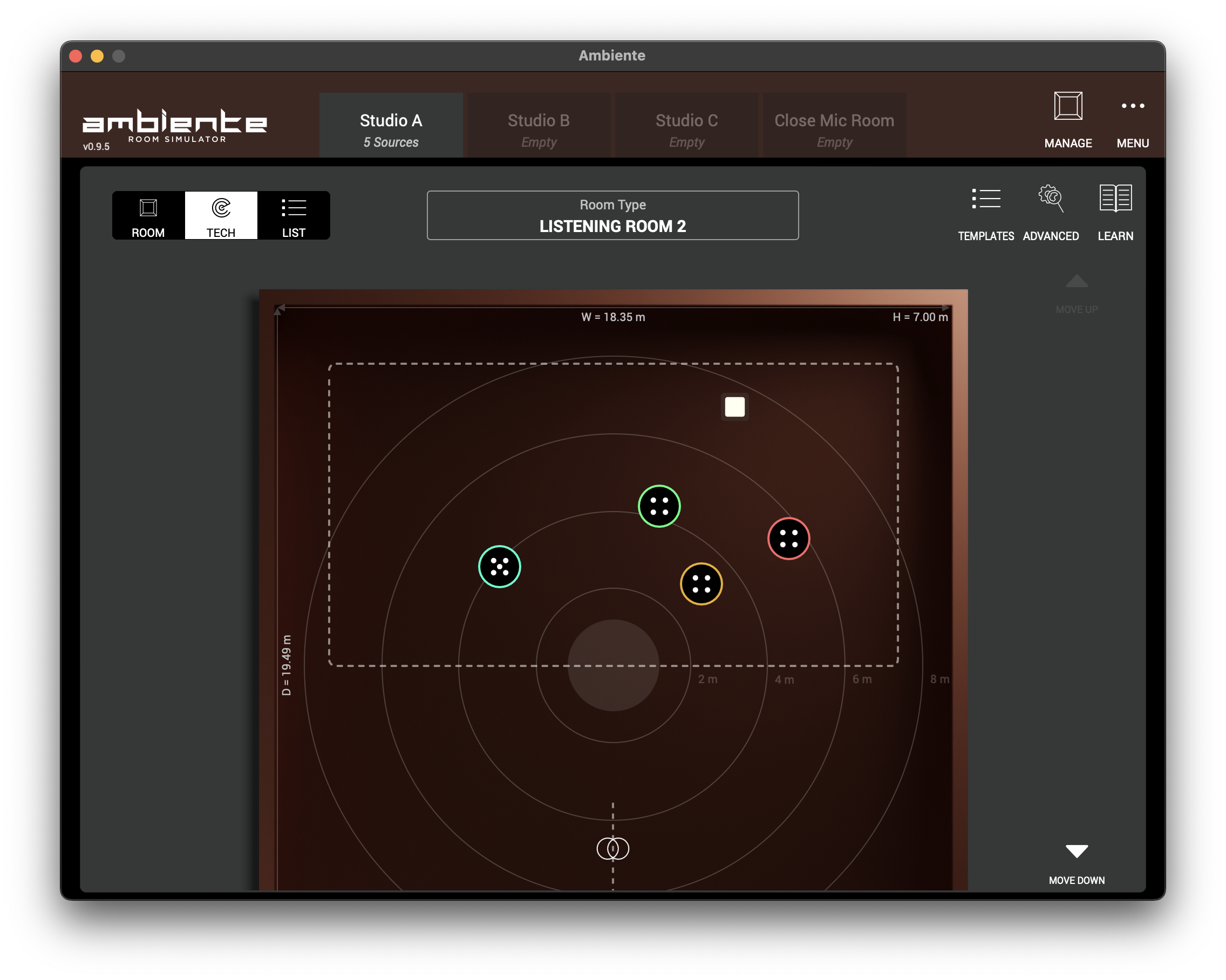
VSS2 doesn't sound as good as Ambiente and it only models the early reflections. You still need to provide the reverb tail when using VSS2. It's what I was using before Ambiente existed. That's also why I became concerned with knowing the actual dimensions of the room, because you have to match your reverb (sans early reflections) to the particular VSS2 room you're using.
I wrote up a whole math-heavy process for how to do that using Studio One's Room Modeler here.
Ambiente doesn't need an external reverb, and it sounded signficantly better than Virtual Sound Stage in my head-to-head comparisons. But you gotta admit VSS2 looks cooler.

Last edited by jamcat on Thu Nov 13, 2025 1:09 am, edited 1 time in total.
THIS MUSIC HAS BEEN MIXED TO BE PLAYED LOUD SO TURN IT UP
-
- KVRian
- 1200 posts since 16 May, 2007 from At home. Good bye city ways!
Oh, there was this.. was it a book? An article? BBC film? about studio sound development through the decades.jamcat wrote: Thu Nov 13, 2025 12:43 amYes, but they recorded in real rooms which were designed for their acoustic properties and the size of their sound stage. And the engineer chose to record in that room for those properties. He chose to record a 20-piece string section in a large room that could hold them and provide the appropriate acoustics. And he absolutely knew the size of the room because he could look around.Funkybot's Evil Twin wrote: Thu Nov 13, 2025 12:30 amSome of the absolute best records of all time were made before room physical modeling reverb plug-ins were ever a thing.jamcat wrote: Thu Nov 13, 2025 12:23 am But how big is "100%"? What are the room dimensions? This is kind of important information for a serious engineer.
The algorithms may have changed a little since the 1970s, but the nonsensical parameters still haven't.
And if they wanted artificial reverb, they tended to use a reverb chamber, or a physical plate reverb, which itself is a "reverb effect" rather than a real or realistic room. And it is the artificial plate which reverb processors attempted to recreate, as opposed to a real player sitting somewhere in a real room. Most digital reverbs to this day inherit their design from that.
Basically, every studio you record an ensemble in IS an idealised version of a room. Just like Sean‘s plugin.
They invest huge sums of money into removing all the issues which a mathematically perfect calculation would cause. None of these rooms are mere box shapes, they invest a lot of thought and experimentation into the dimensions(ratios), creating diffusion, into controlling decay times, controlling reflections, etc.
And once they find specific locations in that room where specific instrument types sound good, they make sure that specific instruments are always positioned in the same place. They don’t record any instrument in any freely chosen position because the results are at best unpredictable, but usually, they’re just bad and a huge waste of studio time and budget.
Some even install „stages“ for orchestral ensembles, so that certain chairs end up in the same place every time. They also use loads and loads of acoustic walls and microphone directivity to create separation between instruments and counteract the room acoustics.
Many rooms have huge curtains and other dampening elements they can move to tune the room acoustics to the ensemble. So you would have to model partially covered walls and ceilings and the exact position of these acoustic elements.
These methods aren‘t inherently more real or natural, they are just the result of a lot of research, experience and the technology available at the time.
..off to play with my music toys - library music production.
http://www.FiveMinuteHippo.com
http://www.FiveMinuteHippo.com
-
- KVRAF
- 7669 posts since 2 Sep, 2019
You're not!billinder33 wrote: Thu Nov 13, 2025 1:01 am I've never been all that impressed with Valhalla's offerings. Always figured I was all alone in that opinion.
THIS MUSIC HAS BEEN MIXED TO BE PLAYED LOUD SO TURN IT UP
-

- KVRist
- 66 posts since 23 Jun, 2025 from France
You’re not. Though I own most of their products (eh... reverbs!), they’re not the ones I use the most.billinder33 wrote: Thu Nov 13, 2025 1:01 am I've never been all that impressed with Valhalla's offerings. Always figured I was all alone in that opinion.
Fans talk loud. Because value for money. And a good team you want to support behind. That’s why.
But I need to give a try to this one before saying anything else.

EDIT : tried it. Best settings I found were easy to recreate using Tai Chi and I like it better.
-
- KVRAF
- 5444 posts since 15 Feb, 2020
In this thread non-fans talk louder.
Look at how many posts spamcat has made and tell me it’s not weird to post so many neg posts in the same thread…
VVV is my go to, really liked EOS too. Love Sean’s verbs and not just ‘cos they’re affordable and he seems cool— I think they’re brilliant reverbs.
I lost my heart in Cap de Creus
-
- KVRAF
- 7669 posts since 2 Sep, 2019
Well this is kind of true for some studios. And totally not true for others. And of course there were always producers and engineers who would experiment with placement and unconventional techniques even in the most meticulously designed rooms.medienhexer wrote: Thu Nov 13, 2025 1:08 amOh, there was this.. was it a book? An article? BBC film? about studio sound development through the decades.jamcat wrote: Thu Nov 13, 2025 12:43 amYes, but they recorded in real rooms which were designed for their acoustic properties and the size of their sound stage. And the engineer chose to record in that room for those properties. He chose to record a 20-piece string section in a large room that could hold them and provide the appropriate acoustics. And he absolutely knew the size of the room because he could look around.Funkybot's Evil Twin wrote: Thu Nov 13, 2025 12:30 amSome of the absolute best records of all time were made before room physical modeling reverb plug-ins were ever a thing.jamcat wrote: Thu Nov 13, 2025 12:23 am But how big is "100%"? What are the room dimensions? This is kind of important information for a serious engineer.
The algorithms may have changed a little since the 1970s, but the nonsensical parameters still haven't.
And if they wanted artificial reverb, they tended to use a reverb chamber, or a physical plate reverb, which itself is a "reverb effect" rather than a real or realistic room. And it is the artificial plate which reverb processors attempted to recreate, as opposed to a real player sitting somewhere in a real room. Most digital reverbs to this day inherit their design from that.
Basically, every studio you record an ensemble in IS an idealised version of a room. Just like Sean‘s plugin.
They invest huge sums of money into removing all the issues which a mathematically perfect calculation would cause. None of these rooms are mere box shapes, they invest a lot of thought and experimentation into the dimensions(ratios), creating diffusion, into controlling decay times, controlling reflections, etc.
And once they find specific locations in that room where specific instrument types sound good, they make sure that specific instruments are always positioned in the same place. They don’t record any instrument in any freely chosen position because the results are at best unpredictable, but usually, they’re just bad and a huge waste of studio time and budget.
Some even install „stages“ for orchestral ensembles, so that certain chairs end up in the same place every time. They also use loads and loads of acoustic walls and microphone directivity to create separation between instruments and counteract the room acoustics.
Many rooms have huge curtains and other dampening elements they can move to tune the room acoustics to the ensemble. So you would have to model partially covered walls and ceilings and the exact position of these acoustic elements.
These methods aren‘t inherently more real or natural, they are just the result of a lot of research, experience and the technology available at the time.
Again, though, if Valhalla reverbs are actually modeling ideal placement within ideal rooms, then we still should be given some useful information about what size that room is. Really, that's all I'm asking for at this point. It would go a long way towards helping me make decisions about how to set it, which would make the difference between it being a useful tool for me or not.
But of course in reality, no Valhalla reverb actually attempts to model an ideal room in the first place. That's not what Sean Costello is all about. If you've ever read any of his posts then you know he's all about classic reverb algorithm design in the same vein as Lexicon or Eventide. He approaches reverb as an effect, not as an acoustic simulation.
THIS MUSIC HAS BEEN MIXED TO BE PLAYED LOUD SO TURN IT UP
-
- KVRist
- 66 posts since 23 Jun, 2025 from France
Come on, read any reverb thread on this forum and you'll see Valhalla recommendations everywhere. This thread is a drop in the ocean.
And please : I didn't mean anything bad. I even explained why I totally understand why people recommend Valhalla reverbs. Valhalla fans are reliable supporters.

-
- KVRAF
- 7669 posts since 2 Sep, 2019
Well mostly I'm responding to stuff people wrote to me about things only tangentially related to the particular reverb in question. 
But thanks for paying such close attention! It's the fans like you that I do it for.
But thanks for paying such close attention! It's the fans like you that I do it for.
THIS MUSIC HAS BEEN MIXED TO BE PLAYED LOUD SO TURN IT UP
-
- KVRAF
- 2064 posts since 13 Dec, 2016
Yeah. When you have no point left, turning it into a fake victory lap is… a choice.
Its over for Bitwig--CUBASE WON !!!!!!!!!!!!!!!!!!!!!!!!!!!!!!!!!
-
- KVRist
- 97 posts since 8 Oct, 2011
Pretty low signal to noise ratio in this thread. I don't care what algorithms are used. Most people don't. Get the demo version of the plugin if interested. Test it out. Decide if it is worth the money. Buy it if is worth it to you. All this nonsense about ray tracing and room dimensions for the reverb are irrelevant.
-
- KVRAF
- 2841 posts since 24 Nov, 2023
Why should it attempt to model a an ideal room? Why should it be anything other than an effect?jamcat wrote: Thu Nov 13, 2025 1:39 am But of course in reality, no Valhalla reverb actually attempts to model an ideal room in the first place. That's not what Sean Costello is all about. If you've ever read any of his posts then you know he's all about classic reverb algorithm design in the same vein as Lexicon or Eventide. He approaches reverb as an effect, not as an acoustic simulation.
It's not a convolution reverb, you can use one of those along with an actual impulse response recorded in an actual space to give you an actual acoustic simulation if that is what you want
This is an effect that I am going to use with synthesizers to make electronic music, and unless you are recording acoustic instruments in an Anechoic Chamber. That have no acoustic reflections of any kind on your recording. That you then want to accurately place inside of a simulators acoustic space, that's based on a a actual room, your entire premise is rather silly
-
- KVRAF
- 7669 posts since 2 Sep, 2019
Exactly. It's not! But then why is it being marketed as "transparent and realistic" instead of as the artificial reverb/delay effect that it actually is? This is entirely my point of contention.IvyBirds wrote: Thu Nov 13, 2025 2:28 amWhy should it attempt to model a an ideal room? Why should it be anything other than an effect?jamcat wrote: Thu Nov 13, 2025 1:39 am But of course in reality, no Valhalla reverb actually attempts to model an ideal room in the first place. That's not what Sean Costello is all about. If you've ever read any of his posts then you know he's all about classic reverb algorithm design in the same vein as Lexicon or Eventide. He approaches reverb as an effect, not as an acoustic simulation.
THIS MUSIC HAS BEEN MIXED TO BE PLAYED LOUD SO TURN IT UP