

Tuning
-
- KVRist
- 170 posts since 24 Jun, 2011 from Canada, Toronto
What standard do the MIDI composers like Zimmer use? Equal Temperament consistently or the other extreme? (i.e. different tuning for every project, track)
-
- KVRAF
- 7837 posts since 20 Jan, 2008
Most probably.
I have little tolerance for off key performance. For a soloist performance it doesn't matter as much. However when you have multiple instruments all with their own independent tuning it can sound quite horrid.
Period pieces are another matter. There are times when one would want to tune correctly for the period piece but all instruments would also have to be tuned for it as well. Usually period pieces don't have rich harmonies, When you don't have say a 13th chord going on the notes in key will sound sharper if the key agrees with the tuning.
I have little tolerance for off key performance. For a soloist performance it doesn't matter as much. However when you have multiple instruments all with their own independent tuning it can sound quite horrid.
Period pieces are another matter. There are times when one would want to tune correctly for the period piece but all instruments would also have to be tuned for it as well. Usually period pieces don't have rich harmonies, When you don't have say a 13th chord going on the notes in key will sound sharper if the key agrees with the tuning.
Dell Vostro i9 64GB Ram Windows 11 Pro, Cubase, Bitwig, Mixcraft Guitar Pod Go, Linntrument Nektar P1, Novation Launchpad
-
- KVRist
- Topic Starter
- 170 posts since 24 Jun, 2011 from Canada, Toronto
So as long as all instruments are tuned to the same ratio, it wouldn't matter? I think modern samplers and sequencers let you save tuning presets, so you can make one for each key.tapper mike wrote:Most probably.
I have little tolerance for off key performance. For a soloist performance it doesn't matter as much. However when you have multiple instruments all with their own independent tuning it can sound quite horrid. Period pieces are another matter. There are times when one would want to tune correctly for the period piece but all instruments would also have to be tuned for it as well.
Can you elaborate on that?Usually period pieces don't have rich harmonies, When you don't have say a 13th chord going on the notes in key will sound sharper if the key agrees with the tuning.
Thanks.
-
- KVRAF
- 2285 posts since 20 Dec, 2002 from The Benighted States of Trumpistan
Bear with me; this gets a bit long and I'm too exhausted to make it shorter.
Modern tuning is just that -- modern. For one thing, the pitch standard (A=440 Hz) is fairly recent; in Mozart's time, it was substantially lower.
More importantly, modern chromatic tuning is also quite new. That is, we divide the octave into 12 equally spaced steps these days. Earlier musicians didn't. Why? Because equal temperament (another name for this) is harsh -- the thirds are substantially sharper than they ought to be, by the overtones. This causes dissonance.
If you take a pitch, say our friend A @ 440 Hz, doubling the frequency (a 2:1 ratio) gives you another A. If you triple the frequency, you get the fifth (E); and so on. Integer multiples of a frequency give you perfect harmonies, which are very nice indeed. Early musicians worked in these pure tunings. Once you scale these back into the same octave, the ratios for the frequencies are 1:1 (root), 9:8 (second), 5:4 (major third), 4:3 (fourth), 3:2 (fifth), 5:3 (major sixth), and either 7:4 or 15:8 for the 7th. You can find instruments tuned like this all over the world, especially outside Western Europe and its kin -- bagpipes and sitars are usually based on this. Each step is a different size.
The problem is that this won't let you go into other keys easily. The perfect E of A (3/2 of 440, or 660 Hz) and the perfect E of C (4/3 of 523.251, or 697.668) are different frequencies. The further you get from a key, the more out of tune the notes of the new scale will be in comparison to the old.
Your options are to ignore the dissonance, stay in one key, or detune things slightly. Western classical music did the third, and created all sorts of schemes. Google "equal temperament" and "well temperament." If you didn't venture too far from a given key, you were ok. Bach did that.
But things changed. Experiments happened. Eventually, we chose to make each interval the exact same distance. This let us use all keys equally, but it is harsh. Fourths and fifths are only slightly out of tune, but thirds and sixths are markedly so. See here for more info.
(Similar arguments apply for minor chords, but there are different ways to build the perfect ratios -- do you use the ratios of D-F-A, E-G-B, or A-C-E in C Major?)
But here's an interesting thing -- when it's possible to adjust the pitch (if one is a vocalist, a violinist, flutist, whatevs), you can adjust the pitch while performing to get closer to perfect ratios. A seventh becomes a consonant interval; even a thirteenth chord has a shimmering harmony.
Modern tuning is just that -- modern. For one thing, the pitch standard (A=440 Hz) is fairly recent; in Mozart's time, it was substantially lower.
More importantly, modern chromatic tuning is also quite new. That is, we divide the octave into 12 equally spaced steps these days. Earlier musicians didn't. Why? Because equal temperament (another name for this) is harsh -- the thirds are substantially sharper than they ought to be, by the overtones. This causes dissonance.
If you take a pitch, say our friend A @ 440 Hz, doubling the frequency (a 2:1 ratio) gives you another A. If you triple the frequency, you get the fifth (E); and so on. Integer multiples of a frequency give you perfect harmonies, which are very nice indeed. Early musicians worked in these pure tunings. Once you scale these back into the same octave, the ratios for the frequencies are 1:1 (root), 9:8 (second), 5:4 (major third), 4:3 (fourth), 3:2 (fifth), 5:3 (major sixth), and either 7:4 or 15:8 for the 7th. You can find instruments tuned like this all over the world, especially outside Western Europe and its kin -- bagpipes and sitars are usually based on this. Each step is a different size.
The problem is that this won't let you go into other keys easily. The perfect E of A (3/2 of 440, or 660 Hz) and the perfect E of C (4/3 of 523.251, or 697.668) are different frequencies. The further you get from a key, the more out of tune the notes of the new scale will be in comparison to the old.
Your options are to ignore the dissonance, stay in one key, or detune things slightly. Western classical music did the third, and created all sorts of schemes. Google "equal temperament" and "well temperament." If you didn't venture too far from a given key, you were ok. Bach did that.
But things changed. Experiments happened. Eventually, we chose to make each interval the exact same distance. This let us use all keys equally, but it is harsh. Fourths and fifths are only slightly out of tune, but thirds and sixths are markedly so. See here for more info.
(Similar arguments apply for minor chords, but there are different ways to build the perfect ratios -- do you use the ratios of D-F-A, E-G-B, or A-C-E in C Major?)
But here's an interesting thing -- when it's possible to adjust the pitch (if one is a vocalist, a violinist, flutist, whatevs), you can adjust the pitch while performing to get closer to perfect ratios. A seventh becomes a consonant interval; even a thirteenth chord has a shimmering harmony.
Wait... loot _then_ burn? D'oh!
-
- KVRist
- Topic Starter
- 170 posts since 24 Jun, 2011 from Canada, Toronto
Can you elaborate on that?stay in one key
If you didn't venture too far from a given key, you were ok. Bach did that.
Is that done to any level of commonality by midi composers for films and games? Especially when they do a historical themed one?But here's an interesting thing -- when it's possible to adjust the pitch (if one is a vocalist, a violinist, flutist, whatevs), you can adjust the pitch while performing to get closer to perfect ratios. A seventh becomes a consonant interval; even a thirteenth chord has a shimmering harmony.
-
- KVRAF
- 6388 posts since 8 Jun, 2009
Why are you asking about 'MIDI composers' specifically? It assumes that people doing music for film and games even consider themselves to be strictly MIDI ("Oh I'd never work with orchestras, strictly a mouse and keyboard person me").canadianlight wrote:Is that done to any level of commonality by midi composers for films and games? Especially when they do a historical themed one?
And we're assuming US/western film and games, right? Because otherwise the answer will be "quite a lot don't use equal temperament".
And are you including or excluding xenharmonic or microtonal music (ie octaves with more or fewer than 12 notes in them)?
-
- KVRAF
- 2285 posts since 20 Dec, 2002 from The Benighted States of Trumpistan
Keys that only differ by a flat or sharp, maybe two, will have minimal differences. Keys that differ by more will be increasingly out of tune. Easily proven by starting from A=440 and applying the pure interval formulae I gave earlier. Google equal temperament, well temperament, and just intonation for more details. You can also play with Scala tuning or CSound to hear the differences more directly. Or retune your piano to perfect fifths. Or listen to a pipe organ with a historically accurate tuning.canadianlight wrote:Can you elaborate on that?I wrote:stay in one key
If you didn't venture too far from a given key, you were ok. Bach did that.
Nope. The vast majority of composers stick with equal temperament, the McDonald's of tuning, since the vast majority of moviegoers and gamers can't hear the difference.canadianlight wrote:Is that done to any level of commonality by midi composers for films and games? Especially when they do a historical themed one?I wrote: But here's an interesting thing -- when it's possible to adjust the pitch (if one is a vocalist, a violinist, flutist, whatevs), you can adjust the pitch while performing to get closer to perfect ratios. A seventh becomes a consonant interval; even a thirteenth chord has a shimmering harmony.
Wait... loot _then_ burn? D'oh!
-

- KVRAF
- 26033 posts since 20 Oct, 2007 from gonesville
I believe CL is asking about tuning systems in a MIDI/piano roll situation rather than problems of people deciding not to tune in concert with others. I never heard of that problem, sounds horrid indeed.tapper mike wrote:Most probably.
I have little tolerance for off key performance. For a soloist performance it doesn't matter as much. However when you have multiple instruments all with their own independent tuning it can sound quite horrid.

ET in actual practice is fraught with compromise for harmony. Wind players, string players, singers adjust their intonation in concert to obtain a more consonant result. The proof in the negative is found when we use samples, revealing the compromises and flaws of pure ET in all their splendor...
The Vienna Instruments Pro interface makes it so you can select for instance just intonation per key and emulate this kind of natural adjustment; for instance ET major third is 13.69¢ sharper than the 5:4 just major third. People that can, WILL make this kind of adjustment, in 'rich harmonies', particularly. There is a solid reason for this choice in the interface; the market determined it, people that know about this problem will like to deal with it.
There is a fairly popular book about this issue "How Equal Temperament Ruined Harmony and Why You Should Care"...
I don't know what other composers do particularly. I attend to intonation issues rigorously myself. Often in the pitch bend lane actually; some things in samples or synth are not going to intone great with other things even before you get into the problems of how harmonic intervals are botched in ET. IE: you want something along the lines of the 3:2 fifth when you get a fifth in another part. Restricted to ET, no good, don't work, too much of the time the interval is compromised for the sake of having consistency for key modulations. In that VIP engine, you can eat your cake and have it.
Most movie music is performed by an orchestra or some kind of live ensemble and these professionals ensure a result naturally that a midi composer must attend to in adjustments or live with the deficient result, and it can really be a problem. There are I think people that work in TV that do a fair amt. with MIDI; however it's a problem for a virtual musician to really suss the space of an orchestra; sometimes a mockup is called for before investing all the $$$$$ and hiring all the mechanics to perform the score. it's called a mockup for a reason, the lack of the reality of space shows in a theatrical release a lot more than on the TV box.
So-called ethnic musics seem to be popular in movie music and may use instruments that do not use ET; in the interfaces for these instruments, Kontakt or Play engines there will be options that are scripted for.
-
- KVRist
- Topic Starter
- 170 posts since 24 Jun, 2011 from Canada, Toronto
Got to pick that up now since I'm having problems "transcribing" some of the Renaissance dances into MIDI notation.Jafo wrote:What happens when there are more than one possible chord progression for a given tune?canadianlight wrote: Keys that only differ by a flat or sharp, maybe two, will have minimal differences. Keys that differ by more will be increasingly out of tune.
And isn't out of tuneness based on a particular note/pitch, rather than the key that underlies a passage?
There is a fairly popular book about this issue "How Equal Temperament Ruined Harmony and Why You Should Care"...
They are mostly homophonic, so when the cantus line that carries the melody is out of tune the result is very prominent. Hiding in the mix is apparently not an option.
-
- KVRAF
- 7837 posts since 20 Jan, 2008
Dell Vostro i9 64GB Ram Windows 11 Pro, Cubase, Bitwig, Mixcraft Guitar Pod Go, Linntrument Nektar P1, Novation Launchpad
-
- KVRAF
- 26033 posts since 20 Oct, 2007 from gonesville
with temperaments that are not equal, the further you get from all white keys, the more deviance there is in the interval relationships.canadianlight wrote:
And isn't out of tuneness based on a particular note/pitch, rather than the key that underlies a passage?
http://en.wikipedia.org/wiki/Just_inton ... fficulties
-
- Banned
- 12367 posts since 30 Apr, 2002 from i might peeramid
i'm expecting the link jan posted covers the issue nicely. as someone who isn't too concerned (i hardly ever use pads or much longer than an 8th note) i have researched the issue of ET vs. just intonation for the construction of several vsts.
as far as i am aware, the problem, as stated, with just intonation is that some intervals work better together than others with any particular solution - all work well combined with the tonic, but the nth step and the n2th step not so well, which is why you will find endless just intonation schemes, such as the werckmeister variations for (harpsichord or whatever).
and there are some involved, out there theories.. 4d matrices and lattices and ..time cube.
as far as i am aware, the problem, as stated, with just intonation is that some intervals work better together than others with any particular solution - all work well combined with the tonic, but the nth step and the n2th step not so well, which is why you will find endless just intonation schemes, such as the werckmeister variations for (harpsichord or whatever).
and there are some involved, out there theories.. 4d matrices and lattices and ..time cube.
you come and go, you come and go. amitabha neither a follower nor a leader be tagore "where roads are made i lose my way" where there is certainty, consideration is absent.
-
- KVRAF
- 26033 posts since 20 Oct, 2007 from gonesville
I am on a piece right now that is very illustrative of the problem, using samples; most are pretty well in tune per ET and consistent from one to the other. but where there is variance, the problem can be exacerbated. bass clarinet has a lot of harmonics, and there is drift in some of the held notes, and sharper here in the attack than the sustain. I may have to define key areas and really use the interface. you can set a matrix up per key and assign just intonation for that key and with a switch go to just intonation on another tonic.
the thirds and their inversion, sixths are the more noticably off; the ear likes 5:4 major thirds and that can't happen in ET. Again, winds, strings in a good orchestra seek to play in tune better than a piano can. I'm sensitive to the major thirds problem. I tune longer than the Grateful Dead with a band, I'm a known PITA. I won't tune a guitar to a strobe or machine... eg., open position E major and open position G major, to both be perfect would require two different tunings and I compromise.
the thirds and their inversion, sixths are the more noticably off; the ear likes 5:4 major thirds and that can't happen in ET. Again, winds, strings in a good orchestra seek to play in tune better than a piano can. I'm sensitive to the major thirds problem. I tune longer than the Grateful Dead with a band, I'm a known PITA. I won't tune a guitar to a strobe or machine... eg., open position E major and open position G major, to both be perfect would require two different tunings and I compromise.
-
- KVRAF
- 7837 posts since 20 Jan, 2008
I remember this project idea back in the 70's where a guy had made moveable individual frets for eacy string. Once one had tuned the open notes one could tune the fretted notes by moving the frets. Obviously you couldn't bend with these frets but it was an interesting concept.
Most guitarists either accept the limitations of the inaccuracy of tuning a fretted instrument or don't develop the critical ear for it. they think they can set the intonation and that's the best they'll ever get. I too was fine with it until my first midi guitar.
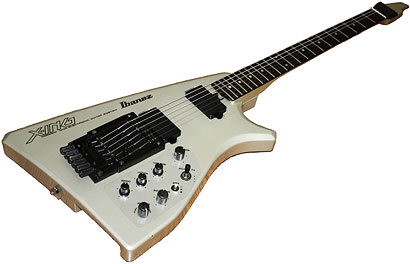
Yhr more zi plsyed it the more it drove me insane. The intonation was set as well as any guitar could be back then, and yet when I'd play it the glaring off tone response was extremely noticeable compared to midi keyboards. It's funny I can play guitar just fine with it's tuning limitations and be satisfied with it but when playing a midi sound I expect/demand even temperment especially when/where there are multiple instrument and specific harmonies.
Most guitarists either accept the limitations of the inaccuracy of tuning a fretted instrument or don't develop the critical ear for it. they think they can set the intonation and that's the best they'll ever get. I too was fine with it until my first midi guitar.
Yhr more zi plsyed it the more it drove me insane. The intonation was set as well as any guitar could be back then, and yet when I'd play it the glaring off tone response was extremely noticeable compared to midi keyboards. It's funny I can play guitar just fine with it's tuning limitations and be satisfied with it but when playing a midi sound I expect/demand even temperment especially when/where there are multiple instrument and specific harmonies.
Dell Vostro i9 64GB Ram Windows 11 Pro, Cubase, Bitwig, Mixcraft Guitar Pod Go, Linntrument Nektar P1, Novation Launchpad
-
- KVRAF
- 26033 posts since 20 Oct, 2007 from gonesville
I think the variances of strings vibrating combined with the fretted problem is not apt for midi and synths. I had a Roland setup and I miss nothing about it.