

Is it possible to play instruments in different modes at the same time?
-
- KVRist
- 126 posts since 14 Jun, 2012 from South of Mars
For instance say i have a piano and guitar playing a melody and counter melody in C Major. Would it be possible to play base guitar in C Major but on a different mode like dorian or whatever?
-

- KVRAF
- 26033 posts since 20 Oct, 2007 from gonesville
'major' and 'dorian' are different things. If you mean can you do D dorian and C major at the same time, no, because they each prioritize according to that D, or that C; as these use the same set of notes you can't really do both. Each has its own feel which belongs with its priorities, relationships per that 'tonic' or center. 'In C major' has a meaning you move away from with 'dorian'. At this point you're looking at a confusion where you want to know the distinction. The same seven notes can have the names of seven modes, but they each have an identity as mode, or meaning is lost.
I would advise at this point founding questions in terms of the musical idea. That is a kind of theory qua theory question; ie., there isn't really a point to doing that. You've read about some stuff, or, if someone has suggested that, they're confused.
I would advise at this point founding questions in terms of the musical idea. That is a kind of theory qua theory question; ie., there isn't really a point to doing that. You've read about some stuff, or, if someone has suggested that, they're confused.
-

- addled muppet weed
- 111286 posts since 26 Jan, 2003 from through the looking glass
you "can" do it.
whether it works out is a different question entirely, and could be somewhat subjective, depending on what you are aiming to acheive.
have you tried it?
whether it works out is a different question entirely, and could be somewhat subjective, depending on what you are aiming to acheive.
have you tried it?

-

- KVRAF
- 11162 posts since 16 Mar, 2003 from Porto - Portugal
Like Jancivil said, Major and dorian are different things. Major is a mode, actually (although people tend to forget it), therefore, aiming that would be like wanting to play C Major and C minor at the same time (this last example would probably be even easier).willdub1 wrote:For instance say i have a piano and guitar playing a melody and counter melody in C Major. Would it be possible to play base guitar in C Major but on a different mode like dorian or whatever?
There were experiments with polytonality in the end of XIX century and in the 20th century, and there are even pieces written using that method, but it's probably something way out of what you want to achieve.
If your musical thought is tonal, I would say "stay tonal". But technically, you can make music without even thinking in terms of "chords" and "tonality". It's not like you would be breaking any law by doing it - it's just a matter if you achieve something musically interesting or not.
Fernando (FMR)
-

- KVRAF
- 5223 posts since 20 Jul, 2010
It's more interesting to use polytonality between related tonalities, i.e. ones that share a lot of material but have one or two differing colour notes. Happened a lot in early urban music when producers composed by ear rather than using theory.
http://sendy.bandcamp.com/releases < My new album at Bandcamp! Now pay what you like!
-
- KVRAF
- 11162 posts since 16 Mar, 2003 from Porto - Portugal
One of the first examples (and also one of the finest, IMO) of the use of polytonality in music:
Not all the piece, just some passages, namely the intro.
Not all the piece, just some passages, namely the intro.
Fernando (FMR)
-
- KVRAF
- 26033 posts since 20 Oct, 2007 from gonesville
'it' was "playing *in C major* but on a different mode".vurt wrote:you "can" do it.
The meaning of either term is exceeded. If there is a reality to C major at the same time as dorian, the dorian is going to have to be based in a different set than the major or the terms are useless. it could happen there is ambiguity as to where the 'tonic' or center is in the case, C major/D dorian, but no way to pin it down, why call it one or the other.
it would at least be a meaningful thing to say. Or, C major and F dorian.fmr wrote:like wanting to play C Major and C minor at the same time (this last example would probably be even easier).
You could be 'in' both of those, but now you're operating on two planes. Which most people are not going to hear as such. Some examples of polytonality - I'm going to define this as 'more than one key', as in key signature - can be completely explained in terms of one of them.
Some things were blatant.
let's look at one, though
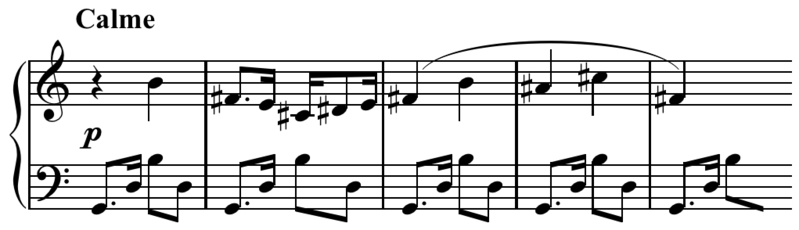
I believe that the left hand part is so strongly G major, that the right hand part is simply heard in terms of it. For a jazz person, we have ^7, #11 and #9. And that D# to E. I think his thought was line in B major on the G major figure, but acoustically the bass factor and the strength of the voicing means that G tonality dominates.
Milhaud_-_Saudades_do_Brazil_polytonality
-
- KVRian
- 1002 posts since 1 Dec, 2004
Normally in jazz you only have one diatonic scale at the time (the scale used for the chord), because usually when you have different altered versions of the same interval at the same time (for instance b2 and 2, b6 and 6, b7 and 7...) it usually sounds really dissonant and not very usable (though 3 and b3 are very usable together, as long as the b3 is on top... but that's about the only exception). The scale can change very fast though (changes on every chord).
Note that this leaves out non-diatonic scales! For instance, you can play the C minor blues scale over the C7 chord (= C mixolydian scale): even though there are lots of dissonances in the blues scale (b3 4 #4) they sound like color notes and work (but they would probably totally bomb if you tried to put them in the chord voicings). Another classic trick is playing the G major pentatonic scale over a chord progression that goes Dm7, G7, Cmaj7... C is the avoid note of G7 (4th), and F is the avoid note of Cmaj7 (4th), so that leaves out D E G A B (G major pentatonic).
Note that this leaves out non-diatonic scales! For instance, you can play the C minor blues scale over the C7 chord (= C mixolydian scale): even though there are lots of dissonances in the blues scale (b3 4 #4) they sound like color notes and work (but they would probably totally bomb if you tried to put them in the chord voicings). Another classic trick is playing the G major pentatonic scale over a chord progression that goes Dm7, G7, Cmaj7... C is the avoid note of G7 (4th), and F is the avoid note of Cmaj7 (4th), so that leaves out D E G A B (G major pentatonic).
-
- KVRAF
- 11162 posts since 16 Mar, 2003 from Porto - Portugal
I would disagree here. If you had more than one chord of G Major, probably, but you have just the same chord, arpeggiated. For me, it works like a pedal, over which the melody develops independently. But I'm not a jazz person, though, and my hearing and musical thought is not so "chordal".jancivil wrote:
I believe that the left hand part is so strongly G major, that the right hand part is simply heard in terms of it. For a jazz person, we have ^7, #11 and #9. And that D# to E. I think his thought was line in B major on the G major figure, but acoustically the bass factor and the strength of the voicing means that G tonality dominates.
Milhaud_-_Saudades_do_Brazil_polytonality
Fernando (FMR)
-
- KVRAF
- 26033 posts since 20 Oct, 2007 from gonesville
'it works like a pedal' doesn't so much as disagree with me. I'm not a chordal person either, I work from lines. What I'm saying is that the ear bases in G, or I'm not getting B major really at all. That those 'B major' notes relate to G, specifically those intervals to G.
If we have something particular to say regarding 'tonality', I take your point, but that's besides what I wanted to say, for me a matter of a definition that didn't interest me. As presented, such as the wiki 'Polytonality' it's "right hand in B major and left hand in G major, or both hands in extended G major (Leeuw 2005, 87)".
If we have something particular to say regarding 'tonality', I take your point, but that's besides what I wanted to say, for me a matter of a definition that didn't interest me. As presented, such as the wiki 'Polytonality' it's "right hand in B major and left hand in G major, or both hands in extended G major (Leeuw 2005, 87)".
-
Aroused by JarJar Aroused by JarJar https://www.kvraudio.com/forum/memberlist.php?mode=viewprofile&u=191505
- KVRian
- 1048 posts since 16 Oct, 2008
wildub1, I think you mean to say "would it be possible to play the bass guitar using the same C major SCALE but using a different mode than the other instruments?"
There are several ways in which the answer to your question is "yes".
It could be that the piano and guitar are playing in C major and the bass uses the same tones (the "white keys") except that the bass moves from D to D. But in order to be playing in Dorian and not just restricting the range from D to D whilst playing C major all the time you don't just hit the notes. There has to be emphasis so the D sounds like the tonic, you have to hit both F and B in such a way that you can hear both m3 and M6 in the bass line because that's what distinguishes it as Dorian, and so on.
You'd have to really hang on to the modal feeling in each voice, strictly, and even it you do it's not necessarily going to sound "polymodal", as Jan Civil has been pointing out.
Another way your question could be answered "yes" would be if say the bass and keys were playing in C major and the guitar in say C phyrgian (same tonic, different modal scale). This of course is going to tend towards have a lot of dissonant tones, but not necessarily. Lydian or Mixolydian over Ionian probably would not cause anyone to bat an eyelash.
Those are versions of polymodality. Another way the answer might be "yes" is polytonality- one voice in C major, the other in Ab major, for example. For almost a hundred years musicians have argued whether this a real effect, or whether one key always dominates, or whether it's "atonal". I'd say "depends on the piece, performance and the listener".
There are yet other ways the answer to your question might be "yes", but they don't apply to modern Western music in 12-tone equal temperament.
There are several ways in which the answer to your question is "yes".
It could be that the piano and guitar are playing in C major and the bass uses the same tones (the "white keys") except that the bass moves from D to D. But in order to be playing in Dorian and not just restricting the range from D to D whilst playing C major all the time you don't just hit the notes. There has to be emphasis so the D sounds like the tonic, you have to hit both F and B in such a way that you can hear both m3 and M6 in the bass line because that's what distinguishes it as Dorian, and so on.
You'd have to really hang on to the modal feeling in each voice, strictly, and even it you do it's not necessarily going to sound "polymodal", as Jan Civil has been pointing out.
Another way your question could be answered "yes" would be if say the bass and keys were playing in C major and the guitar in say C phyrgian (same tonic, different modal scale). This of course is going to tend towards have a lot of dissonant tones, but not necessarily. Lydian or Mixolydian over Ionian probably would not cause anyone to bat an eyelash.
Those are versions of polymodality. Another way the answer might be "yes" is polytonality- one voice in C major, the other in Ab major, for example. For almost a hundred years musicians have argued whether this a real effect, or whether one key always dominates, or whether it's "atonal". I'd say "depends on the piece, performance and the listener".
There are yet other ways the answer to your question might be "yes", but they don't apply to modern Western music in 12-tone equal temperament.
-
- KVRAF
- 26033 posts since 20 Oct, 2007 from gonesville
*NO*Aroused by JarJar wrote:I think you mean to say "would it be possible to play the bass guitar using the same C major SCALE but using a different mode than the other instruments?"
"yes".
It could be that the piano and guitar are playing in C major and the bass uses the same tones (the "white keys") except that the bass moves from D to D. But in order to be playing in Dorian and not just restricting the range from D to D whilst playing C major all the time you don't just hit the notes. There has to be emphasis so the D sounds like the tonic, you have to hit both F and B in such a way that you can hear both m3 and M6 in the bass line because that's what distinguishes it as Dorian, and so on.
You'd have to really hang on to the modal feeling in each voice, strictly.
First of all, 'the bass moves from D to D' [all white keys] just does not define D dorian. That D is the 'tonic' of that set of notes is what defines it. If you're playing 'in C major', C is the freaking tonic! I don't know why you're doing this. It really muddies waters that are not hard to keep clear.
Additionally, the clause 'both m3 and M6 in the bass line' seems uncertain to me. Dorian is clearly enough a minor type of mode, distinguishing itself from 'the minor mode' [D E F G A Bb C], 'natural minor' by having a raised sixth per se [D E F G A B C]. SO, we've two character or identifying tones for D dorian mode, F and B.
However if we sound them together we have a potential feature of the major key: per D dorian, C major, and a connotation of C major harmony.
I would not be able to in clear conscience call D dorian mode 'C major scale' because of the confusion in probably any beginner, ie., there must be the distinction made. There are seven mode names for the set which many base in the major scale. The very thing you're saying blurs this. The mode we would, per modes, call the major scale is ionian. While it is a true statement that dorian is the second mode of ionian, it is equally true that ionian is the seventh mode of dorian! Dorian and Ionian are different modes. Beyond this there tends to be a harmonic connotation when we say 'In C major'. A key defining feature of this harmonic connotation for C major is the tension F/B and the perception it needs handling, resolution to the harmony E/C. Something to know in order to become adept at keeping dorian's character. You could do Dm / G7 in a vamp and it not become ii / V7 of C but you'd need to be a strong modal player.
"really hang on to the modal feeling in each voice"? There is no polymodal or poly anything restricted to one common seven tone scale or row, here 'all white keys'. It could be pandiatonic and there is really no center at the moment to name, but in terms of calling it a mode, or scale how is there more than one 'tonic' or center at the same time? To the ear, at the same time? You could be doing D dorian and a big fat D emphasis and move to C with the same quality of emphasis and go back and forth, sure. At the same time? Noop.
This is why I provided an example with music and an audio file of something known as a textbook example of polytonality, clear intent. I believe the G major chord, the pedal, is the center/tonic and B major, while it is some theory, it colors the G. You may disagree but I would want proof of concept to accept two tonics at the same time with only one key signature as you seem to assert [via 'whilst'].
-
Aroused by JarJar Aroused by JarJar https://www.kvraudio.com/forum/memberlist.php?mode=viewprofile&u=191505
- KVRian
- 1048 posts since 16 Oct, 2008
Read what I wrote. I just got through explaining that that D to D does not define Dorian!jancivil wrote:*NO*Aroused by JarJar wrote:I think you mean to say "would it be possible to play the bass guitar using the same C major SCALE but using a different mode than the other instruments?"
"yes".
It could be that the piano and guitar are playing in C major and the bass uses the same tones (the "white keys") except that the bass moves from D to D. But in order to be playing in Dorian and not just restricting the range from D to D whilst playing C major all the time you don't just hit the notes. There has to be emphasis so the D sounds like the tonic, you have to hit both F and B in such a way that you can hear both m3 and M6 in the bass line because that's what distinguishes it as Dorian, and so on.
You'd have to really hang on to the modal feeling in each voice, strictly.
First of all, 'the bass moves from D to D' [all white keys] just does not define D dorian. That D is the 'tonic' of that set of notes is what defines it. If you're playing 'in C major', C is the freaking tonic! I don't know why you're doing this. It really muddies waters that are not hard to keep clear.
It's very simple: ONE voice plays in Dorian, ANOTHER voice plays in "Ionian".
Both voices adhere to their respective tonalities/modalities.
This is how La Steaua by Nicolae Bretan works- the vocal melody sung alone is clearly E phyrgian while the piano alone is clearly A minor. Together they make a new thing.
"Why I'm doing this" is because I do stuff like this all the time, and it works.
It doesn't matter if *you* hear a single tonic, nor does it matter if *I* hear a single tonic. Some people might hear more than one tonic, others might have a conception that isn't tonic-based at all. That's a subjective matter, no matter how much people try to rationalize their own particular perception as "natural".jancivil wrote: Additionally, the clause 'both m3 and M6 in the bass line' seems uncertain to me. Dorian is clearly enough a minor type of mode, distinguishing itself from 'the minor mode' [D E F G A Bb C], 'natural minor' by having a raised sixth per se [D E F G A B C]. SO, we've two character or identifying tones for D dorian mode, F and B.
However if we sound them together we have a potential feature of the major key: per D dorian, C major, and a connotation of C major harmony.
I would not be able to in clear conscience call D dorian mode 'C major scale' because of the confusion in probably any beginner, ie., there must be the distinction made. There are seven mode names for the set which many base in the major scale. The very thing you're saying blurs this. The mode we would, per modes, call the major scale is ionian. While it is a true statement that dorian is the second mode of ionian, it is equally true that ionian is the seventh mode of dorian! Dorian and Ionian are different modes. Beyond this there tends to be a harmonic connotation when we say 'In C major'. A key defining feature of this harmonic connotation for C major is the tension F/B and the perception it needs handling, resolution to the harmony E/C. Something to know in order to become adept at keeping dorian's character. You could do Dm / G7 in a vamp and it not become ii / V7 of C but you'd need to be a strong modal player.
"really hang on to the modal feeling in each voice"? There is no polymodal or poly anything restricted to one common seven tone scale or row, here 'all white keys'. It could be pandiatonic and there is really no center at the moment to name, but in terms of calling it a mode, or scale how is there more than one 'tonic' or center at the same time? To the ear, at the same time? You could be doing D dorian and a big fat D emphasis and move to C with the same quality of emphasis and go back and forth, sure. At the same time? Noop.
This is why I provided an example with music and an audio file of something known as a textbook example of polytonality, clear intent. I believe the G major chord, the pedal, is the center/tonic and B major, while it is some theory, it colors the G. You may disagree but I would want proof of concept to accept two tonics at the same time with only one key signature as you seem to assert [via 'whilst'].
What matters is that yes, you *can* do what the original poster describes. BUT!
Is it "easy"? No. Is it likely to sound "good"? No. It's a more advanced (or primitive) way than the "usual".
-
- KVRAF
- 26033 posts since 20 Oct, 2007 from gonesville
I'm not being argumentative for the sake of it. I read it. The problem isn't with me. You initially state <playing in C major and the bass uses the same except that the bass moves from D to D> then you do state 'emphasize the D'. Well, you could 'emphasize the D' and C is still the tonic.Aroused by JarJar wrote:Read what I wrote. I just got through explaining that that D to D does not define Dorian!
I'm taking on the job of sorting you for the reader. Nothing personal, I just think it's all too muddy.
I'm not persuaded in the least. We must have a different conception of 'simple' (and 'very'). There has to be a sum of these two phenomena in terms of a [perceived, heard] tonic, ie., center; I think 'center' should be a very clear concept. This next only reinforces my position:Aroused by JarJar wrote:It's very simple: ONE voice plays in Dorian, ANOTHER voice plays in "Ionian".
Both voices adhere to their respective tonalities/modalities.
So what are you doing?Aroused by JarJar wrote:What matters is that yes, you *can* do what the original poster describes. BUT!
Is it "easy"? No. Is it likely to sound "good"? No.
Well, you seem persuaded. I'm sure there is music where the different modes found within one key signature move one from the other - 'primitive' ie., medieval church - but to say that two *centers* co-exist at the same time is not simple, & I think not useful.Aroused by JarJar wrote:It's a more advanced (or primitive) way than the "usual".
I'm not rationalizing my particular anything. What I am saying is clear and simple, and I'm sure this 'one center at a time' is not something unique to me; this quality of rhetoric (wait, it doesn't matter if you can hear it?? aka bullshit) is where 'rationalizing' enters into it. More than one center [inside one key signature] simultaneously? Good for you and your advanced mind or whatever, I think pushing it is not good here.Aroused by JarJar wrote:It doesn't matter if *you* hear a single tonic, nor does it matter if *I* hear a single tonic. Some people might hear more than one tonic, others might have a conception that isn't tonic-based at all. That's a subjective matter, no matter how much people try to rationalize their own particular perception as "natural".
The mode functions in terms of the relation with the 'tonic' or the central tone. The thing of 'character tones of D Dorian' requires D to be the heard center. C major requires C to be central. These words carry real meaning when it works for the ear. You're insisting you hear the two centers at the same time. I say that's kind of special, subjective. My remarks on mode vis a vis center are straight up how things work.