


AUTO-ADMIN: Non-MP3, WAV, OGG, SoundCloud, YouTube, Vimeo, Twitter and Facebook links in this post have been protected automatically. Once the member reaches 5 posts the links will function as normal.
Hi,I'm Petr from Ciderka Labs (https://labs.ciderka.com/). I've been building Ferment (https://labs.ciderka.com/ferment/)— a real-time sound processor for musicians who need to quickly find a sound at rehearsal, fine-tune it, and then use it on stage. I'm looking for beta testers and offering a free license in return.
If you're interested: labs.ciderka.com/beta (http://labs.ciderka.com/beta)
Why Ferment exists
I play double bass and needed an effect processor that comes from the synth world — deep parameter control, modulation, sound shaping — but actually works for acoustic instruments like upright bass, violin, or voice. Guitar pedals and stomp boxes don't cut it when your source isn't a guitar. And most plugin effects give you a preset browser and hope for the best.
Ferment takes a different approach: use AI to sketch a sound quickly, then dial it in precisely with 92 exposed parameters. Save it, recall it on stage. The whole workflow is built around getting from "I have an idea" to "I have a usable preset" as fast as possible.
It's a real-time sound processor with one coherent signal path. Here's how it works:
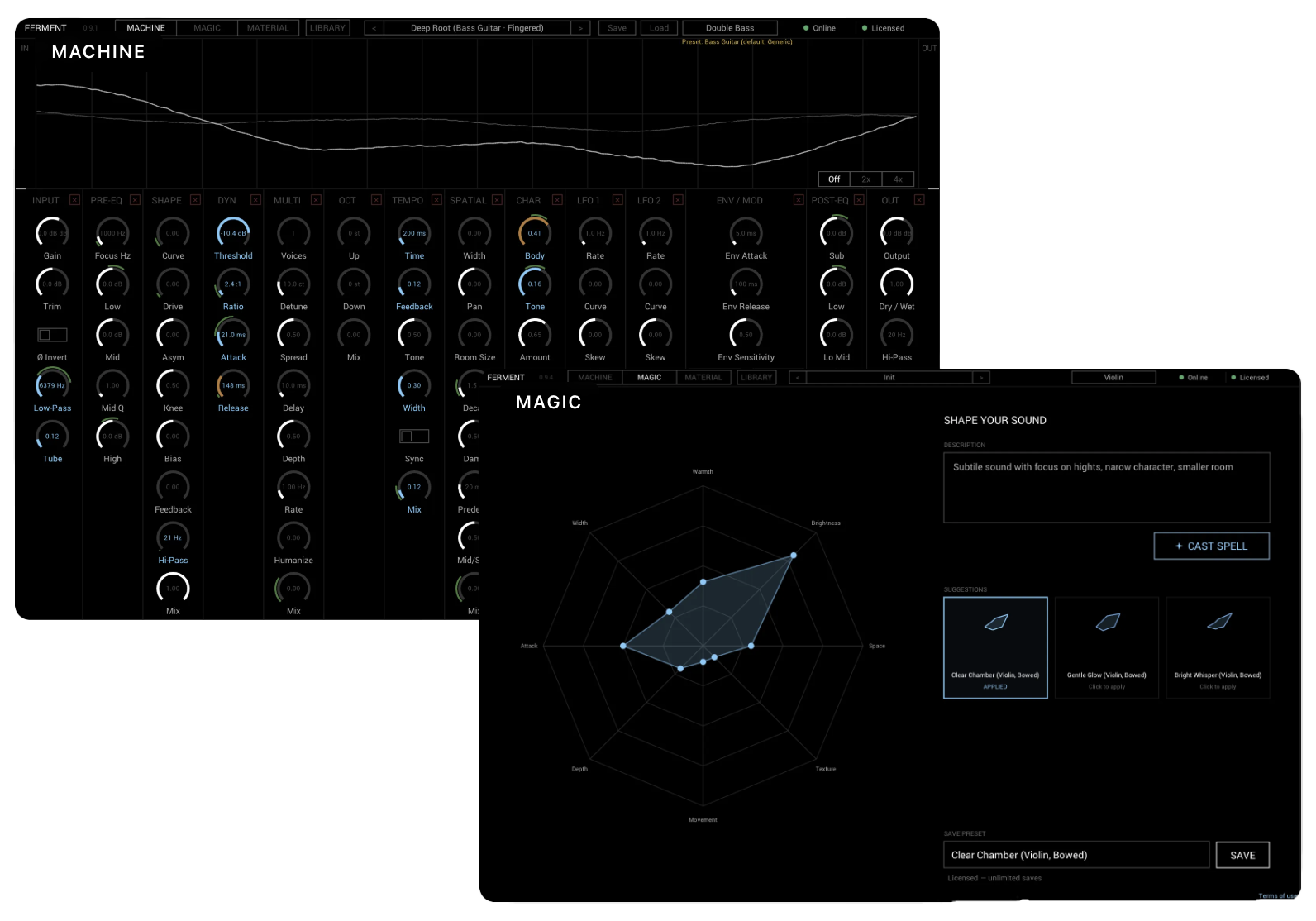
 Machine — the full signal chain: waveshaping, chorus, octaver, delay, spatial, character, dual LFOs, envelope follower, post EQ. Everything on one screen, everything MIDI-mappable. No tabs, no hidden menus — you see all 92 parameters at once and tweak during performance.
 Material — this is the part that doesn't exist elsewhere. Play a few notes on your instrument and Ferment analyzes your specific sound — spectral content, dynamics, harmonics, attack. Then it optimizes the effect chain for that source. A violin and a guitar don't need the same processing, and Material knows the difference.
 Magic — describe a sound in words ("dark, rhythmic, with metallic texture") and AI generates a full preset across all 92 parameters. You hear three options, pick one, refine. Every generated value is visible and editable — if you don't like what AI did, just change it. And if you don't want AI at all, don't use it — the rest of Ferment works completely offline.
 Library — browse and preview presets with one click before loading.
 Machine — the full signal chain: waveshaping, chorus, octaver, delay, spatial, character, dual LFOs, envelope follower, post EQ. Everything on one screen, everything MIDI-mappable. No tabs, no hidden menus — you see all 92 parameters at once and tweak during performance.
 Material — this is the part that doesn't exist elsewhere. Play a few notes on your instrument and Ferment analyzes your specific sound — spectral content, dynamics, harmonics, attack. Then it optimizes the effect chain for that source. A violin and a guitar don't need the same processing, and Material knows the difference.
 Magic — describe a sound in words ("dark, rhythmic, with metallic texture") and AI generates a full preset across all 92 parameters. You hear three options, pick one, refine. Every generated value is visible and editable — if you don't like what AI did, just change it. And if you don't want AI at all, don't use it — the rest of Ferment works completely offline.
 Library — browse and preview presets with one click before loading.
Who should test this
- Musicians who run a laptop or desktop on stage — processing through a DAW during gigs or rehearsals
- Players of acoustic instruments (strings, voice, guitar, wind…) who've been frustrated by effects that don't really fit their sound
- Sound designers curious about AI-assisted preset creation and willing to push it until it breaks
- Anyone who can tell me honestly what works and what doesn't
What you get
 A free Ferment license. Full app, all features, no limitations. You test the beta, you keep the product when it launches. That's the deal.
Specs
- Formats: VST3, AU, CLAP
- Platforms: macOS 10.15+ / Windows 10+ (64-bit)
- Version: 0.9.5 Beta
If you're interested: labs.ciderka.com/beta (https://labs.ciderka.com/beta)
Or write me at labs@ciderka.com (mailto:labs@ciderka.com)
A few testers have already jumped in and their feedback is shaping the next build. Thanks for reading.
Petr / Ciderka Labs (https://labs.ciderka.com)
