

Choroboros beta - One week in

89 signups, 36 countries, one week in. Here's how we got here.
I didn't expect that. Honestly I was hoping for maybe 20 or 30 people who were curious enough to sign up for a beta from a developer nobody had heard of. Instead Choroboros hit 38 signups on the first night, got picked up by two Japanese music blogs without me doing anything, and as of this morning has 89 people across 36 countries testing it. I'm still a little surprised.
So I figured I'd write up how it actually happened, because it's an interesting story.
It started with a four hour session
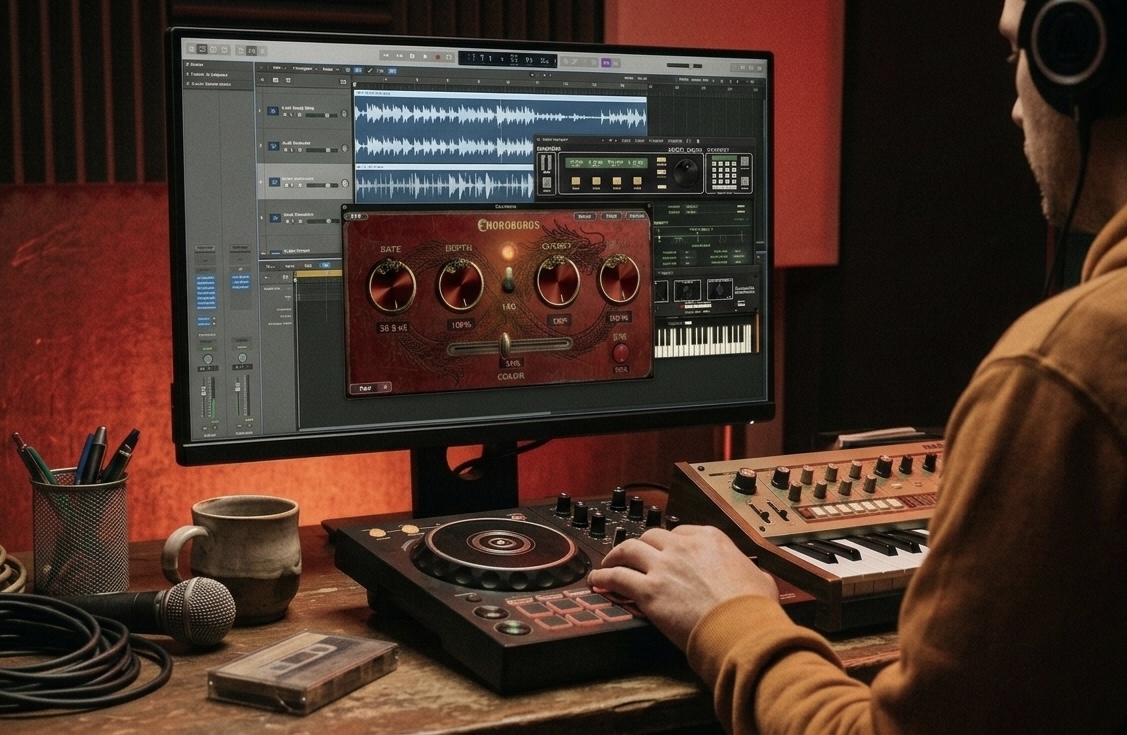
Early February. I sat down and built the first chorus engine, what became the Green engine, in one sprint. It sounded right. So I kept going. Four more engines over the next couple of days, each one deliberately different: clean and modern, analog and warm, experimental, lightweight. By the time I stopped I had five engines, ten algorithms, and a concept I actually believed in.
Then I needed to make it look like something.
I tried Blender. It didn't work for me.
Each engine needed its own visual identity. Not just a colour, a full skin with its own knobs, its own character. I wanted the Red engine to feel analog. The Purple engine to feel genuinely strange. The Green engine to feel like something you'd reach for without thinking.
Blender is great software. But the iteration cycle for getting production-ready knob assets out of it was too slow for how I work. Every change meant a full re-render. I needed to be able to tweak lighting or material properties and see it fast.
So I spent five days building KnobGoblin, a custom 3D knob asset pipeline that handles everything: geometry, lighting, materials, frame export. Once it existed I could generate a full set of knob assets for a new engine skin in a controlled repeatable way. Five skins done in days.
Probably overkill. But it's how I think about problems, remove the friction and the work goes faster.
Launch night didn't go smoothly
First person to download Choroboros hit a broken ZIP. Turns out Vercel has a 4MB blob limit and the file was larger than that. Truncated ZIP, failed install, AU validation error. Not a great first impression.
Fixed it the same day, moved the binaries to GitHub Releases where they belong. But that's beta for you. Something always breaks on the first person.
The dev panel
One thing I should explain because people ask about it: every Kaizen DSP plugin ships with a dev panel built specifically for that plugin. For Choroboros that means live signal flow, real-time tone response curves per engine, a validation console, and a UI editor where you can adjust things like knob drag sensitivity without restarting anything.
It's not a generic debug screen. It's built around the DSP of this specific plugin. The idea is simple, the stuff most developers leave hidden, we put in front of you. If you want to know what the Red tape engine is actually doing to your signal you can see it live while you're working.
That same attention went into the smaller stuff too. The knob animations, the engine skin transitions, the text reflections. Not because anyone asked for it but because it felt wrong to cut corners on it.
Where things are at
v2.03 is live with full Windows support. The beta runs until May 1, 2026 and it's free for the whole period. After that Choroboros becomes a paid product, we've been upfront about that from day one. The beta codebase stays open source under GPLv3 forever.
If you want to try it: https://choroboros.kaizenstrategic.ai
Source code: https://github.com/EsotericShadow/choroboros-open-source
Brutally honest feedback more than welcome.
- Gabriel
info@kaizenstrategic.ai.
