4 KVR members have added OBERTON to 3 MyKVR groups 4 times.
Download KVR Studio Manager (FREE)
Multi-Band Saturator & Parametric EQ
Six bands. Twelve saturation algorithms. A new way to shape harmonics in your mix.
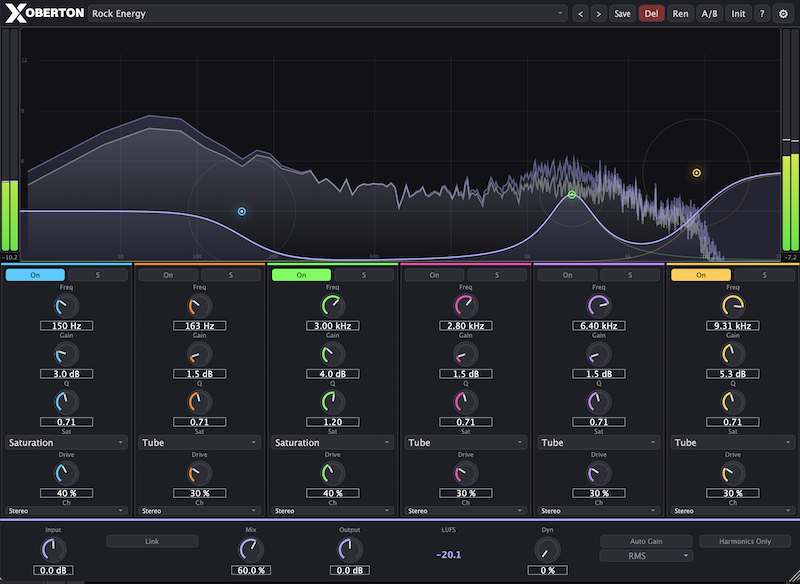
OBERTON is not just another tape saturator with a single global drive knob. OBERTON is a 6-band parametric saturator where every frequency band gets its own EQ, its own drive and its own saturation algorithm. You shape harmonics exactly where you want them. Period.
We built OBERTON because classic saturation plugins felt too one-size-fits-all. Tape on everything? Tube across the master? Sounds fat, but usually in the wrong places. OBERTON flips that around: you decide which band gets warm, which gets bitey, which gets metallic, which stays subtle. The rest stays clean.
What makes OBERTON different
Multiband distortion shaping
Each of the six bands runs in parallel-additive mode, not in series. That means: you boost a frequency internally, send it through your saturation of choice, and only the clean difference signal lands on top of your dry. No stacking drive stages, no muddy summing. Pure layering.
Harmonics-Only mode
Probably the killer feature: turn on Harmonics-Only mode and OBERTON subtracts the EQ boost from the wet signal. What is left are only the nonlinear saturation harmonics. You get air and presence without the typical EQ curve fingerprint. Clean, perceptually honest, ideal for mastering.
Auto-Gain in two modes
Compare A/B with proper level matching. Either classic RMS-Match or modern LUFS-Match per ITU-R BS.1770 with K-Weighting. The latter follows perceptual equal-loudness sensation and is the more honest choice when you do not want to be fooled by loudness tricks.
Mode Level Normalization
Clicking through the saturation algorithms doesn't shift the level. Tube, Tape, Diode, Wavefolder, Bitcrush, Rectify — everything is calibrated to Tube's K-weighted loudness within 0.1 dB. Cycle through the modes and compare the pure character without level-matching gymnastics. Clean stays deliberately neutral so the Band-Gain knob shows honestly what it does.
Global Gain Scaler
One knob in the Master section scales all active bands proportionally. You've built your saturation chain, the relationship between the bands is dialed in, and now you want the whole thing harder or softer without destroying the balance. That's exactly what it's for. 0 to 200 percent, default 100. At 200 every band gain doubles in dB, at 50 it halves, the ratios between bands stay untouched.
Solo Plus Off Equals Dry A/B
A classic workflow problem solved: you solo a band, you hear only its saturation, and you want to compare against the dry sound. Band off, you hear the dry original. Band on again, you hear the saturation. Click-free 50 ms crossfade between the two states. This is how A/B comparison should work.
Click-Free Bypass
Bypass button in the Master section, and the DAW's own bypass shortcut runs through the same 50 ms crossfade. Logic Cmd+B, Ableton, Reaper — however the host handles it internally, it's guaranteed click-free. When bypass fully engages, the entire DSP chain shuts down, CPU drops to dry-passthrough cost. Input and Output Volume stay active; bypass only affects the saturation chain, not the gain path.
Mono Bus Support
OBERTON runs on mono tracks too. Bass DI, mono guitar, vocal lead, drum mics. Same plugin, same bundle — your host picks mono or stereo automatically. Internally the mono signal runs through the stereo DSP chain, bit-identical to the stereo L channel. On mono busses the per-band Mid/Side/L/R channel modes are hidden, because they don't make sense on a single channel.
The six bands
BandDefault FreqFilter
142 HzLowShelf.
2164 HzPeak.
3632 HzPeak.
42.8 kHzPeak.
56.4 kHzPeak.
612 kHzHighShelf.
Frequency, Gain (0 to 12 dB), Q (0.1 to 10), Drive, Sat-Type and channel routing are freely adjustable per band. Each band can run as Stereo, Left, Right, Mid or Side. Each band has its own Solo switch. Out of the box all bands are deactivated, meaning a fresh plugin instance is bypass. Activate a band and its saturation path kicks in immediately.
12 saturation algorithms with their own DNA
Every algorithm has a unique harmonic fingerprint. Here is the range:
Tube: classic warm, asymmetric, 12AX7 triode character.
WarmTube: Class-A power tube with dominant 2nd harmonic, fat.
Tape: soft, low-THD, cassette and 15ips vibe.
Diode: Shockley-equation smooth-clip, fuzz pedal style.
Saturation: pure x/(1+|x|), symmetric odd-only, neutral reference.
Rectify: pure even harmonics, the 808 sub-bass booster trick.
Harmonic: even and odd blended, rich and balanced.
Cubic: pure 3rd harmonic, transparent.
Transformer: iron-core B-H curve, Neve-style iron warmth.
Clean: bypass, EQ-only mode (no sat).
Wavefolder: sin-based folding, Buchla and Serge style metallic.
Bitcrush: integer bit reduction, digital quantization grit.
From subtle glue on the master bus to full-on sound design destruction, it is all in there. You pick per band individually.
170 factory presets in 10 categories
Every preset was built to work in a mix immediately, not to sound impressive on YouTube. Drive and mix values are realistic, not spectacular.
Mastering (20): Air Lift, Pultec Vibe, Analog Glue, Final Polish.
Vocals (20): Vocal Presence, Radio Ready, Whisper Close, Rap Aggression.
Drums (20): Kick Punch, Snare Crack, 808 Sub, Parallel Crush.
Bass (20): Sub Fundament, Acid Character, 808 Enhancement, Cut Through Mix.
Guitar (20): Guitar Bite, Cabinet Warmth, Metal Crunch, Lead Sustain.
Keys & Piano (20): Rhodes Warmth, Hammond Drive, Mellotron Tape, Pad Evolve.
Creative (10): Mid Crunch, Lo-Fi Vinyl, Mid Bloom, 8-Bit Retro.
Genre (20): Techno Drive, Trap 808, DnB Amen, Synthwave Retro, Psytrance Acid.
Experimental (20): Folded Bass, Robot Voice, Glitch Pop, Industrial Bass.
Technical highlights
Oversampling: Off, 4x (Good) or 16x (Best), IIR half-band polyphase, with plugin delay compensation.
Spectrum analyzer: live pre/post overlay right inside the EQ display, bands editable via drag.
LUFS meter: ITU-R BS.1770 K-weighted, 400 ms momentary.
Mid/Side and Left/Right: selectable per band for surgical stereo work.
Dynamics modulation: drive follows the level envelope, transient-aware.
A/B Compare: two slots in the preset bar with Copy A to B and Copy B to A.
MIDI CC Learn: right-click any knob, move your hardware controller, done. Lock-free on the audio thread.
Click-free toggles: 50 ms crossfade when switching auto-gain.
170 factory presets: plus user presets stored under Documents/Kreuzberg Audio/OBERTON/Presets.
Formats & Systems.
Formats: VST3, AU, Standalone.
Systems:
macOS 11.0+ Big Sur, Universal Binary (Intel and Apple Silicon), signed and notarized.
Windows 10 64-bit or newer.
Linux Ubuntu 22.04+ (glibc 2.35 or newer), JACK or ALSA.
Sample Rates: 44.1, 48, 88.2, 96, 176.4 and 192 kHz
GUI: 900 x 800 px, resizable up to 1.5x, light and dark theme.
License.
Online activation with 3-machine limit per license. 30-day refund guarantee. Free v1.x updates. Demo without license: 30 plugin starts with a subtle demo marker (low-level white noise every 30 seconds), after that audio is muted. Educational and NFR licenses on request.
Made in Berlin.
OBERTON was developed entirely in Berlin. The DSP is based on JUCE, the saturation algorithms are written from scratch, every filter coefficient is sample-rate-correct. No white-label, no generic toolkit saturator. Our secret weapon is attention to detail.
Tools by producers, for producers.

Please log in to join the discussion
Submit: News, Plugins, Hosts & Apps | Advertise @ KVR | Developer Account | About KVR / Contact Us | Privacy Statement | Sell @ KVR | KVR Marketplace Terms & Conditions
© KVR Audio, Inc. 2000-2026