Music Theory Thread.

Chords, scales, harmony, melody, etc.
RELATED
PRODUCTS

Post

Ok, I think this is long overdue. While I am starting this solely for my own enlightenment in Music Theory, I encourage anyone who needs help to post their questions as well.

Now that I have time signatures down, mostly. I'd like to ask a few other questions that have been boggling me...and there are no shortage of them, believe me!

1. After reading about various markings used in writing music, I came across the "Repeating Sections" markings, more spefically the "Coda" marking. I'm having one hell of a time understanding the idea behind the "D.C. al Coda" because in this book it says "Go back to the beginning and play to the Coda sign; then skip to the Coda section". The problem I have is that it doesn't seem so clear to those of us who knew nothing about such a marking. Do we just continue forward past the Coda marking, or, for whatever reason (and I believe that if i'm reading in to this too much, this is an idiotic assumption) we skip past the section where the Coda marking is? If it is right at the beginning of a specific measure, do we skip that next measure altogether? I would normally take it as it says, but everytime I do such things, thinking it is obvious, it comes back to bite me in the ass!

2.Now, note repeat marks. It is the markings for us lazy folks who can signify a number of successive notes, of course these notes are all the same value. For instance, if you wanted an easier way to write out 2 quarter notes, you would simply write a half note with a slash through it to signifify that there should be two quarter notes played. It is all a walk in the park until I try to understand note repeats with dotted notes. My book states "When you put a single slash on a dotted note, you play three notes of the next higher value." Huh? :lol: Are they simple saying that it is the same thing whether it has a dash in it or not? So a quarter note with a repeat slash would just be three eigth notes...or is it that what they really mean is three dotted eighth notes?

I sound...and feel like a dumb ass :lol:
"You are going to let the fear of poverty govern your life and your reward will be that you will eat, but you will not live."

Post

Max Hodges
Publisher
White Rabbit Press
www.whiterabbitpress.com

There are two rules for success in life.
First, never tell anyone all that you know.

Post

which book are you using? You can go to Amazon, serach for "the Complete idiot's guide to music theory" and use the search inside this book features. search for "slash" and read the "page 81" link.

I read something in Music Theory for Dummies about a way of notating notes to indicate an octave higher. I'll look it up tonight and post tomorrow.
Max Hodges
Publisher
White Rabbit Press
www.whiterabbitpress.com

There are two rules for success in life.
First, never tell anyone all that you know.

Post

Dal segno al coda is exactlywhat you said. When you get to that point in the song, jump back to the beginning, play up to the coda sign, and then skip everything after that except the coda part which usually contains the surprise ending. It's a trick so they didn't have to write all those same notes one more time.

<-------to be played first time------------->D.S al Coda(jump back)
<-------to be played second time---* skip *-------play the coda----->
Last edited by Hovmod on Thu Dec 21, 2006 9:48 am, edited 3 times in total.

Post

Actually, that's the book I have.
"You are going to let the fear of poverty govern your life and your reward will be that you will eat, but you will not live."

Post

No name wrote: My book states "When you put a single slash on a dotted note, you play three notes of the next higher value." Huh? :lol: Are they simple saying that it is the same thing whether it has a dash in it or not? So a quarter note with a repeat slash would just be three eigth notes...or is it that what they really mean is three dotted eighth notes?
A quarter note with a dot is normally as long as three eighth notes, right? If there's a slash through it, you play it as three eighth notes in stead of as one note that lasts as long as three eigth notes.

Post

So, just to be clear here, you're saying to pla the part up to the coda sign, skip back to the beginning, and then just play all the way through like you normally would, as if the sign was never even there, correct?
"You are going to let the fear of poverty govern your life and your reward will be that you will eat, but you will not live."

Post

No name wrote:So, just to be clear here, you're saying to pla the part up to the coda sign, skip back to the beginning, and then just play all the way through like you normally would, as if the sign was never even there, correct?
No. First time you play up to where it says DS Al Coda. This is usually past the coda sign, right? At DS al Coda you skip back to the beginning, and play up to the coda sign. Then you skip to the ending, which is called the coda.

This way there's two parts that are played only once each: the part between the coda sign and the DS al Coda point is only played the first time, and the coda is only played the second time. The beginning, up to DS al coda, is played twice.
Last edited by Hovmod on Thu Dec 21, 2006 10:00 am, edited 1 time in total.

Post

Hovmod wrote:
No name wrote: My book states "When you put a single slash on a dotted note, you play three notes of the next higher value." Huh? :lol: Are they simple saying that it is the same thing whether it has a dash in it or not? So a quarter note with a repeat slash would just be three eigth notes...or is it that what they really mean is three dotted eighth notes?
A quarter note with a dot is normally as long as three eighth notes, right? If there's a slash through it, you play it as three eighth notes in stead of as one note that lasts as long as three eigth notes.
This is what i'm led to assume because that is really the only logical anwser to me. In this book, there just isn't enough info on it, it isn't as clear as it could be. It was partly my failure too because I seemed to have forgotten the fact that when you dot the note and it is lengthened by half, it is played all together, not the original note and then a different note half the value of the original.

As for that link to the wiki article, thanks, because i'm really not coming up with any info online at all about the coda sign. To be honest though, the wiki article was a big more confusing, because it through in things that I have yet to even get to in the book, so ultimately it didn't help so much. I really do thank you for your help though!
"You are going to let the fear of poverty govern your life and your reward will be that you will eat, but you will not live."

Post

When a note is dotted its value is the original note plus half.

So a dotted crotchet would be a crotchet + a quaver.

At least that's what they taught me.
My Youtube Channel - Wires Dream Disasters

Post

Hovmod wrote:
No name wrote:So, just to be clear here, you're saying to pla the part up to the coda sign, skip back to the beginning, and then just play all the way through like you normally would, as if the sign was never even there, correct?
No. First time you play up to where it says DS Al Coda. This is usually past the coda sign, right? At DS al Coda you skip back to the beginning, and play up to the coda sign. Then you skip to the ending, which is called the coda.

This way there's two parts that are played only once each: the part between the coda sign and the DS al Coda point is only played the first time, and the coda is only played the second time. The beginning, up to DS al coda, is played twice.

Ok, I think I see, it's just that in this book, the picture shows just two markings. A segno sign at the beginning of this piece, and a coda sign about half way through this four measure piece. It begins right at the start of the third measure.
"You are going to let the fear of poverty govern your life and your reward will be that you will eat, but you will not live."

Post

Amberience wrote:When a note is dotted its value is the original note plus half.

So a dotted crotchet would be a crotchet + a quaver.

At least that's what they taught me.
Indeed, but the problem I had was trying to figure out what it means when there is a repeat mark with the dotted note.

I'll type what the book says in full here...

You can also use note repeats on dotted notes. When you put a single slash on a dotted note, you play three notes of the next-higher value; when you put a double slash on a dotted note, you play six notes of the second-higher value
"You are going to let the fear of poverty govern your life and your reward will be that you will eat, but you will not live."

Post

As a matter of fact, let me see if I an go amazon and get the links to these pages for you all.

Edit: nevermind, for some reason I can't even do that.

I'm burned out for the night so i'm getting my ass to bed. Thanks folks!
"You are going to let the fear of poverty govern your life and your reward will be that you will eat, but you will not live."

Post

In fact, I see that I've goofed a little bit...

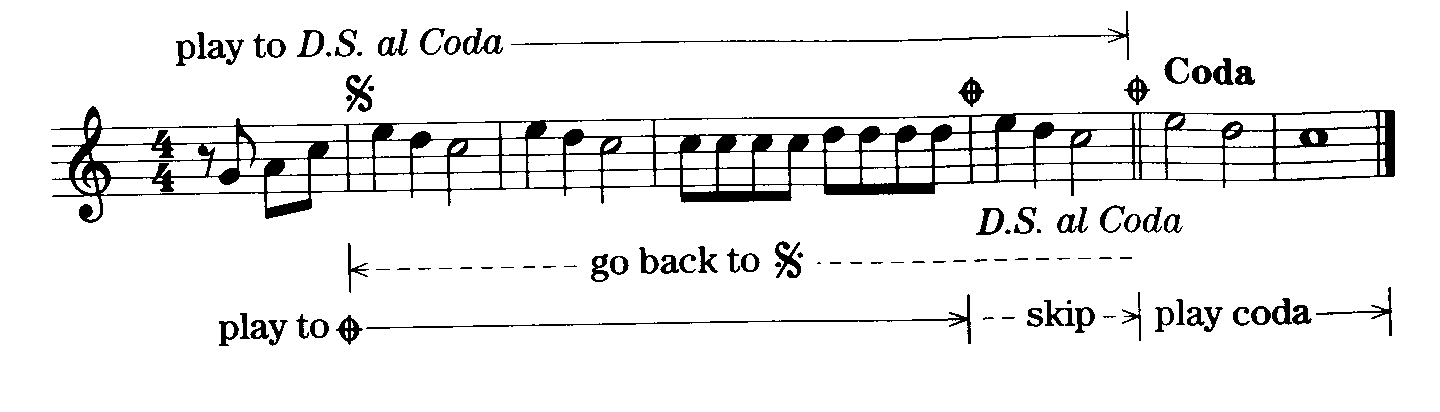
I've been talking about DC al Coda, or Da Capo al Coda, which means start over from the beginning and then skip at the coda sign and jump to the coda.

DS al Coda, Dal Segno (to the sign) means jump back to the squiggly sign, then play to the coda sign, and skip to coda.

Image

Post

Edit: I understand from the pic now, it's just that, in the book, they only put one coda sign, so it threw me off there until I seen the image you put up. Thanks alot hovmod, you really cleared that up after I have been banging my head over the wall for the past 4 hours tryna get these problems cleared so I could move on. :lol:
"You are going to let the fear of poverty govern your life and your reward will be that you will eat, but you will not live."

Post Reply

Return to “Music Theory”