What is Counterpoint?

Chords, scales, harmony, melody, etc.
Post Reply New Topic
RELATED
PRODUCTS

Post

To add to that, if everybody says 'one' at the same time, there will be a sense of 'strong beat/weak beat' in 4/4 and 'strong beat/not so strong beat/weak beat' in 3/4. Therefore, when Monteverdi came along, followed by his baroque descendants, the composers attached the system of figured bass to reflect the strength of these beats to give the music more purpose. For example, the strong beat at the beginning of a bar/measure would invariably contain a chord in root position, and usually one of the primary chords I, IV or V (although this was not always the case), and a bar/measure would always finish with a weak chord, maybe a first* inversion or a secondary chord (II, VI or VII)** in root position, or both.***

*Second inversions were only used on three occasions as they were considered to be too weak to sustain the harmonic interest. Those three occasions were called 6/4s (figured bass terminology as opposed to the A,B,C method), and these three "6/4s" in turn, were named 'passing', 'auxilliary' and 'cadential'

**Chord III was generally avoided because of it's ambiguous properties. Was it a variation of chord I7 without the bass (not used at this time) or chord V (with added pedal)? (Remember, chords I and V, tonic and dominant, are the strongest chords in vertical harmony in relation to the harmonic series). Later composers used it widely, but it was usually in the form of a secondary dominant (sharpened 3rd and added 7th) that resolved to chord VI in the form of a perfect cadence.

***Chord VIb was generally avoided because it's structure (in C Major, for argument's sake) C, E, A sounded like an incorrect version of the tonic in root position (C, E, G) which was the strongest chord available.


Ogg Vorbis, does that help you understand the relationship between figured bass (vertical harmony in general) and metre? I'd sure be interested to know. 8)

Post

herodotus wrote: Now first of all, I must say that I am unaware of any 'period' compositional treatises from the time of the Flemish Renaissance or the surrounding years. So far as I have been able to ascertain, the musical thinking of Ockeghem, Busnois, Josquin De Prez, Heinrich Isaac and the rest is known to us only through their work. Oh what I would give to learn how they got their cutting basses, rich pads and soaring leads, but sadly they left no treatises, nor even an interview, that allows us to pick their brains.
Not sure how you arrived at that notion, but there were many theorists and treatises of the period. Here's one, a Flemish contemporary of Ockeghem, specifically citing Ockeghem, in English, annotated, on the web, free. And, not to put too fine a point on it, but someone it would be difficult to miss, were one seeking period compositional treatises of the Flemish Renaissance.

http://www.stoa.org/tinctoris/

hmmm. Well I don't want to sit here the rest of the morning. So let's jump directly to here:

Image
Different parts being in different time signatures means different parts with different metrical structures. The metrical structure of a part has an intimate relationship with the melody.
Sometimes, sure. Ideally, in modern notation. But not here. What you see as polymetric here is an artifact of transcription into modern notation. You're looking at the time signatures, and not seeing the music. It's not polymeter. It's prolation, a rhythmic augmentation/diminution technique of the period, in this case used to construct a double canon.

When this was composed, there were no bar lines as such, and no direct equivalent to the modern time signature. They aren't saying one at the same time, because they're not saying one.

The reason this piece is remarkable is that Ockeghem is able to superimpose two prolation canons here and still have the counterpoint conform to the conventions of the period. Not because he's done something Zappa-esque.
In the above example, the melodies in each part follow their own logic, without reference to any prevailing harmony. The harmonic element is still important, but it is much more loosely conceived. .
In the above example, the melodies in each part conform to the harmonic conventions of 15th century Flemish counterpoint.
And this is what I meant by counterpoint being a sort of reconciliation of the monodic traditions of opera and the polyphony of flemish choral music. Because counterpoint allows one to have a monometrical structure with a progression of prevailing harmonies while preserving at least some of the independent part writing of the Renaissance.
Only if you redefine the word counterpoint to mean "a monometrical structure with a progression of prevailing harmonies while preserving at least some of the independent part writing of the Renaissance". Which is a foolish definition, as Ogg Vorbis has gently tried to point out.
Yes. That's a human ear, all right.

Post

beboop wrote:
herodotus wrote: Now first of all, I must say that I am unaware of any 'period' compositional treatises from the time of the Flemish Renaissance or the surrounding years. So far as I have been able to ascertain, the musical thinking of Ockeghem, Busnois, Josquin De Prez, Heinrich Isaac and the rest is known to us only through their work. Oh what I would give to learn how they got their cutting basses, rich pads and soaring leads, but sadly they left no treatises, nor even an interview, that allows us to pick their brains.
Not sure how you arrived at that notion, but there were many theorists and treatises of the period. Here's one, a Flemish contemporary of Ockeghem, specifically citing Ockeghem, in English, annotated, on the web, free. And, not to put too fine a point on it, but someone it would be difficult to miss, were one seeking period compositional treatises of the Flemish Renaissance.

http://www.stoa.org/tinctoris/
Thanks for the reference, but the link just brought me to a site about Tinctoris. Do you have a name for the actual treatise?

In any case, you caught me here, I was unaware that Tinctoris wrote any analysis at all. I know only of his work on the categorization of the different church modes.

I guess part of my point still stands in that none of the composers listed wrote anything about their own compositional techniques (unless you know of any treatises that I don't?), but I will have to concede the point as a whole.


Different parts being in different time signatures means different parts with different metrical structures. The metrical structure of a part has an intimate relationship with the melody.
Sometimes, sure. Ideally, in modern notation. But not here. What you see as polymetric here is an artifact of transcription into modern notation. You're looking at the time signatures, and not seeing the music. It's not polymeter. It's prolation, a rhythmic augmentation/diminution technique of the period, in this case used to construct a double canon.
When this was composed, there were no bar lines as such, and no direct equivalent to the modern time signature. They aren't saying one at the same time, because they're not saying one.
Your point that 'prolation' is not exactly the same as 'time signature' is a salutary one. But I thought that prolatio, along with modus and tempus, were methods of categorizing different kinds of meter in mensural notation, not a technique of augmentation and diminution.

In any case this doesn't change the fact that if you sing each part in the above example separately, each has a particular metrical 'feel' to it that is different than the metrical 'feel' of the other parts.


And this is what I meant by counterpoint being a sort of reconciliation of the monodic traditions of opera and the polyphony of flemish choral music. Because counterpoint allows one to have a monometrical structure with a progression of prevailing harmonies while preserving at least some of the independent part writing of the Renaissance.
Only if you redefine the word counterpoint to mean "a monometrical structure with a progression of prevailing harmonies while preserving at least some of the independent part writing of the Renaissance". Which is a foolish definition, as Ogg Vorbis has gently tried to point out.
OK, I will concede that the word 'counterpoint' encompasses Netherlandish polyphony.


I do think that the polyphony of Bach was of a fundamentally different sort than the polyphony of Josquin.

But that, as you have pointed out, doesn't really have anything at all to do with the word 'counterpoint', which applies equally well to both.

:)
Last edited by herodotus on Sat Jan 24, 2009 9:18 pm, edited 1 time in total.

Post

herodotus wrote:
beboop wrote:
herodotus wrote:
Different parts being in different time signatures means different parts with different metrical structures. The metrical structure of a part has an intimate relationship with the melody.
Sometimes, sure. Ideally, in modern notation. But not here. What you see as polymetric here is an artifact of transcription into modern notation. You're looking at the time signatures, and not seeing the music. It's not polymeter. It's prolation, a rhythmic augmentation/diminution technique of the period, in this case used to construct a double canon.
When this was composed, there were no bar lines as such, and no direct equivalent to the modern time signature. They aren't saying one at the same time, because they're not saying one.
Your point that 'prolation' is not exactly the same as 'time signature' is a salutary one. But I thought that prolatio, along with modus and tempus, were methods of categorizing different kinds of meter in mensural notation, not a technique of augmentation and diminution.

In any case this doesn't change the fact that if you sing each part in the above example separately, each has a particular metrical 'feel' to it that is different than the metrical 'feel' of the other parts.
They do. Due to a basis in poetical metrics, long/short, metrical feet and all that. Though I've recently seen some arguments which tried to refute that. I don't think they held much water, however.

Post

Besides, each part does say 'one' (or 'now' or 'go'), and they say it at the same time too. It's just that none of them are aiming to reach 'two', because it doesn't exist.

Post

herodotus wrote: Thanks for the reference, but the link just brought me to a site about Tinctoris. Do you have a name for the actual treatise?
The treatises available on that site should be listed in the left pane when you click (wait for it)......treatises. His counterpoint treatises are not there, but if you can read latin (not me) then you're in luck, google will turn them up, and more.
In any case this doesn't change the fact that if you sing each part in the above example separately, each has a particular metrical 'feel' to it that is different than the metrical 'feel' of the other parts.
yeah, absolutely, if you observe those time signatures and bar lines and the patterns they imply, it's impossible not to hear them that way.

But, those bar lines and time signatures weren't there in the 15th century. There weren't separate notations for the performers of the top and second staves, or for the third and bottom staves.

The performers of what's notated here as the top and second staff read the same notation, with one group giving their notes 3/2 the duration of the other -- and similarly, the performers of what's notated here as the third and bottom staves. What is happening is relative augmentation of the notated values, not the same thing as the repeating cells of of strong and weak beats that seem to appear when this stuff is kludged into modern notation, and hence the polymeter between staves.

So, is it really polymetric, I dunno -- arguably, it's arguable.

My interest in 15th century stuff is pretty (ok extremely) limited -- I played in an early music ensemble a few semesters, so I knew what to google in support of Ogg's comment about contemporary treatises. But I don't have any particular passion for or expertise in the subject.

I do share OV's enthusiasm for Fux, though, very happy to see this topic and be reminded what I should really be doing with my spare time. ;)
I do think that the polyphony of Bach was of a fundamentally sort than the polyphony of Josquin.
well, yeah, that's never been in question
Yes. That's a human ear, all right.

Post

herodotus wrote: And this is what I meant by counterpoint being a sort of reconciliation of the monodic traditions of opera and the polyphony of flemish choral music. Because counterpoint allows one to have a monometrical structure with a progression of prevailing harmonies while preserving at least some of the independent part writing of the Renaissance.
Herodotus, et al

Sorry for my delay, I am on a short vacation. I suppose I am still struggling to understand how figured bass (a mere report of the intervals above a bass note) "implies a meter". :help:

If there is a hammer someone could use on me to help me understand this relationship, I'd certainly welcome a good whooping. I see the lovely example of Ockeghem's can easily be expressed in figured bass. Why not?

More disturbing though, is the implied correlation between figured bass and triadic (Rameau) theory and its application. In short, there ain't one. Figured bass does not denote triads. Unfortunately, vertical analysis with Roman numerals and associated intervals look an awful lot like figured bass. Perhaps therein lies some confusion between the two?

But perhaps I am taking too much delight and space in trashing Rameau. It's not that bad, really. I learned it in high school and college, still sort of use it, and it also provides a common language for musicians to talk about music. I still maintain that it was not widespread in Europe and North America until the 20th century. Prior to that, it was treated like the tattooed uncle in prison that no one in the family talked about.

It took off so successfully in the 20th century was because of the decline of apprenticeships in music and the shift toward university education. In that context, Rameau was perfect. In "mass music education" you really need a system to squeeze the understanding of the common practice period into about four semesters.

In the bargain, you can also apply the theory to create actual music. If you're talented, you can apply it to actual composition (so long as you're relying 80 percent on your innate abilities and 20 percent on chord theory).

But the best part of the whole thing is that it gives me something to focus my anger on, sort of like jazz purists love to hate Kenny G. Ultimately, puritanical arguments are exposed for being anti-progressive and I don't want to be regressive and reactionary.

God bless progress, and mass education and universal healthcare and UN councils on environmental policy, et al. As in all things, there are trade-offs. In the case of Rameau, the trade-off seems to be in the application of vertical theory to re-creating anything close to the masterworks being analyzed.

Perhaps the argument has always been and will always be, "Haydn was good at stringing phrases together even BEFORE he studied formally."

Post

Welcome back Ogg.

I wrote answer to your underlying question. I think you may have missed it, and that is the relationship between figured bass (vertical harmony, also defined by the a, b, c system as it is below) and metre.

Here is your question, asked recently:

"I suppose I am still struggling to understand how figured bass (a mere report of the intervals above a bass note) "implies a meter"."

Here is my answer:

In figured bass, if everybody says 'one' at the same time, there will be a sense of 'strong beat/weak beat' in 4/4 and 'strong beat/not so strong beat/weak beat' in 3/4. Therefore, when Monteverdi came along, followed by his baroque descendants, the composers attached the system of figured bass to reflect the strength of these beats to give the music more purpose. For example, the strong beat at the beginning of a bar/measure would invariably contain a chord in root position, and usually one of the primary chords I, IV or V (although this was not always the case), and a bar/measure would always finish with a weak chord, maybe a first* inversion or a secondary chord (II, VI or VII)** in root position, or both.***

*Second inversions were only used on three occasions as they were considered to be too weak to sustain the harmonic interest. Those three occasions were called 6/4s (figured bass terminology as opposed to the A,B,C method), and these three "6/4s" in turn, were named 'passing', 'auxilliary' and 'cadential'

**Chord III was generally avoided because of it's ambiguous properties. Was it a variation of chord I7 without the bass (not used at this time) or chord V (with added pedal)? (Remember, chords I and V, tonic and dominant, are the strongest chords in vertical harmony in relation to the harmonic series). Later composers used it widely, but it was usually in the form of a secondary dominant (sharpened 3rd and added 7th) that resolved to chord VI in the form of a perfect cadence.

***Chord VIb was generally avoided because it's structure (in C Major, for argument's sake) C, E, A sounded like an incorrect version of the tonic in root position (C, E, G) which was the strongest chord available.


Please inform me whether this has helped as I feel as if I'm being ignored. Paranoia, eh?

Post

alphabetgreen wrote:Welcome back Ogg.

I wrote answer to your underlying question. I think you may have missed it, and that is the relationship between figured bass (vertical harmony, also defined by the a, b, c system as it is below) and metre.

Here is your question, asked recently:

"I suppose I am still struggling to understand how figured bass (a mere report of the intervals above a bass note) "implies a meter"."

Here is my answer:

In figured bass, if everybody says 'one' at the same time, there will be a sense of 'strong beat/weak beat' in 4/4 and 'strong beat/not so strong beat/weak beat' in 3/4. Therefore, when Monteverdi came along, followed by his baroque descendants, the composers attached the system of figured bass to reflect the strength of these beats to give the music more purpose. For example, the strong beat at the beginning of a bar/measure would invariably contain a chord in root position, and usually one of the primary chords I, IV or V (although this was not always the case), and a bar/measure would always finish with a weak chord, maybe a first* inversion or a secondary chord (II, VI or VII)** in root position, or both.***

*Second inversions were only used on three occasions as they were considered to be too weak to sustain the harmonic interest. Those three occasions were called 6/4s (figured bass terminology as opposed to the A,B,C method), and these three "6/4s" in turn, were named 'passing', 'auxilliary' and 'cadential'

**Chord III was generally avoided because of it's ambiguous properties. Was it a variation of chord I7 without the bass (not used at this time) or chord V (with added pedal)? (Remember, chords I and V, tonic and dominant, are the strongest chords in vertical harmony in relation to the harmonic series). Later composers used it widely, but it was usually in the form of a secondary dominant (sharpened 3rd and added 7th) that resolved to chord VI in the form of a perfect cadence.

***Chord VIb was generally avoided because it's structure (in C Major, for argument's sake) C, E, A sounded like an incorrect version of the tonic in root position (C, E, G) which was the strongest chord available.


Please inform me whether this has helped as I feel as if I'm being ignored. Paranoia, eh?
Okay thank you for pointing out your reply and then offering it again. You've gone above and beyond.

You are referencing the occurence of either "primary chord" or "root position" triads on strong beats as being an element of monometric music of the early Baroque such as Monteverde, etc.

Hmm... well I guess I'll have to plead ignorant on that one and take your word for it. I haven't done the kind of analysis that would offer any corroboration for your claim.

But I'd say that your explanation of "root position" harmonies and "primary chords" are certainly a Rameauean construct and therefore foreign ideas to the composers of that era (and most masters thereafter).

What you call "a chord in second inversion" is actually a dissonance in counterpoint. It involves a perfect fourth above the bass and demands resolution usually downward from above. Therefore it might be a rare occurrence on a strong beat, although I am not sure how rare really.

What vertical chord theory would call a "tonic 6/4 chord" is the result of voiceleading. Many times, it's a double suspension which resolves later. Sometimes it can result as a stepwise accented dissonance and then it resolves in the normal way.

If said, "Hey Claudio, I loved how you used that inversion there on beat three," do you think he would understand what you are saying?

But even after all this, we are just talking about consonance and dissonance on various beats, but none of that has any bearing on figured bass.

I am no expert, but my understanding of figured bass is that it is a sort of shorthand for continuo players, especially keyboard players in the Baroque period. It doesn't seem to have any bearing on meter, density of texture, or anything else I can think of.

Figured bass provides a bass note, intervals above the note and an indication of accidentals if they are needed. You can certainly have any interval or set of intervals above a bass note, whether you're on beat one, two, three, or any other beat.

But thank you again for reposting and trying. I don't doubt that there is a point that I am still missing, and I apologize for my thickness.

Have a beautiful end of January. We are all going to have fun seeing more and more light coming now.
8)

Post

OK, I have a few minutes and so let me see if I can reconcile matters by looking at things a bit more closely.

Now first of all I should acknowledge quite bluntly that I was completely wrong about the usage of the word 'counterpoint'. I thought that it's origin as a term was much more recent than it is in fact. I was wrong, it is quite ancient. So that is settled.

As for the question of 'period treatises' on whatever subject, this is more a matter of imprecision in usage. Let's look at what was said:

herodotus wrote:
Ogg Vorbis wrote:
herodotus wrote:In a sense, what is usually called 'counterpoint' is a reconciliation of the traditions of imitative polyphony that flourished in the Flemish Renaissance (and came to a counter-reformational dead end in the relatively simple music of Palestrina) and the tradition of figured bass, which arose from the 'monodic' or homophonic world of early Italian opera (e.g. Peri, Monteverdi).

Yes, "what is usually called counterpoint" is what you've said. However nothing in the period treatises on the subject support it.

But I guess I already made that point in this thread.


Now first of all, I must say that I am unaware of any 'period' compositional treatises from the time of the Flemish Renaissance or the surrounding years. So far as I have been able to ascertain, the musical thinking of Ockeghem, Busnois, Josquin De Prez, Heinrich Isaac and the rest is known to us only through their work.


What I said here was 'compositional treatises'. What I was trying to express when I said that I was unaware of any such things from the time wasn't that I was unaware of any musical theorists at all. There were many musical theorists. What I meant was that I, as a 'fan' of these composers, had spent a great deal of time trying to find out about the actual, specific methods that actual, specific composers used when they wrote actual, specific pieces, like the Kyrie from the Missa Prolationem quoted above, or Josquin's 'Absalom Fili Mi', or Isaac's 'Angeli Archangeli', or any such pieces.

I never found a damn thing.

I found numerous intelligent recent commentators on the period, who used their command of the relevant languages and their scholarly acumen to provide insights into the composer's milieu. And of course theorists like Tinctoris and Zarlino and Mersenne are invaluable windows into the musical mind of the Renaissance. But they tell us nothing, or at least not much, of the actual, down and dirty practice of being a composer. The composer as an individual was not a matter of serious interest or study for theorists. It was a different world, with much less adulation for 'personality' than our own.

Which is why any treatises concerning compositional practice from that time are unlikely to tell us much about what composers actually did, any more than one could find out what composers living today sound like from reading Walter Piston's Harmony textbook, which is still a standard text in many classrooms.

Now, finally, let's get to the heart of the matter:
beboop wrote: The performers of what's notated here as the top and second staff read the same notation, with one group giving their notes 3/2 the duration of the other -- and similarly, the performers of what's notated here as the third and bottom staves. What is happening is relative augmentation of the notated values, not the same thing as the repeating cells of of strong and weak beats that seem to appear when this stuff is kludged into modern notation, and hence the polymeter between staves.

So, is it really polymetric, I dunno -- arguably, it's arguable.
No, actually, It's not.

While you are right that there were no bar lines (nor were there any scores, per se, just individual parts), that doesn't mean that there was no meter or 'time signature'. There was.

In the following example, observe the part with the blue arrow pointing to it:
Image

This symbol tells us the prolation of the piece. Actually it tells us the prolation and the tempus. A good introductory discussion of how this worked practically is available at wikipedia here.


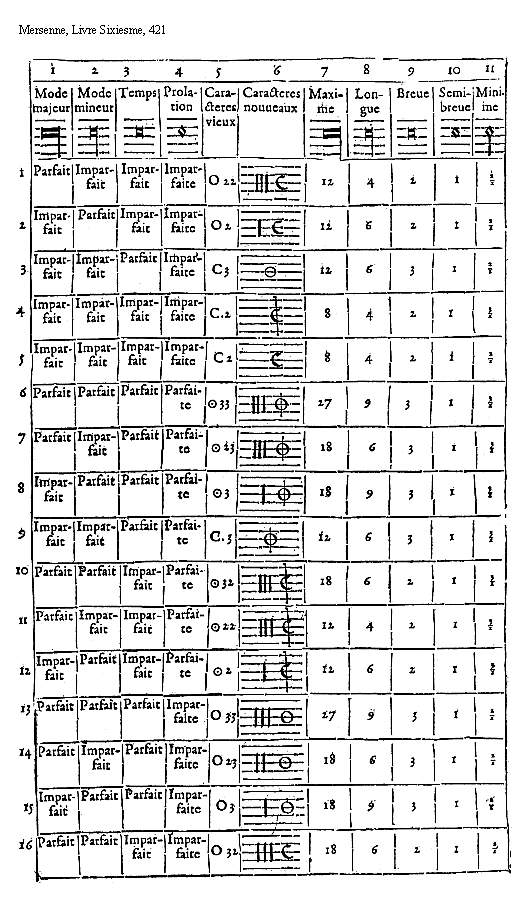
This is but a part of the metrical possibilities. This table from a book by Marin Mersenne (1636) gives a more complete picture:

Image

What all of this worked out to was in fact a complex system of metrical possibilities available to musicians. In fact, there are some who think that this was the first example in history of measured chronometric time; that is clock time. It's a fascinating topic, explored in this very interesting book by Geza Szamosi.


Finally, what the singers are doing in Ockeghem's Missa Prolationem is much more involved than simply singing the same notated part in different prolations. The parts are transposed to different intervals in different sections, and there are numerous liberties that the composer took with the canonical structure. Figuring out how the different meters worked together, simply to insure that everyone got to the cadence at the same time, was in fact a form of polymetrical insight of the highest order.


And that is all.

And now, I really have to take a kvr break.
Last edited by herodotus on Sun Feb 01, 2015 2:24 am, edited 1 time in total.

Post

herodotus wrote: Now, finally, let's get to the heart of the matter:
(a bunch of good stuff on mensural notation snipped)

OK, I'll accept that polymeter is an appropriate term regarding this Ockeghem piece. It wasn't my intention to denigrate Ockeghem or diminish the aesthetic value of the piece. Looking at either canon, the second line of each IS an augmented, isomorphic version of the first. That's just an observation, something that caught my eye, on the page posted, and not a dismissal of Ockeghem's ingenuity. I can see why you find it fascinating.


I think we see the 'heart of the matter' a little differently -- polymeter in Ockeghem is tangential here, the heart of the matter is counterpoint, what the word means, what it does or does not imply harmonically or rhythmically.

When you say
herodotus wrote:
I never found a damn thing.
...
theorists like Tinctoris and Zarlino and Mersenne are invaluable windows into the musical mind of the Renaissance. But they tell us nothing, or at least not much, of the actual, down and dirty practice of being a composer
When you say that, the implicit question is precisely what Fux addresses in Gradus Ad Parnassum., which is not a theory text, but a practical guide to composition.

Does it address the individual practices of each contrapuntal composer, or period, no. That seems a bit much to ask, though. And unnecessary.

well looking at OV's post I think everything's been addressed here -- perhaps a bit more obliquely than ideal. not everything, but enough.
Yes. That's a human ear, all right.

Post

Ok. This is getting interesting, like I could learn something (though I'll be damned if I know how I'd ever use it), even.

>Ogg Vorbis: please explain this assertion to me. "Figured bass does not denote triads. Unfortunately, vertical analysis with Roman numerals and associated intervals look an awful lot like figured bass. Perhaps therein lies some confusion between the two?"


Figured bass, as far as I can tell (and I was required to use it back in halcyon daze) does denote triadic structure.

If I see "V 4-2", I know immediately that the bass is a second (or 9th) from the indicated root and a fourth from what is surely going to be the third of the *chord*, and that that root is located a fifth (usu. 7 semitones) from the 'tonic'. If the 'key' is major (or even minor, in common practice, IE., there is, almost inevitably, a leading tone (subtonic) implied), I know that this fourth is going to be an 'augmented' fourth. (for the rest of the class, a '6' before the '4' and the '2' in that figure denotes the fifth of the chord, located a sixth from the bass as 'figured'. In much practice, this '6' is omitted. IE., is a given.)

I'm fairly confident the above paragraph is describing figured bass. Or, at least what my teachers called by that name. Now, I of course do understand that this is a 'four-note chord' I outlined. But, just how is 'triad' "not denoted"?

Post

'Triad' does not necessarily signify 'three-note chord'.

'Triad' signifies primarily that the intervals in root position are triadic, or tertial. i.e. That they are separated by intervals of thirds, as opposed to 'quartal harmony' (4), and 'quintal harmony' (5)

Post

Holy shit. I hadn't paid attention to this thread in a couple of days.

I'll have some studying to do tonight.

Victor.

Post

alphabetgreen wrote:'Triad' does not necessarily signify 'three-note chord'.

'Triad' signifies primarily that the intervals in root position are triadic, or tertial. i.e. That they are separated by intervals of thirds, as opposed to 'quartal harmony' (4), and 'quintal harmony' (5)
You may note my use of 'triadic'. Your reply, tbh, is a sort of :roll:, to me, who has been composing for nearly forty years, and it seems to have ignored much of my post(s) to have decided to explain such basics to me like that.

My question stands: how does figured bass, which denotes intervals in, generally, a common practice where the harmonies ARE triadic, not denote 'triads'. So, I wondered did OV simply mean the results that are intended from figuring a bass mean they aren't limited to the simple triad. IE: they may indicate chords of the seventh, or even the ninth, in say JS Bach.

I may be missing something, but I don't think that something has been explicated here.

Post Reply

Return to “Music Theory”