acesynth UI vs zebra

Official support for: u-he.com
RELATED
PRODUCTS

Post

kodama wrote:It's cutesy and 3d, I actually prefer Z 2.5 (or Z 1.0).
It's actually quite 2D. There's no fake perspective, it's all parallel projection.

I think it's very tastefully arranged. No clutter (apart from patch cords) and certainly no useless eye candy. I think it's the tidiest and best structured ui I ever did.

You'll see :)

Post

great thanks - looking forward to the release - did u have a beta available?

Post

JFM wrote:did u have a beta available?
I wished... but with this thing, Bazille is already much of a beta. A new alpha of Bazille is coming out in a few days.

Post

Yo! Urs! :)

A.C.E. looks super cool! I won't waste any money so I can get it the day it's released. So this is the 1st synth in the Berlin Modular series? Can you tell us about the specs now? Does it share a lot of code with Bazille?

Thanks and as always, great work! :tu:

Post

I agree, for me at least, Zebra's knobs are off-putting since there's no visual "anchor".

I've been thinking about interactive visual indicators lately, and if I draw up some proof-of-concepts I'll post them here for you.
noise and beats: Negutyv Xeiro do people actually click these?
gearlust: Roland JP-8000, too much/not enough eurorack
machinecode by: u-he, Bitwig, Fabfilter, NI, et al

Post

Urs wrote: I've decided to price it in Euro because the currency exchange rate with the USD causes massive headaches. It'll probably be 69€ including 19% VAT, which corresponds to roughly 85$ without VAT.
:tu:
My other host is Bruce Forsyth

Post

xx JPRacer xx wrote:Yo! Urs! :)

A.C.E. looks super cool! I won't waste any money so I can get it the day it's released. So this is the 1st synth in the Berlin Modular series? Can you tell us about the specs now? Does it share a lot of code with Bazille?

Thanks and as always, great work! :tu:
It's a "precursor" to Berlin Modular. Some people asked in the Bazille/Berlin thread if I could release something up front, because the wait is too long to bear until it's released... I suggested to put things together in a MS-20-style fashion. The idea is, once Berlin Modular is released any owner of Ace receives a voucher of the full price of Ace to be put towards Berlin Modular.

Feature-wise Ace *seems* heavily underspec'ed, but it's really deep anyhow:

- 2 x LFO (1 sine, 1 sine/tri/saw/sqr) 0Hz - 20kHz
- 2 x ADSR (same as Bazille)
- 2 x VCO (saw/pwm) 0Hz - 20kHz, VCO1 with SubOsc
- 2 x VCF (almost same as Bazille, but only two outlets: LP1/LP2/LP3/LP4, HP/BP/BR)
- 2 x VCA/Pan
- 2 x Multiples (as in Bazille)
- 1 x Mixer (Osc balance, Sub, Noise, Aux)
- 1 x Ramp Generator (up->hold->down->rest, loops if rest < 100)
- 1 x noise (white, pink)
- 1 x the common extras, such as Glide/Glide2
- 1 x stereo chorus (global)
- 1 x ping pong delay (global)
- 1 x Bass/Treble booster (global)

25 signal sources, 30+ signal targets, some paths wired internally so that it makes noise even without a single cable attached (think ARP 2600).

100% free of Supersaw. Instead it has:

- exceptional sync /w FM (VCO1->VCO2, think Virus)
- LFOs that can be used as additional VCOs an vice versa
- exceptional filter sound including convincing self oscillation

Well, it has merely become a conceptual marriage between ARP 2600 and SH-7, with a touch of SynthiA. Soundwise however it's rather on the aggressive side.

I'm pleased to say that it does many of those synth sounds that I could never get, specifically reminiscent to Yello and Trevor Horn. It does a good impersonation of the bass sound in New Order's Blue Monday (or rather the idealised version I still have in my head).

That'd be it. We speak more in two weeks when patch design has matured.

;) Urs

Post

Urs wrote:The idea is, once Berlin Modular is released any owner of Ace receives a voucher of the full price of Ace to be put towards Berlin Modular.
That's great! You're probably the most generous developer around.

Quick question. Will Ace become a full u-he product or when Berlin will be release you'll stop supporting/developing Ace?

Thanks!

Post

xx JPRacer xx wrote:Quick question. Will Ace become a full u-he product or when Berlin will be release you'll stop supporting/developing Ace?
It'll be a full product of course. As I said, it's going to be an entry level drug towards modular stuff.

Post

As usual, Urs, I think you're on the right track. Whet the appetites for modular synths while providing a solid product that's worthwhile in it's own right. Not to mention with your previous muso-mag review success, it could very well end up being a go-to "instructional" synth for their "Learn Synthesis in 10 easy steps" type articles.

Post

Ace sounds really.. uh... ace!
Consider me interested.
noise and beats: Negutyv Xeiro do people actually click these?
gearlust: Roland JP-8000, too much/not enough eurorack
machinecode by: u-he, Bitwig, Fabfilter, NI, et al

Post

cool - i'm on standby to purchase

Post

Sounds interesting. The feature I anticipate missing the most (based on the specs you've listed) is a sample & hold module (or a stepped random mode for the noise generator or LFOs).
If you like 80s retro sounds, check out my latest tune…

Post

PaulSC wrote:Sounds interesting. The feature I anticipate missing the most (based on the specs you've listed) is a sample & hold module (or a stepped random mode for the noise generator or LFOs).
No prob 8)

Image

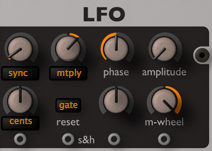
Excerpt from freshly translated chapter about LFOs:
LFO 1

By default, the first LFO delivers a pure sine wave, and the frequency settings are described in the previous chapter.

The "reset" switch determines if and when the LFO is reset (to a definable position - see below):
free - runs quasi-freely i.e. resumes phase position. If LFO 1 is in sync mode, however, it is reset in sync with the song
gate - restarts at each played note.

The phase knob usually determines phase position. This value can be modulated by any signal. For instance, connecting another oscillator gives you classic FM sounds (which illustrates that those synths were actually based on phase modulation - "FM" was and is a misnomer). Of course this modulation source could be LFO 1 itself ("FM feedback"), which results in a much brighter waveform similar to a sawtooth.

The amplitude parameter determines the level of LFO 1, and this value can also be modulated. The default source for this is the modulation wheel (MIDI CC#01) , so LFO 1 is useful for quick access to vibrato effects etc..

LFO 1 - Sample & Hold Mode

If any modulation source is connected to the s&h input, LFO 1 is put into sample and hold mode. LFO 1 samples the input with its own rate as "clock speed". Connect noise here for vintage random effects.

In s&h mode, the phase knob becomes a lag processor, smoothing out the jumps between successive output values. Note: at very high LFO 1 (i.e. clock) rates, the phase parameter acts as a lowpass filter, with cutoff in the opposite direction to normal, so if LFO 1 output disappears, simply set phase to zero.

Using LFO 1 in unconventional ways

Here are a few practical examples:

• classic random waveforms. Connect white noise ("white") to the s&h input and use LFO 1 to modulate e.g. the frequency of an oscillator or filter.

• modern sample rate reduction effects. Connect e.g. an oscillator to the s&h input. Set the coarse mode to "semi" and the fine mode to "multiply". Turn the fine knob to a multiplication factor of about 20 or 30 - the LFO 1 output signal adopts the basic pitch of the oscillator, and delivers a rough version of same. Turn the oscilloscope frequency down to minimum to see the resulting stepped waveform. Remember to set LFO 1 "phase" to zero or thereabouts!

• various distortion effects. ACE doesn't have a dedicated distortion or waveshaper module, but they aren't really necessary - the filters can already introduce plenty of distortion, especially when connected in series. However, LFO 1 can be used as an extra waveshaper...

Start with the default patch, and drag a cable from LFO 1 to one of the the main outputs. Set LFO 1 pitch modes to "semi" and "multiply", and the multiplication factor to 0.00. Switch the reset mode to "gate" - LFO1 doesn't oscillate by itself now. Set the phase to 0.00 so that it completely resets to 0°.

Now patch the signal you want to process (e.g. VCO 1) into LFO 1's phase modulation input. Turn up the amount - you now have a "sine waveshaper"! Change the phase slightly to make the waveshaping asymmetrical. By the way, you can use this method to "bend" any signal, even an envelope! Simply plug an envelope generator into the phase modulation input instead.


Post

Urs, the graphics are simply phenomenal really. Me going to buy this thingy so I can stare at it. Maybe I'll use it occassionally too.

Post Reply

Return to “u-he”