

dont be alarmed though if next week I'm not around much, my wife starts her vacation when she gets home tonight and I plan on spending as much of that time with her as I canhibidy wrote:Oh, and good to see Hink back


dont be alarmed though if next week I'm not around much, my wife starts her vacation when she gets home tonight and I plan on spending as much of that time with her as I canhibidy wrote:Oh, and good to see Hink back
 ).
).


Like you say, with metal there's a certain "safety margin" which is called "elastical deformation" or something, where the metal piece returns to exactly the same shape as before, no damage done.Hink wrote:I knew what you meant bt stretching tbh, but there are a lot people that believe they are physically stretching the strings. I say that I have a name for strings that heve been stretched, broken. (they will be very quickly)

What's the secret?Hink wrote:probably somewhere in the nieghborhood of 100-200 times in my life someone would come into my store because they were having the old 'everytime I get one string in tune the rest are out' problem and in 5 minutes it was fixed by adjusting the the claw
Is there a video demonstrating what you consider to be proper string stretching technique? If not, would you mind making one? String tree friction is what screws me up.susiwong wrote:It's not stretching as in "making the string longer", it's more like pulling it tight, removing any tiny slack due to nut or string tree friction, loose winding on the tuners and similar.
See, that's not what I took away from that video. The way I heard it is there's more tension coming from the low strings and so putting more tension on their corresponding springs allows the trem to hinge uniformly on the screws, thus returning the strings to pitch better.You sure use the claw to balance your horizontal trem position, using individual spring tension to selectively adjust individual string upbend range is voodoo.
by using the claw screws/spring configuration to compensate for the tension of the strings, just like any fulcrum in order for there has to be balance on both sides. This method has worked for me from day I got my first floyd rose.Uncle E wrote:What's the secret?Hink wrote:probably somewhere in the nieghborhood of 100-200 times in my life someone would come into my store because they were having the old 'everytime I get one string in tune the rest are out' problem and in 5 minutes it was fixed by adjusting the the claw
I should watch the video however what you just said about tension on the lower strings is exactly what I am talking about. However I do this strictly by ear, I cannot say that I offset the claw by huge amounts but I do not measure it either to make sure it's straight. Also instead of the springs all being from one point to the same corresponding point on the other end (whammy block/claw) sometimes changing that configuration.Uncle E wrote:Is there a video demonstrating what you consider to be proper string stretching technique? If not, would you mind making one? String tree friction is what screws me up.susiwong wrote:It's not stretching as in "making the string longer", it's more like pulling it tight, removing any tiny slack due to nut or string tree friction, loose winding on the tuners and similar.
See, that's not what I took away from that video. The way I heard it is there's more tension coming from the low strings and so putting more tension on their corresponding springs allows the trem to hinge uniformly on the screws, thus returning the strings to pitch better.You sure use the claw to balance your horizontal trem position, using individual spring tension to selectively adjust individual string upbend range is voodoo.
That was what I thought you did...but I was not going to gainsay it.Hink wrote:by using the claw screws/spring configuration to compensate for the tension of the strings, just like any fulcrum in order for there has to be balance on both sides. This method has worked for me from day I got my first floyd rose.Uncle E wrote:What's the secret?Hink wrote:probably somewhere in the nieghborhood of 100-200 times in my life someone would come into my store because they were having the old 'everytime I get one string in tune the rest are out' problem and in 5 minutes it was fixed by adjusting the the claw
FWIW if I decide I want to do a pick-up change in a guitar with a floyd rose I do not remove the strings, I remove the springs, then the entire whammy, lay it out past the headstock, change the pick-ups, put the whammy back in and typically I never even loosen the locking nut and can fine tune it.
Until the internet came along I thought this was common knowledge and everybody did this with the claw, if the claw was not to be adjusted they would just put hooks to hold the springs to the body instead screws with a free moving claw
Sorry, I'm still not getting this. How is what you're doing different than how other guitars are set up?Hink wrote:by using the claw screws/spring configuration to compensate for the tension of the strings, just like any fulcrum in order for there has to be balance on both sides. This method has worked for me from day I got my first floyd rose.
Very cool! I'll try this when I air my Tone Zone.FWIW if I decide I want to do a pick-up change in a guitar with a floyd rose I do not remove the strings, I remove the springs, then the entire whammy, lay it out past the headstock, change the pick-ups, put the whammy back in and typically I never even loosen the locking nut and can fine tune it.

I'm not sure I understand what your question is Eric? If I change the tension on the springs it changes the force on the strings, it's not really anything different and like I said I just figured this is what everyone does.Uncle E wrote:Sorry, I'm still not getting this. How is what you're doing different than how other guitars are set up?Hink wrote:by using the claw screws/spring configuration to compensate for the tension of the strings, just like any fulcrum in order for there has to be balance on both sides. This method has worked for me from day I got my first floyd rose.
Very cool! I'll try this when I air my Tone Zone.FWIW if I decide I want to do a pick-up change in a guitar with a floyd rose I do not remove the strings, I remove the springs, then the entire whammy, lay it out past the headstock, change the pick-ups, put the whammy back in and typically I never even loosen the locking nut and can fine tune it.
That's what Carl is advocating which makes total sense to me:Hink wrote:I changed to a lower tuning (I like open Gm) which was less tension than standard, by moving the two outside springs from angling to the center and putting them to 1 and 5 on the claw it released some of the tension on those two springs and then a small amount of adjustment on the claw screws was all it needed.

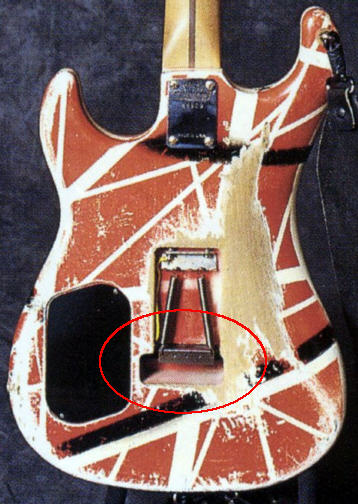

yeah that's basically it, my ESP came like th EVH but with one more spring in the middle.Uncle E wrote:That's what Carl is advocating which makes total sense to me:Hink wrote:I changed to a lower tuning (I like open Gm) which was less tension than standard, by moving the two outside springs from angling to the center and putting them to 1 and 5 on the claw it released some of the tension on those two springs and then a small amount of adjustment on the claw screws was all it needed.
Then there's the EVH way, which also makes sense to me:
Then there's this somewhat common method, which makes the least sense to me of all:
When all is said and done, is there a way that we can actually gauge how much tension is on each string? Is there any optimal string gauge to pitch that keeps the same tension across all strings? IME, the light top/heavy bottom "custom" gauges really do horrible things for me trems.
Music Man headstocks are how strats ought to be done. Why the guitar playing community, including myself, put up with the horrible 6-per-side machines is bizarre.Dean Aka Nekro wrote:Really like Musicmans as they are a doddle to do and sorting Les Paul types or most hardtails equally rapid.
Submit: News, Plugins, Hosts & Apps | Advertise @ KVR | Developer Account | About KVR / Contact Us | Privacy Statement
© KVR Audio, Inc. 2000-2026