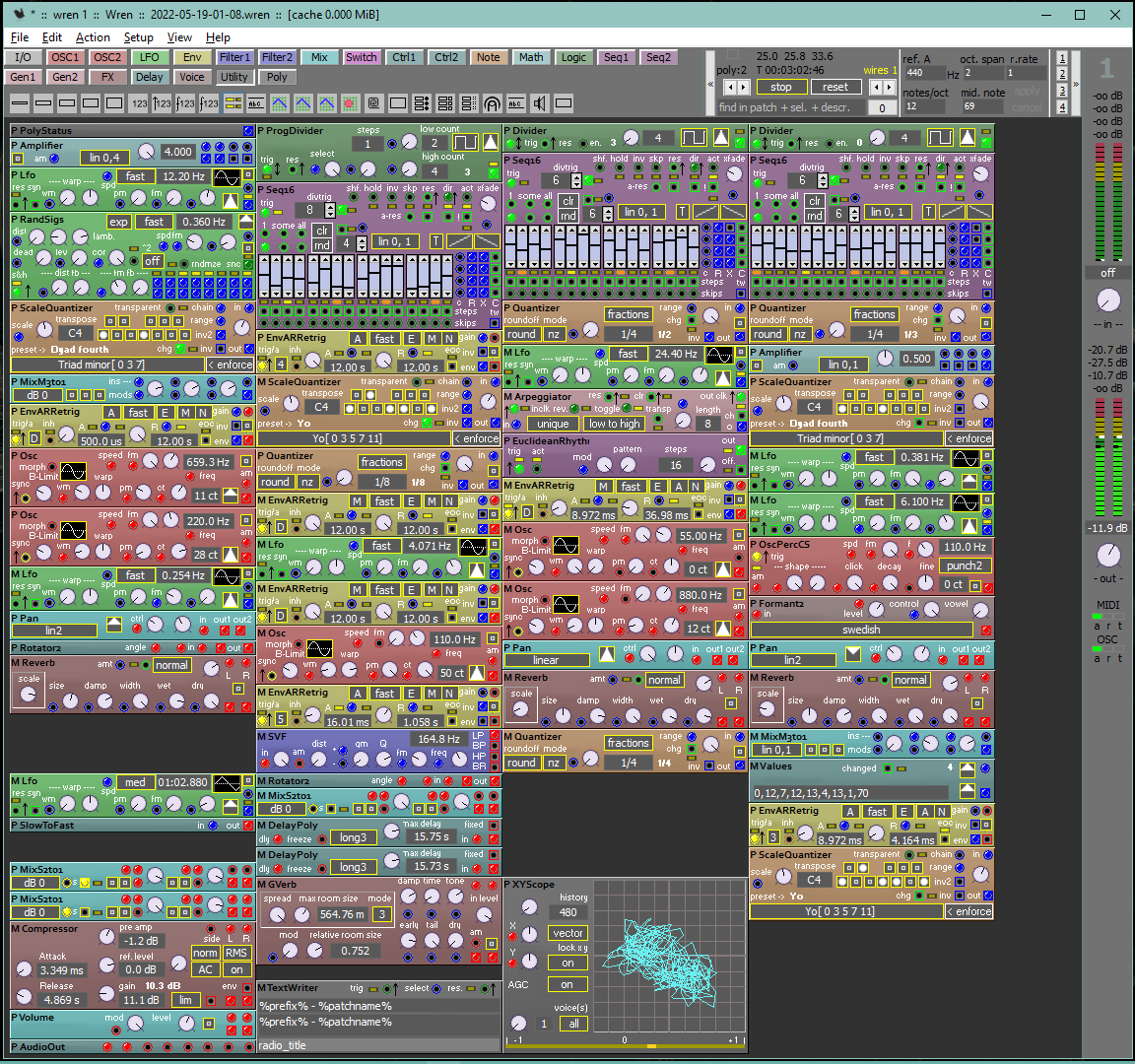
Yes, you said that the user should be used/trained to decipher a modular system ( whatever the connexion scheme), and I think it's true. This is inherent to the freedom --> complexity loop.whyterabbyt wrote:Which gets unwieldy very quickly. I'd say its notable that the XILS4 didnt do that, it has two 23x23 (or whatever) matrices and a couple of smaller ones, not a large 60x60 matrix.Lotuzia wrote:Well, it could be : Add a module, and simply add a column and a row)
The Xils 4 has two main matrixes, and some dedicated smaller ones, because basically, it's two units melted into one. So I think the Xils 3v2 should be a better basis to discuss. But nevertheless, I can have more than 400 connexions on a small square. And it's neat, understandable, and you also have the intensity added. So I let you imagine the same thing with cables.( + the ammount knobs )
Then you're right, an 'expandable' pin matrix could become possibly quickly messy. Say you want to add a 5th oscillator ( Xils 3 has 3 + noise + external, but it's a source and not a real oscillator), it should probably be *inserted* under the other oscillators rows, to avoid having 'oscillators' everywhere. So actually, some 'module categories should be defined. Same with additional filters, or envelopes, LFOs etc. Then color schemes could also help to delimitate 'blocks of similar objects'. Leading to a huge mecanno/lego world. But well, it's about modular worlds so ... But I think it's doable, and could be a very valid alternative to cables. Then, I have nothing against cables, and I can understand people, especially those who have grown and gained experience with most hw modular systems, prefering them. I also dig them sometimes. But I prefer Pin matrixes. For me it's much easier to work with them, decipher existing patches in a glance, or create new ones. It's possibly a question of culture. I can work also with blocks environments a la Reaktor, 3DS etc. With nesting structures, even better. No problemo.