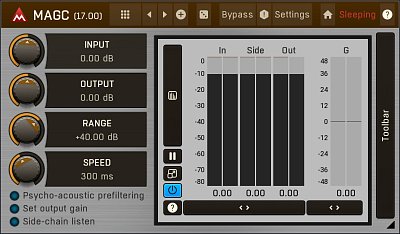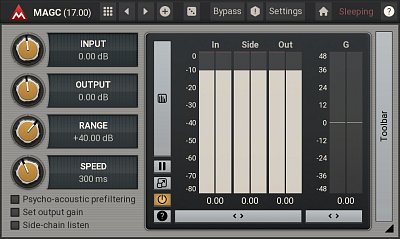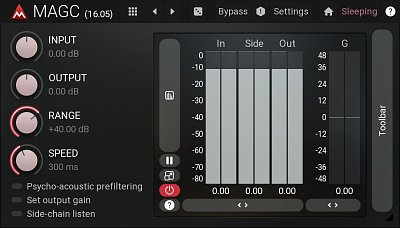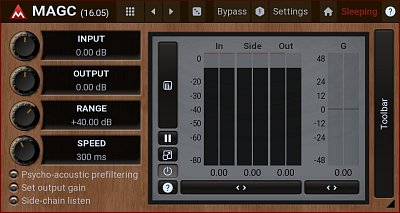
All MeldaProduction effects and MPowerSynth updated to 10.00 and MAGC released.

Official support for: meldaproduction.com
RELATED
PRODUCTS

Post

Hi folks,

next update is here ;). 10.00 is an important update and comes with several new improvements, features and some fixes. It is recommended to install this update. To do that, get the newest version from MeldaProduction download page and use it.

Additionally MAGC, a simple but powerful utility that adjusts the loudness to match the side-chain, has been released. It is FREE and has been added to MXXX and MPowerSynth as well.
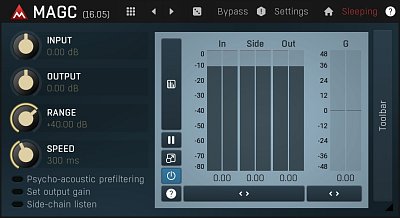
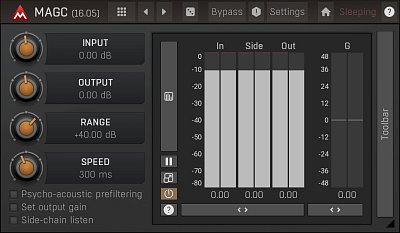
Image Image
Image Image
Image Image

See the list of changes for effects and list of changes for MPowerSynth for further information:
http://www.meldaproduction.com/changes/ ... otalBundle
http://www.meldaproduction.com/changes/ ... PowerSynth
Vojtech
MeldaProduction MSoundFactory MDrummer MCompleteBundle The best plugins in the world :D

Post

You forgot to list in the changelog:

MConvolution now has new IRs for sound design.
Jason @ Melda Production

Post

Added full touch-screen support on Windows for up to 16 fingers/devices.
:)

Post

Who has 16 fingers? He he
Jason @ Melda Production

Post

Nice work Vojtech. Gradient makes the fill mode much more usable :tu:.

Post

I'm not 100% clear on what the use case is for MAGC. I've been using phatik a lot to do volume matching of various things, it's been incredibly useful. Looking at MAGC it looks like a cut down version of the envelope following part of Phatik (without attack/sustain times).

Can someone give me some use cases of it? Given that I ONLY use the volume match parts of phatik (not the convolution/saturation/etc) I'm tempted to use MAGC instead, but the fact that it lacks the attack/sustain control makes it less desirable, so I'm not seeing the point of it's existence.

Thanks!

Post

vectorwarrior wrote:I'm not 100% clear on what the use case is for MAGC. I've been using phatik a lot to do volume matching of various things, it's been incredibly useful. Looking at MAGC it looks like a cut down version of the envelope following part of Phatik (without attack/sustain times).

Can someone give me some use cases of it? Given that I ONLY use the volume match parts of phatik (not the convolution/saturation/etc) I'm tempted to use MAGC instead, but the fact that it lacks the attack/sustain control makes it less desirable, so I'm not seeing the point of it's existence.

Thanks!

Well MPhatik follows the exact dynamic shape (peak riding) where MAGC is just overall loudness matching (just like AGC in all the plugins).
Jason @ Melda Production

Post

Yeah, I noticed the mention of 'loudness' on the webpage. I'm still not clear as to what the use case/purpose is though.

Post

jmg8 wrote:You forgot to list in the changelog:

MConvolution now has new IRs for sound design.
I think those were added 1 or 2 versions back...
Play it by ear

Post

I have to agree. What is the purpose of MAGC? I imagine it has some use, but I can't figure out what it would be used for.

Post

I grabbed this from the agc help from another plugin. Surprisingly this isn't listed in the magc doc:

AGC button enables or disables the automatic gain control - the automatic adjustment of
the output volume such that it matches the input volume. Human hearing is very
adaptable. In fact differences in loudness, for example when loading a preset, may go
unnoticed and instead be perceived by the listener as "better sounding", leading to a
misjudgement. This feature should prevent this effect, thus allowing the listener to focus
on the sonic qualities only.
AGC works by measuring input and output loudness, and then compensating for the
difference while also taking into account any induced latency. The loudness measurement
follows the ITU and EBU specifications with an RMS of 400ms, meaning that the reaction
time is 400ms. This is very important, as you should be aware that AGC needs time to
properly adjust after any change of settings. Also note that this is a nonlinear operation. It
may cause some distortion due to the long measurement time. It should be negligible
though.
AGC makes sense in most applications including reverberation and equalization for
example. However, in some cases it can work against the plugin. A simple example of this
is a tremolo, where the plugin manipulates output volume. If the tremolo rate is slow
enough, say 1Hz, it makes the period longer than the actual AGC measurement time. So
whenever the tremolo changes audio level, the AGC starts compensating for it. This can of
course be used creatively, since AGC will always be a little "late", but it is definitely not a
desired outcome in normal use.
Another example of this is compression. When used with short attack and release times,
AGC can effectively compensate for the attenuation of the compressor. However when the
attack and release times are higher than 100ms, the compressor's reaction time becomes
too slow, and in conjunction with AGC, severe pumping can occur.
As a general rule of thumb as for all audio processing tasks, use it only if you know you
need it. AGC is a powerful tool that can make your workflow easier, but it can also be
damaging.

Post

Macro automation in MXXX still doesn't work in Logic 10.2.3 - when setting Logic to Latch and moving a Macro it picks up the controller ID but it sticks to the initial position of the knob/slider no matter how you turn the knob/slider. This has been broken for months now.

Post

pheeleep wrote:
jmg8 wrote:You forgot to list in the changelog:

MConvolution now has new IRs for sound design.
I think those were added 1 or 2 versions back...

Nope, because I supplied them, he he.
Jason @ Melda Production

Post

I use AGC on everything. For 2 reasons:

1. If I have mostly mixed a track and have my bass sitting at the right level. I can further process the bass with any FX while keeping the level intact.

2. Louder sounds better and can trick you into thinking that your changes are positive. AGC allows me to hear the changes clearly without the loudness clouding my judgement.
Jason @ Melda Production

Post

i don't like the behaviors of the AGC.

in MADEq for example, crank up a frequency about 10 Db and listens to the result.
almost everything else disappears except the boosted band.

i much prefer the behavior of the AGC in Acon Equalize or Pro-Q2.

Post Reply

Return to “MeldaProduction”